Singapore’s fatal injury rate in construction climbed from 3.4 per 100,000 workers in 2023 to 3.7 per 100,000 workers in 2024, a trajectory that signals something more serious than a compliance gap. The safety manager in this sector is not a glorified form processor or a policy librarian. The role functions as the operational nerve center of a site’s risk control architecture, translating regulatory frameworks from Singapore’s Ministry of Manpower (MOM) into lived site behavior, governing contractor conduct, and maintaining the systems that keep fatal hazards in check. This article dissects the safety manager’s core duties, practical strategies, and strategic authority across Singapore’s construction environment.
Table of Contents
- Singapore construction: Why safety managers matter most
- Core responsibilities of a safety manager
- Safety manager strategies: Practical tools and systems engineering
- Prioritizing high-risk controls: Falls from height in Singapore construction
- The uncomfortable truth: Safety manager effectiveness depends on real authority, not checklists
- Ready to strengthen your site’s safety culture?
- Frequently asked questions
Key Takeaways
| Point | Details |
|---|---|
| Safety managers save lives | Their role is pivotal in reducing fatal incidents and creating safer job sites. |
| Beyond compliance | Safety managers in Singapore construction integrate systems, behavioral leadership, and strategic control. |
| Falls from height are top risk | Targeting edge controls and scaffolding is crucial to reducing fatal injuries. |
| Effective reporting is essential | Safety managers track performance through HSE indicators and detailed documentation. |
| Empowerment drives results | Managers are most effective when they have real authority and leadership support. |
Singapore construction: Why safety managers matter most
Building on the sector’s risk profile, let’s break down where safety managers fit within this challenging environment and why their position is non-negotiable rather than advisory.
Singapore’s construction sector consistently occupies the highest tier of workplace risk among all industries in the country. Fatal injury rates rose from 3.4 in 2023 to 3.7 per 100,000 workers in 2024, with falls from height remaining the single leading cause of both fatal and major injuries on site. These figures reflect persistent structural vulnerabilities that no amount of legislation alone can resolve.
The regulatory architecture in Singapore is anchored in the Workplace Safety and Health Act (WSH Act), enforced by MOM, with additional statutory obligations under regulations such as the WSH (Construction) Regulations and the WSH (Risk Management) Regulations. Compliance with these frameworks is mandatory, but meeting minimum statutory thresholds is not equivalent to achieving meaningful risk reduction. Safety managers occupy the critical space between regulatory text and operational reality.
“A safety manager who understands Singapore’s WSH statutory framework does not just ensure paperwork is submitted on time. They engineer the conditions under which hazards are identified, controlled, and documented before incidents occur.”
Their responsibilities position them as the primary interface between ground-level subcontractors and project-level governance structures. Their understanding of Singapore construction safety standards and their ability to enforce those standards under real site pressures determines whether a project’s WSH systems actually protect workers or simply generate files.
Key reasons safety managers are indispensable in Singapore construction:
- The sector’s high-risk designation makes formal safety leadership a legal requirement, not an organizational preference
- Multi-tiered contractor structures on large projects create significant coordination and verification demands
- MOM’s active enforcement environment means inadequate WSH systems carry both regulatory and reputational consequences
- Falls from height, electrical hazards, and crane operations consistently generate severe incident outcomes that require proactive technical controls rather than reactive responses
- Project timelines create pressure to take shortcuts, and the safety manager is the professional mechanism for resisting that pressure systematically
Core responsibilities of a safety manager
With the importance established, here’s what a safety manager actually does, both day-to-day and at the strategic level, in the context of Singapore’s construction sector.
Senior safety roles at major project environments focus on implementing HSE and WSH management systems, providing regulatory and technical guidance, reviewing contractor method statements and material submissions, and auditing Permit-to-Work (PTW) systems. These are not administrative functions. They are technical governance responsibilities requiring deep knowledge of Singapore’s statutory environment and site operations.
The safety management systems guide for Singapore construction outlines how a well-structured system integrates hazard identification, risk control, monitoring, and continual improvement into a coherent operational framework. The safety manager is the professional who builds, maintains, and drives that system across every stage of a project lifecycle.
| Responsibility Area | Primary Function | Regulatory Anchor |
|---|---|---|
| WSH Management System | Build and maintain site safety framework | WSH Act, Risk Management Regs |
| Contractor Governance | Review method statements, approve procedures | WSH (Construction) Regs |
| Permit-to-Work Auditing | Validate PTW issuance and compliance | MOM site-level requirements |
| Risk Assessment | Conduct and review RA documentation | WSH (Risk Management) Regs |
| Incident Investigation | Root cause analysis and corrective action | WSH Act reporting obligations |
| Safety Training | Develop and deliver toolbox talks, induction | MOM competency requirements |
Safety officers operating under MOM WSH Regulations are responsible for monitoring and enforcing policies, conducting training, and preparing compliance reports. The safety manager operates at a higher level of strategic authority, setting the frameworks within which these officers function and ensuring system-level coherence across the project.
Here is the structured breakdown of core safety manager duties:
- Design and implement the Safety Management System (SMS): Establish the WSH management framework covering hazard identification, risk control hierarchy, monitoring protocols, and documented review cycles.
- Provide technical and regulatory guidance: Advise project management on MOM regulatory requirements, WSH Act obligations, and applicable Approved Codes of Practice.
- Review contractor documentation: Scrutinize method statements, risk assessments, and material submissions from subcontractors before work commences.
- Audit Permit-to-Work systems: Verify PTW controls are correctly issued, that conditions are enforced at the work face, and that isolation procedures are validated.
- Conduct and lead risk assessments: Facilitate formal risk assessment processes for high-risk activities, ensuring controls are implemented and residual risk is documented.
- Lead incident investigations: Apply root cause analysis methodologies to incidents and near-misses, translating findings into actionable corrective and preventive measures.
- Deliver training and safety culture programs: Develop site induction content, toolbox talk schedules, and behavioral safety interventions aligned with identified risk profiles.
Pro Tip: When reviewing contractor risk assessments, check not only that the hazard has been identified but that the control measure specified is actually achievable under site conditions. Generic controls like “PPE to be worn” without specifying type, standard, and inspection frequency indicate a superficial process that will not withstand MOM scrutiny or a real incident investigation.
For firms working within complex project structures, integrating design for safety professionals into the safety management process from the design phase reduces the burden on site safety managers by eliminating hazards before they are built into the project.
Safety manager strategies: Practical tools and systems engineering
Now, let’s go deeper into the tools and frameworks that safety managers use to translate principles into practical control across Singapore’s high-pressure construction environment.
The safety manager’s role extends well beyond paperwork into systems engineering: contractor governance, Permit-to-Work controls, risk assessment cycles, HSE key performance indicators (KPIs), and structured emergency response protocols. Each of these functions requires both technical knowledge and management authority to be effective.
Contractor governance is one of the most demanding dimensions of the role. On large Singapore construction projects, a principal contractor may manage dozens of subcontractors simultaneously, each with their own supervisory structures, work cultures, and safety competency levels. The safety manager must establish clear documentation requirements, conduct pre-work approval processes for method statements, and verify that contractor personnel hold the required WSH competencies before mobilizing.
| Control Tool | Purpose | Effectiveness Indicator |
|---|---|---|
| Method Statement Review | Validate safe work procedures before mobilization | Approval rate and revision cycle time |
| Permit-to-Work Auditing | Ensure high-risk work controls are enforced | PTW compliance rate per inspection cycle |
| Job Hazard Analysis (JHA) | Identify task-level hazards before work begins | JHA completion rate by activity type |
| HSE KPI Dashboards | Track leading and lagging safety indicators | Frequency of near-miss reporting, inspection close-out rates |
| Emergency Drill Records | Validate emergency response readiness | Drill frequency and debrief action item completion |
The workplace risk assessment process sits at the operational core of contractor governance. Before any high-risk activity commences, the safety manager must confirm that a site-specific risk assessment has been conducted for actual site conditions, not adapted from a generic template. This distinction is legally and operationally significant under Singapore’s WSH (Risk Management) Regulations.
HSE performance indicators must include both leading indicators (near-miss reporting rates, training completion percentages, inspection frequency, PTW compliance rates) and lagging indicators (incident frequency rates, severity rates, lost-time injury rates). Relying solely on lagging indicators means the system only signals failure after harm has occurred. A mature risk assessment process integrates leading indicators that enable proactive intervention before incidents materialize.
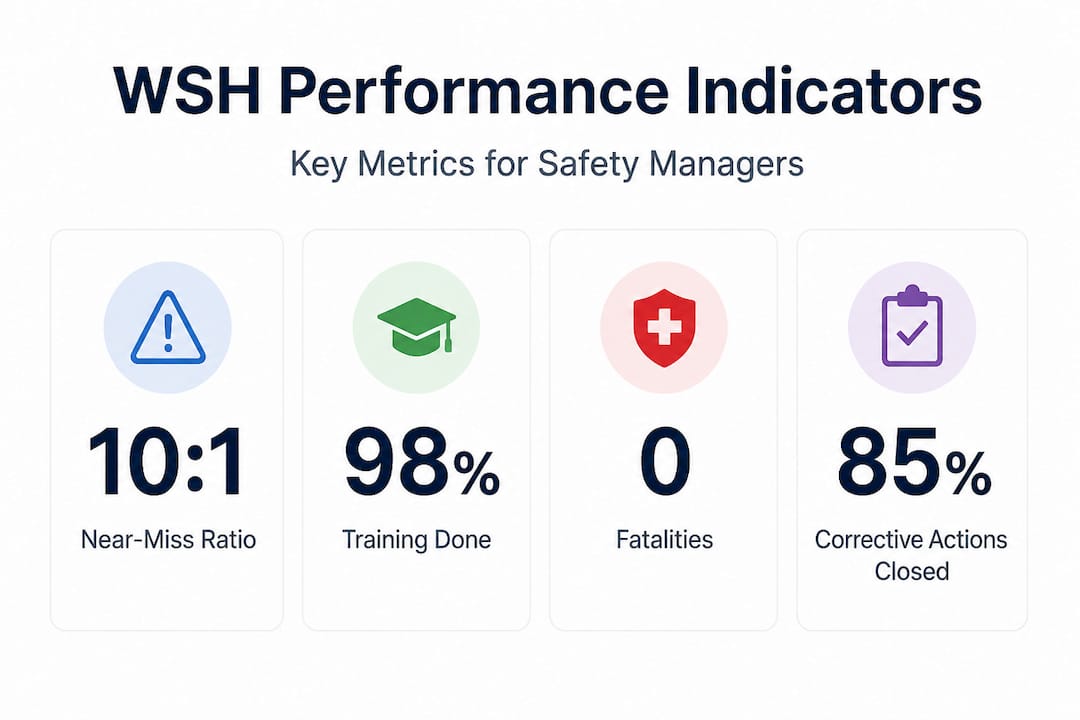
Pro Tip: Set a target near-miss reporting ratio of at least 10:1 relative to recorded incidents. If near-miss reports are rare on your site while incidents occur with any frequency, the reporting culture is broken and safety intelligence is being lost at the ground level. Use anonymous reporting mechanisms and reinforce near-miss reporting in every toolbox talk cycle.
Emergency response planning is another dimension that safety managers must actively own rather than delegate to administrators. This means maintaining up-to-date emergency contact trees, conducting regular emergency drills with documented debrief outcomes, validating that first aid resources meet MOM requirements, and integrating emergency response procedures into contractor induction programs.
Prioritizing high-risk controls: Falls from height in Singapore construction
With the system-level tools explained, here’s how safety managers address the single most persistent deadly hazard confronting Singapore’s construction workforce.
Falls from height remain the leading incident type among both fatal and major injuries in Singapore construction, a categorization that has remained consistent across multiple years of MOM WSH national statistics. This persistence is not attributable to a lack of regulatory guidance. Singapore’s WSH framework includes specific requirements for work at height activities, scaffold inspection regimes, and edge protection standards. The problem is implementation and verification.
“Safety managers who treat edge protection as a secondary aesthetic concern rather than a primary fatal risk control are systematically underestimating the leading cause of worker fatalities in Singapore construction.”
The safety manager’s approach to falls from height must be structured around the hierarchy of hazard controls: elimination and substitution first, then engineering controls such as edge protection, followed by administrative controls and personal protective equipment. In practice, this means:
- Edge protection verification: Every open edge at height must be protected by compliant guardrails or covered openings before work commences in the zone. Safety managers must conduct regular unannounced inspections to verify that edge protection has not been removed to facilitate work without being reinstated.
- Scaffold inspection and certification: All scaffolding on site must be inspected by a competent inspector at the prescribed intervals under MOM requirements. Safety managers must maintain inspection records and ensure that scaffold tags reflect current inspection status at every section of the structure.
- Safe work at height procedures: Every activity requiring work at height must be governed by a documented safe work procedure specifying the type of fall protection required, the inspection criteria for harnesses and anchor points, and the supervision requirements for the activity.
- Work at height PTW controls: High-risk work at height activities such as leading-edge work, work over open voids, or work from suspended platforms must be subject to PTW controls, with the safety manager auditing compliance against those controls on a systematic basis.
- Behavioral reinforcement: Safety managers must use toolbox talks, observation programs, and supervisor coaching to challenge the normalization of unsafe practices at height that can develop on busy sites under schedule pressure.
MOM WSH statistics indicate that safety managers should treat scaffolding adequacy, edge control verification, and work at height procedure compliance as the highest-priority operational controls in any site inspection program. The frequency and rigor of these verifications should be calibrated to the level of height-related activity on site at any given time.
The uncomfortable truth: Safety manager effectiveness depends on real authority, not checklists
After reviewing the statistical risk profile, the regulatory environment, and the technical toolkit of a Singapore construction safety manager, the sector-critical insight is this: the technical competence of a safety manager accounts for perhaps fifty percent of their actual effectiveness. The other fifty percent is determined by whether the organization has genuinely vested them with the authority to stop work, reject contractor submissions, and set site behavioral norms without being overridden by schedule or commercial pressure.
In Singapore’s construction environment, where project timelines are aggressive and contractor networks are complex, safety managers operating without real organizational authority default to administrative roles. They complete inspection forms. They prepare compliance reports. They attend meetings. But they cannot compel contractors to cease unsafe practices if site management consistently prioritizes program over safety governance.
The firms that achieve consistently superior WSH performance in Singapore are those that position the safety manager as a genuine decision-maker within the project governance structure. This means the safety manager has documented authority to suspend high-risk activities pending control verification, has direct access to project directors when escalation is required, and is embedded in pre-construction planning rather than introduced after site mobilization.
Implementing effective workplace safety systems requires senior leadership to treat the safety manager’s authority as a project governance instrument, not an HR requirement. When a safety manager’s recommendations can be routinely deferred or overridden by a project manager under schedule pressure, the safety management system is structurally compromised regardless of how sophisticated the documentation appears. Real authority, exercised consistently, is what separates compliant sites from safe ones.
Ready to strengthen your site’s safety culture?
Safety managers carry the technical and strategic weight of site risk governance, but they perform best when supported by expert consultancy, structured audit frameworks, and specialist resources that extend their operational capacity.

MOSAIC Ecoconstruction Solutions provides practical support across the full spectrum of construction safety management, from safety audit preparation to system design, risk assessment facilitation, and regulatory compliance guidance. Whether your team is preparing for a MOM inspection, strengthening a WSH management system, or building a safety culture that withstands real site pressure, MOSAIC delivers the specialist expertise your safety managers need. Explore how MOSAIC’s comprehensive safety services can help your organization close the gap between documented compliance and genuine risk control on every project you manage.
Frequently asked questions
What qualifications are required to be a safety manager in Singapore construction?
Safety managers in Singapore construction typically hold WSH professional credentials recognized by MOM, such as the Workplace Safety and Health Officer (WSHO) registration, supplemented by substantive experience in construction site safety leadership and familiarity with the WSH Act and its subsidiary regulations.
How does a safety manager enforce compliance on a busy construction site?
They conduct systematic inspections across all active work zones, audit PTW systems, review contractor method statements, and deliver structured training programs to reinforce behavioral compliance among supervisors and workers operating under time pressure.
What are the highest-risk areas safety managers should prioritize?
Falls from height are the leading cause of fatal and major injuries in Singapore construction and must be treated as the primary operational risk priority, with edge protection verification, scaffold inspection, and work at height PTW controls receiving the highest inspection frequency.
How does a safety manager track and report safety performance?
Safety managers define and monitor HSE KPIs encompassing both leading indicators such as near-miss reporting rates and inspection completion rates, and lagging indicators such as incident frequency and severity rates, preparing structured performance reports for project management and statutory oversight bodies.
Recommended
- Safety management systems: A complete guide for Singapore construction
- Risk assessment in construction: essential guide for Singapore managers
- Essential Guide: Singapore Construction Safety Standards
- Risk assessment process: mastering construction safety in Singapore
- Fixings in building safety: essential guide for secure structures – Aussie Nails and Fasteners Warehouse