
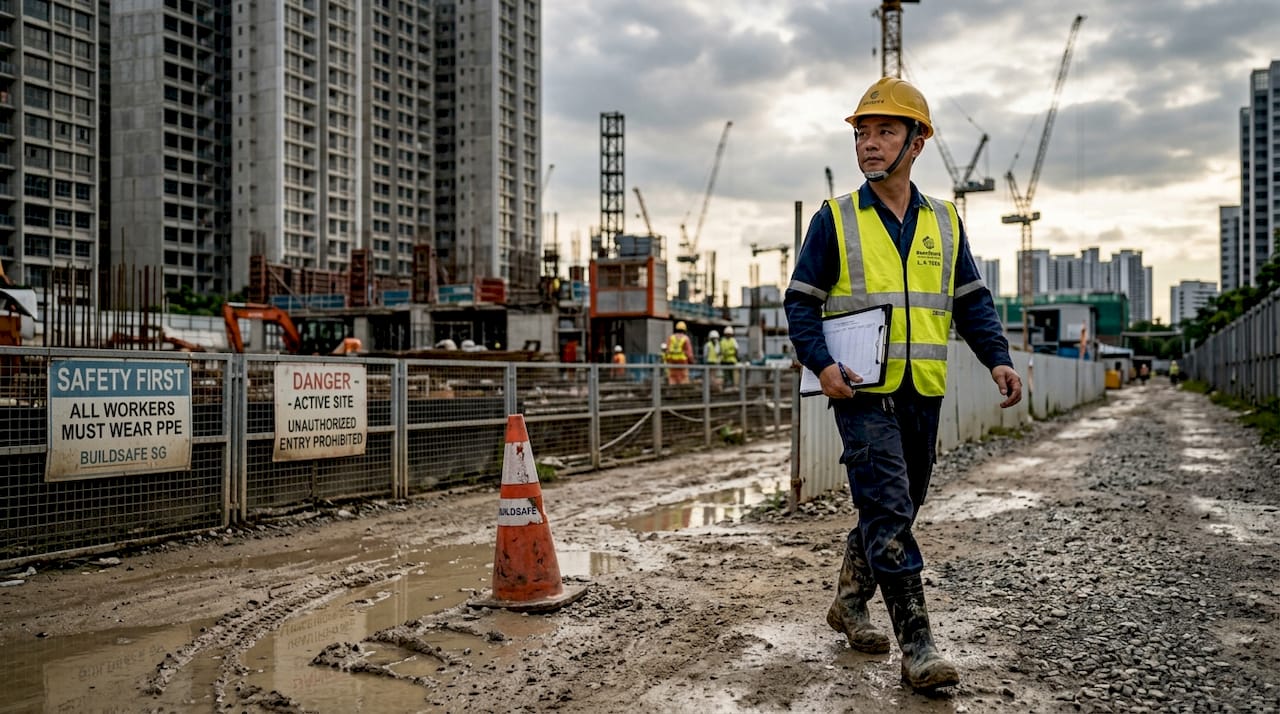
Construction in Singapore carries consequences that extend well beyond project timelines. The sector accounts for roughly half of all workplace fatalities and major injuries annually, making it the highest-risk industry in the country. For developers and contractors, non-compliance is not an administrative inconvenience. It triggers stop-work orders, disqualifies firms from government tenders, exposes principals to criminal liability, and ultimately costs lives. This guide cuts through the regulatory complexity to explain Singapore’s core safety standards, certification pathways, and risk management obligations, so your organization can achieve compliance, secure contracts, and build a genuinely safer operation.
Table of Contents
- Understanding the Singapore construction safety regulatory framework
- Decoding bizSAFE: Singapore’s progressive safety certification system
- ISO 45001 and international best practices: Raising the bar for workplace safety
- Risk management in action: HIRAC, hierarchy of controls, and project realities
- A fresh perspective: What most construction safety guides miss about real compliance
- Take the next step: Improve your site safety and compliance
- Frequently asked questions
Key Takeaways
| Point | Details |
|---|---|
| BizSAFE is essential | Achieving bizSAFE Level 3 or higher is critical for tender eligibility and demonstrates safety commitment. |
| ISO 45001 adds global value | ISO 45001 certification signals best-practice OHS compliance and is increasingly required for international projects. |
| Risk management is ongoing | Effective safety comes from applying HIRAC and control hierarchies, not just certificates. |
| Regulatory compliance protects business | Understanding Singapore regulations reduces project delays, penalties, and injury risks. |
| Small works need focus | Most construction incidents come from overlooked small-scale works—don’t leave compliance unchecked. |
Understanding the Singapore construction safety regulatory framework
Before unpacking the specific standards and certifications, it is essential to grasp Singapore’s safety law landscape. The statutory framework governing construction safety is layered, with obligations distributed across developers, principal contractors, subcontractors, and specialist professionals.
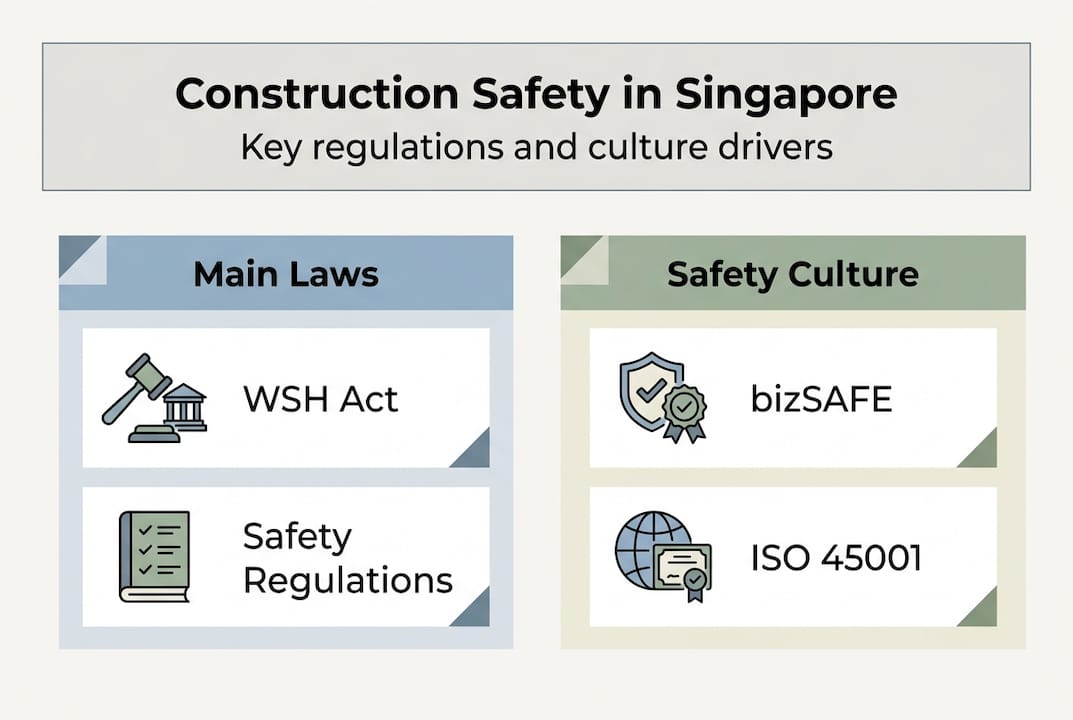
The foundational instrument is the Workplace Safety and Health Act, which establishes general duties for all workplace parties. Beneath it, a suite of subsidiary regulations addresses sector-specific risks with precision:
| Regulation | Primary focus | Key obligation |
|---|---|---|
| WSH (Construction) Regulations 2007 | Site safety plans, training | Mandatory safety plans and competency requirements |
| WSH (Work at Heights) Regulations | Falls prevention | Permit-to-work, safety systems for elevated work |
| WSH (Risk Management) Regulations | HIRAC mandatory | Employers must conduct and document risk assessments |
| WSH (Design for Safety) Regulations 2015 | DfSP appointment | Developers appoint a DfSP for projects exceeding $10 million |
The Ministry of Manpower (MOM) enforces these regulations through inspections, stop-work orders, and prosecutions. The Workplace Safety and Health Council (WSHC) provides advisory support and manages capability-building programs such as bizSAFE. The Building and Construction Authority (BCA) links safety performance to contractor registration grades, creating a direct commercial incentive for compliance.
Responsibility is not confined to site supervisors. Developers bear primary accountability for ensuring safe design and appointing qualified professionals. Principal contractors are responsible for the safety of all workers on site, including those engaged by subcontractors. The Design for Safety framework makes this explicit: a registered Design for Safety Professional (DfSP) must be appointed at the project inception stage, not after construction begins.
Penalties for non-compliance are substantial. Under the WSH Act, corporations face fines up to $500,000 for serious breaches, and individuals, including directors and managers, face personal criminal liability. Repeat offenders attract doubled penalties. Recent enforcement trends show MOM actively prosecuting cases where risk assessments were either absent or treated as paper formalities rather than operational tools.
“The WSH Act places the burden of ensuring safety on those who create the risk, not merely those who are exposed to it. Developers and contractors cannot delegate this accountability.”
Understanding which regulations apply to a specific project requires analysis of project value, work type, and workforce size. Projects above $10 million trigger DfSP obligations. Sites with more than 100 workers require a full Safety and Health Management System (SHMS). Smaller projects carry fewer formal requirements but, as subsequent sections show, statistically carry the highest incident rates.
Decoding bizSAFE: Singapore’s progressive safety certification system
Now that responsibility lines are clear, it is appropriate to examine the most critical path to contract eligibility and compliance: bizSAFE certification.
bizSAFE is a five-level national program administered by the WSHC and supported by MOM, designed to help Singapore companies, particularly SMEs in construction, build Workplace Safety and Health (WSH) capabilities through structured, progressive steps. Each level builds on the previous, moving from management commitment through to internationally recognized certification.
The five levels function as follows:
- Level 1: Top management completes a one-day WSH workshop (the Top Executive WSH Program, or TEWP), signaling organizational commitment.
- Level 2: The company appoints a Risk Management (RM) Champion and develops an internal risk management plan.
- Level 3: The risk management plan is audited and approved by a MOM-approved auditor, confirming it meets regulatory standards.
- Level 4: The company implements a full WSH Management System (WSHMS) with a trained champion overseeing it.
- bizSAFE Star: The company achieves ISO 45001 or SS 506 certification, verified through an independent audit.
| Level | Key milestone | Who is involved |
|---|---|---|
| 1 | Top management WSH workshop | CEO/Director |
| 2 | RM Champion appointed | Designated staff |
| 3 | RM plan independently audited | MOM-approved auditor |
| 4 | WSHMS implemented | WSH champion and management |
| Star | ISO 45001/SS 506 certified | Third-party certification body |
The bizSAFE Level 3 certification threshold is where commercial impact becomes most acute. Level 3 and above is mandatory for government tenders and for companies seeking higher BCA Contractor Registration System (CRS) grades. Without it, firms are effectively excluded from a significant portion of Singapore’s public sector construction pipeline.
Beyond contract eligibility, bizSAFE drives a measurable shift in organizational safety culture. Companies that progress through the levels systematically develop documented risk assessment processes, trained safety personnel, and management accountability structures that persist beyond any single project.
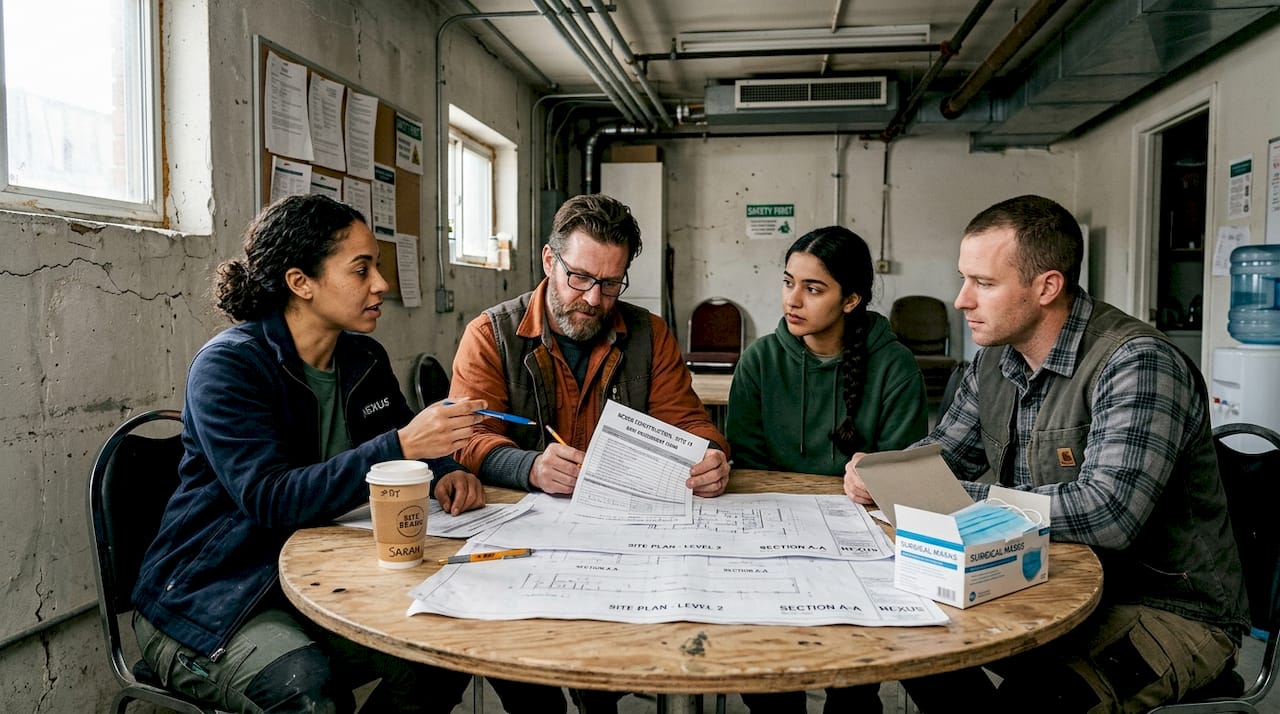
Pro Tip: The most common pitfall for SMEs is treating bizSAFE as a one-time certification exercise rather than an ongoing operational commitment. Auditors assess whether risk management is actually practiced, not merely documented. Firms that let their risk assessment records lapse between audits frequently fail renewal assessments. Maintaining a live, updated risk register throughout the year is the single most effective preparation for audit readiness. For a detailed walkthrough of the process, the bizSAFE certification guide provides step-by-step guidance tailored to Singapore’s construction sector.
ISO 45001 and international best practices: Raising the bar for workplace safety
With bizSAFE mapped out, the next question is what happens when your company targets the highest, internationally recognized standards.
ISO 45001 is the international Occupational Health and Safety Management System standard, structured around the Plan-Do-Check-Act (PDCA) cycle. It emphasizes leadership accountability, worker participation, and continual improvement, and it aligns directly with Singapore’s WSH Act obligations and the mandatory SHMS requirements for larger construction sites.
The PDCA cycle, applied to construction safety, operates as follows:
- Plan: Identify hazards, assess risks, set safety objectives, and define controls.
- Do: Implement controls, conduct training, and execute safety programs.
- Check: Monitor performance through audits, incident analysis, and leading indicator tracking.
- Act: Review findings, address non-conformances, and update the system continuously.
| Feature | bizSAFE Star | ISO 45001 |
|---|---|---|
| Scope | Singapore national program | International standard |
| Governing body | WSHC/MOM | ISO (via accredited certification bodies) |
| Worker participation | Encouraged | Mandatory requirement |
| Psychosocial risk coverage | Limited | Explicitly addressed |
| Global recognition | Regional | Worldwide |
The practical value of ISO 45001 extends well beyond Singapore’s borders. For construction firms engaged in cross-border projects, joint ventures with international partners, or procurement processes involving multinational clients, ISO 45001 certification is frequently a baseline requirement. It signals that the organization’s safety management system has been independently verified against a globally accepted standard.
ISO 45001 also introduces nuances that challenge traditional construction safety cultures. Worker participation requirements demand genuine consultation, not token safety briefings. Contractor and procurement controls must be integrated into the management system, meaning the safety performance of subcontractors directly affects the principal’s certification standing. Critically, the standard explicitly addresses psychosocial risks, including stress, fatigue, and workplace harassment, areas that construction safety programs have historically underemphasized.
Leading construction firms are now incorporating near-miss data and leading indicators, such as safety observation rates and toolbox meeting attendance, into their ISO 45001 performance reviews. This shift from lagging indicators (incident counts) to leading indicators (proactive safety behaviors) is where ISO 45001 delivers its most significant long-term value. For firms seeking expert support in achieving this standard, ISO 45001 consulting services provide structured pathways from gap assessment through to certification.
Risk management in action: HIRAC, hierarchy of controls, and project realities
Standards and certifications establish the “what,” but real risk reduction depends on strong project execution.
HIRAC, which stands for Hazard Identification, Risk Assessment, and Risk Control, is the operational core of Singapore’s mandatory risk management regime. Every employer must conduct HIRAC for all work activities, document the findings, and implement the identified controls before work commences. On a live construction site, this translates into activity-specific risk assessments for tasks such as excavation, formwork erection, hot works, and lifting operations.
The hierarchy of controls provides the decision framework for selecting risk controls. In descending order of effectiveness:
- Elimination: Remove the hazard entirely from the work process.
- Substitution: Replace a hazardous material or method with a safer alternative.
- Engineering controls: Install physical barriers, guardrails, or mechanical lifting aids.
- Administrative controls: Implement safe work procedures, permit-to-work systems, and training.
- Personal Protective Equipment (PPE): Provide respirators, harnesses, and helmets as the last line of defense.
The hierarchy is not optional. MOM inspectors assess whether employers have genuinely attempted higher-order controls before defaulting to PPE, which is the least effective and most frequently over-relied-upon measure in Singapore’s construction sector.
“PPE does not eliminate hazards. It merely reduces the severity of harm when other controls have failed. Treating PPE as a primary control is a systemic failure of risk management.”
Small-scale works account for more than 60% of construction incidents in Singapore, a statistic that exposes a critical gap in how the industry applies HIRAC. Minor renovation and maintenance contracts frequently lack formal risk assessments, competent safety supervision, and documented control measures, precisely because they fall below the thresholds that trigger mandatory SHMS or DfSP requirements. Delegating DfSP duties to a subcontractor does not absolve the developer of liability under the WSH Act.
Common failure modes in certified sites include risk assessments completed after work begins rather than before, generic control measures copied between projects without site-specific adaptation, and near-miss incidents that go unreported and unanalyzed. Each of these failures represents a missed opportunity to prevent a future fatality.
Pro Tip: Build a near-miss reporting culture before your next audit. Near-miss data is the most actionable leading indicator available to site managers. Firms that systematically analyze near-misses and update their HIRAC records accordingly demonstrate continuous improvement, a key criterion for both bizSAFE renewal and ISO 45001 surveillance audits. The risk assessment process framework provides a practical structure for implementing this on active project sites.
A fresh perspective: What most construction safety guides miss about real compliance
After examining how these standards function in practice, it is important to consider what too many guides and even experienced firms actually miss.
The dominant failure mode in Singapore’s construction safety ecosystem is not ignorance of the regulations. It is the organizational tendency to treat compliance as a periodic event rather than a continuous state. Firms invest significant effort in preparing for bizSAFE audits and ISO 45001 surveillance visits, then revert to informal practices the moment the auditor leaves. This pattern produces certified organizations with unsafe sites.
Effective WSH management is visible in daily behavior, not in the thickness of a safety manual. The most reliable indicator of a genuine safety culture is whether frontline workers feel empowered to stop unsafe work without fear of reprisal, and whether management responds to safety concerns with urgency rather than defensiveness.
The emerging risks that current certification frameworks are only beginning to address, particularly psychosocial hazards such as excessive overtime, job insecurity, and language barriers among migrant workers, represent the next frontier of construction safety in Singapore. Organizations that wait for regulatory mandates to address these risks will find themselves responding to incidents rather than preventing them. The firms that lead on safety in the next decade will be those that treat worker wellbeing as a strategic asset, not a compliance checkbox.
Take the next step: Improve your site safety and compliance
If you are ready to move from understanding to action, the right resources and expertise make all the difference between a certified organization and a genuinely safe one.

MOSAIC Ecoconstruction Solutions provides end-to-end support for construction firms and developers navigating Singapore’s safety compliance landscape. Whether your immediate priority is preparing for safety audits, strengthening your documentation through audit checklist solutions, or progressing toward bizSAFE Star support and ISO 45001 certification, our consultancy team delivers structured, site-specific guidance. We work alongside your project teams to build compliance systems that function under operational pressure, not just during scheduled audits.
Frequently asked questions
Is bizSAFE Level 3 certification compulsory for all Singapore construction companies?
bizSAFE Level 3 is not a universal legal requirement, but it is mandatory for government tenders and BCA CRS higher grade projects, making it a practical necessity for most construction firms seeking public sector contracts.
What is the main difference between bizSAFE and ISO 45001 certification?
bizSAFE is a national, stepwise capability program administered by WSHC for the Singapore market, while ISO 45001 is an international OHSMS standard recognized globally and structured around the PDCA cycle for continual improvement.
What does HIRAC stand for in construction safety?
HIRAC stands for Hazard Identification, Risk Assessment, and Risk Control, forming the mandatory operational framework for managing workplace hazards on Singapore construction sites.
Do small projects in Singapore require a DfSP under WSH (Design for Safety) Regulations?
Under the WSH (Design for Safety) Regulations 2015, developers must appoint a registered DfSP for construction projects with an estimated contract value exceeding $10 million; smaller projects operate under different requirements.
What are common reasons safety audits or certifications fail in practice?
Audit failures typically stem from incomplete or outdated risk documentation, insufficient worker involvement in safety processes, and inadequate oversight of small-scale works, which account for more than 60% of construction incidents in Singapore.
Recommended
- The Comprehensive Guide to Design for Safety Professionals (DFSP) in Singapore Construction Projects – MOSAIC Eco-construction Solutions Pte Ltd
- The Ultimate Guide to Top 10 Workplace Hazards in Singapore: Manufacturing & Construction Focus (2025) – MOSAIC Eco-construction Solutions Pte Ltd
- Risk assessment process: mastering construction safety in Singapore
- Implementing Effective Workplace Safety And Health Management Systems In Singapore Construction Industry – MOSAIC Eco-construction Solutions Pte Ltd
