Construction sites in Singapore rank among the highest-risk work environments in the country, where a single uncontrolled hazard can halt a project, trigger regulatory enforcement, or cost a worker their life. For managers and safety officers, understanding construction site risk assessment how to conduct one correctly is not optional — it is a statutory obligation under Singapore’s Workplace Safety and Health (WSH) Act, and a direct determinant of project viability. This guide delivers a structured, legally grounded framework to help you execute risk assessments that protect your workforce, satisfy regulatory scrutiny, and hold up under a ConSASS or BizSAFE audit.
Table of Contents
- How to conduct a construction site risk assessment: the regulatory framework
- Prepare your risk assessment team and tools
- Execute the five-step risk assessment process on your site
- Incorporate dynamic risk assessment and continuous review
- Common pitfalls and how to avoid them
- Why treating risk assessment as a living system beats ticking boxes
- Enhance your construction site safety with MOSAIC Eco-construction Solutions
- Frequently asked questions
Key Takeaways
| Point | Details |
|---|---|
| Mandatory risk assessment | Conduct documented risk assessments before starting work to comply with Singapore safety laws. |
| Five-step HIRAC process | Use Hazard Identification, Risk Assessment, and Control steps methodically to manage site hazards. |
| Hierarchy of controls | Apply controls from elimination to PPE in order to minimize risks effectively. |
| Dynamic risk assessment | Supplement formal assessments with real-time hazard evaluations for evolving site conditions. |
| Continuous review and communication | Review assessments regularly and communicate results clearly to all workers for safety compliance. |
How to conduct a construction site risk assessment: the regulatory framework
To comply effectively, start by understanding the governing safety regulations and their key mandates.
The WSH (Risk Management) Regulations mandate that employers conduct and document risk assessments covering all foreseeable hazards before work commences, with records specifying existing controls, residual risk levels, and any additional controls required. These records must remain accessible on site at all times, and non-compliance penalties reach up to S$500,000. That is not a theoretical ceiling — the Ministry of Manpower (MOM) actively enforces these provisions, and enforcement actions have intensified in recent years across residential, infrastructure, and civil engineering projects.
Key legal requirements every site team must internalize:
- Risk assessments must be conducted before any new work activity commences.
- Documentation must identify hazards, evaluate risk levels, and record both existing and additional control measures.
- Assessments must be reviewed at minimum every three years, and immediately following any incident, near-miss, or significant change in site conditions or scope.
- Records must be made available to inspectors and workers upon request.
- Risk assessments must cover subcontractor activities, not just the main contractor’s work.
Pro Tip: Cross-reference your risk assessment register against your workplace risk assessment Singapore construction obligations before each audit cycle. Gaps in subcontractor coverage are among the most common enforcement triggers.
Understanding where the law draws the line enables your team to master construction risk assessment steps that satisfy both MOM inspectors and project owners demanding documented safety governance.
Prepare your risk assessment team and tools
With regulatory context clear, the next step is assembling your expert team and equipping yourselves with the right tools for accurate hazard identification.
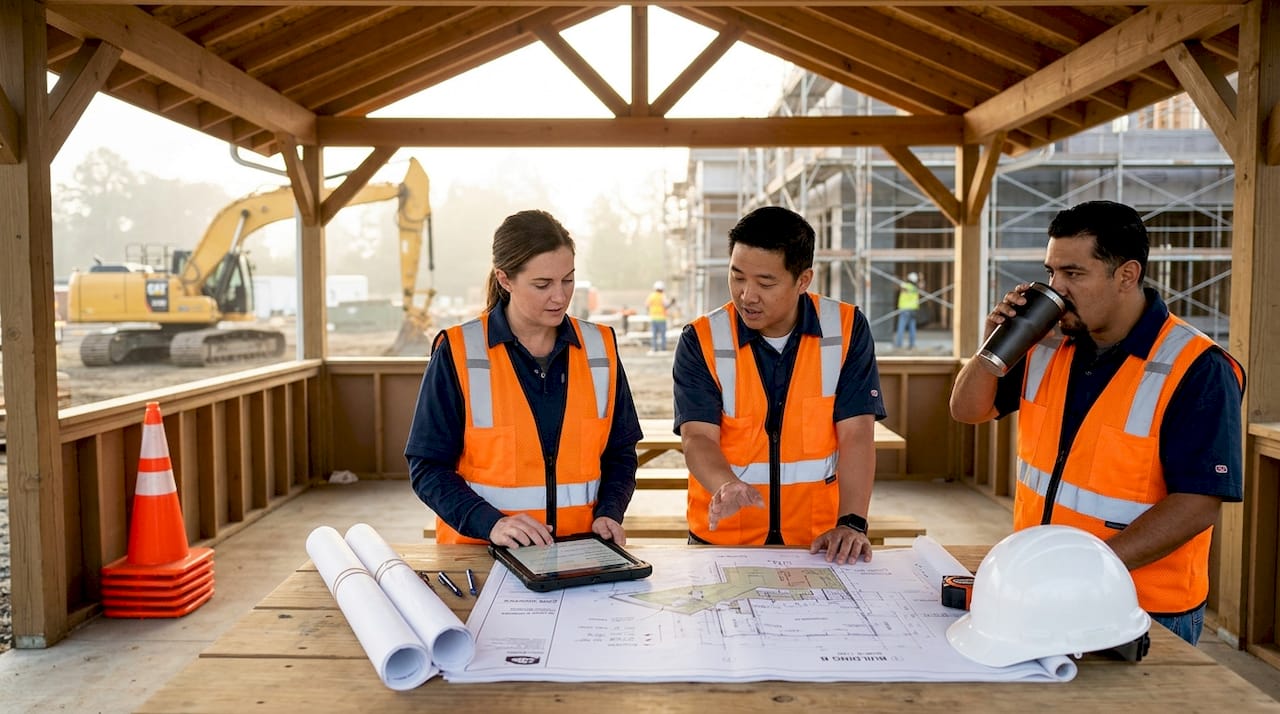
The construction risk assessment process is only as reliable as the people executing it. WSHOs must lead risk assessments, and site walk-throughs conducted together with subcontractors reveal approximately 80% of unique hazards, including soil instability conditions characteristic of Singapore’s tropical geology. A WSHO working in isolation, reviewing paperwork from an office, will not achieve this.
A well-composed risk assessment team for a typical Singapore construction site should include:
- A registered Workplace Safety and Health Officer (WSHO) as team lead.
- Project manager or site engineer for scope and method context.
- Site supervisor representing daily operational realities.
- Subcontractor safety representatives for trade-specific hazard input.
- A designated recorder responsible for documentation accuracy.
On the tooling side, the gap between a generic paper checklist and a site-specific, digitally maintained assessment is the gap between compliance and genuine hazard control. Consider the following comparison when selecting your approach:
| Tool type | Strengths | Limitations |
|---|---|---|
| Paper-based checklist | Low cost, no technical setup required | Difficult to update in real time; version control risk |
| Digital RA platform | Real-time updates, audit trail, cloud storage | Requires training; upfront investment |
| Hybrid (paper + digital sync) | Accessible on site; data preserved digitally | Coordination overhead |
Pro Tip: Build your risk assessment process Singapore checklist from actual site drawings and activity schedules, not from downloaded generic templates. Every crane lift, cofferdam operation, and confined space entry on your specific site should appear as a line item.
Execute the five-step risk assessment process on your site
Now that you have your team and tools, follow this structured five-step HIRAC process to assess and control risks effectively.
HIRAC stands for Hazard Identification, Risk Assessment, and Control — the construction risk assessment process framework mandated under Singapore’s WSH regulatory regime. Each step carries distinct obligations and methodological requirements.
-
Identify all site hazards. Walk the site systematically with your full team during active operations, not just during a quiet morning inspection. Temporary works such as formwork systems, scaffold platforms, and shoring structures present hazards that change with construction sequence. Environmental factors including rain-saturated ground, high humidity affecting equipment performance, and restricted site access during monsoon periods must be captured. Use your site safety inspection checklist to ensure no activity category is overlooked.
-
Evaluate risk using a likelihood-severity matrix. Assign a likelihood rating (rare to almost certain) and a consequence rating (negligible to catastrophic) to each identified hazard. The resulting risk score determines control priority. This is where the ultimate risk assessment guide Singapore provides calibrated matrices aligned with MOM expectations.
-
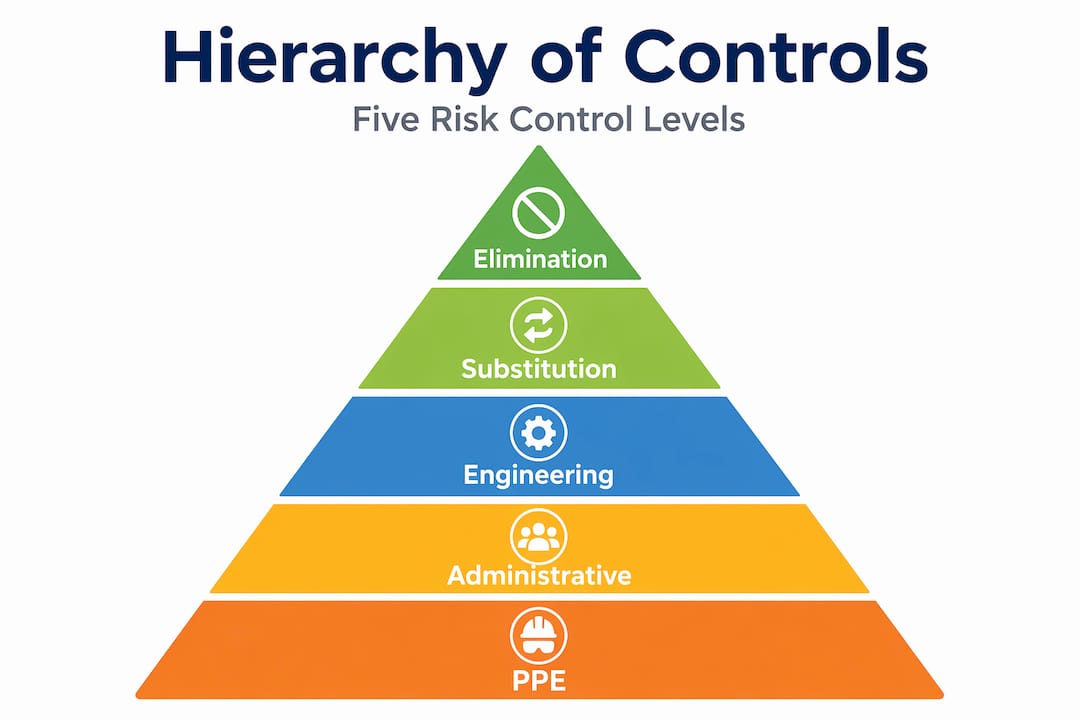
Apply the hierarchy of controls. This is the step most frequently executed incorrectly on Singapore construction sites. The hierarchy of controls mandates elimination as the first and most effective option, followed by substitution, engineering controls, administrative controls, and finally PPE as a last resort. Many sites default to PPE without exhausting superior controls, a practice that exposes them to enforcement action and, more critically, fails to protect workers adequately.
-
Monitor and review assessments continuously. A documented assessment that has not been updated since mobilization is a liability, not a safeguard. Conduct reviews following near-misses, equipment changes, scope revisions, and significant weather events. All review activity must be documented with dates and approving signatures.
-
Communicate findings to all workers. Construction hazard evaluation is meaningless if findings do not reach the workers executing the work. Toolbox talks, multilingual briefing materials, visual hazard boards, and digital notification systems all serve distinct communication roles on diverse Singapore construction sites.
Falls from height accounted for 38% of fatal accidents in Singapore construction, with 94.1% of victims not using any safety device at the time of incident — a statistic that illustrates precisely what happens when risk controls are documented but not enforced.
Pro Tip: When completing your workplace risk assessment detailed guide documentation, record why each control level above PPE was considered and rejected or implemented. This reasoning trail is what differentiates a credible assessment from a checkbox exercise during a MOM audit.
Incorporate dynamic risk assessment and continuous review
To maintain safety on evolving sites, integrate dynamic risk assessment practices and a disciplined review system into your risk management approach.
Static risk assessments, even when meticulously prepared, cannot anticipate every hazard that emerges on a fast-moving construction site. Dynamic risk assessment complements the formal static RA by enabling real-time hazard recognition when site conditions shift unexpectedly, a capability that is especially critical given Singapore’s dense urban construction environment and unpredictable tropical weather patterns.
Effective implementation of dynamic risk assessment involves several operational practices:
- Conduct Field Level Hazard Assessments (FLHA) daily, requiring workers to evaluate their immediate work area before commencing each task.
- Train supervisors to recognize specific reassessment triggers: weather deterioration, ground movement, introduction of new plant or equipment, changes in adjacent work activities, or any condition not covered by the existing static assessment.
- Maintain a logbook of dynamic assessments with dates, hazard descriptions, controls applied, and the name of the person who conducted the assessment.
- Integrate DRA outcomes back into the formal static risk assessment register during scheduled reviews.
Risk assessments must be reviewed at minimum every three years and immediately following incidents, near-misses, or significant operational changes — but the most effective risk assessment process master Singapore programs treat this as a minimum floor, not a practical schedule.
Pro Tip: Appoint a specific supervisor on each work zone as the DRA champion for that shift. This role accountability prevents the common failure mode where dynamic hazards are recognized verbally but never documented, leaving the site exposed during post-incident investigations.
Common pitfalls and how to avoid them
Understanding pitfalls helps you apply the process effectively and prevent costly errors that jeopardize safety and compliance.
Even experienced safety officers fall into recognizable patterns of failure when managing construction risk assessments under project pressure. Frequent issues documented across Singapore construction sites include the use of generic non-site-specific assessments, failure to communicate controls to workers in accessible languages, exclusion of subcontractor hazard registers, non-updating of assessments after incidents, and persistent overreliance on PPE as the primary control measure.
To avoid the most consequential pitfalls:
- Do not use downloaded templates verbatim. Generic assessments fail to capture site-specific conditions such as proximity to MRT tunnels, high-rise adjacency risks, or specific equipment configurations. Customize every assessment to your site’s actual method statements.
- Communicate in the languages your workers speak. Singapore construction sites typically employ workers from multiple countries with varying levels of English literacy. Visual hazard communication, translated toolbox talks, and pictographic safety boards are not optional enhancements — they are effective risk management strategies.
- Register every subcontractor’s high-risk activities. Main contractors remain legally accountable for hazards arising from subcontractor operations. Require subcontractors to submit their own risk assessments and verify these are integrated into the master risk register.
- Document every update after a near-miss or scope change. An undocumented review is legally equivalent to no review having occurred.
- Challenge every PPE-only control. If the assessment records PPE as the sole control for a high-severity hazard, require the team to demonstrate that elimination, substitution, and engineering options were genuinely evaluated before being rejected.
Pro Tip: Review how to identify site hazards specific to your site’s stage of construction at each phase transition: foundation, superstructure, finishes, and commissioning each carry distinct hazard profiles that a single mobilization-phase assessment cannot adequately capture.
Why treating risk assessment as a living system beats ticking boxes
The construction industry has a well-documented tendency to treat risk assessment as a documentation obligation rather than an operational tool. This distinction carries real consequences. Sites that complete HIRAC documentation during mobilization and revisit it only when auditors arrive are not conducting effective risk management — they are manufacturing paper compliance, and the difference shows in injury statistics.
Fatal and major injury rates have declined in sectors where structured, site-specific risk assessments demonstrably influence daily site safety behavior, not merely where documentation records are complete. The mechanism is leadership accountability. When project managers and site supervisors treat the risk assessment register as a live reference document, when they challenge unsafe conditions against documented controls, when they halt work pending reassessment after a near-miss, the risk assessment process acquires operational authority. It stops being paperwork and becomes the backbone of effective WSH management systems.
There is also a direct commercial argument. ConSASS audit scoring — the Construction Safety Audit Scoring System used by BCA to evaluate safety management performance — assigns significant weight to the currency and site-specificity of risk assessments. Contractors with high ConSASS scores gain preferential access to public sector tenders. The risk assessment register is therefore simultaneously a safety tool, a compliance instrument, and a competitive asset. Treating it as any less than all three is a management failure with measurable financial consequences.
The shift required is cultural, not procedural. It begins with senior leadership modeling the behavior they want to see: reading risk assessment updates, asking site supervisors to explain the controls for the day’s highest-risk activity, and visibly linking incident reviews to assessment improvements. When that leadership signal is consistent, the safety culture follows.
Enhance your construction site safety with MOSAIC Eco-construction Solutions
Rigorous risk assessment is achievable, but doing it well under project pressure, across multiple subcontractors, and against Singapore’s demanding regulatory calendar requires structured support. MOSAIC Eco-construction Solutions provides specialized consultancy services designed specifically for construction company managers and safety officers navigating exactly these demands.

MOSAIC’s consultants work directly with your team to develop site-specific risk assessment documentation that meets WSH Act requirements and withstands MOM scrutiny. For companies approaching certification milestones, the team provides structured BizSAFE Level 4 audit preparation support, ensuring your risk management systems reflect current site realities. If your organization requires ongoing safety officer coverage, MOSAIC’s outsourced safety officer services place qualified WSHOs in your operations to maintain compliance continuity. To begin preparing for safety audits with confidence, contact MOSAIC today.
Frequently asked questions
Is risk assessment mandatory for all construction sites in Singapore?
Yes, under Singapore’s WSH Act and Risk Management Regulations, risk assessments are mandatory for all foreseeable work risks on construction sites, and must be completed before work begins.
How often should construction site risk assessments be reviewed?
Assessments must be formally reviewed at least every three years, but post-incident reviews are required immediately after incidents, near-misses, or significant changes in site conditions or scope.
What is the hierarchy of controls in risk assessments?
The hierarchy of controls mandates elimination as the most effective control, followed by substitution, engineering controls, administrative controls, and PPE as the last resort only when higher-order controls are not practicable.
How does dynamic risk assessment improve construction site safety?
Dynamic risk assessment enables workers and supervisors to identify and respond to hazards in real time as site conditions change, supplementing the formal static assessment that cannot anticipate every evolving risk.
Who should be included in the risk assessment team?
A multidisciplinary team including project managers, registered WSHOs, site supervisors, and subcontractor representatives ensures the broadest possible hazard identification and stronger, more practical control planning.