

A job hazard analysis (JHA) is a proactive, systematic technique that breaks a job into discrete steps, identifies the hazards present at each step, and specifies controls to prevent injury or illness before work begins. OSHA formalizes this methodology in its OSHA 3071 publication, which remains the authoritative national reference for U.S. workplaces.
- OSHA guidance: OSHA 3071 defines four basic JHA stages: select the job, break it into steps, identify hazards, and determine preventive measures.
- Governing framework: The hierarchy of controls (Elimination → Substitution → Engineering → Administrative → PPE) dictates how controls are selected, with elimination and engineering solutions taking priority over PPE.
- Primary template: The OSHA JHA Worksheet provides a structured, field-ready format for documenting every step, hazard, and control.
Table of Contents
- What Is a Job Hazard Analysis and Why Does It Matter?
- Which Jobs Should You Prioritize for a JHA First?
- How to Conduct a Job Hazard Analysis: Step-by-Step
- How to Use the OSHA JHA Worksheet
- Who Should Be Involved in a Job Hazard Analysis?
- Implementing Controls, Monitoring Results, and Updating Your JHA
- Three Practical JHA Examples for High-Risk Construction Tasks
- How MOSAIC Supports Organizations with JHA Implementation
- Key Takeaways
- The Practical Reality of JHA Programs
- MOSAIC’s JHA Services for Construction Organizations
- Authoritative Sources and Templates
What Is a Job Hazard Analysis and Why Does It Matter?
At its core, a JHA focuses on the relationship between four variables: the worker, the task, the tools and equipment, and the work environment. That four-way lens is what distinguishes a JHA from a generic safety inspection. Rather than auditing a facility at a point in time, a JHA dissects a specific job as it is actually performed, capturing hazards that facility walkthroughs routinely miss.
The four basic stages, as OSHA defines them, operate in sequence:
- Select the job: Prioritize tasks based on injury history, severity potential, or operational change.
- Break the job into steps: Observe the task being performed and document each discrete action in sequence.
- Identify hazards: At each step, determine what could go wrong, who or what is exposed, and what the worst-case outcome would be.
- Determine preventive measures: Apply the hierarchy of controls to select the most protective feasible control for each identified hazard.
The business case for conducting JHAs is well-supported. OSHA guidance documents that organizations conducting JHAs realize fewer injuries, safer work methods, reduced workers’ compensation costs, and measurable productivity gains. Beyond injury prevention, a completed JHA functions as a training aid for onboarding new workers and briefing experienced personnel on non-routine tasks, a dual utility that compounds its return on investment over time. Integrating JHAs into a broader safety management system amplifies these benefits further by embedding hazard identification into standard operational workflows.
Which Jobs Should You Prioritize for a JHA First?
Risk-based prioritization is the operational reality of any JHA program: no organization has unlimited resources to analyze every job simultaneously, so the sequence in which jobs are selected determines how much risk reduction the program delivers in its early phases.
State safety guidance recommends focusing initial JHA effort on the following high-priority candidates:
- Jobs with a documented history of injuries, illnesses, or near misses
- Newly established jobs where hazards have not yet been identified through operational experience
- Jobs that have undergone changes in process, equipment, materials, or personnel
- Non-routine or infrequent tasks that fall outside workers’ normal duties
- Tasks where the potential consequence of a single failure is severe or fatal
A practical prioritization checklist for site supervisors: review the past 12 months of incident and near-miss records, consult frontline workers directly about which tasks they consider most hazardous, cross-reference any equipment or process changes implemented in the past six months, and flag any task performed fewer than four times per year as a non-routine candidate. That four-step screen will surface the highest-priority JHA targets in under an hour.
Pro Tip: When scoping a JHA, aim for the “sweet spot” in step definition. A step written as “operate the crane” is too broad to identify specific hazards; a step written as “move left hand to lever” is too granular to be practical. The target is a discrete, observable action such as “attach load to crane hook using rated sling” — specific enough to reveal hazards, concise enough to remain usable.

How to Conduct a Job Hazard Analysis: Step-by-Step
Executing a JHA with rigor requires expanding the four basic OSHA stages into a structured sequence of practitioner tasks. The following numbered process reflects the OSHA JHA Worksheet guidance and is designed for direct application on U.S. construction and industrial sites.
- Select and prioritize the job. Apply the prioritization criteria above. Document the rationale for selection so the program’s risk-based logic is auditable.
- Observe the job being performed. Watch multiple workers complete the task, including any special or non-routine procedures. Video or photography can assist in capturing steps accurately. Communicate clearly to workers that the observation evaluates the job, not their performance.
- Break the job into discrete steps. List every action from start to finish. Each step should represent one observable action at the sweet-spot level described above.
- Identify hazards at each step. For every step, apply the five detective questions OSHA specifies: What can go wrong? What are the consequences? How could it happen? What are contributing factors? How likely is occurrence?
- Analyze causes and worst-case outcomes. Document the environment, exposure, trigger, and consequence for each hazard. Consider both the probable scenario and the catastrophic worst case.
- Select controls using the hierarchy of controls. Choose the highest feasible control level for each hazard. Document the rationale when a higher-level control is not practicable.
- Document controls and assign responsibility. Record who is responsible for implementing each control, the target completion date, and the verification method.
- Train workers on the completed JHA. Conduct a pre-task briefing using the completed worksheet. For non-routine tasks, this briefing is mandatory before work begins.
Hierarchy of controls reference
| Control Level | Description | When to Apply |
|---|---|---|
| Elimination | Remove the hazard entirely from the workplace | First choice; apply whenever the task or material can be redesigned out |
| Substitution | Replace the hazardous material or process with a less hazardous one | When elimination is not feasible but a safer alternative exists |
| Engineering controls | Physical modifications that isolate workers from the hazard | Preferred over behavioral controls; examples include guarding, ventilation, interlocks |
| Administrative controls | Procedures, training, scheduling, and work practices that reduce exposure | Use when engineering controls are insufficient or not yet implemented |
| PPE | Personal protective equipment worn by the worker | Last resort; supplements but does not replace higher-level controls |
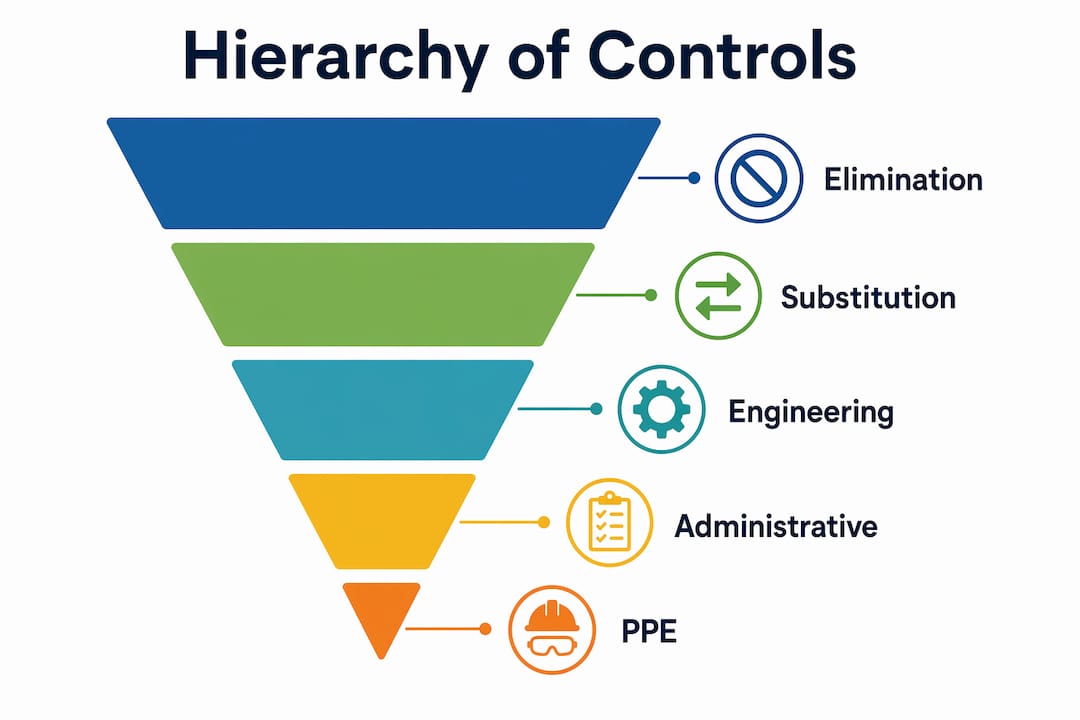
Source: OSHA / Texas Department of Insurance hierarchy of controls guidance
Hazard identification checklist
When scanning each job step for hazards, systematically consider these categories:
- Mechanical: caught-in, caught-between, struck-by, amputation, crush
- Fall: working at height, unprotected edges, ladder use, unstable surfaces
- Electrical: contact with live conductors, arc flash, improper grounding
- Chemical: inhalation, skin or eye contact, ingestion of toxic or corrosive substances
- Ergonomic: lifting, pushing, pulling, twisting, repetitive motion, awkward posture
- Confined space: oxygen deficiency, toxic atmosphere, engulfment
- Environmental: heat stress, cold stress, noise, vibration, environmental hazards such as silica or asbestos
- Human factors: fatigue, distraction, time pressure, inadequate training
Pro Tip: Involve frontline workers during the observation phase, not just supervisors. Workers who perform the job daily hold tacit knowledge of informal workarounds that neither standard operating procedures nor cursory observation will reveal. OSHA’s JHA guide explicitly notes that excluding workers risks overlooking routine unsafe practices that are invisible to outside observers.
How to Use the OSHA JHA Worksheet
The OSHA JHA Worksheet provides a standardized, field-ready template that structures the documentation of every JHA. Each key field serves a specific analytical function:
- Job title / task name: Identifies the specific job being analyzed, not a department or general work area.
- Job step number and description: Records each discrete step in sequence using active, observable language.
- Hazard description: Captures the environment, exposure, trigger, and consequence for each hazard at that step.
- Recommended controls: Documents the selected control(s) from the hierarchy, with the control level noted.
- Person responsible: Names the individual accountable for implementing the control.
- Target date and review date: Establishes the implementation timeline and the scheduled JHA review.
Filled worksheet example: ladder work
| Step | Hazard | Selected Control | Control Level | Responsible | Review Date |
|---|---|---|---|---|---|
| 1. Set up extension ladder against wall | Ladder slip or tip-over causing fall from height | Secure ladder feet with non-slip feet; tie off top; maintain 4:1 angle | Engineering / Administrative | Site Supervisor | 90 days |
| 2. Climb ladder carrying tools | Overreach or loss of balance; struck-by dropped tools | Use tool belt; maintain three points of contact; establish exclusion zone below | Administrative / PPE | Worker | 90 days |
| 3. Perform overhead work at top of ladder | Fatigue-induced loss of grip; falling objects | Limit time at height; use hard hat and safety glasses | Administrative / PPE | Site Supervisor | 90 days |
When completing the worksheet, note any residual risk that remains after controls are applied and specify the monitoring action required to confirm the control is functioning as intended. For example, if the selected control is a guardrail installation, the monitoring action is a documented weekly inspection of guardrail integrity. That residual-risk notation is what transforms a JHA from a compliance checkbox into a living operational document.
Who Should Be Involved in a Job Hazard Analysis?
A JHA conducted by a single safety officer reviewing a procedure manual produces a document. A JHA conducted by a cross-functional team that includes the workers who actually perform the job produces a control system. The distinction in outcome is substantial.
Recommended participants and their contributions:
- Frontline workers: Provide ground-truth knowledge of how the job is actually performed, including informal workarounds and task variations that supervisors and safety staff may not observe.
- Supervisor: Contributes operational context, understands production constraints, and holds authority to assign corrective actions.
- Safety professional or engineer: Applies technical knowledge of hazard categories, control options, and regulatory requirements; facilitates the structured analysis process.
- Subject-matter specialist: Engaged for tasks involving specialized equipment, hazardous chemicals, or confined spaces where domain expertise is required.
- Contractor representatives: Included when the job involves subcontracted work or shared work areas where interface hazards exist.
Roles and responsibilities matrix
| Role | Observes job | Documents steps | Identifies hazards | Signs off JHA | Implements controls | Delivers training |
|---|---|---|---|---|---|---|
| Frontline worker | ✓ | ✓ | ✓ | Receives | ||
| Supervisor | ✓ | ✓ | ✓ | ✓ | Delivers | |
| Safety professional | ✓ | ✓ | ✓ | ✓ | Supports | |
| Subject-matter specialist | ✓ | ✓ |
Management commitment is not a soft cultural aspiration. OSHA guidance identifies it as the paramount driver of JHA program effectiveness: when management fails to act on identified hazards, worker trust in the reporting process erodes, and the program’s ability to surface new hazards collapses. Visible follow-through on corrective actions is the single most important signal management can send.
Implementing Controls, Monitoring Results, and Updating Your JHA
Completing the JHA worksheet is the analytical phase. Implementation is where risk reduction actually occurs, and it requires a structured operational follow-through.
Action checklist for control implementation:
- Assign a named individual and a firm target date to every corrective action before the JHA session closes.
- Confirm that engineering controls are installed and verified before the job resumes.
- Conduct a pre-task briefing with all affected workers using the completed JHA as the briefing document.
- Document training completions and retain records for compliance and audit purposes.
Monitoring metrics that indicate whether controls are working:
- Total recordable incident rate (TRIR) and lost-time injury rate for the analyzed job category
- Near-miss reporting frequency (an increase in near-miss reports often signals improved reporting culture, not deteriorating safety)
- Corrective action completion rate against assigned target dates
- Training completion rate for workers assigned to the analyzed job
A structured incident reporting procedure feeds directly into JHA updates: every reported near miss or incident on a JHA-covered job is a trigger for immediate review.
OSHA guidance is explicit that a JHA is a living document. Triggers for immediate revision include any change in equipment, materials, process, or environmental conditions, as well as any incident or near miss on the analyzed job. Beyond event-driven reviews, best practice calls for a short verification cycle of 30–90 days after initial implementation to confirm controls are operating as intended, followed by a regular annual audit cadence. A JHA filed and forgotten is a compliance artifact, not a safety tool. Connecting JHA review cycles to your broader safety risk assessment workflow ensures that document currency is maintained systematically rather than reactively.
Three Practical JHA Examples for High-Risk Construction Tasks
Example 1: Ladder work and fall protection
Job: Accessing elevated work area via extension ladder
| Step | Hazard | Control | Hierarchy Level |
|---|---|---|---|
| Position ladder | Tip-over, slip at base | Secure feet; tie off top; 4:1 angle | Engineering / Administrative |
| Ascend with tools | Loss of balance; dropped tools | Tool belt; three-point contact; exclusion zone | Administrative / PPE |
| Work at height | Overreach; fatigue | Restrict duration; use fall arrest if >4 ft above lower level | Administrative / PPE |
Pitfall to avoid: Treating “work at height” as a single JHA step. Each distinct elevation task (ascending, working, descending with materials) carries different hazard profiles and requires separate hazard identification.
Key control insight: For ladder work, engineering controls such as fixed access stairs or aerial work platforms should always be evaluated before defaulting to portable ladders. OSHA’s hierarchy requires that the feasibility of elimination and substitution be documented, not assumed impractical.
Example 2: Lockout/tagout for equipment maintenance
Job: Isolating electrical energy before servicing conveyor drive motor
| Step | Hazard | Control | Hierarchy Level |
|---|---|---|---|
| Notify affected workers | Unexpected energization during notification gap | Written LOTO procedure posted; verbal notification logged | Administrative |
| De-energize and lock out | Stored energy release (electrical, mechanical, pneumatic) | Verify zero energy state with calibrated tester; apply personal lock | Engineering / Administrative |
| Perform maintenance | Re-energization by another worker | Personal lock on each authorized worker; group lockout hasp | Administrative |
Pitfall to avoid: Relying on a single group lock rather than individual personal locks for each authorized worker. Each worker must control their own energy isolation.
Example 3: Manual materials handling and ergonomics
Job: Unloading 80-lb concrete bags from delivery pallet
| Step | Hazard | Control | Hierarchy Level |
|---|---|---|---|
| Position at pallet | Awkward posture; slip on debris | Clear pathway; position pallet at knuckle height where possible | Engineering / Administrative |
| Lift and carry bag | Musculoskeletal strain from load weight | Mechanical assist (hand truck, pallet jack); team lift protocol for heavy loads | Engineering / Administrative |
| Stack bags at destination | Cumulative fatigue; pinch points | Rotate workers regularly; use gloves; stack to no more than waist height | Administrative / PPE |
For a deeper treatment of ergonomic hazard controls in construction, the construction site ergonomics guide provides site-manager-level detail on manual handling risk reduction.
Practitioner note: The UW Environmental Health & Safety JHA guidance recommends domain-specific JHA templates for tasks like manual handling, which carry ergonomic hazard profiles that generic templates may underweight. Adapting the OSHA worksheet with an ergonomic hazard sub-checklist improves capture rates for musculoskeletal risk factors.
How MOSAIC Supports Organizations with JHA Implementation
For construction companies, contractors, and project managers who require structured external support, Com (MOSAIC Ecoconstruction Solutions) delivers facilitated JHA programs that move from initial hazard identification through to documented controls and workforce training. The engagement model is designed for organizations that need a completed, audit-ready JHA program without diverting internal safety staff from ongoing site operations.
MOSAIC’s JHA service deliverables include:
- Onsite facilitated JHA workshops with frontline workers and supervisors
- Completed OSHA-aligned JHA worksheets for prioritized job tasks
- Hazard control recommendations mapped to the hierarchy of controls
- Prioritized corrective-action registers with assigned responsibilities and target dates
- Worker training records and pre-task briefing documentation
- Follow-up audits at 30–90 days to verify control effectiveness
Organizations seeking to engage MOSAIC can initiate a scoping inquiry through the EHS manpower support page, where service options and engagement models are detailed.
Key Takeaways
A job hazard analysis is only as effective as the controls it generates and the management commitment that drives their implementation.
| Point | Details |
|---|---|
| Prioritize by risk | Start JHAs on jobs with injury history, recent changes, or severe consequence potential before lower-risk tasks. |
| Involve frontline workers | Workers hold tacit knowledge of workarounds that supervisors and safety staff will not observe independently. |
| Apply the hierarchy of controls | Elimination and engineering controls must be evaluated before defaulting to administrative measures or PPE. |
| Treat the JHA as a living document | Review and update after any equipment change, process modification, near miss, or incident. |
| Com as implementation partner | MOSAIC delivers facilitated JHA workshops, completed worksheets, and follow-up audits for construction organizations. |
The Practical Reality of JHA Programs
The most persistent failure mode in JHA programs is not methodological. Organizations that understand the four stages, apply the hierarchy of controls correctly, and use the OSHA worksheet still produce ineffective programs when management treats the completed document as the endpoint rather than the starting point. A JHA that identifies a fall hazard and recommends a guardrail installation has accomplished nothing until the guardrail is installed, inspected, and confirmed effective. The analytical rigor of the JHA process is only as valuable as the corrective action velocity that follows it.
The second most common failure is scope creep in the opposite direction: teams that attempt to analyze every job simultaneously, producing a library of worksheets that no one has the bandwidth to implement or maintain. Starting with three to five high-priority jobs, completing the full implementation cycle including training and verification, and then expanding the program is a more defensible approach than broad coverage with shallow follow-through. Comparing JHA methodology against other risk assessment types can help safety teams determine where JHAs fit within a broader hazard management framework and where other tools are more appropriate.
MOSAIC’s JHA Services for Construction Organizations
Construction organizations that need structured JHA support without diverting internal resources can engage Com directly. MOSAIC’s facilitated JHA engagements deliver completed, audit-ready documentation and trained workforces, typically within a defined project timeline agreed during an initial scoping call.

To request support, organizations should prepare the following before making contact: a list of the five to ten highest-priority jobs or tasks for JHA analysis, recent incident and near-miss records for those jobs, and a point of contact with site access authority. MOSAIC’s team handles facilitation, documentation, and training delivery.
- Contact MOSAIC via the EHS manpower support page to initiate a scoping inquiry.
- Expect an initial scoping call to confirm job priorities, site access, and timeline.
- MOSAIC delivers completed JHA worksheets, corrective-action registers, and training records as standard deliverables.
Authoritative Sources and Templates
The following resources constitute the primary methodological and template references for JHA practitioners in U.S. workplaces:
- OSHA Job Hazard Analysis (OSHA 3071): The national methodological anchor. Download and use as the primary reference for JHA program design, step definitions, and hierarchy-of-controls application.
- OSHA JHA Worksheet (PDF): The field-ready template. Includes a completed bakery example and a blank worksheet ready for immediate use.
- UW Environmental Health & Safety JHA Page: University-level guidance with domain-specific examples useful for tailoring JHAs to laboratory, research, and facilities maintenance contexts.
- Minnesota Department of Administration JHA Guidance: State-level practical guidance on prioritization and step-scoping, with a focus on public-sector and general-industry applications.
- Texas Department of Insurance JHA Fact Sheet: A concise, printable reference covering the hierarchy of controls and JHA fundamentals, suitable for supervisor training and toolbox talks.
- Hawaii HIOSH JHA Guidance: State OSHA-aligned guidance that reinforces the four-stage methodology and provides additional context on integrating JHAs into safety and health management systems.
OSHA 3071 remains the primary methodological anchor for all U.S. JHA programs. State and university resources complement it with local context and domain-specific examples but do not supersede federal OSHA guidance.
This article provides general safety information for educational purposes. Organizations should verify current OSHA standards and applicable state regulations with a qualified safety professional for their specific operations.
Recommended
- Safety Gap Analysis: A Practical Guide for Safety Leaders
- Demystifying Risk Assessment: Why Hire a WSH Consultant – MOSAIC Eco-construction Solutions Pte Ltd
- Enhancing Workplace Safety Through Effective Audit Checklists And Risk Management Systems – MOSAIC Eco-construction Solutions Pte Ltd
- Hazard Identification Process Guide for Construction Safety