

A safety gap analysis is the systematic comparison of actual workplace safety practices and conditions against established regulatory standards, such as OSHA requirements or ISO 45001, to identify and prioritize deficiencies before they produce incidents or citations. Unlike a compliance audit, which confirms whether documentation exists, a gap analysis investigates why shortfalls occur and what must change to close them. It is a diagnostic instrument, not a report card.
Key characteristics that define a rigorous safety gap analysis:
- Systematic comparison of current performance against defined standards (OSHA, ISO 45001, internal policies)
- Root cause focus that goes beyond document review to examine field conditions and worker behaviors
- Proactive orientation that surfaces risks before formal audits or regulatory inspections
- Prioritized remediation that ranks corrective actions by severity and operational impact
- Accountable ownership with named responsible parties and defined completion deadlines
When and why you should conduct a safety gap assessment
OSHA’s program evaluation guidance recommends running a full-scope safety gap analysis at least annually, with proactive organizations conducting assessments quarterly or immediately following incidents, near-misses, or significant operational changes. The timing is not arbitrary. Safety programs degrade silently as procedures drift, personnel turn over, and equipment ages, often without triggering any formal alert.
Primary use cases for initiating a gap analysis:
- Pre-audit preparation: Identify and remediate weak points before a formal regulatory or certification audit
- Post-incident investigation: Determine systemic root causes beyond the immediate event
- Operational changes: New equipment, processes, or worksites introduce hazards that existing controls may not address
- Annual or quarterly reviews: Maintain continuous improvement cycles aligned with ISO 45001 Plan-Do-Check-Act requirements
- Certification readiness: Prepare for BizSAFE, ISO 45001, or other statutory certification milestones
Gap analysis also uncovers blind spots that routine audits routinely miss, such as inconsistent enforcement of PPE requirements or informal workarounds that workers have normalized over months. These hidden deviations carry the highest incident potential precisely because they are invisible to document-based review.
How to conduct a safety gap analysis step by step
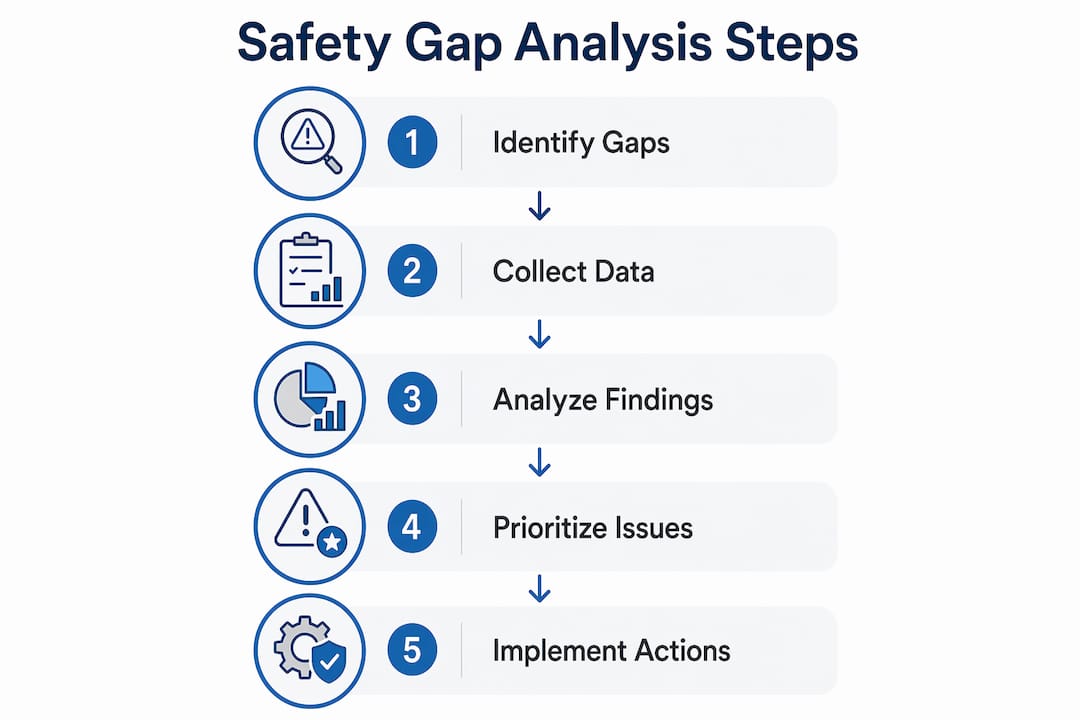
The seven-step process below reflects current best practice for construction and industrial environments. Each phase builds on the last; compressing or skipping steps produces incomplete findings and undermines remediation credibility.
- Define scope and reference standards. Specify which sites, processes, or departments the analysis covers. Identify the governing standards: OSHA 29 CFR, ISO 45001, client contractual requirements, or internal safety management system (SMS) policies.
- Collect field data. Conduct direct site observations, review incident logs, interview frontline workers and supervisors, and examine training records. Field observation is indispensable because procedural drift — the divergence between written policy and actual practice — is rarely visible in documentation alone.
- Identify gaps. Compare collected data against the reference standards. Document every deviation, whether a missing lockout/tagout procedure, an untrained operator, or a hazard control that exists on paper but not in practice.
- Conduct root cause analysis. Apply structured methods such as the 5 Whys or fishbone (Ishikawa) diagrams to determine the underlying drivers of each gap. Surface-level findings without root causes produce corrective actions that fail to hold.
- Prioritize by risk. Rank gaps using a risk matrix that weighs severity of potential harm against likelihood of occurrence. Organizations with constrained resources must focus first on highest-threat gaps to maximize risk reduction per dollar spent.
- Develop a remediation plan. Assign a named owner, a corrective action, and a completion deadline to every prioritized gap. Vague recommendations without accountability rarely translate into field-level change.
- Implement and track. Execute corrective actions, verify effectiveness through follow-up observation, and document closure. Tracking transforms a gap analysis from a static report into a living improvement cycle.
Pro Tip: Engage frontline workers during the data collection phase. They are the most reliable source of information on where written procedures diverge from daily practice, and their involvement increases buy-in for subsequent corrective actions.
What tools and templates make gap analysis more consistent

Structured gap analysis templates are the most widely used standardization tool, and for good reason. A well-designed template captures the current state, desired state, gap description, root cause, corrective action, responsible owner, and target completion date in a single row, making it possible to track dozens of findings across multiple sites without losing accountability.
Common tools and their functions:
- Gap analysis templates: Standardize data capture and ensure no finding lacks an owner or deadline
- Observation checklists: Provide structured prompts for field inspectors, reducing the risk of overlooking hazard categories
- Scoring matrices: Quantify gap severity and likelihood to support objective prioritization
- Corrective action registers: Track remediation status from identification through verified closure
- Interview guides: Ensure consistent questioning of workers and supervisors across different sites or assessors
For construction sites specifically, fire safety compliance checklists serve as a practical supplement to general gap analysis templates, capturing contractor-specific hazard categories that generic forms often omit.
How safety gap analysis differs from a safety audit
The distinction is consequential for how safety managers allocate time and resources. An audit verifies whether required documents, records, and procedures exist and conform to a standard. It produces a pass/fail or conformance/nonconformance finding. A gap analysis investigates root causes behind shortfalls and develops targeted, accountable corrective plans. It produces a prioritized action register.
| Dimension | Safety audit | Safety gap analysis |
|---|---|---|
| Primary focus | Document and record conformance | Actual field conditions and behaviors |
| Output | Conformance/nonconformance findings | Prioritized corrective action register |
| Root cause depth | Limited | Central to the methodology |
| Timing | Periodic, often externally driven | Proactive, internally driven |
| Remediation guidance | Identifies nonconformances | Prescribes specific corrective actions with owners |
A gap analysis often precedes a formal audit, giving organizations the opportunity to remediate deficiencies before an external evaluator arrives. The two tools are complementary, not interchangeable.
What organizations gain from a rigorous gap analysis
The most direct benefit is risk reduction before an incident occurs. A gap analysis surfaces hazards that would otherwise remain latent until they produce a recordable injury, a regulatory citation, or a fatality. Beyond incident prevention, organizations gain a structured corrective action plan that directs safety investment toward the highest-risk deficiencies rather than distributing resources uniformly across all program elements.
Secondary benefits accumulate over time. Documented gap analyses demonstrate due diligence to regulators and insurers. They create an auditable record of continuous improvement that supports ISO 45001 certification maintenance and BizSAFE progression. They also build safety culture by making hazard identification a structured, repeatable organizational practice rather than an ad hoc response to events.
What gap analysis looks like in practice
Consider a mid-size general contractor preparing for ISO 45001 certification. A pre-certification gap analysis reveals that while fall protection procedures are documented, field observation shows workers on three of five active floors routinely bypassing anchor point requirements. The written procedure exists; the behavior does not match it. Root cause analysis identifies inadequate supervisor reinforcement and anchor points that workers find time-consuming to rig correctly. The remediation plan addresses both: targeted supervisor accountability training and a revised anchor point layout that reduces rigging time. Neither finding would have surfaced in a document audit.
A second scenario involves a manufacturing facility that conducts a gap analysis following a near-miss involving lockout/tagout procedures. The analysis reveals that the written LOTO procedure was last updated three years prior and does not reflect two pieces of equipment added during a facility expansion. The gap is not a training failure. It is a change management failure, a systemic root cause that a post-incident audit would likely have missed.
How to interpret and act on gap analysis results
A completed gap analysis produces a prioritized finding register. The first interpretive step is separating critical gaps, those with high severity and high likelihood, from lower-priority administrative deficiencies. Critical gaps demand immediate corrective action, often within days, not the next quarterly review cycle. Lower-priority findings can be scheduled into routine improvement workflows.
Each finding should be read alongside its root cause. A corrective action that addresses only the surface symptom will recur. If workers are bypassing a procedure because it is physically impractical under field conditions, retraining alone will not hold. The corrective action must address the underlying condition. Assign a named owner to every finding, set a verifiable completion criterion, and schedule a follow-up observation to confirm the gap has closed in practice, not just on paper.
Common pitfalls that undermine gap analysis quality
The most frequent failure is conducting the analysis entirely from the office. Reviewing documents and records without field observation produces findings that reflect the safety program as written, not as practiced. Procedural drift is the dominant source of serious gaps, and it is only visible on the floor.
Other pitfalls safety managers should guard against:
- Scope creep: Attempting to analyze every element of the SMS simultaneously produces shallow findings. Define a focused scope and execute it thoroughly.
- No root cause analysis: Listing gaps without diagnosing their causes leads to corrective actions that treat symptoms rather than drivers.
- Unassigned ownership: Findings without named owners and deadlines stall in committee and never close.
- Treating the report as the endpoint: A gap analysis report has no value until corrective actions are implemented and verified. The report is the beginning of the improvement cycle, not the conclusion.
How gap analysis integrates with your safety management system
A safety gap analysis is not a standalone event. Embedded within an ISO 45001-aligned SMS, it functions as the “Check” phase of the Plan-Do-Check-Act cycle, providing the diagnostic data that drives the “Act” phase of continual improvement. Organizations that treat gap analysis as an annual compliance exercise rather than a recurring intelligence function miss most of its value.
The findings from each analysis should feed directly into the organization’s corrective action register, which in turn informs the next planning cycle. Over successive cycles, the gap analysis record becomes a longitudinal view of safety program maturity, showing which hazard categories have been systematically addressed and where recurring gaps signal deeper cultural or structural issues. Integrating gap analysis outputs with environmental risk controls and broader QES management frameworks produces a unified picture of organizational risk that no single audit or inspection can replicate.
How Com supports your safety gap analysis program

Com provides specialist safety consultancy for construction organizations seeking to conduct rigorous gap analyses, remediate identified deficiencies, and progress toward ISO 45001 or BizSAFE certification. The consultancy’s field-experienced team conducts site-level observations, root cause investigations, and prioritized corrective action planning aligned with statutory frameworks applicable to the construction sector.
Key takeaways
A safety gap analysis is the most direct method for identifying the root causes of safety deficiencies before they produce incidents, citations, or certification failures.
| Point | Details |
|---|---|
| Definition and purpose | A gap analysis compares actual safety conditions against standards like OSHA or ISO 45001 to identify and prioritize deficiencies. |
| Frequency of assessment | Experts recommend full-scope analyses at least annually, with proactive teams running them quarterly or after incidents. |
| Seven-step methodology | The process runs from scope definition through data collection, gap identification, root cause analysis, prioritization, remediation, and tracking. |
| Audit vs. gap analysis | Audits verify document conformance; gap analyses investigate root causes and produce prioritized corrective action registers. |
| Integration with SMS | Gap analysis functions as the “Check” phase of the ISO 45001 Plan-Do-Check-Act cycle, driving continual safety improvement. |