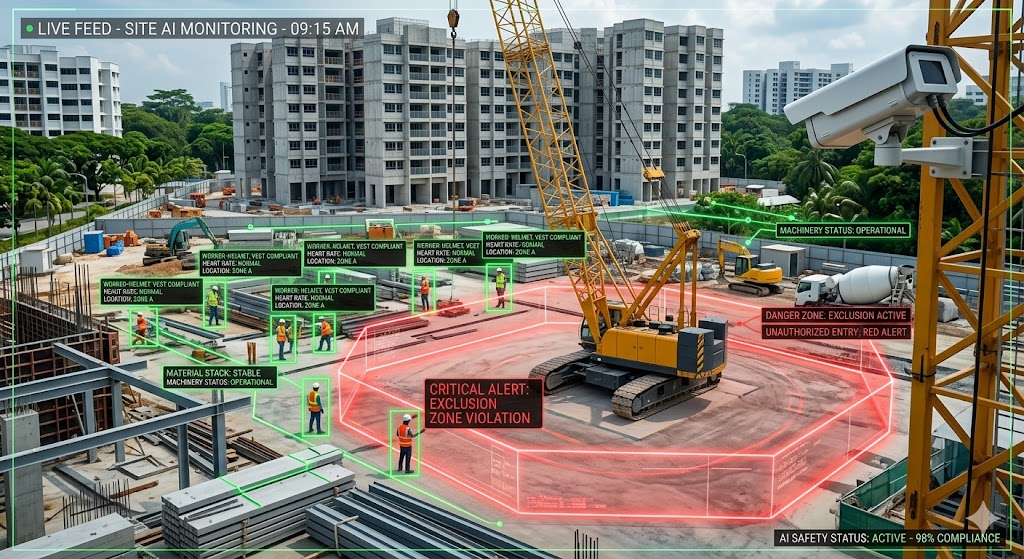

A safety risk assessment workflow is a structured, systematic process through which safety professionals identify workplace hazards, evaluate risk levels, implement control measures, document findings, and schedule reviews to maintain regulatory compliance and protect workers. In construction and industrial settings, this process is not optional. It is the operational backbone of every defensible safety program, directly linked to BizSAFE certification requirements, ISO 45001 obligations, and the statutory frameworks governing site safety in Singapore and beyond. This guide presents the complete workflow, from hazard identification through review scheduling, integrating the globally recognized HSE 5-step framework with advanced risk matrix scoring and digital platform capabilities for 2026 compliance.
What are the essential steps in a safety risk assessment workflow?
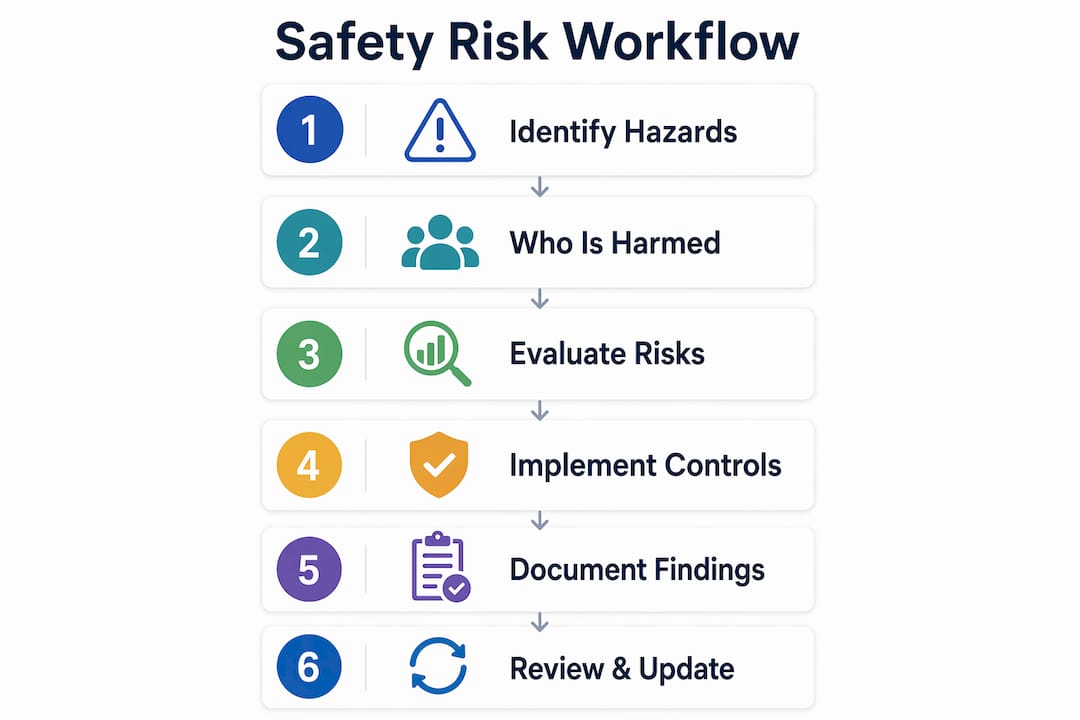
The HSE 5-step process defines the internationally accepted architecture for any safety risk assessment workflow: identify hazards, decide who might be harmed and how, evaluate risks and decide on controls, record findings, and review the assessment regularly. Construction managers who treat these steps as sequential obligations rather than a living cycle consistently produce more defensible, audit-ready documentation. Each step carries specific technical requirements that determine whether the resulting assessment withstands regulatory scrutiny.
Step 1: Identify hazards
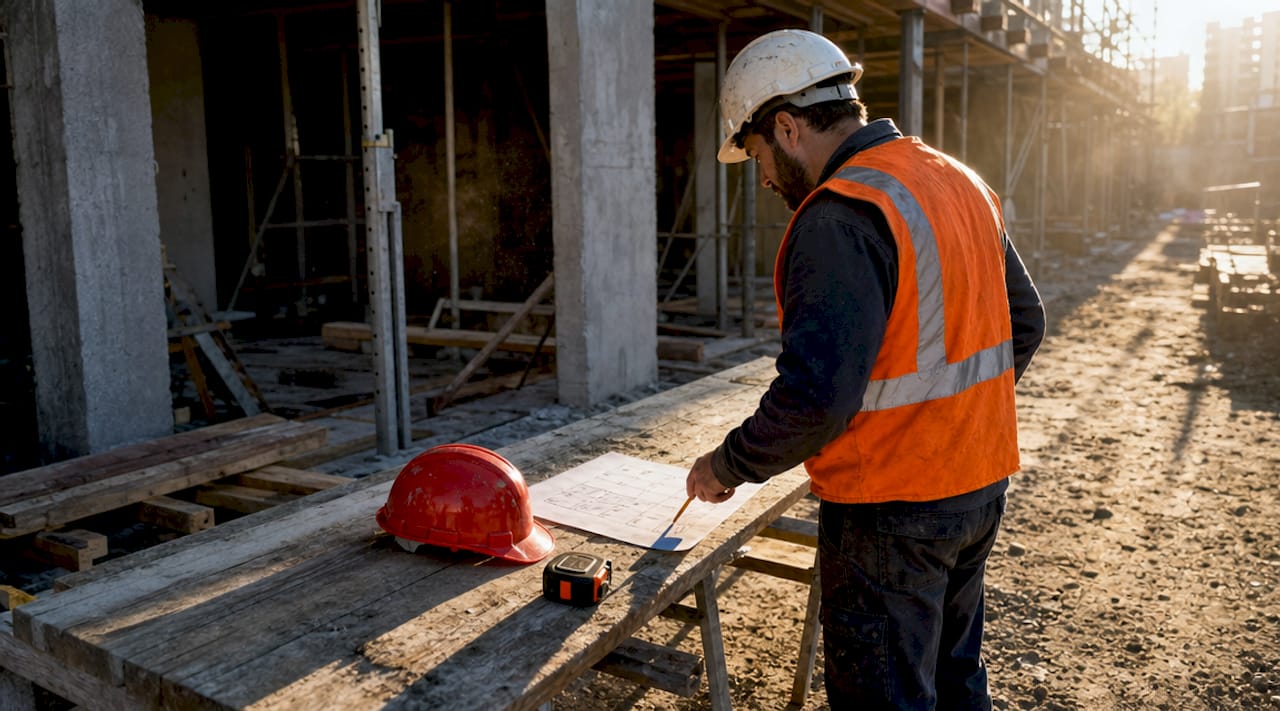
Hazard identification draws from site walk-throughs, toolbox talk records, incident and near-miss logs, Material Safety Data Sheets, and direct frontline input. Frontline worker engagement is not a courtesy. It uncovers real exposures that supervisors and managers routinely miss from behind a desk. For construction sites, hazard categories span physical hazards such as working at height and excavation collapse, chemical hazards from concrete dust and solvents, ergonomic hazards from repetitive lifting, and environmental hazards including noise and vibration.
Step 2: Decide who might be harmed and how
This step requires identifying all exposed populations, not just direct employees. Subcontractors, delivery personnel, visitors, and members of the public adjacent to the site boundary must be assessed. Vulnerable groups, including new workers, pregnant employees, and workers with disabilities, require explicit consideration. Failure to document non-employee exposure is one of the most common audit deficiencies in Singapore construction assessments.
Step 3: Evaluate risks using a 5×5 risk matrix
Risk scoring on a 5×5 matrix combines probability (1 to 5) with severity (1 to 5), producing scores from 1 to 25. Scores of 1 to 4 indicate low risk requiring routine monitoring. Scores of 17 to 25 demand immediate corrective action before work proceeds. This scoring threshold system gives project leaders a defensible, quantitative basis for prioritizing resource allocation and communicating risk levels to site management.
Step 4: Implement controls using the hierarchy of controls
Controls follow the established hierarchy: elimination, substitution, engineering controls, administrative controls, and personal protective equipment. The hierarchy is not a menu. It is a priority sequence. Elimination and substitution must be genuinely considered before defaulting to PPE. For construction projects, this often means redesigning work sequences to remove fall hazards rather than relying solely on harness systems.
Step 5: Document findings
Documentation creates the auditable record that demonstrates due diligence to regulators, insurers, and clients. Records must capture the hazard, the exposed population, the risk score before and after controls, the control measures selected, and the responsible person. A safety compliance checklist embedded within the documentation template reduces the probability of omissions.
Step 6: Review and update
The core logic of risk assessment requires continuously answering three questions: what could cause harm, who could be affected, and what controls are in place. The review step closes the loop and transforms a static document into a living safety instrument.
Pro Tip: Build the review trigger directly into your documentation template. A field labeled “Next review date” with a mandatory completion requirement prevents assessments from aging past their validity without accountability.
How do you use risk matrices and digital platforms to enhance the workflow?
The 5×5 risk matrix is the most widely deployed quantitative tool in the safety assessment process, and its value depends entirely on consistent application. When probability and severity definitions are not standardized across a project team, two assessors evaluating the same hazard can produce scores that differ by 10 or more points. Standardizing the scoring rubric, with written definitions for each probability and severity level, is the single most impactful procedural improvement a safety manager can implement before beginning any assessment cycle.
Digital environmental risk assessment platforms provide centralized documentation, version control, and multi-user collaboration that paper-based systems cannot replicate. This matters for audit readiness because regulators and certification bodies require evidence of who assessed what, when, and on what basis. Platforms such as SafetyCulture (iAuditor) and similar environmental risk assessment tools allow assessors to attach photographic evidence, link control measures to specific hazards, and generate compliance reports automatically. The audit trail produced by these systems is qualitatively superior to folder-based document management.
Environmental risk assessment workflows integrated within broader safety platforms allow construction teams to address noise pollution, dust generation, contaminated soil disturbance, and stormwater runoff within the same documentation framework as occupational safety hazards. This integration prevents the common failure mode where environmental risks are assessed separately and then never cross-referenced with safety controls, creating gaps in both programs.
| Tool type | Primary function | Compliance benefit |
|---|---|---|
| 5×5 risk matrix | Quantitative risk scoring | Prioritizes corrective actions by severity |
| Digital assessment platforms | Centralized records and version control | Produces audit-ready documentation trails |
| Environmental risk assessment tools | Integrates environmental and safety hazards | Prevents cross-program compliance gaps |
| Safety compliance checklist templates | Structured hazard capture | Reduces omission errors during field assessments |
Pro Tip: When selecting environmental risk assessment platforms, verify that the system supports custom scoring rubrics and exports data in formats accepted by your certifying body. Generic templates that cannot be adapted to Singapore’s WSH Act requirements create rework during audit preparation.
What are common challenges in construction site safety assessments?
Scope drift is the paramount failure mode in safety risk assessment workflows, occurring when assessors expand or contract the assessment boundary mid-process without documenting the change. Clearly defined scope and boundaries must be documented before hazard identification begins. For construction projects, scope definition specifies the work activities covered, the site boundaries, the phases of work included, and the populations considered. Without this anchor, assessments become inconsistent across phases and indefensible under audit.
Several additional challenges consistently undermine assessment quality on construction sites:
- Non-routine scenario omission. Assessors focus on standard work sequences and neglect maintenance activities, emergency scenarios, and temporary works. A scaffold erection sequence and a scaffold dismantling sequence carry different risk profiles and require separate assessment.
- Insufficient documentation of reasoning. Recording a risk score without documenting the assumptions, exposure duration, and control effectiveness that produced it creates an assessment that cannot be defended or improved. Separating quantitative scoring from qualitative reasoning and documenting both is the standard that distinguishes high-quality assessments from checkbox exercises.
- Inadequate worker involvement. Safety professionals who conduct assessments without structured input from the workers performing the tasks miss the actual exposure conditions. Toolbox talks, structured interviews, and pre-task analysis sessions are the mechanisms that close this gap.
- Treating assessments as one-time deliverables. A risk assessment submitted at project commencement and never revisited is a compliance artifact, not a safety instrument. It must function as a living document updated in response to site conditions, incidents, and work sequence changes.
“The most defensible risk assessment is not the one with the highest scores or the most controls listed. It is the one that documents the reasoning behind every decision, names the people involved in making it, and records the date it was last verified against actual site conditions.”
For projects involving safety instrumented systems, the IEC 61511 standard requires that risk assessments begin early in the project lifecycle with tolerable risk criteria defined before hazard analysis commences. This principle applies equally to construction projects: defining what constitutes an acceptable residual risk level before scoring begins prevents post-hoc rationalization of inadequate controls.
When and how should safety risk assessments be reviewed?
Review of risk assessments is mandated at a minimum annual frequency, with additional trigger-driven reviews required whenever significant changes occur. Annual reviews without trigger-driven reviews are insufficient for active construction projects where site conditions, work sequences, and personnel change continuously. The review schedule must be formalized, assigned to named individuals, and tracked through a management system.
The following triggers mandate an immediate review regardless of the scheduled review date:
- A workplace accident, incident, or near-miss involving the assessed activity
- Introduction of new equipment, plant, or machinery to the work sequence
- Changes in work methods, materials, or chemical substances
- Legislative or regulatory updates affecting the assessed activity
- Findings from internal or external safety audits identifying gaps in existing controls
- Changes in the workforce, including new subcontractors or high-risk worker categories
Management of Change processes provide the formal mechanism for linking risk assessment reviews to workplace changes. An MOC process requires that any proposed change to equipment, process, or personnel triggers a documented review of affected risk assessments before the change is implemented. This prevents the common scenario where a new piece of plant is introduced to a site without reassessing the hazards it creates for adjacent workers.
Version control is the technical requirement that makes review cycles auditable. Each revision of a risk assessment must carry a version number, the date of revision, the name of the assessor, and a summary of changes made. Digital platforms enforce this automatically. Paper-based systems require a disciplined manual protocol. The construction risk assessment process for Singapore projects must align review cycles with WSH Act obligations and BizSAFE audit schedules to maintain certification standing.
Regular reviews also serve a cultural function beyond compliance. When frontline workers observe that risk assessments are updated in response to their reported near-misses and hazard observations, they develop confidence that the safety program is responsive rather than bureaucratic. This confidence drives higher-quality hazard reporting, which in turn improves the accuracy of subsequent assessments.
Key takeaways
A defensible safety risk assessment workflow requires structured hazard identification, quantitative risk scoring, documented control rationale, and formalized review cycles linked to both schedules and change triggers.
| Point | Details |
|---|---|
| Follow the HSE 5-step framework | Apply all five steps sequentially and treat the process as a continuous cycle, not a one-time deliverable. |
| Standardize risk matrix scoring | Define probability and severity levels in writing before assessments begin to prevent inconsistent scoring across teams. |
| Document reasoning, not just scores | Record assumptions, exposure details, and control effectiveness alongside numerical scores for audit defensibility. |
| Integrate digital platforms | Use environmental risk assessment platforms to centralize records, enforce version control, and generate compliance reports. |
| Formalize review triggers | Link review obligations to MOC processes, incident investigations, and regulatory changes, not only to annual calendar dates. |
Why most risk assessment programs fail before the first audit
The programs that fail under audit scrutiny share a common structural flaw: they were designed to produce documents rather than to manage risk. After working through numerous construction safety programs across Singapore and the broader region, the pattern is consistent. Organizations invest in templates, train assessors on scoring methodology, and submit assessments on schedule. Then an auditor asks a single question: “Who verified that these controls are actually in place on site today?” The silence that follows reveals the gap.
The most durable risk assessment programs treat the workflow as an operational process, not a documentation process. Frontline workers are not consulted as a formality. They are the primary source of hazard intelligence, and their input is structured, recorded, and traceable. Digital tools matter, but not because they produce better-looking reports. They matter because they make it physically difficult to skip steps, override version history, or submit an assessment without a named reviewer. The technology enforces the discipline that manual systems rely on individual conscientiousness to maintain.
The emerging role of AI in risk assessment platforms is worth monitoring. Several environmental risk assessment platforms are beginning to incorporate predictive hazard flagging based on activity type and historical incident data. This capability will not replace the judgment of an experienced safety professional. It will, however, surface non-routine hazard scenarios that assessors under time pressure are most likely to miss. The organizations that integrate these tools early will hold a material compliance advantage within the next two to three years.
The construction hazard identification discipline is where most programs either build or lose their credibility. Get that step right, document the reasoning rigorously, and the rest of the workflow follows with considerably less friction.
— Aman
How Mosaic Safety supports your risk assessment program

Com’s safety audit and consultancy services are built specifically for construction organizations operating under Singapore’s WSH Act and BizSAFE certification requirements. The safety audit examples for Singapore construction resource provides structured templates and real-world audit scenarios that align directly with the workflow steps covered in this guide. Construction managers can use these examples to benchmark their existing documentation against compliance standards, identify gaps before external audits, and build assessment templates that satisfy both regulatory and certification requirements. Com’s team also provides hands-on consultancy to integrate digital risk assessment tools into existing site safety programs, reducing the administrative burden on safety officers while improving audit readiness. Explore the Singapore construction risk assessment guide for a deeper operational framework tailored to local regulatory conditions.
FAQ
What is a safety risk assessment workflow?
A safety risk assessment workflow is a structured, repeatable process covering hazard identification, risk evaluation, control implementation, documentation, and periodic review. The HSE 5-step framework is the most widely recognized model for this process in construction and industrial settings.
How often should risk assessments be reviewed on construction sites?
Risk assessments require review at least annually and immediately following any significant change, incident, or near-miss. Review triggers include new equipment, revised work methods, legislative updates, and audit findings.
What is a 5×5 risk matrix and how is it used?
A 5×5 risk matrix scores risks by multiplying probability (1 to 5) by severity (1 to 5), producing a score between 1 and 25. Scores of 17 to 25 require immediate corrective action before work proceeds.
What is environmental risk assessment and how does it relate to safety workflows?
Environmental risk assessment is the systematic process of identifying and evaluating risks to the environment from workplace activities, including noise, dust, chemical discharge, and contaminated soil disturbance. Integrating environmental risk assessment tools within a unified safety workflow prevents compliance gaps between occupational safety and environmental regulatory obligations.
How do digital platforms improve safety risk assessment compliance?
Digital assessment platforms provide version control, centralized documentation, and automated audit trails that paper-based systems cannot produce. They enforce procedural discipline by requiring named reviewers, dated revisions, and attached evidence before an assessment can be submitted or closed.