Hazard identification is frequently mischaracterized as a one-time administrative task, a box to check before work begins and then file away. That mischaracterization costs lives on construction sites. A rigorous hazard identification process guide does not describe a static checklist; it describes a living, iterative discipline that underpins every credible safety management system in the construction sector. This guide walks construction professionals and safety managers through the foundational concepts, step-by-step procedures, common hazard categories, and system-level integration strategies that transform hazard identification from bureaucratic exercise into a genuine risk reduction mechanism.
Table of Contents
- Key Takeaways
- The hazard identification process guide: foundations and purpose
- Step-by-step hazard identification in construction
- Common hazard categories and construction-specific challenges
- Integrating hazard identification into safety management systems
- What I’ve learned about making hazard identification actually work
- How MOSAIC supports your hazard identification and compliance program
- FAQ
Key Takeaways
| Point | Details |
|---|---|
| Hazard ID precedes risk assessment | Identifying hazards must occur before any risk assessment or control implementation can be valid. |
| JHA structures the process | Break tasks into discrete steps and apply the hierarchy of controls to each one for audit-ready documentation. |
| Dynamic, not static | Hazard identification must recur after modifications, incidents, and at defined project intervals. |
| Worker input is non-negotiable | Frontline workers observe conditions that supervisors and planners routinely miss during desktop reviews. |
| Technology multiplies effectiveness | Digitized hazard records enable real-time tracking, pattern recognition, and continuous compliance evidence. |
The hazard identification process guide: foundations and purpose
What is hazard identification, and how does it differ from risk assessment?
What is hazard identification? At its most precise definition, it is the systematic recognition of conditions, agents, and events that have the potential to cause harm before that harm materializes. It is a prerequisite screening activity, not an analytical one. Missing hazards in identification invalidates all subsequent safety studies, including HAZOP analyses and quantitative risk assessments. The sequence is non-negotiable: identify first, then assess severity and likelihood, then implement controls.
Risk assessment, by contrast, applies probability and consequence analysis to hazards that have already been identified. Conflating the two is one of the most consequential errors a safety manager can commit, because it creates the illusion of rigor while leaving fundamental hazards unexamined. Hazard identification is the foundation; everything else is built on it.
In the construction context, the legal obligations are explicit. OSHA 29 CFR 1910.132(d) mandates a written hazard assessment documenting the workplace evaluated, the certifier’s name, the date, and a formal certification statement before PPE requirements can be lawfully specified. The regulatory framework treats hazard identification as a formal act, not an informal walkthrough.
Key distinctions that every construction safety manager must internalize:
- Hazard identification asks: What could go wrong here?
- Risk assessment asks: How likely is it, and how severe would the outcome be?
- Hazard control asks: What do we do about it?
- Early identification during design-stage risk management eliminates hazards structurally, before labor costs and program commitments make changes prohibitively expensive.
“Hazard identification is the foundation of every safety study, best done early in project phases to capture major hazard categories.” — Hazard Identification in Process Safety Explained
Step-by-step hazard identification in construction
A credible safety hazard analysis guide for construction does not describe vague “site inspections.” It describes a structured sequence of defined activities, each producing documented outputs that withstand regulatory scrutiny.
-
Define scope and gather documentation. Before setting foot on site, assemble site plans, method statements, material safety data sheets, equipment specifications, and records of prior incidents. Scope definition determines which work activities, areas, and interfaces fall within the identification boundary. Incomplete scoping produces incomplete results.
-
Decompose tasks using Job Hazard Analysis (JHA). Break each significant work activity into five to ten discrete sequential steps. Effective JHAs describe what is done at each step, not how to be safe, which maintains analytical clarity and prevents steps from collapsing into generic safety instructions. A concrete example: excavation work is decomposed into ground survey, equipment positioning, shoring installation, spoil removal, and utility verification. Each step carries its own hazard profile.
-
Apply multiple identification techniques simultaneously. No single technique captures all hazards. Site walkthroughs with experienced workers reveal physical conditions; structured worker interviews surface behavioral and ergonomic hazards that inspectors overlook; review of incident records and near-miss logs identifies recurring hazard patterns; what-if analysis and checklist reviews address hazards that have not yet manifested on the current site but are known to the industry.
-
Apply the hierarchy of controls to each identified hazard. Hazard control hierarchy prioritizes elimination, then substitution, then engineering controls, then administrative controls, and finally personal protective equipment. Document the selected control against each hazard in the JHA with enough specificity that any competent worker can implement it without further instruction.
-
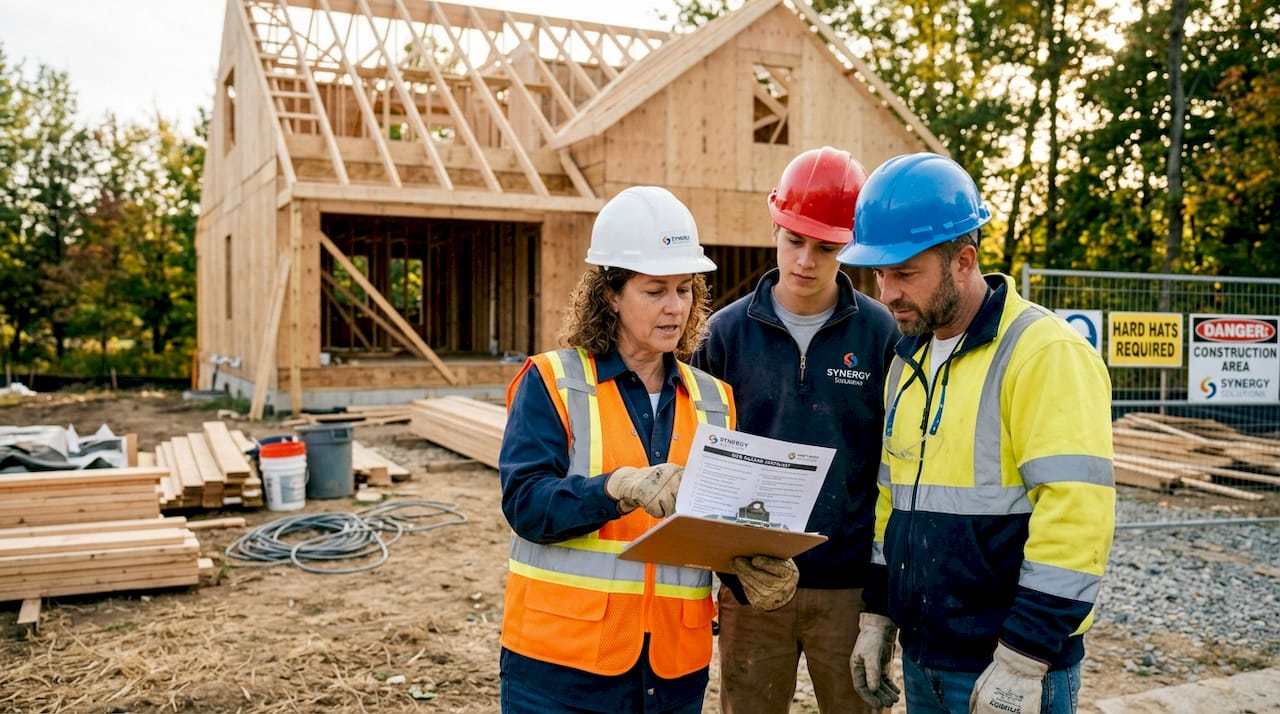
Validate with field crews and supervisors. A desktop JHA that has not been reviewed by the workers performing the task is a liability, not an asset. Structured walkthrough validation sessions identify gaps, generate crew buy-in, and satisfy the worker-involvement requirements embedded in most national safety regulations.
-
Create documentation that functions in daily use. A well-structured JHA builds accountability by specifying hazards and controls step-by-step in language that field personnel can actually read and apply, not language written for auditors alone.
Pro Tip: Use conditional logic in your JHA templates so that when a hazard is identified, the template automatically prompts the user to select a control from each tier of the hierarchy before allowing the document to be completed. This eliminates the common error of documenting a hazard without documenting a proportionate control.
Common hazard categories and construction-specific challenges

Construction sites present a hazard density that most other industries do not approach. Understanding the standard hazard categories is the starting point; anticipating the interaction effects between categories is where experienced safety managers distinguish themselves.
The most frequently encountered hazard categories on construction sites include:
- Hazardous energy sources: Electrical, pneumatic, hydraulic, gravitational, and thermal energy during equipment operation, maintenance, and isolation activities.
- Falls from height: The leading cause of fatality across the global construction sector, encompassing scaffolding, roof work, floor openings, and ladder use.
- Struck-by events: Moving plant and vehicles, swinging loads, ejected materials, and falling objects from elevated work zones.
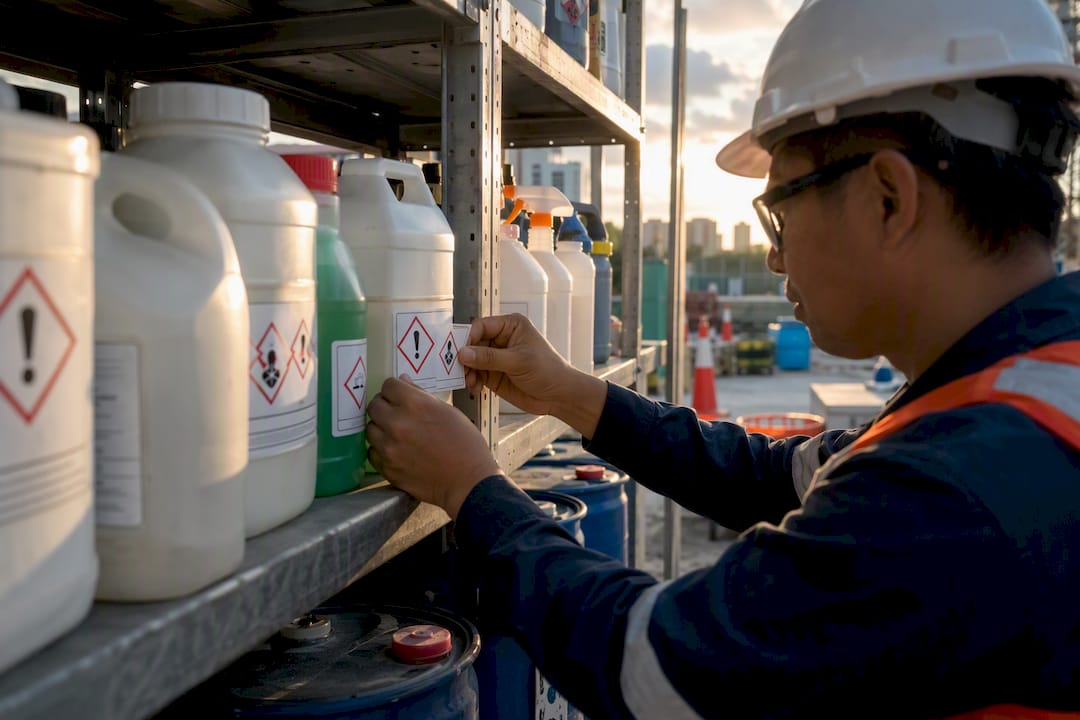
- Chemical and substance exposures: Silica dust, isocyanates, lead, asbestos-containing materials, and solvent vapors encountered during demolition, surface preparation, and finishing operations.
- Ergonomic stressors: Cumulative musculoskeletal loading from manual handling, awkward postures, repetitive motions, and sustained static loading in confined or elevated positions.
The identification challenge unique to construction is not the existence of these categories. Every experienced safety manager knows them. The challenge is the dynamic and non-repetitive character of construction work, where the hazard profile of a single work area changes daily as trades sequence in and out, temporary structures are erected and removed, and weather conditions alter surface and structural stability.
Pro Tip: Conduct a fresh hazard identification review at every significant scope change, not just at project kickoff. A risk identification checklist developed for structural framing work is materially incomplete when the same crew transitions to mechanical installation three weeks later.
Overlapping hazards compound the challenge further. Overhead electrical work occurring simultaneously with ground-level concrete placement creates struck-by, electrical, and ergonomic hazards that interact in ways that neither a falls-focused checklist nor an electrical safety checklist captures individually. Effective hazard communication under frameworks such as training-driven safety compliance requires that workers understand not just the hazards in their immediate task but the hazards generated by adjacent activities in the same space.
Integrating hazard identification into safety management systems
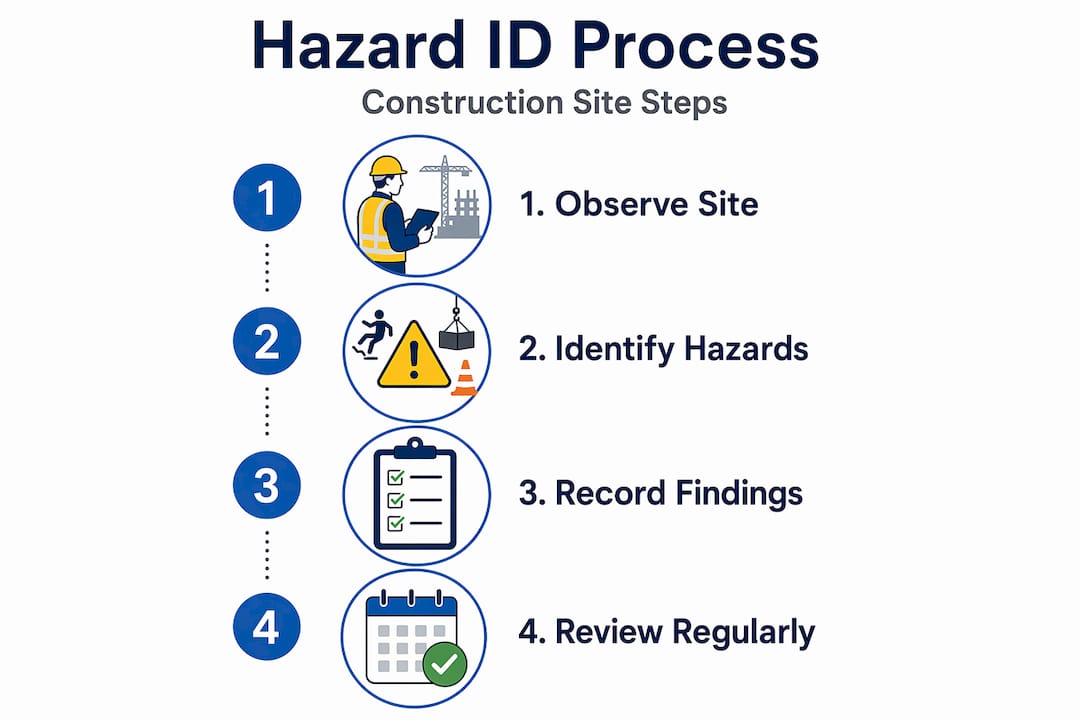
Treating hazard identification as a project-phase deliverable rather than a continuous process is the structural flaw that undermines otherwise well-designed safety programs. The hazard evaluation process must be embedded into the operational rhythm of the organization.
Pro Tip: Assign named ownership to each hazard register with a defined review date. Anonymous ownership is no ownership. If no individual is accountable for reviewing and updating a hazard record, it will not be reviewed or updated.
The table below summarizes the key integration points within a construction safety management system:
| Integration Point | Activity | Frequency |
|---|---|---|
| Management of Change | Re-run hazard identification for all scope, method, or personnel changes | At every change event |
| Toolbox Talks | Present site-specific active hazards identified from current JHAs | Daily or pre-task |
| Safety Audits | Verify that documented hazards match observed site conditions | Weekly minimum |
| Training Programs | Use JHA content to drive task-specific safety training | Before task commencement |
| Incident Investigation | Review hazard identification records to identify missed hazards | After every incident or near-miss |
Hazard identification must be performed not just during initial safety case development but after modifications, after major accidents, and at defined operational intervals. The regulatory expectation has shifted from “document once” to “demonstrate continuous review,” a distinction that many construction organizations underestimate until an audit or incident forces the issue.
Digitized JHAs enable real-time hazard tracking, pattern recognition across projects, and continuous improvement evidence that manual systems cannot produce at scale. Digital platforms also support the construction site risk assessment documentation requirements that regulators increasingly expect to be audit-ready and version-controlled.
Quality assurance during hazard identification phases confirms that all major accident events and hazards have been recognized and documented thoroughly, which is the evidentiary standard that serious incident investigations apply retrospectively when examining whether an organization met its duty of care.
What I’ve learned about making hazard identification actually work
I’ve observed safety programs across dozens of construction projects, and the pattern is consistent. Organizations that treat hazard identification as a documentation exercise produce impressive binders. Organizations that treat it as a conversation produce safer sites.
The paperwork is not the safety. The conversation is the safety. When I see a JHA that was completed at a desk, signed by a supervisor, and handed to workers who were never consulted during its development, I see a document that will pass an initial audit and fail the moment conditions deviate from the assumptions embedded in it. And conditions always deviate.
The most effective hazard identification programs I’ve encountered share one characteristic: the frontline workers who perform the tasks are the primary authors of the hazard list, not the recipients of it. Supervisors and safety managers provide structure, regulatory knowledge, and quality assurance. Workers provide the granular, task-level observational intelligence that no desk review can replicate.
There is also a persistent failure mode around the hierarchy of controls. Skipping stronger controls and defaulting to PPE is not a minor shortcut; it is a systematic underinvestment in risk reduction that compounds over time. Every PPE-only solution that should have been an engineering control represents a hazard that exists every day, managed only by human reliability.
Ownership and scheduled review are the mechanisms that prevent hazard identification from becoming a historical artifact. A hazard register with no named owner and no review date is a record of what someone thought was dangerous on a specific day in the past. It is not a safety tool.
— Aman
How MOSAIC supports your hazard identification and compliance program
Construction organizations that treat hazard identification as an internal administrative process frequently discover its limitations during regulatory audits, incident investigations, or certification assessments. Professional consultancy support restructures that exposure.

MOSAIC Eco-construction Solutions provides expert-led hazard identification, safety management system implementation, and BizSAFE Star certification support tailored specifically to the construction sector. MOSAIC’s consultants work directly with project teams to develop audit-ready JHAs, integrate hazard identification into management of change protocols, and establish the documentation infrastructure that sustains compliance through project cycles. For organizations seeking to extend their risk management framework into business continuity, MOSAIC also provides ISO 22301 consultancy services aligned with construction-sector operational realities. Contact MOSAIC to build a hazard identification program that functions as a genuine operational tool, not a compliance artifact.
FAQ
What is hazard identification in construction?
Hazard identification is the systematic process of recognizing conditions, agents, and events on a construction site that have the potential to cause harm before they do. It is a prerequisite step that must occur before risk assessment or control implementation can be valid.
How does a JHA support the hazard identification process?
A Job Hazard Analysis breaks work activities into discrete sequential steps, identifies the specific hazards at each step, and documents proportionate controls prioritized by the hierarchy of controls. Properly structured JHAs build accountability and prevent audit deficiencies by specifying hazards and controls at task level.
How often should hazard identification be repeated on a construction site?
Hazard identification should recur at every significant scope or method change, after any incident or near-miss, and at defined project intervals. Regulatory guidance requires hazard ID to be performed after modifications and major accidents, not only during initial project planning.
What are the most common hazard categories on construction sites?
The primary categories are hazardous energy sources, falls from height, struck-by events, chemical and substance exposures, and ergonomic stressors. The interaction effects between co-located activities frequently compound these hazards in ways that category-specific checklists fail to capture.
What documentation does OSHA require for hazard assessment?
OSHA 29 CFR 1910.132(d) requires a written certification that includes the workplace evaluated, the name of the person who performed the assessment, the date of the assessment, and a formal certification statement before PPE requirements can be lawfully specified.