AI in the Workplace: How Computer Vision Transforms WSH Monitoring in Singapore
The Evolution of Workplace Safety
Workplace safety demands continuous technological innovation. Traditional safety audits rely heavily on manual human oversight. Unfortunately, human attention wanes significantly over time. Supervisors cannot monitor every worksite corner simultaneously. Consequently, physical hazards go unnoticed until dangerous accidents occur. Singapore is aggressively addressing this critical operational gap.
The integration of AI in the workplace revolutionizes hazard prevention. Specifically, computer vision is transforming WSH monitoring in Singapore. Camera networks no longer just record events passively. AI algorithms turn these cameras into intelligent, proactive sentinels.1 They analyze live video streams continuously without fatigue. They flag high-risk scenarios instantly.2
This technological shift moves safety from reactive to predictive. AI in the workplace prevents accidents before they unfold. Singapore leads this transformation through robust government mandates. This comprehensive report details the mechanisms driving this digital safety revolution.
Singapore’s WSH 2028 Strategic Framework
Singapore aims to achieve global leadership in workplace safety. The national Workplace Safety and Health (WSH) 2028 strategy guides this ambition.3 A core objective is cultivating a Vision Zero culture.5 The government seeks to eliminate all preventable workplace injuries. Prime Minister Lee Hsien Loong emphasized this critical goal strongly.6
The primary target is reducing the fatality rate drastically. Singapore aims for less than 1.0 fatality per 100,000 workers by 2028.6 In 2025, Singapore achieved significant safety milestones. The workplace death rate fell to 0.96 per 100,000 workers.7 This corresponds to 36 workplace deaths.7 This metric represents the lowest rate since 2020.7 It marks the first time Singapore surpassed its WSH 2028 target.8
Sustaining this performance requires systemic technological adoption. The WSH 2028 framework rests upon four distinct strategic outcomes. Furthermore, three core strategies support these ambitious outcomes.4
| Strategic Component | Description of Focus Area |
| Outcome 1 | Sustained reduction in workplace injury rates.5 |
| Outcome 2 | Minimize hazards that lead to occupational diseases.5 |
| Outcome 3 | Promotion of good workforce health actively.5 |
| Outcome 4 | Pervasive adoption of the Vision Zero culture.5 |
| Strategy 1 | Strengthen overall WSH ownership among stakeholders.5 |
| Strategy 2 | Enhance focus on holistic workplace health.5 |
| Strategy 3 | Promote technology-enabled WSH monitoring in Singapore.5 |
Strategy 3 explicitly promotes technology-enabled safety systems.5 WSH monitoring in Singapore relies heavily on this technological ecosystem. Computer vision systems remove workers from risky activities.9 They deter unsafe behaviors effectively and reduce human error.9 Furthermore, they monitor and provide alerts on WSH hazards.9
Total WSH and Workforce Health
The government encourages a holistic approach to safety. In Singapore, officials call this Total Workplace Safety and Health.6 There is a strong correlation between healthy workers and safe workplaces.6 The WSH 2028 strategy addresses occupational diseases proactively.5 These diseases often manifest only after prolonged exposure.5
Workforce health promotion is a critical success indicator. Currently, 50% of employees access employer-initiated health promotion activities.4 The desired goal for 2028 is significantly higher.4 Furthermore, employers must consider health risks for safety-sensitive jobs.4 Hypertension and diabetes impact worker safety in high-risk industries.4 Therefore, AI in the workplace must also monitor worker health indicators.
Regulatory Mandates Forcing Technological Adoption
The adoption of AI in the workplace is not strictly voluntary. Regulatory bodies actively enforce technological compliance. The Ministry of Manpower (MOM) utilizes potent regulatory instruments. These instruments enforce strict WSH monitoring in Singapore.
Mandatory Video Surveillance Systems (VSS)
MOM implemented stringent new safety measures recently. Starting June 1, 2024, Video Surveillance Systems (VSS) became mandatory.10 This rule applies to specific high-value construction projects. Workplaces with contract values exceeding $5 million must comply.10
MOM provided no grace period for this implementation.10 The industry received a 12-month advance notice to prepare.10 The requirement applies regardless of the estimated completion date.10 If a site is handed over, the new contractor assumes compliance duties.10
For office renovations, VSS only applies to specific risk locations.10 Temporary buildings like showflats do not require mandatory VSS.10 This targeted approach prevents unnecessary financial burdens on low-risk projects.
Strategic VSS Deployment Locations
VSS requirements target high-risk operational zones specifically. Employers do not need to cover the entire site.10 A 100% coverage eliminating all blind spots is unnecessary.10 Instead, computer vision cameras must monitor critical danger areas.
| Mandated High-Risk Location | Specific Operational Activities Monitored |
| Work at Height | Areas where fall distances exceed 2 meters.10 |
| Scaffolding | Erection, dismantling, and maintenance of structures.10 |
| Excavations | Earth removal operations and trench shoring.10 |
| Lifting Operations | Areas utilizing cranes, gondolas, or elevated platforms.10 |
| Industrial Trucks | Zones operating forklifts, excavators, and steam rollers.10 |
| Vehicular Traffic | Areas where traffic poses hazards to workers.10 |
| Loading Zones | Every designated loading or unloading area.10 |
| Confined Spaces | Enclosed spaces where VSS can be safely installed.10 |
This strategic deployment maximizes the efficiency of video analytics. It focuses AI in the workplace on the most lethal hazards.
Overcoming Technical and Site Constraints
Deploying VSS involves navigating complex physical limitations. Cameras must maximize a clear line of sight.10 Obstructed views hinder effective WSH monitoring in Singapore.10
Sometimes, clients disallow VSS due to privacy concerns.10 Intellectual property and security concerns also restrict camera placement.10 In these cases, occupiers must conduct thorough assessments.10 They must document specific, substantiated reasons for excluding certain locations.10
For example, cameras can be angled away from occupied buildings.10 This mitigates privacy risks while maintaining safety oversight.10 If fixed cameras cannot fit due to space limits, alternatives exist.10 Occupiers should use portable VSS without extensive installation work.10
Safety exclusions are permissible if cameras introduce new hazards.10 For instance, confined spaces with flammable gases prohibit standard electrical equipment.10 All decisions to exclude VSS must be properly documented.10 MOM inspectors will review these records during site visits.10
Technical Specifications for WSH Monitoring
MOM enforces strict hardware and software specifications for VSS. These baselines enable effective AI in the workplace.
| VSS Specification Category | Mandatory MOM Requirement |
| Image Resolution | Minimum HD 1080 (1920×1080 pixels or equivalent).10 |
| Frame Rate | Minimum of 12 frames per second (fps).10 |
| Export Formats | Standard formats like .avi or .mp4.10 |
| Timestamping | Visible date, time, and camera ID overlay.10 |
| Visibility Conditions | Night vision capability for low-light operations.10 |
| Standard Retention | Minimum 30 days of continuous footage storage.10 |
| Incident Retention | Minimum 180 days storage following any reportable accident.10 |
These foundational requirements enable advanced computer vision integration. Clear, high-resolution footage provides necessary data for AI models.14 Twelve frames per second ensures sufficient temporal resolution for motion tracking. Night vision guarantees continuous protection during overnight shifts.
While basic VSS satisfies minimum compliance, AI analytics optimize operations. Live streaming is recommended but not strictly mandatory.10 Third-party video analytics for real-time analysis is highly encouraged.10 Therefore, AI in the workplace provides maximum return on hardware investments.
The Weaponization of the Demerit Point System
Fines alone rarely change deeply entrenched corporate behaviors. Therefore, MOM introduced the Demerit Point System (DPS). The DPS represents a formidable tool of corporate accountability.15 Following spikes in fatalities, authorities strengthened these administrative penalties.15 The DPS directly targets a company’s commercial viability.
Initially restricted to construction, the DPS expanded recently. In October 2023, MOM applied the DPS to the manufacturing sector.16 This expansion forces widespread upgrades in WSH monitoring in Singapore. The system assigns points based on incident severity.18
| Disciplinary Action / Incident Severity | Demerit Points (DPs) Issued |
| Composition fine | 1 Point 18 |
| Partial Stop Work Order (SWO) | 5 Points 18 |
| Full Stop Work Order (SWO) | 10 Points 18 |
| Prosecution for major injury or single fatality | 25 Points 18 |
| Prosecution for multiple fatalities | 50 Points 18 |
Accumulating demerit points triggers severe operational restrictions. Companies accumulating 25 points face immediate migrant labor bans.18 Applications for all types of work passes will be rejected.18
| Demerit Points | Hire New Workers? | Renew Existing Workers? | Debarment Duration |
| 25 to 49 | No | Yes | 3 months 18 |
| 50 to 74 | No | Yes | 6 months 18 |
| 75 to 99 | No | Yes | 1 year 18 |
| 100 to 124 | No | Yes | 2 years 18 |
| 125 and above | No | No | 2 years 18 |
Furthermore, the DPS impacts public sector commercial tenders. Companies with 25 points face immediate tender disqualifications.19 A three-month disqualification applies for minor accumulations.19 Severe infractions trigger two-year bans from lucrative government contracts.19 Consequently, AI in the workplace becomes a commercial survival tool. Computer vision prevents the accumulation of these catastrophic demerit points.
Director-Level Accountability and the Code of Practice
Corporate governance now directly encompasses physical workplace safety. The Code of Practice (COP) for Company Directors explicitly mandates this.20 The COP applies to Chief Executives and Board Directors.20 It aims to strengthen ownership of WSH roles and duties.23
The Code outlines 17 essential measures across four core principles.20
| COP Core Principle | Strategic Objective |
| Principle 1 | Integrate WSH into core business decisions and roles.21 |
| Principle 2 | Build a strong WSH culture and demonstrate visible leadership.21 |
| Principle 3 | Ensure highly effective, regularly reviewed WSH management systems.21 |
| Principle 4 | Empower workers to engage actively in WSH initiatives.21 |
Executives must track the organization’s WSH targets performance regularly.21 They must set WSH as a regular agenda item in board meetings.21 They must ensure sufficient resource allocation for safety.21 Directors must also facilitate direct reporting of WSH issues.21 Furthermore, they must demand effective WSH standards from vendors.21
Failure to adhere to the COP carries heavy legal risks. Courts use the COP to determine sentencing for safety breaches.20 Non-compliance results in highly aggravated punitive sanctions.20 A failure to allocate sufficient resources entails increased employer liability.20
Concurrently, the maximum fine for initial safety breaches recently increased. Fines now reach up to $50,000 for first convictions.11 Computer vision provides executives with objective compliance data. AI in the workplace generates automated safety dashboards.25 These dashboards allow directors to track WSH targets accurately.26 Therefore, continuous WSH monitoring in Singapore protects both workers and executives.
The Technological Architecture of Computer Vision
Understanding AI in the workplace requires examining the underlying technology. Computer vision utilizes advanced algorithms to interpret visual data.1 It trains machines to understand the visual world comprehensively.1 It mimics human optical comprehension but operates tirelessly.1
YOLO Architectures in Safety Detection
Object detection forms the core of visual safety monitoring. The YOLO (You Only Look Once) architecture dominates this field.27 YOLO models process entire images in a single evaluation.28 This single-pass capability ensures exceptional real-time processing speeds.28
Recent iterations, like YOLOv8, offer lightweight, fast frameworks.28 They require significantly fewer computational resources than legacy models.28 YOLOv8 is ideal for real-time object detection tasks.28 YOLOX, an anchor-free architecture, also yields superior performance.27 It delivers high mean average precision (mAP) for safety gear.27
Researchers applied YOLOv11 to Personal Protective Equipment (PPE) detection.29 The results demonstrated remarkable reliability for industrial applications. The system achieved 94.0% precision in detecting workers.29 It achieved near-perfect accuracy for full-body harness detection.29
Furthermore, image processing required only 2 to 3 seconds on standard hardware.29 This rapid analysis enables instantaneous safety interventions. Specialized datasets contain thousands of annotated images for training.27 These datasets provide dual-positive and negative structures.30 This enables models to detect both worn gear and missing equipment.30
Overcoming Infrastructure Limits with Edge Computing
Deploying computer vision in rugged environments presents significant hurdles. Construction sites feature numerous metallic obstructions.31 They often lack a clear line of sight.31 Traditional wireless transmission fails under these harsh conditions.31 Streaming high-definition video to cloud servers consumes massive bandwidth.
Edge computing solves this critical infrastructure challenge. Edge AI processes video streams locally on site.31 Hardware like NVIDIA Jetson runs custom safety analytics directly.31 The camera system does not upload raw video continuously. Instead, it only transmits lightweight metadata and alert notifications.31
Companies like Exyte actively seek these edge computing solutions.31 Exyte engineers high-tech facilities globally.31 They require minimal network infrastructure to transmit critical data.31 Edge computing allows immediate notification of site safety breaches.31 Consequently, WSH monitoring in Singapore remains uninterrupted despite poor connectivity.
The Role of 5G in Ubiquitous Monitoring
When cloud processing is necessary, 5G networks provide the solution. 5G connectivity revolutionizes AI in the workplace.32 It delivers ultra-reliable, low-latency communication.32 It supports multi-access edge computing seamlessly.32 It also enables dedicated network slicing capabilities.32
Camera-based analytical solutions require stable, high-definition streaming.32 5G breaks new ground in network reliability.32 It enables complex AI models to function without lag. Therefore, immediate hazard alerts arrive exactly when needed. The synergy between computer vision and 5G enhances WSH monitoring in Singapore immensely.
Sector-Specific Transformations via Computer Vision
AI in the workplace adapts to diverse industrial challenges. Different sectors deploy computer vision to solve unique safety problems. WSH monitoring in Singapore spans construction, maritime, and manufacturing environments.
Transforming Construction and Infrastructure Safety
Construction consistently records high fatality and injury rates.16 Heavy machinery, heights, and dynamic environments create constant hazards. Missing a hazard is no longer an option.34 Computer vision mitigates these risks through continuous, automated vigilance.
Automating Hazard Recognition
AI-powered VSS automatically identifies high-risk scenarios instantly.1 These detection capabilities surpass manual human monitoring vastly.1 Video analytics turn cameras into proactive, intelligent sentinels.1
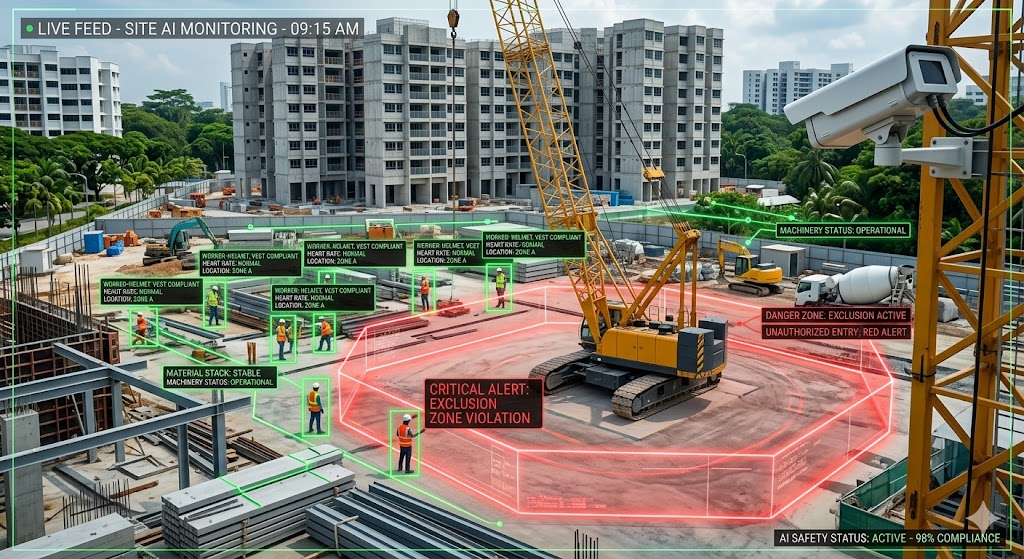
First, AI algorithms ensure strict PPE compliance.1 The system detects missing safety helmets immediately.1 It verifies the presence of high-visibility safety vests.1 Non-compliance triggers instant notifications to site supervisors.1
Second, computer vision monitors unsafe zones and proximity.1 AI identifies workers entering hazardous operational areas.1 It detects workers standing in the “line of fire”.1 Furthermore, it monitors the dangerous drop zones beneath suspended crane loads.1 Real-time alerts warn both workers and machinery operators simultaneously.1
Third, algorithms detect static environmental hazards continuously.1 The system identifies missing barricades at open building edges.1 It flags poor housekeeping practices that cause slips and trips.1
Finally, advanced AI models recognize specific unsafe worker behaviors.1 They detect improper ladder usage and unsecured platform standing.1 This allows for immediate corrective intervention by safety officers.1
HDB’s Integration of AI Video Analytics
The Housing and Development Board (HDB) drives construction innovation. Public housing accommodates 77% of Singapore’s population.14 Therefore, HDB construction sites are ubiquitous across the island. HDB actively deploys AI in the workplace to protect workers.35
HDB recently mandated AI systems for 30 major housing projects.2 These projects were tendered before January 2023.2 Because they remain in early construction stages, AI deployment is feasible.2 HDB’s mandate anticipated MOM’s June 2024 VSS requirements proactively.2
Maintaining safety standards normally requires multiple safety personnel.2 AI systems carry out real-time monitoring with far less manpower.2 HDB conducts extensive AI-enabled CCTV trials.7 One system, SafeSite VA, monitors 14 construction sites simultaneously.7 SafeSite VA detects violations and alerts supervisors via Telegram.7
It flags workers standing near non-barricaded edges exceeding two meters.36 It also detects workers positioned under heavy lifted loads.36 The AI system alerts safety supervisors within 15 seconds.7 This rapid response prevents unfolding accidents effectively.7 Furthermore, it reduces labor-intensive footage review times drastically.7
Overcoming Data Bottlenecks: The Central Image Repository
HDB addresses a critical AI development bottleneck. AI models require massive datasets of localized site images.14 Without local data, algorithms struggle to recognize specific hazards accurately. Ailytics faced difficulty finding publicly available training information initially.14
Consequently, HDB created a central image repository.2 This database contains images of workers, barricades, and lifted loads.2 It also includes precast modules and building edges.2 Vendors offering AI services must contribute their images to HDB.2
HDB shares this repository with industry partners generously.2 This collaborative data sharing accelerates AI maturity across the sector.2 It helps AI systems learn to recognize objects efficiently.2
Predictive AI for Heat Stress Management
Singapore’s tropical climate induces severe worker heat stress. Prolonged heat exposure causes debilitating occupational illnesses.37 MOM regulates heat stress strictly. It mandates Wet Bulb Globe Temperature (WBGT) monitoring.37
WBGT factors in air temperature, humidity, wind, and solar radiation.37 High WBGT readings dictate mandatory worker rest periods.37 If WBGT hits 32°C, intense labor requires 10 minutes rest hourly.37 Workers must also hydrate with 300ml of water hourly.37 MOM recently penalized 213 employers for flouting these rules.37
Hwa Seng Builder implemented an innovative AI prediction system.37 They deployed this at the Loyang Viaduct traffic worksite.37 The system analyzes weather forecasts and previous WBGT data.37 The AI then forecasts heat stress hours in advance.37
If dangerous temperatures are predicted, the AI sends automated warnings.37 Supervisors receive WhatsApp alerts recommending cooling solutions.37 They ensure workers hydrate and rest preemptively.37 This system replaces tedious manual hourly temperature checks.37
Furthermore, Hwa Seng is developing solar-powered cooling vests.37 Battery-powered vests heat up dangerously during use.37 Solar variants embedded with fans provide safer alternatives.37 Consequently, AI in the workplace prevents heat-related injuries efficiently.
Drone Inspections for Building Maintenance
WSH monitoring in Singapore includes post-construction safety. HDB utilizes drones to make building maintenance safer.35 Drones conduct high-rise visual scans without endangering human inspectors.36
The drone system taps into a cloud software platform.36 AI processes thousands of photos to identify building defects automatically.36 The AI categorizes defects and highlights their severity.36 The platform then recommends possible structural remedies.36 AI models detect cracks, window damage, and structural irregularities.38 This prevents safety hazards before catastrophic failures happen.38
Elevating Maritime and Shipyard Operations
Singapore operates the world’s second-busiest shipping port.39 The maritime sector demands rigorous WSH monitoring in Singapore. Shipyards feature massive moving components and hazardous heavy engineering.
Computer vision improves navigational and operational safety significantly. The Centre of Excellence in Maritime Safety (CEMS) pioneers these systems.39 Located at Singapore Polytechnic, CEMS researches advanced AI technologies.39
CEMS utilizes AI software to monitor seafarer training.39 Computer vision tracks candidate performance during complex simulator exercises.39 Simultaneously, electroencephalograms measure worker stress levels objectively.39 This holistic data improves training outcomes and prevents human error.39
AI for Collision Avoidance at Sea
AI enhances collision avoidance in crowded port environments. The ABB Ability Marine Pilot Vision system demonstrates this capability.40 Human operators struggle to maintain wide-angle overviews continuously.40 They often fail to detect slow, gradual spatial changes.40
The ABB system provides early alerts of potential collision dangers.40 It tracks the actual distance and motion of all significant objects.40 This technology acts as an electronic lookout, ensuring vessel safety.40
Furthermore, ABB and Keppel O&M achieved an autonomy milestone.40 They successfully executed remote joystick control of a tugboat.40 This trial occurred directly within the busy Port of Singapore.40 Remote operations remove crews from physically dangerous maritime scenarios entirely.
Predictive Maintenance and Optimization
ASTAR I²R develops advanced AI models for maritime applications.41 Digitalization revolutionizes traditional practices like route optimization and predictive maintenance.41 ASTAR technologies analyze extensive datasets gathered from diverse operations.41
They empower organizations to predict equipment failures preemptively.41 This mitigates risks, minimizes downtime, and reduces operational costs.41 Specific modules include the Smart Automated Ship Inspection System (SASIS).41 Another module is the Auto Cargo Allocation System.41 These innovations elevate efficiency and safety within maritime operations.41
Cybersecurity also intersects with maritime safety critically. iTrust developed a Maritime Testbed of Shipboard Operational Technology.42 Supported by CEMS, this ensures AI systems resist malicious tampering.42
Securing Manufacturing and Logistics Environments
The manufacturing industry generates up to 25% of Singapore’s GDP.43 However, it records high numbers of major workplace injuries.43 Common hazards include heavy machinery, hazardous materials, and trips.43 AI in the workplace addresses these manufacturing dangers directly.
Logistics hubs and warehouses present unique safety challenges. Forklifts and autonomous robotic devices navigate crowded operational floors.44 Computer vision monitors the complex movements of people and vehicles.44 AI algorithms detect dangerous speeding and unauthorized parking.44 They identify movement in the wrong direction immediately.44
DHL collaborated with the computer vision startup Protex AI.44 They implemented an AI-based unsafe event capture solution.44 The system identifies real-time noncompliance, such as ignoring designated walkways.44 It issues instant safety alerts to minimize risky behaviors.44 This data empowers EHS teams to make proactive safety decisions.44
Furthermore, computer vision enhances manufacturing ergonomics. It tracks worker postures to improve ergonomic pose health.44 VR training also identifies machine guarding deficiencies across production lines.45 AI systems optimize processes and enhance overall quality control.43 Thus, WSH monitoring in Singapore extends beyond injury prevention into workflow optimization.
Lorry Crane Video Analytics
Loading and unloading activities pose severe safety risks. The government actively supports video analytics for lorry cranes specifically.25 This technology provides real-time detection for early intervention.25 It enables geofencing to create exclusion zones for high-risk areas.25 Computer vision tracks lifted loads and detects heavy machinery proximity.25 It even provides fire and smoke detection capabilities.25
Case Studies: Quantifying the ROI of Computer Vision
Theoretical benefits translate into measurable operational improvements. Several prominent startups drive WSH monitoring in Singapore. Their case studies demonstrate the profound impact of computer vision.
viAct: Transforming a Construction Giant
A leading Singapore-based construction conglomerate faced severe safety challenges.46 They manage numerous high-rise and infrastructure projects.46 Manual audits were highly inconsistent, reactive, and resource-intensive.46 Recurring safety violations threatened compliance with MOM regulations.46
The company integrated viAct’s AI-powered safety modules via viHUB.46 This integration transformed standard CCTV cameras into continuous monitors.46 The deployed modules tracked PPE, open edges, and confined spaces.46 They also managed site access and monitored heavy machinery.46
The results of this AI implementation were transformative. The company achieved a 10x improvement in its overall safety score.46 Automated monitoring saved over 7,000 working hours previously spent on administration.46 Furthermore, fewer accidents meant fewer operational stoppages.46 Consequently, the firm improved its on-time project delivery metrics.46
AI dashboards eliminated weeks of manual paperwork.46 Real-time compliance reporting ensured smooth MOM inspections.46 The verified safety record also strengthened the firm’s competitive tender bidding.46 Therefore, AI in the workplace delivers massive commercial returns alongside safety.
Ailytics: Partnering for National Impact
Ailytics represents a leading Southeast Asian video analytics provider.14 As a participant in the IMDA Spark Programme, Ailytics drives innovation.14 Their platform is intentionally hardware-agnostic.47 It integrates seamlessly with almost any existing CCTV infrastructure.47Ailytics models are conditioned for supreme accuracy.47
They function reliably in rain, low lighting, and dusty environments.47 The system detects hazards accurately at long ranges using lower-end cameras.14 This capability drastically reduces deployment costs for contractors.14
Deploying Ailytics yields a 70% improvement in spotting unsafe workers.14 The AI model comprises about 60% of the whole system.14 Extensive software engineering tuning comprises the remaining effectiveness.14 The system tracks water hazards, traffic jams, and unattended objects.47
By partnering with HDB, Ailytics gained crucial access to training sites.14 This collaboration refined their AI models significantly.14 Today, Ailytics monitors complex sites like the Jurong Innovation District.14 The CEO, Lenard Tan, emphasizes leveraging existing camera feeds for actionable insights.48
Invigilo: Behavioral-Based Safety Analytics
Invigilo AI provides targeted safety video analytics across multiple sectors.49 Their primary software product is Invigilo SafeKey.50 SafeKey implements a behavior-based safety (BBS) methodology.50 It analyzes worker actions to prevent dangerous habits from forming.50
The SafeKey system detects over 35 distinct safety risks.51 It integrates smoothly with existing CCTV networks.51 Invigilo boasts an impressive 85% verified detection accuracy rate.51 The company offers tailored platforms featuring AI, video analytics, and IoT tools.49
Invigilo excels in less networked areas utilizing specific long-range SIMs.52 They provide intelligent safety helmets equipped with video analytics.53 They also offer real-time location tracking systems for personnel.53 By fostering proactive safety cultures, Invigilo prevents catastrophic accidents.51
GovTech Video Analytics System (VAS)
The Singapore government also develops proprietary AI solutions. GovTech engineered the Video Analytics System (VAS) for public sector agencies.54 VAS handles the exponential growth of daily video data.54 Manual monitoring by government officers became entirely unproductive.54
VAS harnesses advanced AI video analysis algorithms.54 It monitors, investigates, and extracts real-time operational insights.54 The system utilizes the Government on Commercial Cloud (GCC) ecosystem.54 Agencies integrate their video feeds securely within this ecosystem.54
This streamlined approach allows agencies to quickly harness video intelligence.54 VAS ensures stringent compliance with national data security regulations.54 This guarantees responsible AI use for the public good.54
Navigating Data Privacy and PDPA Compliance
AI in the workplace relies on capturing vast amounts of visual data. Consequently, WSH monitoring in Singapore raises legitimate privacy concerns. Employees worry about continuous surveillance and data misuse. Organizations must balance safety protocols with strict legal privacy requirements.55
The Personal Data Protection Act 2012 (PDPA) governs all data collection.56 Employers have a legitimate interest in monitoring safety.57 They must ensure productivity and comply with regulatory obligations.57 However, these interests must be exercised within PDPA boundaries strictly.57
PDPC Advisory Guidelines on AI Systems
The Personal Data Protection Commission (PDPC) regulates AI data usage. The PDPC issued specific Advisory Guidelines for AI Systems.56 These guidelines clarify how the PDPA applies to machine learning models.56 They cover three implementation stages: development, deployment, and procurement.60
Generally, organizations must obtain meaningful individual consent to process data.56 However, the PDPA provides crucial exceptions for AI development.
| PDPA Exception Category | Application Context for AI Systems |
| Business Improvement Exception | Using data to enhance operational efficiency and safety protocols.56 |
| Research Exception | Commercial R&D for AI systems demonstrating clear public benefits.56 |
| Legitimate Interests Exception | Processing data without consent to detect illegal activities.62 |
| Employment Exception | Enforcing workplace safety requirements within the employment relationship.63 |
The Employment Exception is highly relevant for WSH monitoring in Singapore.63 Providing a safe working environment constitutes a legitimate employment purpose.63 For example, a construction site deploying CCTVs for safe distancing utilizes this exception.63
Notification, Transparency, and Security
Despite these exceptions, strict accountability obligations remain in force.62 Employers must display clear notices regarding CCTV operations.57 Covert surveillance is generally prohibited without specific criminal justification.57
Organizations must inform workers about the exact purpose of monitoring devices.55 This notification typically occurs through employee handbooks or HR policies.55 Surveillance cameras should never be deployed in private areas like restrooms.55
Furthermore, employers face strict Purpose Limitation obligations.57 Safety CCTV footage cannot be used routinely for performance management.57 Using safety data for unstated purposes breaches the PDPA.57
Data protection safeguards are absolutely critical. Organizations face financial penalties of up to $1 million for breaches.65 They face a mandatory 72-hour breach notification window.65 Footage must be stored securely and access restricted strictly.55
Technological solutions assist in maintaining this privacy compliance. Platforms like WalledAI ensure raw personal data is protected.65 Walled Redact masks personal data before it reaches AI models.65 This mask-and-send architecture prevents purpose creep and protects employee privacy.65 Therefore, ethical WSH monitoring in Singapore requires both policy and technological safeguards.
Ecosystem Support and Financial Grants
Deploying AI in the workplace requires capital expenditure. Smaller contractors often struggle with initial integration costs.33 Acknowledging this, the Singapore government provides substantial financial support. Subsidies ensure that advanced WSH monitoring in Singapore is accessible to all.
The Productivity Solutions Grant (PSG)
The Productivity Solutions Grant (PSG) drives nationwide technological adoption.66 The PSG helps Singapore companies automate existing processes.66 It provides crucial funding for IT solutions and smart equipment.66
Eligible Small and Medium Enterprises (SMEs) receive massive support.9 The PSG covers up to 50% of qualifying costs.66 There is an annual grant cap of $30,000 per company.67 Notably, the PSG specifically supports WSH technology adoption.9 A dedicated WSH Tag feature helps companies find approved solutions quickly.9
EnterpriseSG pre-approves specific IT solutions and vendors.66 Pre-scoped packages simplify the procurement process for SMEs.9 Crucially, MOM only recommends VSS packages that integrate AI features.10 Basic surveillance packages lacking analytics do not qualify for safety grants.10
Solution providers offer tiered packages optimized for PSG funding. For example, Ailytics provides various “AiSafety” packages.69
| AI Video Analytics Package Name | Total Cost | Qualifying Cost |
| Mobile VSS (2 New Cameras) | $6,900 | $5,000 69 |
| AI Analytics (4 Existing Cameras) | $9,200 | $6,700 69 |
| AI Analytics (4 New Cameras) | $15,070 | $12,070 69 |
| AI Analytics (10 Existing Cameras) | $20,700 | $15,700 69 |
| AI Analytics (8 New Cameras) | $25,100 | $18,600 69 |
These grants democratize access to advanced computer vision. They remove financial barriers, enabling widespread industry compliance with MOM mandates.
NTUC Company Training Committee (CTC) Grant
Hardware alone cannot transform workplace safety cultures. Workers require training to interact with new AI systems safely. The NTUC Company Training Committee (CTC) Grant supports this capability building.9
The CTC Grant funds solutions leading to enhanced business capabilities.9 It aims to improve employment outcomes for local workers.9 By combining PSG hardware funding with CTC training grants, companies transform holistically. Workers transition from manual laborers to digital safety operators.
Lorry Crane Safety Support
The government provides specific grants for highly dangerous machinery. The MOM Grant on SCS supports lorry crane safety.25 This grant runs from March 2023 to March 2025.25 It covers hardware, software, and installation costs.25
Eligible businesses must purchase acceptable solutions from authorized agents.25 The crane must be 17 years old or newer.25 This financial support encourages the rapid deployment of crane video analytics.
Future Outlook: Predictive Safety in 2026 and Beyond
The landscape of WSH monitoring in Singapore evolves rapidly. As 2026 unfolds, AI in the workplace pushes new boundaries.70 The momentum from 2025 translates into mainstream, operational-scale adoption.70
Currently, computer vision excels at descriptive and diagnostic analytics. It tells supervisors what happened and why it happened. However, the future lies in prescriptive and predictive analytics. AI is no longer limited to merely observing incidents.70 It is actively predicting and orchestrating safety responses across complex worksites.70
Predictive AI analyzes historical data to forecast future hazard probabilities.41 By integrating computer vision with IoT sensors, systems become vastly smarter.70 Wearable technology will synchronize with video analytics seamlessly.1 This integration creates a ubiquitous, invisible safety net over the worksite.
Furthermore, generative AI will streamline safety administration. Automated systems will draft compliance reports autonomously. AI agents will manage safety audits with minimal human input. This frees safety officers to focus entirely on worker engagement and training.
Ultimately, these technologies guarantee the realization of WSH 2028 goals. Singapore’s reputation as a global leader in occupational safety remains secure. The nation demonstrates that technological innovation and human well-being are deeply synergistic.
Conclusion
The integration of AI in the workplace fundamentally alters occupational safety. Computer vision has proven itself as an indispensable tool for risk management. The days of relying solely on intermittent manual inspections are definitively over. WSH monitoring in Singapore now operates continuously, intelligently, and proactively.
Regulatory instruments drive this rapid technological adoption. The mandatory VSS requirements force large construction projects to upgrade their surveillance. Concurrently, the expanded Demerit Point System penalizes safety laggards severely. Companies risking their access to migrant labor must embrace predictive safety technologies. Furthermore, the Code of Practice holds top executives personally accountable for safety metrics.
Technological advancements meet these strict regulatory demands perfectly. Advanced YOLO architectures detect PPE violations and hazardous behaviors in milliseconds. Edge computing and 5G networks guarantee reliable monitoring in the harshest environments. Startups like viAct, Ailytics, and Invigilo deliver immense commercial value. They save thousands of administrative hours while preventing fatal accidents.
Simultaneously, Singapore balances innovation with strict privacy protection. The PDPA and specialized AI guidelines ensure employee data remains secure. Government grants like the PSG provide the necessary capital for SMEs to modernize.
Computer vision is not merely a compliance tool. It is a strategic commercial asset. By preventing accidents, optimizing workflows, and protecting lives, AI shapes a sustainable industrial future. Singapore’s relentless pursuit of Vision Zero showcases a blueprint for the world. Through continuous innovation, a truly zero-harm workplace is finally within reach.
Works cited
- WSH Tech Singapore: How Wearables, AI & Drones Are …, accessed June 1, 2026, https://mosaicsafety.com.sg/wsh-tech-singapore-how-wearables-ai-drones-revolutionizing-construction-safety/
- New HDB projects use AI to boost worksite safety | The Straits Times, accessed June 1, 2026, https://www.straitstimes.com/tech/new-hdb-projects-use-ai-to-boost-worksite-safety
- Workplace safety and health reports and statistics – Singapore – MOM, accessed June 1, 2026, https://www.mom.gov.sg/workplace-safety-and-health/wsh-reports-and-statistics
- WSH 2028 – Singapore – MOM, accessed June 1, 2026, https://www.mom.gov.sg/-/media/mom/documents/safety-health/publications/wsh2028-report.pdf
- WSH 2028 Vision – A Healthy Workforce in Safe Workplaces; A Country Renowned for “Best Practices in Workplace Safety and Health.” – Eversafe Academy, accessed June 1, 2026, https://eversafe.edu.sg/wsh-2028-vision-a-healthy-workforce-in-safe-workplaces-a-country-renowned-for-best-practices-in-workplace-safety-and-health/
- Prioritizing People: Singapore’s Push for Safer Workplaces by 2028 – DISA, accessed June 1, 2026, https://disa.com/news/prioritizing-people/
- AI-enabled CCTV trial ongoing at 14 construction sites in Singapore …, accessed June 1, 2026, https://www.straitstimes.com/singapore/ai-enabled-cctv-trial-at-14-construction-sites-as-spore-records-36-workplace-deaths-in-2025
- Fatal, major injuries for workplaces reach new low in Singapore, accessed June 1, 2026, https://www.hcamag.com/asia/specialisation/workplace-health-and-safety/fatal-major-injuries-for-workplaces-reach-new-low-in-singapore/483170
- Workplace Safety and Health (WSH) Technology – Singapore – MOM, accessed June 1, 2026, https://www.mom.gov.sg/workplace-safety-and-health/wsh-technology
- FAQs for video surveillance system (VSS) for construction … – MOM, accessed June 1, 2026, https://www.mom.gov.sg/-/media/mom/documents/safety-health/faqs-for-vss.pdf
- New WSH Measures from 1 June 2024: Increase in Maximum Fines, Mandatory Video Surveillance Systems for Relevant Construction Projects | Rajah & Tann Asia, accessed June 1, 2026, https://www.rajahtannasia.com/viewpoints/new-wsh-measures-from-1-june-2024-increase-in-maximum-fines-mandatory-video-surveillance-systems-for-relevant-construction-projects/
- Video surveillance system (VSS) for construction sector – MOM, accessed June 1, 2026, https://www.mom.gov.sg/workplace-safety-and-health/safe-measures/sectoral-level/video-surveillance-system-for-construction-sector
- Workplace Safety and Health Guide – Tripartite Alliance Limited, accessed June 1, 2026, https://www.tal.sg/wshc/-/media/tal/wshc/media/pdf/draft-for-public-consultation_wsh-guide-on-vss.pdf
- Enhancing safety and efficiency AI in construction – IMDA, accessed June 1, 2026, https://www.imda.gov.sg/resources/blog/blog-articles/2024/02/enhancing-safety-and-efficiency-ai-in-construction
- Beyond Fines: A C-Suite Guide to Singapore’s WSH Demerit Point System and the High Stakes of Non-Compliance, accessed June 1, 2026, https://mosaicsafety.com.sg/singapores-wsh-demerit-point-system/
- Exit from Heightened Safety Period and New Measures for Sustainable WSH Outcomes, accessed June 1, 2026, https://www.mom.gov.sg/newsroom/press-releases/2023/0523-exit-from-heightened-safety-period-and-new-measures-for-sustainable-wsh-outcomes
- Demerit point system for manufacturing sector – Singapore – MOM, accessed June 1, 2026, https://www.mom.gov.sg/workplace-safety-and-health/safe-measures/sectoral-level/demerit-point-system-for-manufacturing-sector
- Demerit point system for construction and manufacturing sectors – MOM, accessed June 1, 2026, https://www.mom.gov.sg/workplace-safety-and-health/monitoring-and-surveillance/demerit-point-system
- Safety disqualification criteria for public sector construction and construction-related projects, accessed June 1, 2026, https://www.mom.gov.sg/workplace-safety-and-health/monitoring-and-surveillance/safety-disqualification-criteria-for-public-sector-construction-and-construction-related-projects
- Code of Practice on Chief Executives’ and Board of Directors’ WSH Duties: What Employers Should Know – SingaporeLegalAdvice.com, accessed June 1, 2026, https://singaporelegaladvice.com/law-articles/code-of-practice-workplace-safety-health-employers/
- Code of Practice – Singapore Institute of Directors, accessed June 1, 2026, https://www.sid.org.sg/common/Uploaded%20files/Resources/2022_10_25CodeofPractice.pdf
- Code of Practice, accessed June 1, 2026, https://www.tal.sg/wshc/-/media/tal/wshc/media/pdf/draft-cp-on-chief-executives-and-board-of-directors.ashx
- Code of Practice on Chief Executives’ and Board of Directors’ WSH Duties, accessed June 1, 2026, https://www.tal.sg/wshc/resources/publications/codes-of-practice/code-of-practice-on-chief-executives-and-board-of-directors-wsh-duties
- MOM to implement new video surveillance requirement and increase fines to curb construction site accidents – NTUC, accessed June 1, 2026, https://www.ntuc.org.sg/essu/news/new-video-surveillance-requirement-and-increase-fines-to-curb-construction-site-accidents/
- Technology as an Enabler to Improve WSH, accessed June 1, 2026, https://www.tal.sg/wshc/-/media/tal/wshc/resources/event-resources/presentation-slides/files/technology-as-an-enabler-to-improve-wsh.pdf
- Code of Practice – Chief Executives’ and Board of Directors’ Workplace Safety and Health Duties – Year of Issue: 2022 – Eversafe Academy, accessed June 1, 2026, https://eversafe.edu.sg/code-of-practice-chief-executives-and-board-of-directors-workplace-safety-and-health-duties-year-of-issue-2022/
- PPE detector: a YOLO-based architecture to detect personal protective equipment (PPE) for construction sites – PMC, accessed June 1, 2026, https://pmc.ncbi.nlm.nih.gov/articles/PMC9299268/
- Full article: Personal protective equipment detection using YOLOv8 architecture on object detection benchmark datasets: a comparative study – Taylor & Francis, accessed June 1, 2026, https://www.tandfonline.com/doi/full/10.1080/23311916.2024.2333209
- YOLOv11-Based Automated PPE Detection System for Workplace Safety Monitoring in Electric Power Distribution Operations – Journal ISI, accessed June 1, 2026, https://journal-isi.org/index.php/isi/article/view/1379
- Construction-PPE Dataset – Ultralytics Docs, accessed June 1, 2026, https://docs.ultralytics.com/datasets/detect/construction-ppe
- Construction Site Safety Edge AI Video Analytics for Monitoring Site Safety Learn More – Beamp, accessed June 1, 2026, https://www.beamp.sg/cycle5/edge-ai-video-analytics-for-monitoring-site-safety
- How is 5G led Video Analytics revolutionizing Public/Enterprise Safety & Security, accessed June 1, 2026, https://www.techmahindra.com/insights/views/how-5g-led-video-analytics-revolutionizing-publicenterprise-safety-security/
- COMPUTER VISION FOR SAFETY: APPLICATIONS AND CHALLENGES IN THE SINGAPORE CONSTRUCTION INDUSTRY – ScholarBank@NUS, accessed June 1, 2026, https://scholarbank.nus.edu.sg/entities/publication/9b56d374-0c81-4a42-8f16-7b76eb21864c
- Top 5 Video Analytics Providers in Singapore for Workplace Safety – viAct, accessed June 1, 2026, https://www.viact.ai/post/top-5-video-analytics-providers-in-singapore-for-workplace-safety
- Singapore HDB uses technology to make construction sites safer – Tech Wire Asia, accessed June 1, 2026, https://techwireasia.com/2019/09/singapore-hdb-uses-technology-to-make-construction-sites-safer/
- HDB to try out automated alert system for worksite safety | The Straits Times, accessed June 1, 2026, https://www.straitstimes.com/singapore/housing/hdb-to-try-out-automated-alert-system-for-worksite-safety
- AI heat alerts for worksite safety | The Straits Times, accessed June 1, 2026, https://www.straitstimes.com/singapore/environment/worksite-trialling-ai-to-predict-heat-stress-warnings-has-sprinklers-cooling-vests-to-protect
- HDB Indoor Inspection – Generation 2 Object Detection Dataset by new-workspace-oia0f, accessed June 1, 2026, https://universe.roboflow.com/new-workspace-oia0f/hdb-indoor-inspection—generation-2
- Centre in Excellence for Maritime Safety: Enhancing Port Safety Through AI | SP – Singapore Polytechnic, accessed June 1, 2026, https://www.sp.edu.sg/courses/schools/sma/happenings/detail/pathways-to-success/centre-in-excellence-for-maritime-safety–enhancing-port-safety-through-ai
- ABB Ability™ Marine Pilot Vision, accessed June 1, 2026, https://new.abb.com/marine/systems-and-solutions/digital/abb-ability-marine-pilot/abb-ability-marine-pilot-vision
- Navigating Singapore’s Maritime Transformation with I²R technologies, accessed June 1, 2026, https://www.a-star.edu.sg/i2r/news-accolades/news-accolades/publicity-highlights/NewsNAccolades/publicity-highlights/navigating-singapore-s-maritime-transformation-with-i2r-technologies
- Collective Efforts to Strengthen Maritime Cybersecurity, accessed June 1, 2026, https://www.mpa.gov.sg/media-centre/details/collective-efforts-to-strengthen-maritime-cybersecurity
- Safety in Manufacturing through AI Technology | Invigilo Blog, accessed June 1, 2026, https://www.invigilo.ai/post/safety-in-manufacturing-through-ai-technology
- People Health and Safety – Computer Vision – DHL, accessed June 1, 2026, https://www.dhl.com/sg-en/microsites/csi/computer-vision/logistics-use-cases/people-health-and-safety.html
- WSH Technology & Innovation | Top Tech Advancements in Workplace Safety, accessed June 1, 2026, https://scal-academy.com.sg/courses/course_detail/WSH-Technology-and-Innovation
- Singapore Construction Giant Increases Safety Score by 10× – viAct, accessed June 1, 2026, https://www.viact.ai/case-studies/singapore-construction-giant
- Ailytics – Smarter Vision, accessed June 1, 2026, https://www.ailytics.ai/
- Startup Conversations: Ailytics – AngelCentral, accessed June 1, 2026, https://resources.angelcentral.co/startup-conversations-ailytics/
- INVIGILO SAFEKEY About Us Media Coverage Our Solution The Problem – IMDA, accessed June 1, 2026, https://www.imda.gov.sg/assets/111d3b4f-8cfb-49d3-8d97-f73f8c420711.pdf
- Invigilo Technologies – BuiltWorlds, accessed June 1, 2026, https://builtworlds.com/companies/invigilo-technologies/
- Invigilo – The Global Series, accessed June 1, 2026, https://theglobalseries.com/partners/inviglio/
- please give tool suggestions for safety video analytics : r/ConstructionManagers – Reddit, accessed June 1, 2026, https://www.reddit.com/r/ConstructionManagers/comments/1qgvtvq/please_give_tool_suggestions_for_safety_video/
- Top Video Analytics Companies In Singapore For Safety Monitoring – Invigilo, accessed June 1, 2026, https://www.invigilo.ai/post/top-video-analytics-companies-in-singapore-for-safety-monitoring
- Video Analytics System | Government Technology Agency of … – GovTech Singapore, accessed June 1, 2026, https://www.tech.gov.sg/products-and-services/for-government-agencies/data-and-ai/video-analytics-system/
- Oral Answer to PQ on Guidelines for CCTVs at workplaces – MOM, accessed June 1, 2026, https://www.mom.gov.sg/newsroom/parliament-questions-and-replies/2023/0918-oral-answer-to-pq-on-guidelines-for-cctvs-at-workplaces
- advisory guidelines on use of personal data in ai recommendation and decision systems – pdpc, accessed June 1, 2026, https://www.pdpc.gov.sg/-/media/files/pdpc/pdf-files/advisory-guidelines/advisory-guidelines-on-the-use-of-personal-data-in-ai-recommendation-and-decision-systems.pdf
- Employee Monitoring and Data Privacy in Singapore Workplaces – ResGuard Solutions, accessed June 1, 2026, https://resguard-solutions.com/blog/en/singapore-employee-monitoring-privacy/
- Advisory Guidelines on use of Personal Data in AI Recommendation and Decision Systems, accessed June 1, 2026, https://www.pdpc.gov.sg/organisations/regulations-decisions/regulatory-guidance/advisory-guidelines-on-use-of-personal-data-in-ai-recommendation-and-decision-systems
- Singapore PDPC Consultation on New Guidance for Use of Personal Data in AI Systems, accessed June 1, 2026, https://datamatters.sidley.com/2023/07/24/singapore-pdpc-consultation-on-new-guidance-for-use-of-personal-data-in-ai-systems/
- Singapore Consults on Personal Data Guidelines for AI | Privacy World, accessed June 1, 2026, https://www.privacyworld.blog/2023/07/singapore-consults-on-personal-data-guidelines-for-ai/
- PDPC Issues Advisory Guidelines on Use of Personal Data in AI Recommendation and Decision Systems | Rajah & Tann Asia, accessed June 1, 2026, https://www.rajahtannasia.com/viewpoints/pdpc-issues-advisory-guidelines-on-use-of-personal-data-in-ai-recommendation-and-decision-systems/
- Singapore releases New Guidelines on the Use of Personal Data in AI Systems, accessed June 1, 2026, https://www.dataprotectionreport.com/2024/03/singapore-releases-new-guidelines-on-the-use-of-personal-data-in-ai-systems/
- ADVISORY GUIDELINES ON THE PERSONAL DATA PROTECTION ACT (PDPA) FOR SELECTED TOPICS – PDPC, accessed June 1, 2026, https://www.pdpc.gov.sg/-/media/files/pdpc/pdf-files/advisory-guidelines/ag-on-selected-topics/advisory-guidelines-on-the-pdpa-for-selected-topics-(revised-may-2024).pdf
- PDPA & MOM Compliance 2026 | eMonitor – Employee Monitoring Laws Singapore, accessed June 1, 2026, https://www.employee-monitoring.net/compliance/employee-monitoring-laws-singapore
- PDPA Compliance for AI – Data Protection | WalledAI, accessed June 1, 2026, https://walled.ai/compliance/pdpa
- Productivity Solutions Grant (PSG) – Enterprise Singapore, accessed June 1, 2026, https://www.enterprisesg.gov.sg/financial-support/productivity-solutions-grant
- Productivity Solutions Grant (PSG) 2026: Eligible Solutions, Caps & Application Walkthrough – Raffles Corporate Services, accessed June 1, 2026, https://rafflescorporateservices.com/psg-productivity-solutions-grant-singapore-2026-application-guide/
- Leveraging WSH Technology and Grants in Construction – Singapore Contractors Association, accessed June 1, 2026, https://www.scal.com.sg/uploads/files/Leveraging%20WSH%20Technology%20and%20Grants%20in%20Construction.pdf
- Ailyssa | PSG Grants, accessed June 1, 2026, https://grants.gobusiness.gov.sg/support/productivity-solutions-grant/psg-directory/ailyssa
Top 5 Workplace Safety AI Trends in Singapore in 2026 – viAct, accessed June 1, 2026, https://www.viact.ai/post/top-5-workplace-safety-ai-trends-in-singapore-in-2026