
Environmental risk controls are the layered measures an organization deploys to prevent, reduce, or contain environmental harm. The first action any EHS manager, project lead, or compliance officer should take is to identify the top hazards at the asset or project level and map each one to the hierarchy of controls. That mapping produces an immediate deliverable: a short register of your top five hazards, each with a proposed top-level control and a named responsible owner.
Start with these actions within the first 90 days:
- Identify hazards: Walk the site or facility and document every activity that could release pollutants, generate waste, or disturb land or water.
- Map to the hierarchy: For each hazard, determine whether elimination or substitution is feasible before defaulting to engineering or administrative controls.
- Assign ownership: Every hazard entry needs a named owner, not a department title, who is accountable for control implementation and verification.
- Build the register: Compile the top five hazards, their risk scores, proposed controls, and target completion dates into a single document accessible to operations and EHS staff.
- Set a review date: Schedule the first 30-day check-in before you leave the planning meeting.
The U.S. EPA distinguishes risk assessment from risk management: assessment identifies what the risks are; management integrates those findings with economic, legal, and operational considerations to determine which controls are practical and proportionate. That distinction matters operationally because it prevents organizations from treating every identified hazard as requiring the most expensive solution.
Table of Contents
- What are environmental risk controls and how does the mitigation process work?
- What types of environmental risks do businesses commonly face?
- How do you select the most effective controls using the hierarchy?
- How do you assess and prioritize controls using risk scoring?
- What does implementing environmental controls actually involve?
- Which U.S. standards and regulations should you align with?
- How do you monitor controls and drive continuous improvement?
- How do environmental controls work on a U.S. construction site?
- Quick templates and checklists you can use right away
- Key Takeaways
- Why early design decisions outweigh downstream fixes
- How a QES specialist can accelerate your environmental control program
- Useful sources and references
What are environmental risk controls and how does the mitigation process work?
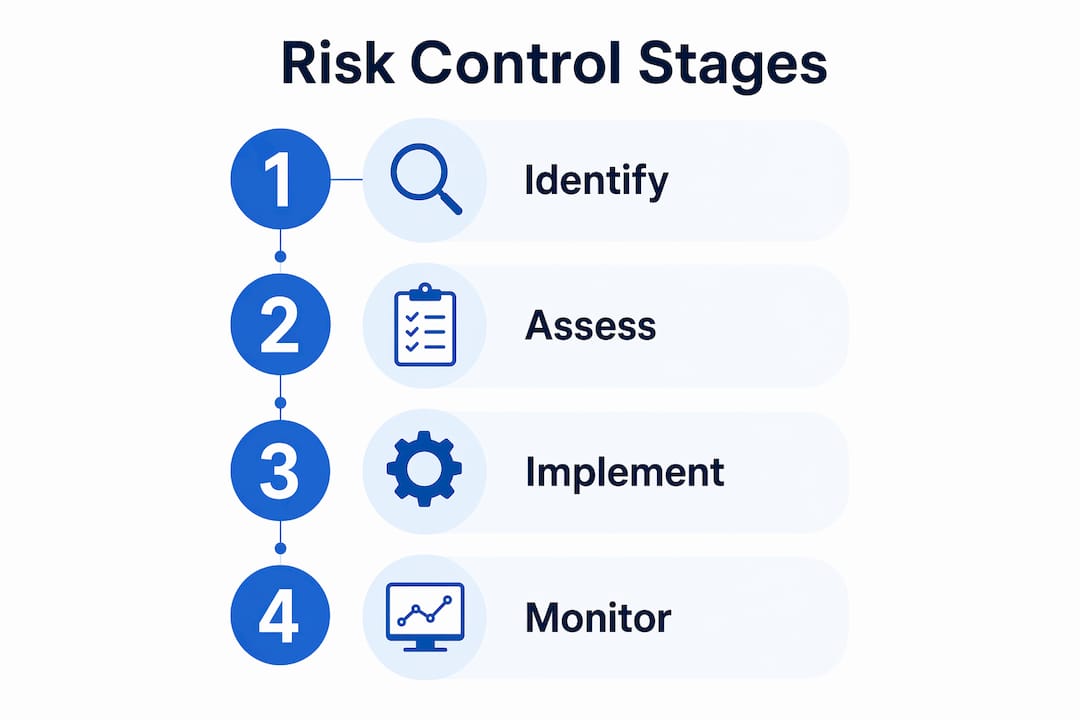
The standard environmental risk management cycle is a recurring four-stage process: Identify, Assess, Implement, and Monitor/Review. It is not a one-time exercise. Business activities change, regulations update, and site conditions shift, so the cycle must repeat on a defined cadence.
Stage 1: Identify. Hazard identification draws on site inspections, process flow analysis, regulatory inventories, and incident history. The output is a hazard register that captures the source, pathway, and receptor for each potential environmental impact.
Stage 2: Assess. Each hazard is scored on likelihood and consequence to produce a risk rating. High-consequence items, regardless of their likelihood score, warrant immediate attention. The risk matrix output determines which hazards are acceptable and which require controls before operations continue.
Stage 3: Implement. Control selection follows the hierarchy, from elimination at the top to PPE at the base. Controls are documented in the risk register, standard operating procedures (SOPs), and permit conditions. Capital-intensive controls enter the project budget and procurement pipeline; administrative controls enter training schedules.
Stage 4: Monitor and Review. Controls are only as effective as their verification. Monitoring plans specify parameters, sampling methods, and QA/QC protocols aligned to national standards. Audit findings, incident data, and permit compliance records feed back into Stage 1, closing the loop.
Controls also serve two distinct functions within this cycle. Preventative controls stop harmful events from occurring at all. Mitigating controls limit the consequence when a harmful event cannot be fully prevented. A well-designed program deploys both categories in combination, particularly for high-consequence hazards where residual risk remains after elimination or substitution.
What types of environmental risks do businesses commonly face?
Environmental risk factors span physical, chemical, biological, and systemic categories. Understanding the taxonomy is the prerequisite for a complete hazard register.
Primary risk categories:
- Air emissions: Combustion exhaust, volatile organic compound (VOC) releases, fugitive dust, and process stack emissions regulated under the Clean Air Act.
- Wastewater and stormwater discharges: Process effluent, site runoff, and dewatering discharges subject to National Pollutant Discharge Elimination System (NPDES) permits.
- Hazardous materials handling and spills: Storage, transfer, and disposal of chemicals, fuels, and solvents with spill pathway to soil or water.
- Solid and hazardous waste: Generation, segregation, storage, and disposal obligations under the Resource Conservation and Recovery Act (RCRA).
- Soil and groundwater contamination: Legacy contamination, leaking underground storage tanks, and land application of waste materials.
- Noise and vibration: Construction and industrial operations affecting neighboring communities and sensitive receptors.
- Biodiversity and habitat impact: Land clearing, wetland disturbance, and species habitat disruption requiring federal and state permits.
- Natural hazards: Flood, storm surge, and seismic events that can release stored materials or compromise containment systems.
- Supply-chain and ESG risks: Upstream supplier environmental performance that creates reputational, legal, and investor-relations exposure.
Cross-cutting risks compound these categories. Regulatory noncompliance can convert a manageable spill into a significant enforcement action. Community impact from noise, odor, or visual blight generates reputational exposure that affects permitting relationships and ESG ratings. Construction, manufacturing, and facilities operations each face a distinct subset of these categories, though chemical handling and stormwater management appear across all three sectors with high frequency. For a detailed breakdown of construction-specific environmental hazards, the risk profile differs materially from a fixed industrial facility.
How do you select the most effective controls using the hierarchy?
The hierarchy of controls is the organizing principle for control selection, ranking options from most to least effective at eliminating or reducing environmental harm. Higher-level controls are preferred because they reduce ongoing operational burden and do not depend on human behavior to remain effective.

Elimination removes the hazard entirely. Examples: redesigning a process to eliminate a solvent cleaning step; selecting a site that avoids a floodplain; discontinuing a waste-generating activity.
Substitution replaces a hazardous material or process with a less hazardous alternative. Examples: replacing a chlorinated solvent with a water-based cleaner; switching from diesel-powered equipment to electric; using low-VOC coatings instead of solvent-based products.
Engineering controls are physical systems that prevent pollution from occurring or stop it spreading, operating independently of human action. Practical engineering controls include secondary containment bunding around chemical storage, automated shutdown systems triggered by leak sensors, closed-loop process water recycling, and stormwater sediment basins.
Administrative controls rely on people following defined procedures. They include written SOPs, training programs, permit-to-work systems, inspection schedules, and shift designs that reduce exposure windows. These controls are less reliable than engineering solutions because their effectiveness degrades when supervision lapses or staff turns over.
PPE is the last line of defense. It protects the worker but does nothing to prevent the release at source. Programs that default to PPE as the primary control for environmental hazards carry persistent residual risk and accumulate ongoing procurement and training costs.
Pro Tip: When elimination or substitution is not immediately feasible, implement an engineering control as the interim measure and set a defined timeline for the design-stage change. Never allow PPE or an administrative procedure to become a permanent substitute for a higher-level control.
In practice, most programs deploy a combination of controls. A chemical storage area might combine secondary containment (engineering), a spill response SOP (administrative), and chemical-resistant gloves for handlers (PPE). The combination is appropriate; the error is treating the combination as equivalent to elimination when elimination remains achievable through process redesign.
How do you assess and prioritize controls using risk scoring?
Prioritization converts a hazard register into an actionable roadmap. The following sequence applies a likelihood-by-consequence matrix to rank controls and overlay cost and timeline to produce a phased implementation plan.
- Score each hazard. Rate likelihood and consequence on qualitative scales from rare to almost certain and negligible to catastrophic, respectively. Multiply the scores to produce a risk rating to guide prioritization.
- Apply a non-negotiable rule for high-consequence items. Any hazard assessed as having high or severe consequences is treated as top priority regardless of its likelihood score. Irreversible impacts, including groundwater contamination and significant habitat destruction, cannot be managed reactively.
- Overlay cost and lead time. For each candidate control, estimate implementation cost and the time required to procure, install, and verify. Plot controls on a two-axis grid: cost versus risk reduction. Controls in the high-reduction/low-cost quadrant are quick wins; controls in the high-reduction/high-cost quadrant become capital projects.
- Classify controls as interim or permanent. Administrative controls and PPE may be appropriate interim measures while a capital engineering project is designed and procured. Document the interim status explicitly in the risk register, with a target date for the permanent control.
- Sequence the roadmap. Assign quick wins to the first 30–60 days. Schedule capital projects with permit lead times, procurement cycles, and construction windows. Assign a named owner and a completion date to every line item.
The U.S. EPA’s risk management framework reinforces that control selection must account for economic and legal factors alongside technical feasibility. A control that is theoretically optimal but financially or operationally impractical will not be implemented consistently, which produces a worse outcome than a lower-level control that is reliably maintained.
What does implementing environmental controls actually involve?
Implementation is where control programs succeed or fail. A well-scored risk register that never translates into verified site changes produces no environmental benefit and creates significant regulatory exposure.
| Implementation Step | Key Activities | Responsible Party | Documentation Required |
|---|---|---|---|
| Scope and design | Define control specifications, performance standards, and acceptance criteria | EHS owner + project manager | Design brief, performance targets |
| Permitting | Identify required federal, state, and local permits; submit applications with lead time | EHS owner + legal/compliance | Permit applications, correspondence log |
| Procurement | Source materials, equipment, and contractors; include environmental clauses in contracts | Procurement + operations owner | Supplier contracts, environmental requirements |
| Pilot and testing | Install and test controls at small scale; verify performance against acceptance criteria | Project manager + EHS owner | Pilot test report, verification checklist |
| Full rollout | Deploy controls across all applicable areas; update SOPs and risk register | Operations owner + project manager | Updated SOPs, risk register revision |
| Training | Deliver role-specific training to all affected personnel and contractors | EHS owner + HR | Training records, competency assessments |
| Verification | Conduct post-implementation inspection and confirm controls meet performance targets | EHS owner | Verification report, permit compliance confirmation |
Contractor management deserves particular attention. Third-party contractors who perform work within a controlled area must be qualified, briefed on environmental requirements, and held to the same standards as direct employees. Contract clauses should specify environmental performance expectations, reporting obligations for incidents and near-misses, and the right to remove non-compliant contractors from site. Embedding environmental requirements into construction risk management from the contract stage prevents the common failure mode of discovering noncompliance after irreversible damage has occurred.
Which U.S. standards and regulations should you align with?
The U.S. regulatory framework for environmental risk management is multi-layered, spanning federal statutes, agency rules, state permits, and voluntary standards. Professionals must navigate all levels simultaneously.
Federal statutes and agency rules:
- Clean Air Act (CAA): Governs air emissions from stationary and mobile sources; requires permits for major and minor sources under Title V and the New Source Review program.
- Clean Water Act (CWA): Regulates discharges to waters of the United States through the NPDES permit program; construction sites disturbing one or more acres require a Construction General Permit.
- Resource Conservation and Recovery Act (RCRA): Establishes the cradle-to-grave management framework for hazardous and solid waste, including generator requirements, storage standards, and disposal obligations.
- OSHA standards: Worker protection regulations that intersect with environmental controls, particularly for hazardous materials handling, confined space entry, and emergency response.
- U.S. EPA sector-specific rules: The EPA’s compliance assistance program provides sector-specific guidance for construction, manufacturing, chemical production, and other industries.
Voluntary standards and frameworks:
- ISO 14001: The international standard for environmental management systems (EMS); provides a structured framework for policy, planning, implementation, monitoring, and management review that maps directly onto the four-stage risk cycle.
- COSO ERM framework: COSO guidance recommends treating environmental and ESG risks as integral components of enterprise risk management because they affect long-term value and profitability. Siloing environmental controls in a standalone “environmental manual” disconnected from capital planning and ERM is a structural failure that the COSO approach explicitly addresses.
Federal rules set the floor; state and local permits often impose stricter requirements. Permit timing is a critical planning variable: major air and water permits can require 6–18 months for approval, and construction cannot legally commence without them. Integrate permit applications into the project schedule at the earliest feasible stage, not as an afterthought after design is complete.
How do you monitor controls and drive continuous improvement?
Monitoring confirms that controls perform as designed and generates the data needed to improve them. A monitoring program without defined parameters and QA/QC protocols produces data of uncertain quality that cannot support regulatory reporting or management decisions. IFC EHS Guidelines call for monitoring plans with defined parameters, sampling methods, and QA/QC aligned to national or international standards.
Recommended KPIs:
- Number of spills and uncontrolled releases per quarter
- Permit exceedances (air, water, waste) per reporting period
- Corrective action closure time (days from identification to verified resolution)
- Audit findings trend (total findings and repeat findings by category)
- Near-miss reports submitted per month (a leading indicator of control degradation)
Monitoring types and cadence:
- Continuous instrumentation: Real-time sensors for stack emissions, effluent flow, and containment integrity; alerts trigger immediate response.
- Periodic sampling: Scheduled water, air, and soil sampling per permit conditions and SOPs; results compared against permit limits and baseline data.
- Visual inspections: Daily or weekly site walks by trained personnel to identify physical control failures, unauthorized discharges, or waste management lapses.
- Management review: Annual review of the full EMS performance, including KPI trends, audit results, regulatory changes, and capital planning implications.
A practical audit cycle runs on three frequencies: monthly operational checks covering physical control condition and documentation currency; quarterly performance reviews comparing KPIs against targets and closing corrective actions; and an annual management review that feeds findings into the next planning cycle. Large operators increasingly deploy digital systems to automate waste tracking, permit calendars, and risk-register updates, which reduces the administrative burden of manual record-keeping and improves data integrity across sites.
How do environmental controls work on a U.S. construction site?
Construction sites present a concentrated set of environmental risks within a compressed timeframe, making early integration of controls into project planning the highest-leverage intervention available. The U.S. EPA’s construction planning guide is explicit: compliance planning should begin at site selection and design, not after ground is broken.
Common construction risks and typical controls:
- Erosion and sediment control: Silt fences, sediment basins, inlet protection, and stabilized construction entrances prevent soil from entering stormwater systems; required under the Construction General Permit for sites over one acre.
- Stormwater discharges: A Stormwater Pollution Prevention Plan (SWPPP) documents controls, inspection schedules, and corrective action procedures; it must be on site and available to inspectors at all times.
- Hazardous materials and fuel storage: Secondary containment for fuel tanks and chemical storage areas; spill kits staged at storage locations; contractor briefings on spill response procedures.
- Dust and air emissions: Water suppression for active grading areas, speed limits on unpaved haul roads, and equipment idling restrictions reduce fugitive dust and diesel particulate emissions.
- Construction waste: Segregated waste streams for concrete, metal, wood, and hazardous materials; designated staging areas with covered storage to prevent stormwater contact.
Design-stage decisions drive the most significant risk reductions. Selecting a site that avoids wetlands, floodplains, and sensitive habitat eliminates entire permit categories. Specifying low-VOC materials and electric equipment at the design stage removes air emission risks before a single worker arrives on site. For a structured approach to managing risk during the design stage, integrating environmental requirements into design documents and capital requests is the single most cost-effective intervention in the project lifecycle.
Contractor qualification and oversight are equally critical. Environmental requirements should appear in prequalification criteria, contract terms, and site induction materials. Monitoring expectations, incident reporting obligations, and the consequences of noncompliance must be communicated before work begins, not after a violation occurs.
Quick templates and checklists you can use right away
The following templates give teams a starting point for documenting and managing controls without building a system from scratch. Host them in a shared drive or EHS management platform with version control and named document owners.
| Template Name | Purpose | Owner | Review Frequency |
|---|---|---|---|
| Hazard Register Entry | Document each hazard, its risk score, proposed controls, and responsible party | EHS Manager | Quarterly or after any incident |
| Control Selection Worksheet | Evaluate hierarchy options, cost, lead time, and interim vs. permanent status for each control | EHS Manager + Project Manager | At project initiation and major scope changes |
| Implementation Plan Template | Track control design, permitting, procurement, installation, and verification milestones | Project Manager | Monthly during active implementation |
| Verification Checklist | Confirm each control is installed, functional, and meets performance targets post-implementation | EHS Manager | After installation; annually thereafter |
| Permit Tracking Table | Log all required permits, application dates, approval status, expiry dates, and renewal deadlines | Compliance Officer | Monthly |
Each template should carry a document number, version date, and the name of the approving authority. When a control is modified or a permit condition changes, the affected templates are updated simultaneously, not sequentially. Embedding these documents into the organization’s ERM or capital planning system, rather than maintaining them as standalone files, prevents the common failure of controls existing on paper but not in operational practice.
Key Takeaways
Effective environmental risk management requires embedding controls into operations, procurement, and capital planning from the earliest project stage, not retrofitting them after regulatory pressure arrives.
| Point | Details |
|---|---|
| Hierarchy drives selection | Prefer elimination and substitution; treat PPE and administrative controls as interim measures, not permanent solutions. |
| Score and prioritize early | Use a likelihood × consequence matrix; treat any consequence score of 4–5 as top priority regardless of likelihood. |
| Assign named owners | Every hazard register entry needs a named individual accountable for control implementation and verification. |
| Integrate into ERM and capital planning | Environmental controls embedded in enterprise risk management and project budgets are implemented; those kept in a standalone manual are not. |
| Com’s QES consultancy | Com accelerates control design, permitting, auditing, and training for construction and industrial clients seeking verified compliance. |
Why early design decisions outweigh downstream fixes
The most consequential insight from sustained environmental risk practice is that the leverage point is at the beginning, not the middle. Organizations that treat environmental controls as a compliance response to a regulatory notice have already absorbed the most expensive outcome: a retrofit, an enforcement action, or an irreversible impact that no administrative procedure can undo.
The persistent pitfall is the compliance-only mindset, where controls are treated as paperwork to satisfy an inspector rather than operational changes that reduce real costs. A spill containment bund that exists on a site plan but is never inspected, maintained, or understood by site personnel is not a control. It is a document. The distinction between a control that functions and a control that is documented is where most programs fail, and where auditors find the most significant gaps.
The practical recommendation for leaders is to establish a rolling 90-day controls checklist tied to measurable KPIs, reviewed at the operational level, not just at the annual management review. Corrective actions that close within 30 days of identification indicate a functioning program. Corrective actions that remain open for two quarters indicate a structural problem with ownership, resources, or organizational priority.
How a QES specialist can accelerate your environmental control program
For organizations managing complex permits, capital projects, or limited internal EHS capacity, external specialist support compresses the time between hazard identification and verified control implementation.

Com provides end-to-end QES consultancy services that cover risk register development, control design, permitting assistance, EHS audits, personnel training, and contractor oversight. The practical value is clearest in three scenarios: when a project triggers multiple federal and state permits with overlapping timelines; when an organization is scaling operations faster than its internal EHS team can absorb; and when an audit or enforcement action has identified systemic control gaps requiring rapid remediation. Clients who engage Com’s safety consultancy services at the project planning stage consistently achieve faster permit approvals, reduced incident rates, and clearer capital budgets because environmental requirements are scoped and priced before design is locked. A site review begins with a rapid hazard scoping session that produces a prioritized control roadmap within days, not months. Contact Com to schedule that initial scoping session and establish a defensible, operational control program for your next project.
Useful sources and references
The following primary sources substantiate the guidance in this article and provide the in-depth regulatory text, templates, and technical standards needed for permit applications, SOPs, and management system documentation. Store these links in your project folder and reference them by section when drafting regulatory submissions.
- U.S. EPA Risk Management: The authoritative federal framework for integrating risk assessment results with economic and legal considerations when selecting controls. Consult for prioritization rationale and regulatory defensibility.
- U.S. EPA Construction Planning Guide: Sector-specific guidance on stormwater, NPDES permits, and early-stage compliance planning for construction and development projects.
- U.S. EPA Compliance Assistance Resources: Sector-specific compliance tools covering construction, manufacturing, chemical production, and more; includes NPDES, RCRA, and Clean Air Act guidance.
- IFC General EHS Guidelines (2023): International best-practice standards for monitoring program design, QA/QC, and control hierarchy application; widely referenced by U.S. project finance lenders and ESG auditors.
- IFC Performance Standard 1 Guidance Note: Detailed guidance on the identify-assess-implement-monitor cycle and stakeholder engagement requirements for environmental and social risk management.
- Princeton EHS Hazard Controls: Clear, authoritative explanation of the five-level hierarchy of controls with practical application guidance; use when training staff or drafting control selection rationale.
- COSO: Integrating ESG into ERM: Framework guidance for embedding environmental and sustainability risks into enterprise risk management; essential for organizations aligning EHS programs with board-level ESG reporting.