

A safety audit closing meeting must convert documented findings into an agreed, time-bound corrective action plan with named owners, defined deadlines, and a verification timeline. Without that outcome, even a technically rigorous audit produces little more than a report that gathers dust rather than driving measurable improvement. The meeting is the operational pivot point between identification and remediation.
The essential elements every closing meeting must produce:
- A signed attendance record with roles noted
- A restated scope and sampling-limit disclosure (audit evidence is sample-based and may not reveal every nonconformity)
- A sequenced presentation of major nonconformities, minor issues, and opportunities for improvement (OFIs)
- Verbatim or summarized management responses to each finding
- An agreed action log with finding ID, corrective action, named owner, due date, and verification method
- Signed or acknowledged meeting minutes
- Confirmed next steps: final report delivery date, follow-up verification schedule, and escalation path if actions are not completed
Three authoritative references auditors should have on hand before the meeting: OSHA standards applicable to the site, ISO 19011 (Guidelines for Auditing Management Systems), and the organization’s own safety policy and corrective action procedure. Together, these define what constitutes a recordable finding, what severity classifications are defensible, and what timelines are legally or contractually required.
Table of Contents
- What does a closing meeting checklist cover?
- Who should attend and what each role must do
- How to prepare before the closing meeting
- How to run the closing meeting from start to finish
- What to record: minutes, action log, and format
- What happens after the closing meeting: follow-up and closure
- How to handle disputed findings without losing credibility
- U.S. regulatory checks that affect closing meeting outcomes
- Practitioner-ready templates: agenda, minutes, and action log
- Common mistakes that undermine closing meetings
- Key Takeaways
- The closing meeting is where audits either deliver or disappear
- Authoritative sources and further reading
- Com’s audit support services for safety and compliance teams
What does a closing meeting checklist cover?
A one-page checklist keeps the session focused and prevents procedural gaps. The OCIMF SIRE 2.0 closing-meeting checklist, one of the most detailed formal models available, structures the process around confirming observation declarations, presenting copies to the inspected party, explaining contents, and exchanging signed copies. That architecture translates directly to safety audits.
Before the meeting opens:
- Confirm room or virtual link, start time, and planned duration (60–90 minutes for multi-day audits; 20–30 minutes for single-day exit sessions)
- Assign a designated minute-taker who is not the lead auditor
- Distribute the draft findings summary to the audit team for final alignment
- Confirm attendee list and notify process owners of the agenda
Opening steps (first 5–10 minutes):
- Reintroduce all attendees and state their roles
- Restate the audit scope, objectives, and applicable standards
- Declare sampling limits: findings are based on evidence reviewed and may not represent all conditions
- Explain the grading system (major nonconformity, minor nonconformity, OFI) and the reporting timeline
Presentation steps (15–30 minutes):
- Present major nonconformities first, with supporting evidence references
- Present minor nonconformities
- Present OFIs, framed constructively
- Invite questions or clarifications after each category, not after each individual finding
Decision and action steps (20–40 minutes):
- Invite management response to each major finding
- Agree on corrective action, owner, due date, and verification method for each item
- Record partial agreements or conditional commitments verbatim
- Confirm the corrective action plan (CAP) submission deadline
Closing steps (10–15 minutes):
- Confirm the distribution list for draft minutes and the final report
- State the final report delivery date
- Confirm the next follow-up or verification date
- Thank participants and formally close the meeting
Pro Tip: Print the checklist and place it in front of the lead auditor, not just the minute-taker. Checking off each item in real time prevents the most common procedural omission: failing to state sampling limits before presenting findings.
Who should attend and what each role must do
The meeting is authoritative only when the people with decision-making authority are present. Practitioner guidance consistently identifies senior management presence as the single factor most correlated with corrective action commitment. Pre-briefing executives in advance, where possible, increases the likelihood of resource commitment even if they cannot attend the full session.
Core attendees and responsibilities:
- Lead auditor: Facilitates the meeting, presents the overall audit conclusion, manages time, and ensures all findings are acknowledged. Does not argue or defend findings under challenge; instead, invites supplementary evidence.
- Audit team members: Present area-specific findings within their assigned scope. Speak only to findings they personally gathered evidence for.
- Site safety manager / EHS manager: Serves as the primary auditee liaison, clarifies operational context, and coordinates management responses.
- Process owners: Acknowledge findings within their area, propose corrective actions, and commit to deadlines. Their presence is non-negotiable for major nonconformities.
- Senior management representative: Provides organizational authority to commit resources and approve timelines. Without this role present, corrective action commitments carry limited enforceability.
- Minute-taker: Records attendees, findings as presented, management responses verbatim where significant, agreed actions, owners, deadlines, and next steps. Should not participate in substantive discussion.
- Optional observers / technical SMEs: Permitted when their expertise is needed to clarify a technical finding. Limit to one or two; too many observers diffuse accountability and can shift the meeting’s dynamic toward debate rather than resolution.
Pro Tip: When senior management cannot attend in person, secure a written pre-authorization confirming their delegate’s authority to commit corrective action resources. Record that authorization in the minutes.
How to prepare before the closing meeting
Preparation determines whether the meeting produces enforceable commitments or inconclusive discussion. The Oriel STAT A MATRIX guidance is explicit: never “wing” the closing meeting. Choreography and team alignment protect both credibility and the audit’s legal defensibility.
Auditor preparation timeline:
- Same day (short audits) or within 48 hours (multi-day audits): Schedule the closing meeting while evidence is fresh and auditees are still engaged with the audit process.
- 24 hours before: Finalize finding wording and severity classifications with the full audit team. Resolve any internal disagreements on classification before the meeting, not during it.
- 2–4 hours before: Prepare a concise slide summary or one-page findings overview. Visual aids reduce misunderstanding and keep the meeting on schedule.
- 30–60 minutes before: Pre-brief the lead executive or their delegate if a major nonconformity or regulatory citation is on the findings list. Surprises at the executive level are the leading cause of defensive responses that delay corrective action.
Auditee preparation guidance (communicate this in advance):
- Bring all relevant process owners, not just the safety manager
- Have supplementary documents available (procedures, training records, maintenance logs) in case a finding is disputed
- Be prepared to discuss corrective feasibility and realistic timelines, not just acknowledgment
- Designate one person to coordinate management responses so the meeting does not stall on internal disagreements
Pro Tip: Hold a 15–30 minute internal audit team pre-meeting immediately before the closing session. Confirm the sequence of findings, agree on who presents each item, and rehearse neutral phrasing for the two or three most sensitive findings. This single practice eliminates the majority of on-the-spot wording disputes.
For a comprehensive view of audit preparation steps before the closing meeting, the MOSAIC resource library provides structured pre-audit checklists applicable to construction and industrial sites.

How to run the closing meeting from start to finish
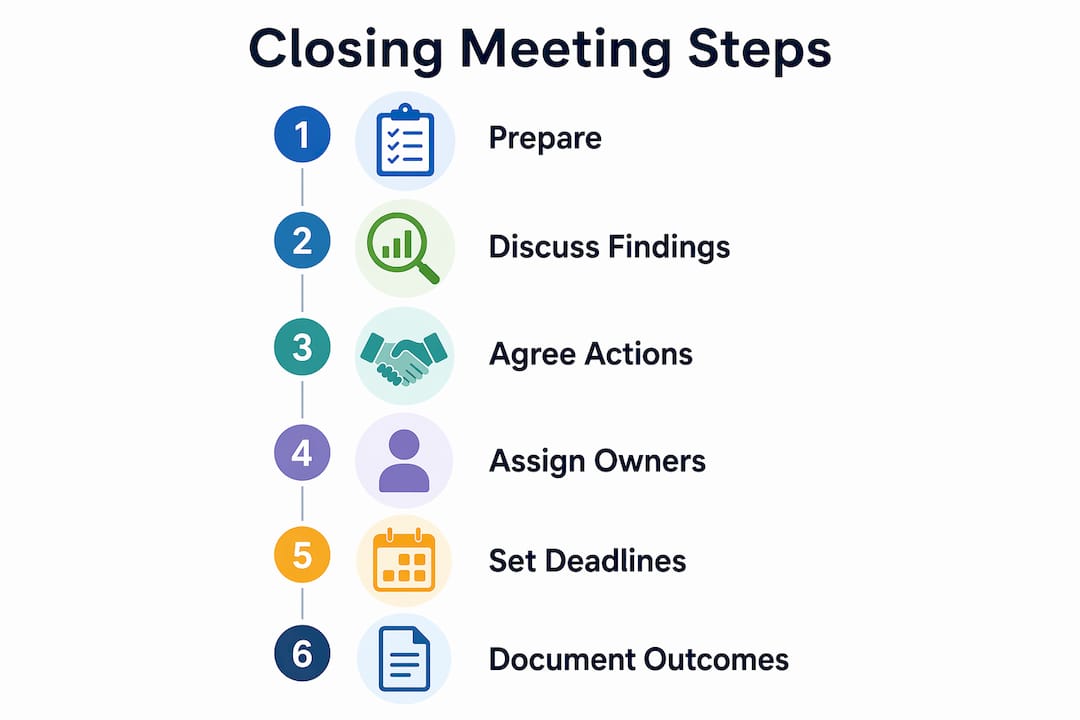
The meeting follows a time-boxed script. Deviating from the sequence, particularly by presenting minor issues before major ones, undermines the meeting’s authority and allows discussion to consume time that should be reserved for action agreement.
Suggested timing for a 60–90 minute session:
- Opening (5–10 min): Lead auditor opens, reintroduces the team, restates scope and objectives, declares sampling limits, and explains the grading system.
- Findings summary (15–30 min): Individual auditors present area-specific findings. Major nonconformities first, then minor issues, then OFIs. This sequence ensures the most consequential items receive the most time and attention, and the meeting closes on a constructive note.
- Management response and action negotiation (20–40 min): Process owners respond to each finding. Lead auditor facilitates, not adjudicates. Corrective actions, owners, and deadlines are agreed and recorded in real time.
- Agreement and closing (10–15 min): Lead auditor summarizes agreed actions, confirms the CAP submission deadline, states the final report delivery date, and formally closes the meeting.
Choreography notes:
- Lead auditor opens and closes; individual auditors present only their assigned findings
- Process owners respond immediately after each finding in their area; do not batch all responses to the end
- Pause after each major finding for clarification before moving to the next
- If time overruns, schedule a focused sub-session for remaining OFIs rather than compressing the action-agreement phase
Sample neutral phrases for presenting findings:
- “The evidence reviewed indicates that the procedure for [X] was not consistently applied in [area]. The specific records reviewed were [Y] and [Z].”
- “During the site walk on [date], the following condition was observed: [description]. This represents a departure from [standard/procedure reference].”
- “We noted an opportunity to strengthen [process]. This is not a nonconformity, but addressing it would reduce exposure to [risk].”
Pro Tip: Assign a visible timer to the meeting. When the action-negotiation phase approaches its limit, the lead auditor should state: “We have ten minutes remaining for this phase. Let’s confirm the outstanding action owners and move to closing.” This prevents the most common time failure: open-ended debate on a single finding.
What to record: minutes, action log, and format
The record produced at the closing meeting is the legal and operational foundation for everything that follows. Assurco’s guidance identifies required closing meeting documentation as including sampling limits, reporting timeframes, grading of findings, and the complaint and appeal handling process. The action log is the enforcement instrument.
Minimum fields for the action log:
- Finding ID (unique reference number)
- Short description of the finding
- Evidence summary (document or observation reference)
- Severity classification (major / minor / OFI)
- Agreed corrective action
- Named owner (individual, not department)
- Due date
- Verification method (documentary, onsite inspection, remote review)
- Status (open / submitted / verified / closed)
Minutes format guidance:
- Capture management responses verbatim for major nonconformities; summarize minor ones
- Record partial agreements and conditional commitments explicitly (e.g., “Owner will submit a revised procedure by [date], contingent on approval from [department]”)
- Note any finding the auditee disputes and record their stated position without editorial comment
- Include the distribution list and the date by which draft minutes will be circulated
Confidentiality and distribution:
- Draft minutes go to the audit team and the auditee’s designated contact only
- The final report, once approved, follows the distribution list agreed at the meeting
- Sensitive findings (potential regulatory violations, personnel-related observations) should be flagged for restricted distribution in consultation with legal counsel
| Document | Recipient | Timeline |
|---|---|---|
| Draft minutes | Audit team + auditee contact | Within 48–72 hours of meeting |
| Final audit report | Agreed distribution list | Per audit program schedule |
| Action log | Process owners + safety manager | Immediately after meeting |
| CAP submission | Lead auditor for review | Per agreed deadline (typically 30 days for major findings) |
Designate the minute-taker before the meeting, not during it. A minute-taker who is also managing discussion produces incomplete records.
What happens after the closing meeting: follow-up and closure
The closing meeting initiates a structured follow-up workflow. Without a defined process, corrective actions stall and the audit’s value is lost. The workflow below applies to safety audits in U.S. construction and industrial environments; adapt timelines to organizational policy and regulatory requirements.
Follow-up process flow:
- Draft minutes distributed within 48–72 hours of the closing meeting
- Auditee submits formal CAP for each major finding (typically within 30 days; high-risk or regulatory findings may require 5–10 business days)
- Lead auditor reviews CAP for adequacy: does the proposed action address root cause, not just the symptom?
- Auditor accepts or returns the CAP with documented rationale if rejected
- Verification conducted by documentary review, remote assessment, or onsite inspection, depending on severity
- Finding closed when verification evidence is accepted and recorded
- Audit formally closed when all major findings are verified and closed; minor findings and OFIs may follow a longer cycle
Verification evidence that typically suffices:
- Revised and approved procedures or work instructions
- Training records showing affected personnel have been trained on the revised procedure
- Photographs of corrected physical conditions
- Updated risk assessments or hazard registers
- Observation records from a follow-up site inspection
Pro Tip: For construction sites, link closing-meeting commitments to site inspection schedules so verification is built into the project’s existing oversight cadence rather than treated as a separate audit event.
| Milestone | Responsibility | Typical Timeline |
|---|---|---|
| Draft minutes distributed | Lead auditor / minute-taker | 48–72 hours post-meeting |
| CAP submitted (major findings) | Process owner | 30 days (5–10 days for regulatory findings) |
| CAP reviewed and accepted | Lead auditor | Within 5 business days of receipt |
| Verification completed | Auditor or designated verifier | 60–90 days from CAP acceptance |
| Finding formally closed | Lead auditor | Upon verified evidence acceptance |
| Audit program closure | Audit manager | When all major findings are closed |
How to handle disputed findings without losing credibility
Disputes at the closing meeting are procedurally normal. The auditor’s obligation is to maintain the finding’s integrity while keeping the meeting constructive. Withdrawing a defensible finding under pressure is a credibility failure; refusing to consider supplementary evidence is an integrity failure. The path between them is procedural.
Step-by-step dispute handling:
- Pause and reframe. State: “I understand this finding may not reflect the full picture. Let me restate the specific evidence on which it is based.” Reframe the finding as a system or process observation, not a personal or departmental failure.
- Invite supplementary evidence. If the auditee claims the condition has been corrected or that additional documentation exists, record the claim and request the evidence within a defined timeframe (typically 5 business days).
- Record the dispute verbatim. Capture the auditee’s stated position in the minutes without editorial comment. This protects both parties.
- Time-box the discussion. If agreement is not reached within 10 minutes on a single finding, move on and flag it for formal follow-up. Do not allow one disputed finding to consume the meeting.
- Invoke the formal appeal or escalation route if the dispute is unresolved after supplementary evidence review.
Escalation path:
- Level 1: Process owner and lead auditor (at the meeting)
- Level 2: Site safety manager and audit manager (within 5 business days)
- Level 3: Safety director or EHS director and independent audit reviewer (within 15 business days)
- Level 4: Formal written appeal per the organization’s audit governance policy
Pro Tip: When a finding is genuinely contested, propose a trial corrective measure: “Would you be willing to implement [specific interim control] while we review the supplementary evidence? That protects the site and gives us time to resolve the classification.” This keeps the meeting moving and demonstrates good faith.
U.S. regulatory checks that affect closing meeting outcomes
Certain findings carry regulatory weight that directly affects severity classification and follow-up timelines. Auditors operating on U.S. sites should verify the following before finalizing classifications at the closing meeting.
Key regulatory references:
- OSHA 29 CFR 1926 (Construction) and 29 CFR 1910 (General Industry): Findings that correspond to specific OSHA standards should be cited by standard number. A finding that maps to an OSHA violation category (serious, willful, repeat) requires faster corrective action and may require immediate interim controls.
- OSHA Recordkeeping (29 CFR 1904): If a finding involves a condition that contributed to or could contribute to a recordable incident, note this in the severity rationale. It affects both the CAP timeline and the organization’s OSHA 300 log obligations.
- ANSI/ASSP Z10.0 (Occupational Health and Safety Management Systems): Provides a U.S.-specific framework for corrective action prioritization that aligns with ISO 45001. Useful for justifying severity classifications to management.
- ISO 19011: The international standard for auditing management systems. Sections 6.6 (conducting the closing meeting) and 6.7 (preparing and distributing the audit report) provide the procedural baseline that most U.S. audit programs reference.
When a finding involves imminent danger, willful noncompliance, or a condition that has already resulted in a recordable incident, the corrective action timeline compresses significantly. In those cases, interim controls must be agreed at the closing meeting itself, not deferred to the CAP submission.
Pro Tip: This article is a procedural reference, not legal advice. When a finding may carry regulatory enforcement implications, consult the organization’s legal counsel or a qualified EHS regulatory specialist before finalizing the severity classification and the corrective action timeline.
Practitioner-ready templates: agenda, minutes, and action log
The following templates are designed for direct adoption into an organization’s audit SOP. Adapt field labels to match internal terminology; retain the core fields (owner, deadline, verification method) in every version.
Sample closing meeting agenda (60–90 minute session)
| Time | Agenda Item | Presenter |
|---|---|---|
| 5–10 minutes | Welcome, introductions, scope restatement, sampling-limit declaration | Lead auditor |
| 0:10–0:40 | Findings presentation: major nonconformities, then minor, then OFIs | Audit team members |
| 0:40–1:10 | Management responses, corrective action agreement, owner/deadline assignment | Process owners + lead auditor |
| 1:10–1:20 | Minutes confirmation, report delivery date, next steps, formal close | Lead auditor |
Condensed agenda (20–30 minute exit session):
- Scope and sampling-limit statement (2 min)
- Summary of findings by category (10 min)
- Agreement on immediate actions and owners (12 min)
- Confirm report delivery date and close (3 min)
Minute template fields
- Meeting date, time, location / virtual platform
- Attendees (name, title, organization, role)
- Audit scope and reference standard
- Sampling-limit declaration (verbatim or standard text)
- Findings as presented (by finding ID, description, severity)
- Management response per finding (verbatim for major findings)
- Agreed corrective actions, owners, and deadlines
- Disputed findings and auditee’s stated position
- Distribution list and final report delivery date
- Signatures: lead auditor and auditee representative
Action log table
| Finding ID | Description | Severity | Agreed Action | Owner | Due Date | Verification Method | Status |
|---|---|---|---|---|---|---|---|
| NC-001 | [Short description] | Major | [Corrective action] | [Name] | [Date] | Documentary / Onsite | Open |
| NC-02 | [Short description] | Minor | [Corrective action] | [Name] | [Date] | Documentary | Open |
| OFI-001 | [Short description] | OFI | [Improvement action] | [Name] | [Date] | Documentary | Open |
Script snippets:
- Opening: “Good [morning/afternoon]. This is the closing meeting for the [audit name] conducted on [dates]. The audit scope covered [areas]. I want to remind everyone that our findings are based on a sample of evidence reviewed and may not represent all conditions across the site.”
- Presenting a major finding: “Finding NC-001: During the review of [process/area], the evidence indicates that [specific condition]. This represents a departure from [standard/procedure]. The supporting evidence is [document/observation reference].”
- Inviting management response: “What is your response to this finding, and what corrective action do you propose?”
- Closing: “We have agreed on [X] corrective actions. Draft minutes will be distributed within 48 hours. The final report will be issued by [date]. Thank you for your participation.”
Pro Tip: For construction sector audits, cross-reference corrective actions against subcontractor reliability criteria when findings involve subcontractor-controlled work. This ensures the CAP assigns accountability at the correct organizational level.
Common mistakes that undermine closing meetings
The most consequential errors in closing meetings are procedural, not technical. They are also entirely preventable.
Pitfalls to avoid:
- Surprising auditees with findings they have not seen: Circulate a draft findings summary before the meeting. Surprises produce defensiveness, not commitment.
- Blaming individuals: Frame every finding as a system or process failure. Personal attribution shuts down constructive dialogue immediately.
- Vague corrective actions: “Improve training” is not a corrective action. “Deliver revised fall-protection training to all site workers by [date], verified by signed attendance records” is.
- No named owner: A corrective action assigned to a department is assigned to no one. Every action requires a named individual.
- Delayed minutes distribution: Minutes distributed more than 72 hours after the meeting lose their operational urgency. Owners begin to disengage.
- Skipping the sampling-limit declaration: Failing to state that findings are sample-based exposes the auditor to challenges when the auditee claims the finding is not representative.
Best practices that increase corrective action uptake:
- Present major findings first; close with OFIs so the meeting ends constructively
- Use process-focused language throughout: “the procedure was not applied” rather than “the team failed to follow”
- Require a named owner and a specific deadline for every action before leaving the meeting
- Use visual aids (a one-page findings summary) to keep discussion anchored to evidence
- Brief senior management in advance when major findings or regulatory citations are on the list
Pro Tip: Circulate a one-page executive summary to leadership within 24 hours of the closing meeting, before the full minutes are distributed. This gives decision-makers the information they need to authorize resources without waiting for the formal report, and it dramatically shortens the time between finding and funded corrective action.
Key Takeaways
A safety audit closing meeting succeeds when it produces a signed action log with named owners, specific deadlines, and defined verification criteria before participants leave the room.
| Point | Details |
|---|---|
| BLUF: the meeting’s single output | Every closing meeting must produce an agreed, time-bound corrective action plan with named owners and a verification timeline. |
| Sequence findings deliberately | Present major nonconformities first, then minor issues, then OFIs to allocate time proportionally and close constructively. |
| Minutes within 48–72 hours | Draft minutes distributed beyond 72 hours lose operational urgency; owner engagement drops sharply after that window. |
| Verification drives closure | A finding is not closed until verification evidence (procedures, training records, photographs, or observation) is accepted by the lead auditor. |
| Com’s role | Com provides structured audit support, corrective action facilitation, and follow-up verification for construction and industrial sites. |
The closing meeting is where audits either deliver or disappear
The procedural templates in this guide reflect a consistent pattern observed across well-run safety audits: the meetings that produce measurable corrective action are not the ones with the most detailed findings reports. They are the ones where the choreography was deliberate, the roles were clear, and the action log was completed before the room emptied.
One pattern worth noting from well-documented audit cycles: when a closing meeting includes a pre-briefed senior executive, a named minute-taker, and a sequenced findings presentation, the corrective action submission rate within the agreed deadline is substantially higher than in meetings where those elements are absent. The difference is not the quality of the audit fieldwork. It is the quality of the closing meeting itself.
The templates here, particularly the action log and the minute template fields, are designed to be adopted verbatim and then adapted to organizational terminology. The fields that must never be removed: named owner, specific deadline, and verification method. Those three fields are the difference between a finding that drives change and one that is acknowledged and forgotten.
Auditors who want to strengthen their broader audit lifecycle, from pre-audit preparation through to contractor-level corrective action, will find that improving contractor safety culture is often the downstream work that closing meeting commitments make possible.
Authoritative sources and further reading
The following references provide regulatory guidance, procedural templates, and practitioner checklists relevant to safety audit closing meetings in U.S. contexts.
- The IIA: Audit Report and Closing Meeting Procedure — The Institute of Internal Auditors’ procedural framework for closing meetings and audit report issuance; the primary reference for internal audit programs.
- BCM Institute: What Is Required During the Closing Meeting? — Practical checklist of required closing meeting elements; useful for SOP development.
- Oriel STAT A MATRIX: Conducting an Audit Closing Meeting That Compels Action — Detailed practitioner guidance on meeting choreography, minute-taking, and findings sequencing.
- OCIMF SIRE 2.0 Closing Meeting Checklist — Formal stepwise checklist for closing meetings; provides a model for observation declaration and signed copy exchange.
- Assurco: Opening and Closing Meetings — Covers required disclosures including sampling limits, grading, reporting timeframes, and appeal handling.
- iDiscord: How to Ensure Your Audit Closing Meeting Leads to Corrective Actions — Focuses on CAP ownership, prioritization, and the conditions under which findings fail to translate into improvement.
- HSEC Awareness: The Significance of Close Out Meeting in HSE Audits — HSE-specific guidance on collaborative discussion, celebrating positive findings, and joint CAP development.
- Study.com: How to Conduct the Closing Meeting of an Audit — Training-oriented checklist covering introductions, attendance, scope reminder, and management response steps.
Com’s audit support services for safety and compliance teams
Construction and industrial organizations that need structured closing meeting facilitation, corrective action tracking, and follow-up verification have a direct path through Com. Rather than building internal audit capacity from scratch, many site managers and EHS teams find that outsourcing safety manpower to a specialized consultancy produces faster corrective action closure and more defensible audit records.

Com’s audit support practice covers the full closing meeting workflow: pre-meeting preparation, findings presentation facilitation, action log completion, CAP review, and onsite verification. The service is designed for construction companies, developers, and industrial operators who require audit-ready documentation and regulatory compliance support without maintaining a full-time internal audit function. For organizations managing multiple sites or complex subcontractor networks, Com’s team brings the procedural discipline described in this guide to every engagement.
To discuss how Com can support your next safety audit closing meeting or corrective action cycle, contact the team directly through mosaicsafety.com.sg.