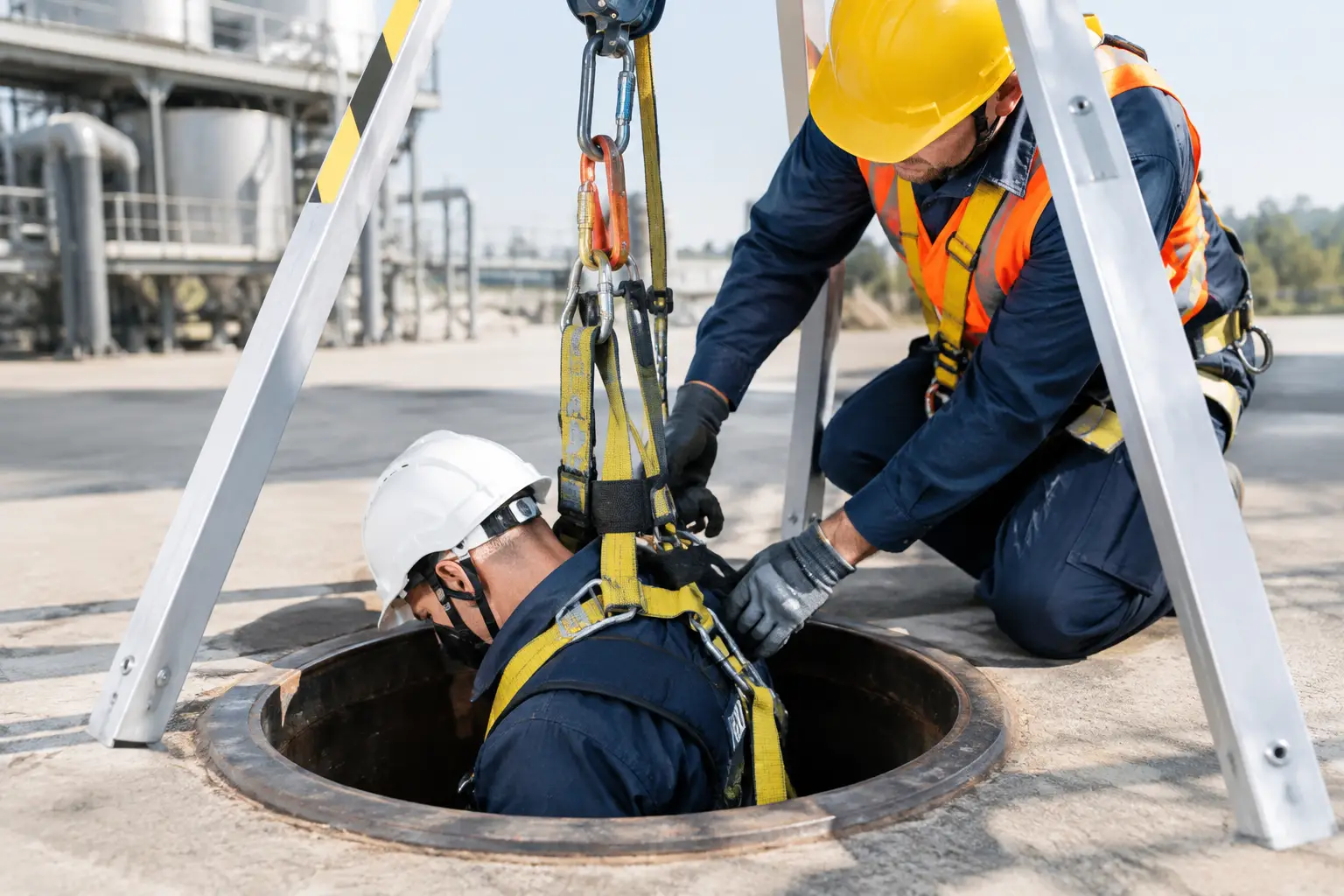

Continuous improvement in safety is the systematic process by which organizations convert incidents, near-misses, and audit findings into permanent, verifiable risk reductions. Rather than treating safety as a static compliance obligation, CI embeds iterative learning into daily operations through a recurring cycle: assess, implement, monitor, learn, adapt. The mechanisms that drive this are well-established: PDCA/PDSA cycles, near-miss reporting systems, and leading indicators that signal risk before an injury occurs.
Three immediate actions that validate or launch a CI program:
- Activate a near-miss reporting system with a non-punitive feedback path this week.
- Run a PDCA pilot on one high-frequency, low-severity task within an appropriate near-term period.
- Assign a named owner and verification deadline to every open corrective action before the next safety review.
Pro Tip: Start with near-miss reporting before any other initiative. The data it generates will tell you exactly where to focus your first PDCA cycle.
Table of Contents
- Why continuous improvement matters for workplace safety
- Core CI models every safety team should know
- How to embed CI into an existing safety program
- How to measure safety CI: KPIs, leading indicators, and near-miss capture
- Leadership and psychological safety: what the research says
- Common pitfalls when implementing CI in safety
- Realistic timeline and cost factors for CI initiatives
- Key Takeaways
- Com’s QES consultancy supports your CI program from day one
Why continuous improvement matters for workplace safety
The core argument for CI in safety is not philosophical. It is operational: organizations that treat safety as a recurring improvement process rather than a periodic audit exercise experience fewer repeat incidents, capture more hazard data, and maintain compliance with less administrative friction.
Continuous improvement transforms safety from one-off compliance into ongoing, proactive work that reduces incidents and builds organizational resilience. The shift from reactive to proactive management is the defining outcome. A reactive organization investigates injuries after they occur; a CI-driven organization investigates near-misses, identifies systemic root causes, and closes controls before an injury is possible.
The evidence-based benefits cluster around four dimensions:
- Incident prevention: Repeated PDCA cycles close the root causes of near-misses before they escalate to recordable injuries.
- Cost control: Reduced recordable incidents lower workers’ compensation premiums, lost-time costs, and regulatory penalty exposure.
- Regulatory resilience: CI practices are increasingly standardized and may be required for compliance with safety management systems and some regulatory frameworks, including ISO 45001.
- Workforce engagement: Workers who see their hazard reports converted into verified controls report higher trust in management and greater participation in safety programs.
Statistic: ISO 45001 and recognized safety standards frame continual improvement as a recurring, mandatory activity across policies, procedures, and reporting — not an optional enhancement.
Pro Tip: Target the three highest-frequency near-miss categories first. Fixing a high-volume, low-severity hazard delivers faster measurable improvement than tackling a rare, high-severity event.
Core CI models every safety team should know
PDCA is the operational backbone of safety CI; Kaizen and 5S are its cultural and practical complements. Understanding when to apply each model is what separates organizations that sustain improvement from those that run a single audit cycle and stall.

PDCA/PDSA: the operational cycle
Plan-Do-Check-Act (PDCA), also called Plan-Do-Study-Act (PDSA) in contexts emphasizing learning over verification, maps directly onto safety management:
- Plan: Conduct a hazard assessment; identify the root cause of a recurring near-miss; define a control measure and success criteria.
- Do: Trial the control on a limited scope (one shift, one work area).
- Check/Study: Measure leading indicators (near-miss rate, control effectiveness tests) over a defined period.
- Act: Standardize the effective control across all relevant areas; update procedures and training.
PDCA keeps safety active rather than reactive and places equal weight on the Act phase, where most organizations underinvest. Skipping rigorous verification at the Act stage is precisely how corrective actions become paper exercises.
Kaizen and 5S
Kaizen, rooted in the Toyota Production System, applies the principle that incremental, small improvements are more sustainable than large, frequent overhauls. In safety, this translates to daily or weekly micro-improvements: relocating a chemical storage point, adding a visual cue to a slip-risk area, or shortening a permit-to-work form to increase completion accuracy. Research on Kaizen’s role in workplace safety confirms that its integration into Japanese safety management systems has produced measurable reductions in accident rates through proactive hazard prevention.
5S (Sort, Set in Order, Shine, Standardize, Sustain) addresses the physical environment. A disorganized worksite is a hazard-generating worksite; 5S reduces ambient risk by eliminating the conditions that allow hazards to accumulate unnoticed.
Five core CI principles for safety
| Principle | Operational meaning in safety |
|---|---|
| Incrementalism | Prefer many small, verifiable changes over infrequent large overhauls |
| Worker participation | Frontline workers identify hazards that management cannot see from the office |
| Data-driven decisions | Base corrective actions on near-miss data and leading indicators, not intuition |
| Ownership and accountability | Every corrective action has a named owner and a deadline |
| Verification | No action is “closed” until its effectiveness has been confirmed against defined criteria |
Pro Tip: For organizations with fewer than 50 workers, ongoing PDCA cycles on daily tasks outperform formal Kaizen events. Reserve structured Kaizen events for multi-department processes where cross-functional alignment is the primary obstacle.
How to embed CI into an existing safety program
The minimum governance required to sustain CI is a named executive sponsor, an owner assigned to every corrective action, and a feedback loop that reports closure rates back to the workforce. Without those three elements, CI initiatives stall within two to three review cycles.
Initial governance and baseline checklist
- Designate a CI lead with authority to assign corrective actions across departments.
- Conduct a baseline assessment: map current incident rates, near-miss capture volume, and open corrective actions.
- Select 3–5 pilot projects based on frequency of occurrence and feasibility of control.
- Define KPIs for each pilot before work begins (see the measurement section below).
- Draft a communication plan that explains CI goals, reporting channels, and how feedback will be used.
Step-by-step pilot project structure
- Scope: Define the specific task, work area, or hazard category.
- Objective: State the measurable outcome (e.g., reduce hand-tool slip incidents in Zone B by 50% within 60 days).
- Root cause: Complete a root-cause analysis before selecting a control.
- Control measure: Choose a control aligned with the hierarchy of controls (elimination preferred over administrative).
- Owner: Assign one named individual responsible for implementation and verification.
- Deadline: Set a specific date for implementation and a separate date for effectiveness verification.
- Verification criteria: Define what “effective” looks like in measurable terms before the pilot begins.
Example: reducing hand-tool slips
A construction site records multiple hand-tool slip near-misses over a recent period. The CI pilot scopes to one trade crew, identifies grip-surface degradation and inadequate lighting as root causes, replaces worn tool grips (engineering control), and installs task lighting at the workstation. The owner verifies effectiveness at 30 days by reviewing near-miss reports for that crew. Zero recurrences confirm closure; the control is then standardized across all crews.
Corrective actions linked to root causes and prioritized by risk reduction potential produce the most durable outcomes. Actions selected for convenience rather than causal alignment tend to close on paper but not in practice.
Pro Tip: Limit the number of active CI projects at any one time to maintain focus. Attempting to run ten simultaneous pilots fragments ownership, dilutes follow-through, and produces the appearance of activity without verified closure.
How to measure safety CI: KPIs, leading indicators, and near-miss capture
Measurement converts CI from opinion into verifiable improvement. Leaders who shift to leading indicators can predict and prevent incidents rather than react to lagging outcomes. The distinction between leading and lagging indicators is the single most consequential measurement decision a safety manager makes.

Leading indicators measure the inputs and conditions that precede incidents: near-miss reporting rates, corrective action closure time, and control effectiveness tests. They are actionable because they signal risk before an injury occurs.
Lagging indicators measure outcomes after the fact: Total Recordable Incident Rate (TRIR), lost-time injury frequency, and workers’ compensation costs. They confirm whether CI is working over time but cannot guide real-time intervention.
Sample safety CI KPI table
| Indicator type | KPI | Measurement frequency | Owner |
|---|---|---|---|
| Leading | Near-miss reports per month | Monthly | Safety Manager |
| Leading | Corrective action closure rate (%) | Monthly | CI Lead |
| Leading | Control effectiveness tests completed vs. scheduled | Quarterly | Department Supervisor |
| Lagging | Total Recordable Incident Rate (TRIR) | Quarterly | Safety Manager |
| Lagging | Lost-time injury frequency rate | Quarterly | Safety Manager |
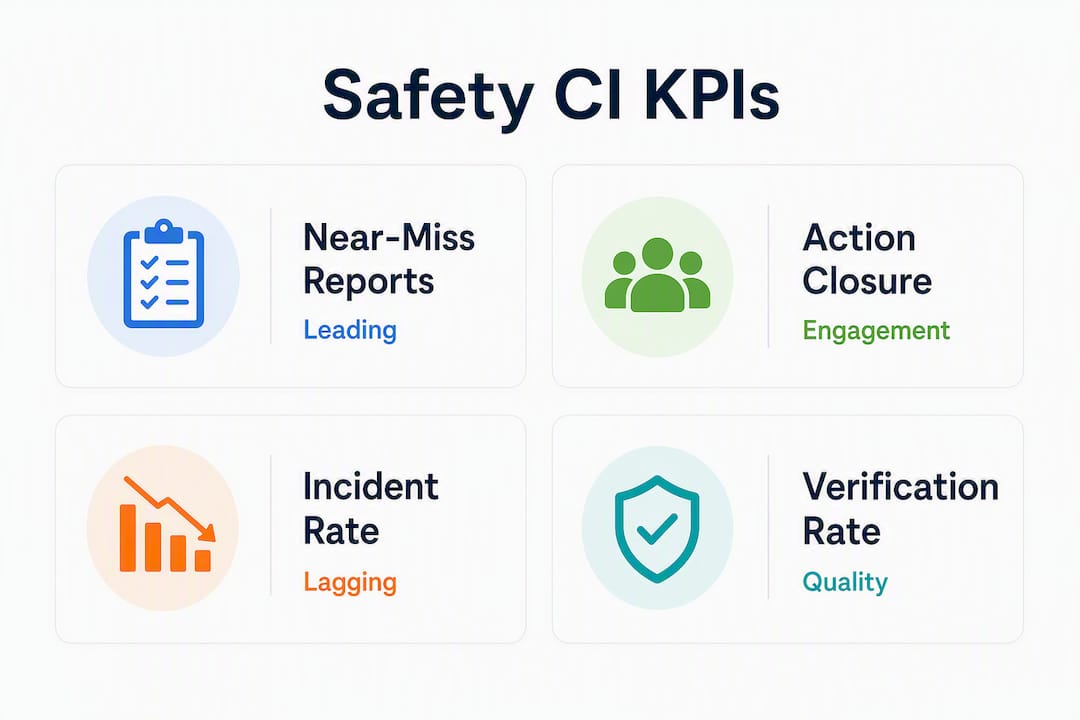
Different metrics suit different CI maturity stages. Early-stage programs should focus on activity and engagement metrics (number of near-miss reports submitted, percentage of workers trained). Mid-stage programs track closure time and near-miss rates. Mature programs measure control effectiveness and reduction in high-consequence events.
Near-miss reporting: what to capture and how
Effective near-miss systems capture: the task being performed, the hazard encountered, the potential severity, the immediate cause, and the contributing systemic factors. Anonymous reporting increases initial volume; named reporting with a verified non-punitive policy produces higher-quality data. The fire incident reporting process used in high-consequence environments provides a useful structural template for construction near-miss forms.
Recommended data collection practices:
- Review near-miss data weekly at the supervisory level; escalate systemic patterns monthly to the CI lead.
- Track corrective action closure rate as a standing agenda item at every safety committee meeting.
- Use digital tracking tools to automate reminder workflows for open actions and generate closure-rate dashboards.
- Verify effectiveness of closed actions at 30 and 90 days post-implementation.
Leadership and psychological safety: what the research says
Leadership commitment and psychological safety are not soft prerequisites for CI. They are necessary conditions. Without them, near-miss and hazard data remain incomplete, and CI efforts stall regardless of the tools or audit schedules in place.
Leaders who create psychological safety see higher near-miss capture and better-quality data for CI. The mechanism is direct: workers who fear punishment for reporting hazards withhold information; workers who trust that reports fix systems rather than assign blame provide the data that drives improvement.
Leadership CI checklist
- Conduct visible safety walks (Gemba walks) at least monthly, with documented findings and assigned actions.
- Allocate budget for corrective actions before the fiscal year begins, not reactively after incidents.
- Review CI KPI dashboards at every senior leadership meeting and hold department heads accountable for closure rates.
- Publicly recognize workers whose near-miss reports led to verified control improvements.
- Respond to every reported near-miss with a visible action within 72 hours, even if only to acknowledge receipt and assign an owner.
Effective safety leadership requires translating these behaviors into consistent, observable actions that frontline workers can verify. A leader who discusses CI in meetings but never appears on the worksite sends a signal that safety is a compliance exercise, not an operational priority.
Pro Tip: Build psychological safety by closing the loop publicly. When a worker’s near-miss report leads to a verified control, announce it by name (with permission) in the next toolbox talk. That single act does more for reporting culture than any policy document.
Common pitfalls when implementing CI in safety
The most common CI failure modes are overreach, blame-based reporting, and the Act-phase gap where corrective actions are recorded but never verified. Each has an immediate corrective action.
Top pitfalls and their fixes
- Trying to change everything at once. Launching ten simultaneous CI projects fragments ownership and produces no verified closures. Fix: limit active projects to five; complete and verify before opening new ones.
- Blame-based reporting culture. When near-miss reports trigger disciplinary responses, reporting volume collapses within weeks. Fix: establish a written non-punitive reporting policy, communicate it at every induction, and enforce it visibly when a report is made.
- Closing actions without verification. Marking a corrective action “complete” when the control has been installed but not tested is the most common source of repeat incidents. Fix: require a defined verification method and a second sign-off before any action is closed in the system.
- Focusing exclusively on lagging indicators. TRIR and lost-time rates confirm past performance; they cannot guide current intervention. Fix: add at least two leading indicators to every safety review agenda.
- Checklist fatigue. Audits conducted to satisfy a schedule rather than to generate learning produce forms, not improvements. The Act phase is the differentiator: assign owners, set deadlines, and verify completion to prevent audits from becoming paper exercises.
Do/Don’t summary:
- Do assign a named owner to every finding before the audit meeting ends.
- Don’t close an action until effectiveness has been verified against predefined criteria.
- Do report closure rates to the workforce monthly.
- Don’t use near-miss data to identify individuals for discipline.
Pro Tip: Track “verification completion rate” as a standalone KPI separate from “action closure rate.” The gap between those two numbers tells you exactly how much of your CI activity is real versus administrative.
Realistic timeline and cost factors for CI initiatives
A CI pilot in safety can show measurable leading-indicator improvement within a few months. Embedding CI as an organizational habit, with sustained leading-indicator trends and integration into the management system, takes several months to over a year. Decision-makers who expect transformational results in 90 days will defund programs before they mature.
CI implementation timeline
| Phase | Duration | Key milestone |
|---|---|---|
| Pilot planning | Initial weeks | Governance assigned, baseline assessed, a few pilots scoped |
| Pilot execution | Early months | Controls implemented, leading indicators tracked |
| Verification | Month 3 | Effectiveness confirmed as appropriate; controls standardized or revised. |
| Scale-up | Several months following pilot | Successful pilots replicated across departments |
| Management system integration | Extended timeframe | CI embedded in safety policy, procedures, and review cadence |
Cost factors to budget
- Training: Initial CI methodology training for safety leads and supervisors; ongoing continuous safety training for frontline workers.
- Reporting tools: Digital near-miss and corrective-action tracking platforms (costs vary by platform and organization size).
- Staff time: Root-cause investigations, corrective action implementation, and verification reviews represent the largest time cost.
- Minor capital controls: Engineering controls identified through pilots (e.g., guarding, lighting, tool replacement) require capital allocation.
- External consultancy: For organizations without in-house CI expertise, a QES consultancy engagement accelerates implementation and reduces the risk of stalled pilots.
ROI from CI in safety typically materializes through reduced workers’ compensation costs, lower incident-related productivity losses, and improved regulatory audit outcomes. Organizations that track these costs before and after CI implementation can quantify returns within 12–24 months of sustained effort.
Key Takeaways
Continuous improvement in safety produces verifiable, lasting risk reduction only when PDCA cycles are closed with verified corrective actions, leading indicators are tracked alongside lagging ones, and leadership creates the psychological safety that makes frontline reporting reliable.
| Point | Details |
|---|---|
| Lead with near-miss data | Near-miss reporting is the primary data source for CI; activate a non-punitive system before any other initiative. |
| Prioritize leading indicators | Metrics like corrective action closure rate and near-miss frequency predict incidents; lagging indicators only confirm them after the fact. |
| Verify every corrective action | No action is closed until effectiveness is confirmed against predefined criteria; unverified closures are the leading cause of repeat incidents. |
| Limit concurrent projects | Cap active CI pilots at five to maintain ownership, focus, and verified closure rates. |
| Com’s QES consultancy | Com accelerates CI implementation through pilot design, root-cause investigations, KPI dashboards, and leadership coaching for construction organizations. |
The lever that actually moves the needle
The most reliable predictor of CI success in safety is not the sophistication of the methodology. Organizations that run PDCA cycles on paper but never verify corrective action effectiveness produce audit records, not safer worksites. The lever that consistently moves the needle is the combination of visible leadership commitment and a non-punitive reporting culture that gives frontline workers a genuine reason to submit near-miss data.
Improving contractor safety culture follows the same logic: contractors report hazards when they trust the system will respond with controls, not consequences. That trust is built through consistent, visible follow-through, not policy documents.
The practical implication for safety managers is this: before investing in new tools or expanding audit schedules, assign a named owner and a verification deadline to every open corrective action currently in the system. That single governance action, executed this week, will produce more measurable CI progress than any new initiative launched without it. A safety officer, CI lead, or department supervisor can execute it without additional budget or external support.
Com’s QES consultancy supports your CI program from day one
Construction organizations that engage Com’s QES consultancy gain a structured implementation partner that speeds the transition from reactive safety management to verified, data-driven improvement. The practical advantage is specificity: rather than applying a generic CI framework, Com’s consultants design pilots calibrated to the hazard profile, workforce size, and regulatory obligations of each client’s operations.

Services directly relevant to CI implementation include pilot project design and scoping, root-cause investigation facilitation, KPI dashboard development, safety culture improvement programs, and leadership coaching for supervisors responsible for closing corrective actions. In the first 30–90 days of an engagement, clients receive a baseline assessment, a prioritized list of CI pilot projects, and a governance structure with named owners and verification protocols already in place.
For construction companies, contractors, and developers ready to move from compliance-driven safety to a verified CI program, the next step is a direct consultation with Com’s QES team. Review the QES consultancy options to identify the engagement model that fits your organization’s scale and timeline.
Authoritative sources and references
- How to Create a Continuous Safety Improvement Cycle — Step-by-step framework for embedding CI into daily safety operations, including near-miss capture and root-cause linkage.
- Why Continuous Improvement Is Essential for Workplace Safety — Research-backed analysis of psychological safety, leading indicators, and leadership behaviors that sustain CI.
- Introduction to Continuous Improvement (IOSH) — IOSH’s foundational overview of CI principles and their alignment with ISO 45001 and safety management systems.
- Continuous Improvement (Safeopedia) — Authoritative definition and standard context for CI within health, safety, and environment frameworks.
- Kaizen and Workplace Safety — Academic analysis of Kaizen’s role in Japanese safety management systems and its effectiveness in reducing workplace accidents.
- Trenching Safety: A Field Guide for Construction Supervisors — Field-level safety guidance illustrating how focused CI pilots apply to high-risk construction activities.