A worker enters a below-grade valve vault to inspect a leaking line. The entry permit is in place, the attendant is stationed outside, and communication checks begin normally. Ten minutes later, the entrant reports dizziness, then stops responding. This confined space rescue example illustrates the decision that separates a controlled emergency from a multiple-casualty incident: the attendant does not enter the vault.
Instead, the attendant initiates the site emergency procedure, calls for the designated rescue resource, keeps unauthorized personnel away from the opening, and maintains communication with the emergency response team. Because the entrant wore a full-body harness connected to a retrieval line before entry, trained personnel can assess whether non-entry retrieval is possible. The situation is still serious, but the rescue plan is functioning as intended.
For construction and industrial leaders, the lesson is clear. A confined-space rescue plan cannot be a generic document stored in a site folder. It must reflect the space, the work, the hazards, the available equipment, the rescue provider, and the time required to reach an incapacitated worker.
A confined space rescue example: the incident sequence
Consider a realistic maintenance task at an industrial facility. A two-person contractor crew is assigned to inspect a valve inside a vault that has limited access, restricted natural ventilation, and a vertical ladder. The vault may contain residual vapors from process piping, while rusting surfaces and decomposition of organic material may also affect air quality.
Before entry, the supervisor identifies the vault as a permit-required confined space under the site’s program. The team isolates the relevant energy sources, verifies lockout and tagout controls, barricades the entry point, and tests the atmosphere from outside the opening. Initial readings are acceptable. Continuous monitoring is arranged because conditions can change during the work.
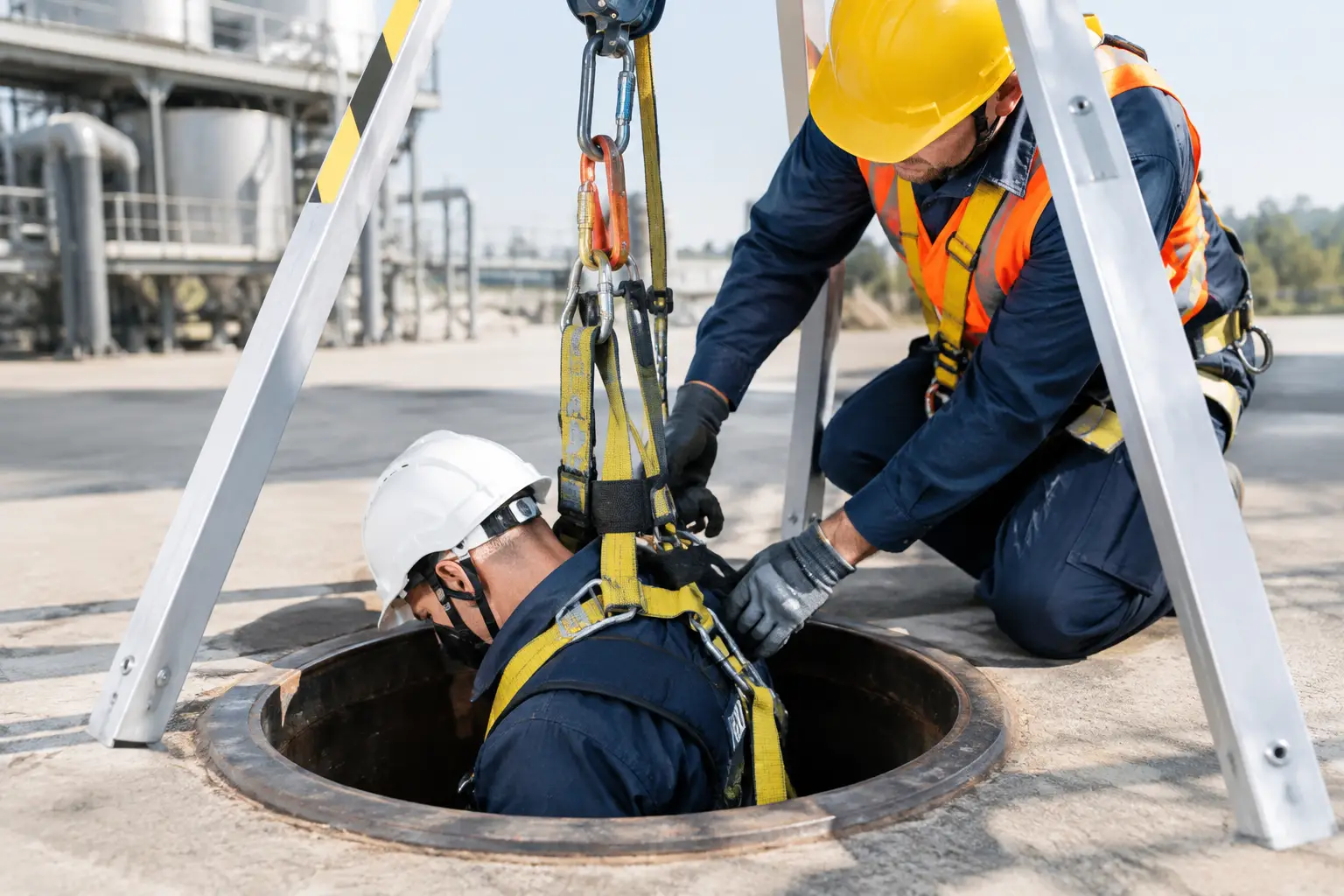
The entrant wears the required personal protective equipment, including a harness suitable for retrieval. The attendant has no other duties that would interfere with monitoring the entry. A rescue tripod and retrieval device are positioned over the opening, and the rescue contact procedure has been confirmed before work starts.
During the inspection, the atmospheric monitor alarms. The entrant reports lightheadedness and collapses. The attendant recognizes that entry to retrieve the worker could expose another person to the same hazardous atmosphere. Rather than attempting an impulsive rescue, the attendant activates the emergency plan.
If the retrieval line is clear and the worker can be removed without creating additional hazards, trained personnel use the mechanical retrieval system to extract the entrant. Emergency medical care is provided immediately. If the line is snagged, the worker is obstructed, or a non-entry rescue could worsen an injury, the designated entry rescue team takes over using the established rescue procedure.
This example is not a substitute for a site-specific assessment. A vault, tank, sewer, pit, duct, manhole, and vessel present different access, atmospheric, engulfment, mechanical, and structural hazards. The correct rescue method depends on those conditions.
Why unplanned rescue attempts cause more injuries
Most confined-space fatalities do not begin with a deliberate decision to take an unreasonable risk. They often begin with a co-worker seeing someone collapse and responding instinctively. In an oxygen-deficient or toxic atmosphere, however, a rescuer may lose consciousness within moments. One victim becomes two, then three.
This is why the attendant’s role is operationally critical. The attendant must understand that calling for help and preventing unauthorized entry are active rescue actions, not passive delays. That person needs authority to stop work, activate alarms, control access, and communicate accurate information about the entrant, space, hazards, and entry status.
A rescue provider also needs more than a phone number on the permit. Site management should confirm that the provider can respond within a time frame suitable for the identified hazards, has access to the site, understands the type of space involved, and has equipment and personnel capable of performing the required rescue. A municipal fire department may be an appropriate resource for some locations and tasks, but that determination should be verified rather than assumed.
The controls that made the difference
In this scenario, the positive outcome did not depend on luck. It depended on controls established before the entrant climbed down the ladder.
First, the employer evaluated the space and the planned work. Atmospheric hazards were anticipated, isolation requirements were identified, and the entry was controlled through a permit process. Conditions such as welding, cleaning chemicals, line breaking, sludge disturbance, or nearby vehicle exhaust can change the risk profile and must be considered before and during entry.
Second, the team used atmospheric testing correctly. Testing should address oxygen concentration, flammable gases or vapors, and toxic contaminants that may reasonably be present. Instruments must be appropriate for the expected hazards, within calibration requirements, bump-tested according to the manufacturer’s instructions and company procedure, and used at multiple levels where gases may stratify. A safe reading at the opening does not prove that the atmosphere at the bottom of a deep space is safe.
Third, the crew planned for non-entry rescue. A retrieval system can reduce the need for another person to enter a hazardous space, but only when it is compatible with the entrant’s movement and the configuration of the opening. A vertical entry with a clear path may allow mechanical retrieval. A horizontal vessel with internal obstructions may not. The equipment choice must follow the rescue assessment, not the other way around.
Finally, roles were clear. The entry supervisor, entrant, attendant, rescue team, and emergency medical response functioned as coordinated parts of one plan. Confusion over who makes the call, who contacts emergency services, or who controls the scene wastes time when every minute matters.
Building a rescue plan that works at the worksite
A credible confined-space rescue plan starts during work planning, not after the permit is issued. Project managers and EHS leaders should review each recurring or unusual space with the people who will execute the work. This includes subcontractors, maintenance personnel, and any external rescue provider.
The rescue assessment should establish the likely emergency scenarios and the method for each one. An unresponsive worker in a vertical pit, an injured worker inside a horizontal tank, and an entrant exposed to a corrosive substance may require very different techniques, equipment, and medical support. Rescue access routes, lifting points, communication dead zones, gate access, traffic conditions, and site security restrictions all affect response time.
Training must be practical. Classroom instruction explains responsibilities, but drills reveal whether a team can assemble equipment, establish communication, manage the opening, operate retrieval gear, and transfer a simulated casualty safely. Drills should use representative spaces where feasible. A rescue exercise performed in an open training area may not expose the limitations of a narrow manhole, a congested plant room, or a remote construction zone.
There is a trade-off to manage. Maintaining an internal rescue capability can provide faster response and stronger familiarity with the site, but it requires ongoing competency, staffing, equipment inspection, medical readiness, and realistic practice. Contracting a specialist rescue service can bring deeper technical capability, but the employer must validate availability, response arrangements, and familiarity with the work environment. Some higher-risk operations justify a dedicated standby rescue team; lower-risk, well-controlled entries may not. The decision should be documented and based on risk, not convenience.
Documentation should support action, not paperwork alone
A permit, rescue plan, and emergency contact list are valuable only when they match field conditions. Supervisors should confirm them at the point of entry, especially when scope changes, weather affects the area, shift personnel change, or new energy sources and chemicals are introduced.
After any alarm, near miss, aborted entry, or rescue drill, the team should capture what occurred. Was the atmosphere monitored effectively? Did the attendant have a clear line of communication? Was the retrieval device positioned correctly? Did responders reach the location without delay? These findings should lead to corrective actions, revised procedures, and targeted retraining.
For contractors, this discipline also supports stronger client confidence and inspection readiness. It demonstrates that confined-space controls are being implemented as a working safety system, not treated as a formality for prequalification or audit purposes.
The strongest rescue outcome is the one that never requires entry by a rescuer. When a worksite plans for changing conditions, equips people for non-entry retrieval where appropriate, and practices the response before an emergency occurs, workers are given more than a permit to enter. They are given a reliable path back out.