

The National Environment Agency (NEA) governs who may act as an Environmental Control Officer for Specified Construction Sites (ECO(SCS)) in Singapore, and registration is mandatory before anyone performs the role. Candidates need a degree in any discipline, or a diploma plus two years of relevant experience, or an approved Workplace Literacy and Numeracy (WPLN) pathway. They must then pass an NEA-recognized ECO training course, requiring 75% attendance and roughly a 70% exam score, before applying through the GoBusiness licence directory. The contract sum ultimately decides whether a site needs a part-time or full-time ECO at all.
TL;DR:
- ECO appointment is only required for construction projects with a contract sum above $10 million, with full-time officers needed for sums exceeding $50 million.
- Candidates must pass an NEA-recognized training course with at least 75% attendance and a 70% exam score before registering on GoBusiness for a $200 fee.
- Proper documentation, including certificates and experience evidence, must be current within five years and matched to NEA’s vocabularies to expedite review.
- ECO duties include developing and monitoring site environmental programs, maintaining records, and overseeing vector control, waste, noise, and dust management.
- Continuous training of six hours or more within the renewal cycle is required, and documentation must be meticulously organized for timely license renewal.
Table of Contents
- Which Construction Sites Actually Require an Environmental Control Officer?
- What Qualifications Do You Need for Environmental Officer Registration?
- What Does the ECO Training Course and Exam Involve?
- How Do You Register as an ECO on GoBusiness?
- What Do Environmental Control Officers Actually Do on Site?
- How Do You Renew Your ECO Licence and Stay Compliant?
- Where Can You Take a Recognized ECO Training Course?
- Should You Train Staff In-House or Outsource the ECO Role?
- Get Your Site Compliant Without the Trial and Error
- Sources
- FAQ
Which Construction Sites Actually Require an Environmental Control Officer?
Not every worksite in Singapore needs one. NEA sets the trigger at contract sum, and the appointment obligation scales with project size under the ECO(SCS) framework.
- Contract sum of $10 million or less: no ECO appointment required.
- Above $10 million up to $50 million: a part-time ECO, defined as at least 15 hours a week on site.
- Above $50 million: a full-time ECO, defined as at least 40 hours a week on site.
The occupier, not the contractor, casually carries the legal duty to appoint an ECO before works begin and to keep the position filled throughout construction. If an ECO leaves or is suspended, the site has just 14 days to appoint a replacement. Acting as an ECO without valid registration is an offense under the Environmental Public Health Act (EPHA) 1987 and its subsidiary regulations, so occupiers who skip this step are exposed to enforcement action, not just a compliance gap.
What Qualifications Do You Need for Environmental Officer Registration?
NEA’s environmental officer qualifications are built around two entry routes, and picking the right one from the start saves months of back-and-forth with the licensing team.
- Degree route: a degree from any discipline qualifies you academically, no environmental science or engineering major required.
- Diploma route: a diploma plus two years of relevant work experience in fields like environmental engineering, pest control, waste management, cleaning services, or estate management.
- WPLN route: candidates who lack formal qualifications may still qualify through an approved Workplace Literacy and Numeracy assessment at the level NEA specifies.
For the diploma route, acceptable evidence includes appointment letters and employer testimonials on company letterhead that describe your actual duties, not just your job title. Vague references (“worked in facilities”) rarely satisfy NEA reviewers, while specific descriptions (“managed pest control contracts and monitored waste disposal for a 200 unit estate”) tend to move through faster.
Pro Tip: Before you submit anything, rewrite your past job descriptions using NEA’s own vocabulary from the Code of Practice, things like vector control, sanitary facilities, or earth control. Reviewers are matching your evidence against a checklist, and matching their exact terms shortens the review.
What Does the ECO Training Course and Exam Involve?
The course itself is where certification for environmental officers gets concrete, and it follows a fairly rigid structure across recognized providers.
- Course content covers environmental laws and enforcement powers, vector control, food hygiene, waste management, noise and air/dust abatement, and hands-on drafting of the Site Environmental Control Programme (SECP) and Site Environmental Control Report (SECR) templates.
- Attendance requirement: you need at least 75% attendance to even sit the exam, a rule enforced strictly by SP PACE and comparable providers).
- Exam format and pass mark: the assessment is a timed, electronic multiple-choice exam, typically scheduled about two weeks after the course ends, with a pass mark around 70%.
- Certificate validity: your course certificate must be issued within five years of your licence application. Wait too long and you will need a refresher exam or full retake before NEA accepts your file.
The practical drafting exercises matter more than they sound. Course providers build the SECP and SECR practice sessions specifically so graduates can walk onto a real site and produce compliant paperwork on day one, rather than learning the templates from scratch under deadline pressure.
How Do You Register as an ECO on GoBusiness?
Registration runs entirely through the GoBusiness licence directory, and the licence fee is $200. Before you start the online application, gather these:
- Your ECO training certificate, issued within the five-year validity window.
- Proof of academic qualifications or documented relevant experience, matching the route you qualified under.
- An identity photo meeting NEA’s specific format requirements (dimensions and background matter here, so check the spec sheet rather than reusing a passport photo).
- The “ECO(SCS) Proof of Training Attendance” form, when your provider requires it separately from the certificate.
Once appointed to a site, you also need to submit your SECP and SECR templates, and keep them inspection-ready at all times since NEA officers can request them without notice. Processing isn’t instant, and if NEA flags a gap in your documentation, respond promptly with the specific clarification requested rather than resubmitting the whole file. A well-organized environmental compliance guide for your site’s specific risk profile makes this step considerably smoother.
What Do Environmental Control Officers Actually Do on Site?
Environmental compliance officer duties go well beyond periodic inspections. NEA frames the role as active stewardship: you develop, implement, and revise your site’s environmental program, not just check boxes against someone else’s plan.
- SECP (Site Environmental Control Programme): the master plan for the site, submitted for occupier endorsement within one month of works commencing.
- SECR (Site Environmental Control Report): a recurring report, prepared monthly or as NEA requires, documenting what actually happened on site and endorsed by the occupier before any inspection.
- Vector control: engaging NEA-registered Vector Control Operators, maintaining weekly service records, and swapping out underperforming contractors when results slip.
- Core focus areas: food hygiene, waste management, noise control, air and dust abatement, earth control and water pollution prevention, and sanitary facility upkeep.
None of this works as a paper exercise. NEA expects ECOs to keep dated records, monitor conditions on a set cadence, and recommend concrete improvements when something isn’t working, treating the SECP as a living document rather than a file drawer formality.
How Do You Renew Your ECO Licence and Stay Compliant?
Renewal hinges on continuing training, and NEA counts specific activities toward it: post-graduate courses, SkillsFuture Singapore (SSG) or WSQ-accredited courses, seminars, and workshops. You need at least six accumulated hours of this informal training within your renewal cycle, and your underlying course certificate still can’t be older than five years at the point of any application tied to it.
- Expired certificates are the single most common rejection reason. Track your five-year window from day one.
- Thin experience documentation slows diploma-route applications; generic testimonials get sent back for revision.
- Wrong photo specifications cause avoidable delays on an otherwise complete file.
- Late notification of occupation or appointment changes beyond NEA’s timelines creates compliance gaps that outlast the paperwork fix.
Pro Tip: Keep one folder, digital or physical, holding every attendance certificate, employer letterhead, and appointment letter with dates attached. When renewal comes around, you assemble in minutes instead of chasing HR departments for records from three years ago.
Where Can You Take a Recognized ECO Training Course?
Recognized ECO training courses run through polytechnic continuing-education arms like SP PACE, alongside SSG and WSQ-approved providers listed on MySkillsFuture. Formats vary: in-person classroom sessions, synchronous e-learning, and standalone refresher exams for lapsed certificates.
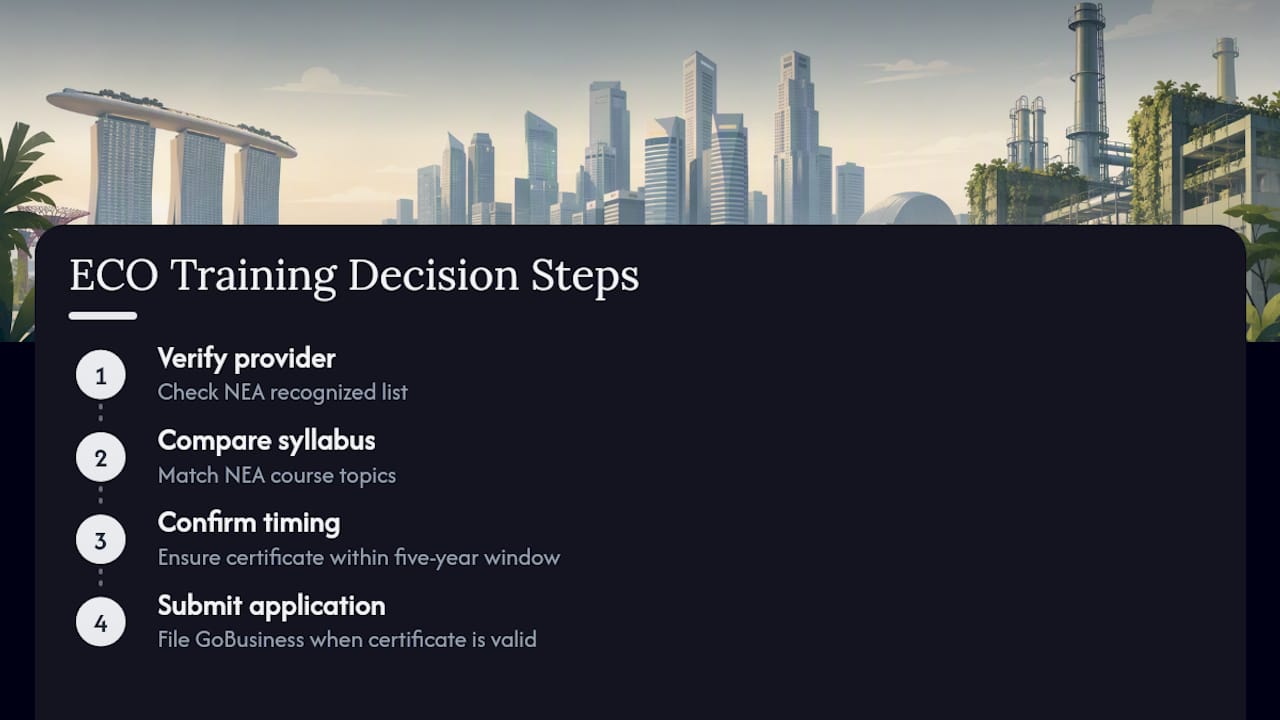
Before enrolling, cross-check the provider against NEA’s recognized list and compare the syllabus to NEA’s own course topics, vector control, waste, noise, air and dust, SECP/SECR drafting. Time your enrollment so the resulting certificate falls within the five-year window when you actually submit your GoBusiness application, not just when you finish the course.
Should You Train Staff In-House or Outsource the ECO Role?
Outsourcing suits short projects or one-off full-time ECO needs where building internal capability doesn’t pay off. Training your own staff makes sense on long-running developments where continuity and a genuine career path for environmental control officer talent matter more than short-term convenience. Firms offering EHS manpower outsourcing and hands-on training, like MOSAIC, can bridge either choice.
— Aman
Get Your Site Compliant Without the Trial and Error
Chasing down NEA’s forms, contract-sum thresholds, and five-year certificate windows on your own is where most occupiers lose weeks they don’t have. Some firms work these requirements daily across construction sites in Singapore, which means an occupier can get a compliance path built around the actual project size, not a generic checklist copied from a government PDF.

Our EHS Advisory and Documentation service handles the SECP and SECR templates NEA expects to see on inspection, prepared in the exact format reviewers look for, so your ECO isn’t drafting from scratch under deadline pressure. If your team needs the training itself, our Environment Health Safety Training programs map directly to ECO competency areas, giving candidates a head start before they sit the NEA exam. And where a site simply needs a qualified ECO now rather than in three months, our Consultancy team can staff and support that role directly. Once construction wraps, coordinating post-project site cleanup against NEA’s building site cleaning standards rounds out a clean handover. Contact providers to review your project’s contract sum and get a documentation plan started.
Sources
- Environmental Control Officers for Specified Construction Sites — NEA
- Environmental Control Officer (Specified Construction Sites) — GoBusiness licence directory
FAQ
How Do You Become an Environmental Control Officer in Singapore?
You need a degree in any discipline, or a diploma plus two years of relevant experience, or an approved WPLN pathway. From there, complete an NEA-recognized training course with 75% attendance, pass the exam, and register on GoBusiness.
What Do You Need to Qualify as an Environmental Officer?
You need either formal academic qualifications (degree or diploma plus relevant experience) or an approved WPLN assessment, followed by a passed NEA training course. Registration through GoBusiness with a valid course certificate completes the process.
What Is the Average Salary for an Environmental Control Officer in Singapore?
Salary figures for this role aren’t published by NEA or any government source, and no verified industry-wide figure is publicly listed. Pay typically depends on whether the role is part-time or full-time and the size of the appointing construction firm.
What Are the Main Responsibilities of an Environmental Control Officer?
An ECO develops and maintains the Site Environmental Control Programme, submits monthly Site Environmental Control Reports, and oversees vector control, waste management, noise, air and dust abatement, and sanitary facilities on site. They also coordinate NEA-registered vector control operators and keep inspection-ready records at all times.
How Much Does ECO Registration Cost?
The NEA licence fee for ECO(SCS) registration is $200, payable through the GoBusiness portal. Training course fees are separate and vary by provider, so check current pricing directly with providers like SP PACE.
Recommended
- Environmental compliance guide for Singapore construction projects
- 50 mg/L Limit: Singapore Earth Control Measures for PUB Compliance
- Construction safety compliance guide: Steps for Singapore firms
- The Ultimate Guide to EHS Compliance in Singapore: Navigating Key NEA & MOM Regulations for Your Business