
A safe work procedure (SWP) is a formal, step-by-step document specifying the safest and most efficient method to perform a specific task, outlining the associated hazards, required controls, personal protective equipment (PPE), and emergency responses. Unlike general safe work practices, which are broad behavioral guidelines, an SWP is task-specific and prescriptive. It tells workers exactly what to do, in what order, and how to manage each risk at every stage.
Every effective SWP contains these core elements:
- Task description: A clear identification of the work activity and its scope
- Hazard identification: All foreseeable risks associated with each task step
- Control measures: Specific actions to eliminate or reduce each identified hazard
- PPE requirements: Exact equipment required, when to use it, and where to obtain it
- Step-by-step instructions: Sequential, unambiguous actions workers must follow
- Emergency procedures: Defined responses to foreseeable incidents or failures
- Training and competency requirements: Qualifications or authorizations needed to perform the task
- Document control details: Revision dates and responsible personnel for version management
SWPs serve as the operational backbone of any workplace safety management system, standardizing task execution, preserving institutional knowledge when experienced personnel leave, and providing an objective basis for training and supervision.
What is a safe work procedure and when is one required?
Not every task demands a written SWP. OSHA’s safety management guidance is explicit: employers should conduct a job hazard analysis to determine which tasks carry risks serious enough to warrant formal written procedures. Low-risk, routine tasks may be adequately addressed through verbal instruction alone.
Written SWPs are generally required when:
- The task involves hazardous materials, dangerous machinery, or confined spaces
- Workers are infrequently assigned to the task and need structured reminders about hazard controls
- The consequences of error are severe, including potential fatality or serious injury
- Regulatory or statutory frameworks mandate documented procedures for specific activities
- The task involves multiple workers or departments, requiring coordinated, standardized execution
A proactive safety program built around written SWPs reduces workplace injuries, workers’ compensation costs, and operational downtime by replacing reactive incident response with systematic hazard prevention. The organizational case is straightforward: standardized procedures protect workers and shield employers from regulatory liability simultaneously.
Which types of workplace tasks typically need safe work procedures?
High-consequence or technically complex tasks are the primary candidates for formal SWPs. The criterion is not simply whether a task is dangerous in isolation, but whether the potential consequences of deviation are severe and whether the task requires a defined sequence to be performed safely.
Common task categories requiring SWPs include:
- Machinery operation and maintenance: Pre-operation checks, guarding verification, and shutdown sequences for heavy equipment
- Lockout/tagout (LOTO) procedures: Isolation of hazardous energy sources before maintenance or servicing
- Confined space entry: Atmospheric testing, ventilation, standby personnel, and rescue protocols
- Hot work: Welding, cutting, and grinding operations with fire prevention and permit requirements
- Electrical work: Live-line work, panel access, and testing under energized conditions
- Working at height: Scaffold erection, fall arrest system inspection, and ladder use protocols
- Hazardous chemical handling: Storage, transfer, spill response, and disposal procedures
Routine, low-risk tasks such as general office cleaning or basic material stacking may not require formal written procedures. The hazard identification process for each task determines where formal documentation is warranted and where verbal guidance suffices.
How to develop effective safe work procedures step by step
Developing a usable, compliant SWP requires a disciplined process that integrates technical analysis with direct worker input. A procedure written in isolation by a safety manager, without field verification, frequently fails at the point of work.
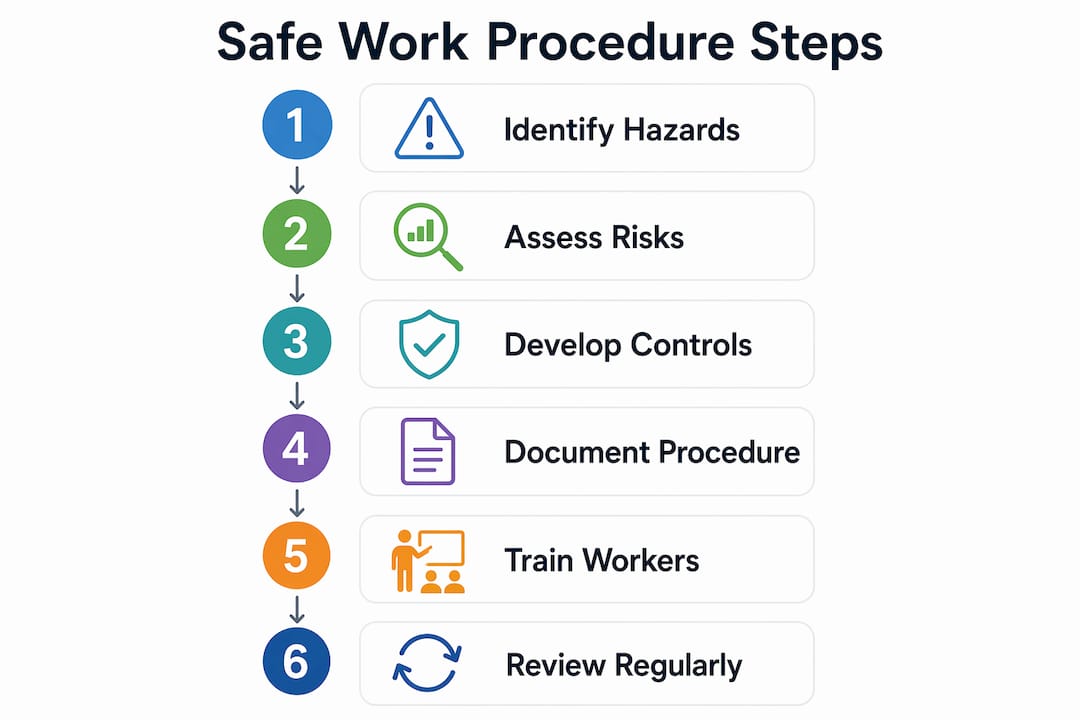
- Identify the task requiring a procedure. Define the scope precisely: what activity, what equipment, what location, and under what conditions the task occurs.
- Break the task into its basic sequential steps. Observe the task being performed by experienced workers to capture the actual sequence, not an assumed one.
- Conduct a job hazard analysis for each step. Identify every foreseeable hazard at each stage, assess the associated risk level using a risk matrix, and determine appropriate control measures following the hierarchy of controls.
- Document controls, PPE, and emergency responses. For each hazard, specify the exact control measure, the PPE required, and the emergency procedure if the control fails.
- Write the procedure in clear, unambiguous language. Specify tools, materials, torque values, calibration settings, and any other technical parameters workers need. Avoid vague directives like “use suitable tools.”
- Assign document control details. Record the author, reviewer, approval authority, revision date, and version number. Documenting revision dates and responsible personnel is critical for ongoing management.
- Validate the procedure with workers before finalizing. Have those who perform the task review the draft for accuracy, feasibility, and completeness.
- Train workers on the procedure and verify competency. Providing a document and asking workers to sign that they have read it is insufficient. Workers must demonstrate they can perform the task according to the procedure.
Pro Tip: Involve workers at every stage of SWP development, not just the review phase. Those performing the task daily identify hazards and practical constraints that no desk-based analysis will surface, and their involvement drives genuine compliance rather than paper compliance.
How to integrate risk assessment with safe work procedures effectively

Risk assessment and SWP development are not parallel processes. They are sequential and interdependent. The job hazard analysis (JHA) generates the hazard data that populates the SWP; the SWP then translates that data into operational instructions workers can execute.
Key integration principles:
- Risk scoring drives procedure priority. Tasks with higher residual risk scores after initial controls are applied require more detailed, prescriptive SWPs. Lower-risk tasks may need only basic procedural documentation.
- Control measures must reflect the hierarchy of controls. Elimination and substitution controls appear first; administrative controls and PPE appear last. The SWP must reflect this hierarchy explicitly, not simply list PPE as the primary safeguard.
- Hazard identification must cover all foreseeable conditions, including abnormal operations, emergency shutdowns, and temporary equipment configurations.
- SWPs should specify competencies and authorizations required for task performance, ensuring only qualified personnel execute high-risk activities.
The construction hazard examples encountered across industrial sites illustrate why generic hazard lists are inadequate. Each task environment introduces site-specific variables that a thorough JHA must capture and the SWP must address directly.
Practical examples of safe work procedures in real-world settings
Three task categories illustrate how SWP principles translate into operational practice across industrial and construction environments.
| Task | Key SWP Elements | Primary Hazards Addressed |
|---|---|---|
| Heavy equipment pre-operation check | Equipment inspection checklist, defect reporting protocol, operator authorization | Mechanical failure, struck-by incidents |
| Lockout/tagout (LOTO) | Energy isolation sequence, lock application, verification testing, group lockout protocol | Unexpected energization, electrocution |
| Confined space entry | Atmospheric testing, ventilation requirements, entry permit, standby person duties, rescue plan | Oxygen deficiency, toxic atmosphere, engulfment |
Effective SWPs across these examples share common structural features:
- A defined authorization or permit requirement before work begins
- Explicit atmospheric or equipment verification steps prior to task commencement
- Named emergency contacts and rescue procedures integrated into the document
- Clear PPE specifications tied to each identified hazard, not listed generically at the document header
The diversity of these examples reflects a core principle: SWP structure is consistent, but content must be task-specific. A confined space entry procedure and a LOTO procedure share the same document architecture but contain entirely different hazard profiles and control sequences.
Best practices for maintaining and applying safe work procedures
Writing a procedure does not improve safety. Implementation, comprehension, and consistent adherence determine whether an SWP delivers its intended outcome. Overly rigid or poorly written procedures frequently generate unsafe workarounds, defeating the purpose of the document entirely.
- Treat SWPs as living documents. Review procedures at least every three years, after any workplace incident, or whenever equipment, processes, or regulatory requirements change. Outdated procedures are operationally hazardous.
- Deploy digital job aids and checklists. Paper-only procedures often go unread at the point of work. On-screen checklists, laminated field cards, and mobile-accessible formats increase real-time adherence.
- Balance completeness with usability. Over-detailed procedures hinder effective use; overly simple ones risk missing critical hazards. The target is a document a qualified worker can follow consistently without needing to interpret ambiguous instructions.
- Never assume compliance without verification. Regular monitoring, direct observation, and periodic audits confirm whether procedures are being followed, and whether they remain fit for purpose.
- Involve workers in every review cycle, not just initial development. Workers who participate in updates are more likely to follow the revised procedure and flag emerging hazards early.
Pro Tip: When workers are observed deviating from an SWP, the first question should be whether the procedure reflects actual current conditions. Deviation often signals a procedure that has fallen out of step with the work, not simply a compliance failure.
Roles and responsibilities in implementing and following SWPs
Effective SWP implementation requires clearly assigned accountability at every organizational level. Diffuse responsibility produces gaps in both development and enforcement.

Employers and senior management bear the primary legal obligation to ensure SWPs exist for all hazardous tasks, are adequately resourced, and are enforced consistently. They set the safety culture that determines whether procedures are taken seriously or treated as administrative formalities.
Safety managers and supervisors are responsible for developing technically sound SWPs through proper hazard analysis, coordinating worker consultation, managing document control, and verifying that training has been completed and competency demonstrated. Supervisors also carry the day-to-day enforcement responsibility, including addressing non-compliance promptly.
Workers are obligated to follow established SWPs, use the specified PPE, and report hazards or procedural deficiencies they identify during task performance. Their practical knowledge is the most reliable source of procedure improvement. Worker consultation at all stages of SWP development is the recognized standard for producing procedures that are realistic and genuinely followed.
How training and communication methods strengthen SWP adherence
Training on an SWP must go beyond document distribution. Providing a procedure and requesting a worker’s signature of acknowledgment does not constitute adequate training. Workers must demonstrate competency in performing the task according to the procedure before being authorized to work independently.
Effective training and communication methods include:
- Practical demonstration and return demonstration: Workers observe a qualified trainer perform the task per the SWP, then demonstrate the procedure themselves under supervision.
- Toolbox talks: Short, task-specific briefings conducted at the worksite before high-risk activities reinforce key SWP steps and hazard controls in context.
- Visual job aids: Laminated cards, posted diagrams, and on-screen checklists placed at the point of work provide real-time procedural reference without requiring workers to retrieve a separate document.
- Multilingual communication: Training materials and job aids must be provided in a form that all workers can understand, including those with limited English proficiency.
- Incident-driven retraining: Following any near-miss or incident linked to a specific task, targeted retraining on the relevant SWP reinforces correct practice and addresses any procedural gaps identified in the incident investigation.
For construction environments, building walkthrough protocols offer a practical model for how pre-task verification and structured communication can be embedded into routine site operations, complementing formal SWP training.
Key Takeaways
A safe work procedure is only as effective as its implementation, worker involvement, and the regularity with which it is reviewed and updated to reflect actual site conditions.
| Point | Details |
|---|---|
| SWPs are task-specific documents | They specify hazards, controls, PPE, and sequential steps for a defined task, not general safety guidance. |
| Risk assessment drives SWP content | Job hazard analysis determines which tasks need formal SWPs and what controls each procedure must specify. |
| Worker consultation is the standard | Engaging workers in development and review produces procedures that are realistic, accurate, and followed. |
| SWPs require periodic review | Procedures must be reviewed at least every three years, after incidents, or when processes or equipment change. |
| Implementation requires verified training | Workers must demonstrate competency in the procedure, not simply acknowledge having read it. |
Com’s safety consultancy team supports construction companies and industrial operators in developing, auditing, and maintaining SWPs that meet regulatory requirements and withstand scrutiny. Explore safety audit frameworks that verify whether your procedures are compliant, current, and operationally effective.

Recommended
- The Ultimate Guide to Risk Assessment in Singapore: Mastering WSH Compliance to Protect Your People and Your Business – MOSAIC Eco-construction Solutions Pte Ltd
- Workplace risk assessment in Singapore construction: A practical guide
- Workplace safety in Singapore: A guide for construction compliance
- The Ultimate Guide to Preventing Slips, Trips, and Falls: A 2025 WSH Blueprint for Singapore Workplaces – MOSAIC Eco-construction Solutions Pte Ltd
