Introduction
Wearable tech on the ground is changing how Singapore’s construction and marine sites manage heat stress prevention. With MOM enhancing its Heat Stress Management Framework-effective 1 December 2026-and explicitly trialling wearable safety tech for real-time physiological monitoring, the question for site supervisors and WSH officers is no longer if but how to deploy these devices effectively.
This article focuses on how IoT wearable devices-heart rate monitors, body temperature sensors, and motion trackers-help safety leaders and consultants manage heat stress and worker fatigue management among outdoor workers in Singapore’s construction industry and marine sectors. It covers what the technology does, how it supports MOM/WSH compliance, how to implement it on live sites, and common pitfalls. This is not a vendor comparison or a deep hardware review.
The short answer: yes, properly deployed wearable safety tech can help meet MOM’s WSH heat stress guidelines, reduce heat related incidents, and give supervisors objective real time data on fatigue-before a worker collapses. Real-time monitoring improves worker safety in high-heat environments, and compliance regulations increasingly recommend wearable physiological monitoring in high risk environments.
Target readers: construction site supervisors, WSH officers, project managers, and marine safety consultants responsible for outdoor crews in Singapore.
Key outcomes you will gain from this article:
-
Understand core MOM / WSH heat stress expectations and why current “manual” controls are not enough in 2026.
-
Know which wearable sensors and features matter for monitoring heat stress and fatigue management on Singapore work sites.
-
See how to integrate wearable data into toolbox meetings, permits-to-work, and risk assessments.
-
Get a simple, staged rollout plan that MOSAIC Ecoconstruction Solutions Pte Ltd typically uses with clients.
-
Learn how to overcome worker resistance, alert fatigue, and integration headaches with practical solutions.
Note: Where appropriate, suggested photo/diagram placements are indicated to help visual learners and content teams.
Understanding Heat Stress and Fatigue in Singapore’s Outdoor Workplaces
Heat stress occurs when environmental conditions-high temperatures, humidity, solar radiation, restricted air movement-place a heat load on the body that it cannot shed fast enough. Work-related fatigue is the cumulative physical and mental exhaustion from prolonged exposure to these conditions combined with heavy labour. In Singapore’s tropical climate, where wet-bulb globe temperature (WBGT) readings regularly hit 31–33 °C during midday, both are daily operational realities rather than rare events.
This is a growing problem. Singapore’s workforce is ageing, and many foreign workers arrive from cooler climates without adequate acclimatisation. MOM and the WSH Council have issued enhanced heat stress measures for outdoor work that elevate several previously recommended practices-cool drinking water, training, suitable clothing-to mandatory requirements from December 2026. High-risk tasks common across Singapore sites include rebar tying, formwork assembly, deck work, tank cleaning, scaffolding erection, and roadworks-all performed in extreme heat with heavy personal protective equipment.

Key Heat Stress Concepts for Site Supervisors
Understanding a few technical terms in plain language makes a real difference when interpreting wearable data or briefing crews:
-
Heat stress vs heat strain vs heat related illness. Heat stress is the external load (environment + workload). Heat strain is how the body responds-elevated core body temperature, increased heart rate, heavy sweating. If heat strain is not managed, it progresses to heat related illness: muscle cramps, heat exhaustion (dizziness, nausea, weakness), and heat stroke (confusion, loss of consciousness, organ damage). A heart rate above 180 bpm minus age indicates heat stress, while core body temperature should not exceed 38 °C during work. Skin temperature above 43 °C is a critical threshold.
-
Environmental vs personal risk factors. Environmental: WBGT level, radiant heat from hot surfaces (asphalt, metal decking), humidity. Personal: type of PPE that traps heat, age, fitness, medications, dehydration, and lack of acclimatisation. MOM WBGT monitoring guidelines require that once WBGT reaches ≥ 32 °C, heavy physical work needs a minimum 10-minute rest every hour under shade.
-
Early symptoms supervisors actually see on the ground. Slower responses to instructions, unsteady gait, excessive or suddenly stopped sweating, clammy skin, unusual quietness, slurred speech, headache complaints, decreased alertness. These are the heat related symptoms that precede a medical emergency.
Current control measures-rest-shade-hydrate policies, spot checks, reliance on supervisor judgement-are reactive. They depend on subjective assessment and cannot “see” internal temperature or cardiovascular strain. Language barriers among multi-national crews and cultural reluctance to report weakness mean symptoms are often under-reported. Environmental measures like hourly WBGT readings tell you about the site, not the individual worker. This is where traditional controls fall short-and why wearable technology has become essential in occupational safety for outdoor workers.
Suggested visual: simple infographic showing heat illness progression timeline across a typical 10-hour day shift, from early heat strain to heat exhaustion to heat stroke.
Understanding Work-Related Fatigue in Outdoor Crews
Physical fatigue in Singapore’s construction and marine sectors comes from long shifts (often 10–12 hours), heavy manual handling, repetitive motions, and overtime. Mental fatigue builds from sustained attention demands, environmental stressors such as noise, vibration, and extreme temperatures, and-in marine work-irregular shift patterns and exposure to sun, spray, and confined spaces. Both forms pose significant health risks.
Heat stress and fatigue interact in a dangerous feedback loop. Heat strain increases heart rate and energy expenditure, meaning workers tire faster. Dehydration-common when crews don’t spend time hydrating consistently-reduces cognitive performance and reaction time. A fatigued worker is less likely to notice hazards, less likely to heed safety measures, and more likely to ignore heat related symptoms or wearable alerts. In the worst case, prolonged exposure to extreme heat while fatigued can progress directly from apparent tiredness to heat stroke with little visible warning.
Supervisors already track lagging indicators that correlate with fatigue: a rise in near misses during late-shift hours, minor injuries (heat rash, slips, dropped tools), rework, and drops in productivity. These are signals-but they come after the risk has materialised. Wearable tech offers a way to move from “gut feel” to objective, real-time physiological information about heat strain and fatigue, giving safety leaders a chance to intervene before incidents occur.
What Wearable Safety Tech Can Do for Heat Stress Prevention
With the physiological and environmental picture clear, the question becomes: what can modern IoT wearable devices actually do on a Singapore job site? This section explains the main functions of devices such as armband sensors, chest straps, smart patches, and smart helmets-focusing on capabilities rather than brand promotion. Wearable technology has become essential in occupational safety for outdoor workers operating in high risk environments.
Core Sensors and Data: Heart Rate, Temperature and Motion
The wearable devices used for heat stress prevention on construction and marine sites typically measure several vital signs and environmental parameters relevant to MOM heat stress guidance:
-
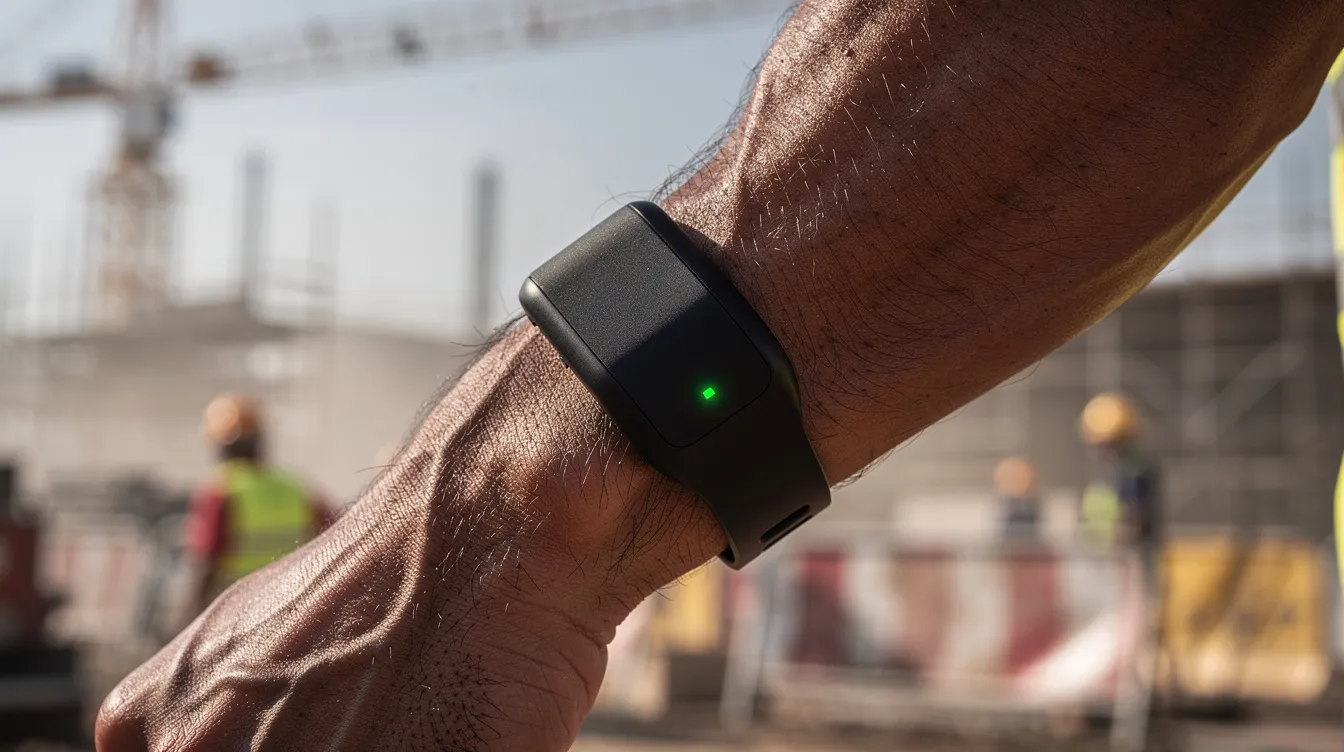
Heart rate and heart rate variability (HRV). Measured via chest straps or optical sensors on armbands worn on the upper arm. Heart rate can indicate heat related illness risk: sustained elevation above safe thresholds (e.g., above 180 bpm minus the worker’s age) signals cardiovascular strain. HRV drops as fatigue accumulates, offering an early warning of physiological strain before symptoms are visible. Wearables monitor heart rate and core body temperature continuously throughout the shift.
-
Skin temperature and estimated core temperature. Skin temperature sensors on armbands or smart patches provide continuous surface readings. Advanced algorithms-some originally developed by the U.S. military-combine skin temperature, ambient conditions, and activity data to estimate core body temperature without invasive ingestible sensors. Core temperature should not exceed 38 °C during work; skin temperature above 43 °C is a critical threshold.
-
Motion and activity level. Accelerometers and gyroscopes distinguish heavy exertion from rest, detect posture changes (e.g., a worker suddenly sitting or falling), and quantify how long someone has been performing intense physical work without a break.
-
Ambient environmental data. Some setups include portable temperature and humidity sensors integrated into PPE or fixed at critical zones, complementing the site’s WBGT meters. Wearable devices can combine environmental data with physiological monitoring to assess heat risk holistically.
-
Smart patches represent a newer category: adhesive sensors that analyze sweat to estimate electrolyte and fluid loss, providing personalised hydration recommendations beyond generic “drink 300 ml per hour” rules.
Data streams from these sensors via Bluetooth to a paired smartphone or local hub, then via LTE or LoRaWAN to a cloud-based supervisor dashboard. For heat safety, sampling frequency matters-some systems record every second, and alert latency should ideally stay under 30–60 seconds. The SlateSafety BAND V2, for example, monitors core body temperature and heart rate and has been deployed with measurable results: SRMC reported no heat related incidents using the BAND V2.
Alerts, Dashboards and Heat Risk Scoring
Raw sensor data only matters if it reaches the right person in a form they can act on. Here is how modern wearable platforms convert data into actionable insights:
-
Personalised thresholds. Rather than applying one-size-fits-all limits, systems can be configured by worker profile-factoring in age, acclimatisation status, and any medical restrictions where disclosed. Wearable technology may not address individual worker needs out of the box, which is why this configuration step is critical.
-
Heat strain indices and fatigue scores. Algorithms combine continuous heart rate, body temperature trends, and activity data into a single risk score. Workers receive immediate alerts to take breaks or hydrate when physiological thresholds are exceeded.
-
Tiered colour-coded alerts. Amber (early warning: elevated readings, drink water, slow down) and red (critical: stop work, rest in shade, supervisor check). Alerts can be delivered via SMS, WhatsApp, in-app pop-ups, or even haptic vibration on the device itself. Real time alerts can prevent heat related illnesses when they reach supervisors fast enough.
-
Dashboard views for site teams. Integrated systems provide site-wide visibility of workers health through dashboards. Typical views include a site “heat map” showing zones or groups at higher risk, a list of workers currently in warning or critical range, and historical graphs for toolbox discussion-for example, “yesterday’s hottest two-hour window saw all rebar workers in the red zone between 1300 and 1500h.”
The time-scale point cannot be overstated: real time data and alerts must arrive within 30–60 seconds to be meaningful for on-the-ground intervention. Anything slower risks becoming a retrospective record rather than a prevention tool. Wearables can predict heat related illnesses before they occur, but only if the alert-to-action loop is fast.
On-the-Ground Interventions Triggered by Wearables
When an alert fires, supervisors can take concrete proactive measures rather than waiting for visible distress:
-
Immediate shaded rest and hydration. The flagged worker moves to shade, drinks water (at least 300 ml), and the recovery period is documented in the system. At WBGT 31–33 °C, MOM guidance calls for at least 300 ml per hour or more depending on work intensity. Cooling garments can actively mitigate heat exposure during recovery periods.
-
Task rotation. The flagged worker is rotated away from heavy exertion-shifted to lighter duties while a co worker takes over the physically demanding task. This prevents heat exhaustion from escalating.
-
Shift adjustments. When wearable data shows recurring dangerous periods (e.g., 1200–1500h consistently triggering multiple red alerts), supervisors can adjust schedules: earlier starts, split shifts, or rescheduling heavy work to cooler hours. These schedule changes are driven by data, not guesswork.
-
Audit-ready logging. Every alert, intervention, and recovery can be logged automatically in the platform, creating a digital record for incident investigations, MOM inspections, or client audits.
Why wearables improve outcomes vs visual checks alone:
-
They detect internal temperature rise and cardiovascular strain before external symptoms appear.
-
They provide objective, timestamped records-not subjective supervisor impressions.
-
They cover every monitored worker simultaneously, not just whoever the supervisor happens to be watching.
-
Real-time monitoring enhances workplace safety and productivity across the site.
-
Wearables can enhance environmental health literacy among workers, helping them understand their own heat related risks.
VigiLife’s technology, as one documented real world application, saved a construction firm over $200,000 by preventing heat related incidents and reducing productivity losses-demonstrating that wearable tech can save lives and protect the bottom line simultaneously.
To get these benefits reliably, sites need to integrate the tech into their WSH system, not just hand out devices.
Integrating Wearable Tech into Singapore Heat Stress Management Programs
Wearable technology only delivers on its promise when embedded within a site’s regulatory and operational framework. In Singapore, that means linking wearable data to MOM requirements, the WSH Council’s advisory framework, ISO 45001, and bizSAFE certification expectations. This is where MOSAIC Ecoconstruction Solutions Pte Ltd brings consultancy experience to bear-offering pragmatic steps, not theory, for helping organizations deploy wearables on real sites.
Mapping Wearables to MOM / WSH Requirements
Wearables support compliance across several regulatory and standards dimensions:
-
MOM guidelines on working under hot environments. The enhanced heat stress measures effective December 2026 require monitoring, acclimatisation protocols, rest schedules, hydration, and emergency response plans. Wearables do not replace mandatory WBGT measurement but augment it by capturing individual heat strain-exactly the kind of “real-time, personalised monitoring” that MOM has referenced in Parliament as a technology being trialled in the construction and built environment sectors.
-
Risk Management Regulations. Employers must assess risk and implement controls. Physiological data from wearables-heart rate trends, core temperature patterns, fatigue indices-feeds directly into risk assessment reviews, providing quantitative evidence where previously only qualitative observations existed.
-
bizSAFE and ISO 45001. Both expect measurement and monitoring of worker health and safety performance. Wearable data provides the documented evidence of heat stress programme effectiveness that auditors look for.
While MOM does not mandate specific brands or devices, they expect employers to demonstrate a systematic approach. Wearable data provides that objective evidence. Document this in your safety management system by attaching threshold settings, alert response procedures, and role definitions to your heat stress SOPs.
Step-by-Step Deployment Process on a Live Site
Many contractors worry that implementing wearables will disrupt production. A phased approach-the kind MOSAIC uses with clients-minimises disruption and builds confidence incrementally:
-
Baseline Assessment – Review current heat related incidents, near-miss data, work schedules, high-risk areas, and existing controls. Survey workers for unreported heat related symptoms. This becomes your “before” benchmark.
-
Pilot Scope Definition – Select 1–2 projects (e.g., a multi-storey building site and a shipyard bay) and specific trades for trial-formwork carpenters, rebar workers, or deck crews who spend time in direct sun. Trial duration should be at least 2–4 weeks, covering variable weather conditions.
-
Device Selection & Configuration – Choose form factor (armband, chest strap, helmet-integrated, or smart patch) based on trade requirements. Set alert thresholds aligned with the site’s risk profile: for example, heart rate > 80% of age-predicted maximum, estimated core temperature approaching 38 °C, skin temperature nearing 43 °C. Most smartwatches (including an Apple Watch) can’t measure core body temperature accurately-purpose-built devices like the SlateSafety BAND V2 are designed for this work setting.
-
Policy & Procedure Update – Integrate wearable use into RAMS, PTWs, and heat stress SOPs. Define what the supervisor must do when an alert triggers, who has authority to stop work, who owns the data, and how records are retained. Align with your dynamic risk assessment framework.
-
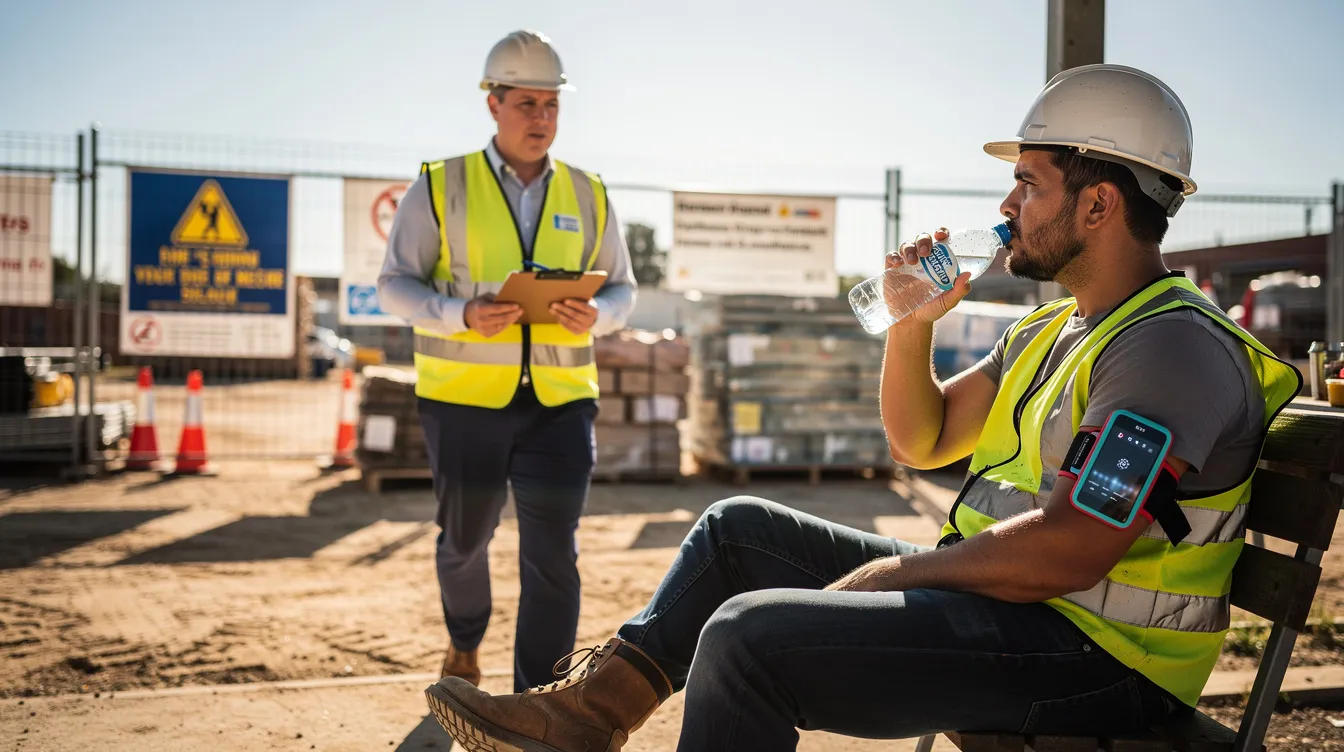
Training & Onboarding – Conduct practical toolbox sessions with workers and supervisors. Explain purpose, benefits, and privacy safeguards using multilingual materials (English, Mandarin, Tamil, Bengali). Demonstrate how to wear the device, what the alerts mean, and crucially-that data is used to protect workers health, not for discipline.
-
Go-Live & Supervision – Closely observe the first 2–3 weeks. Adjust thresholds and workflows using feedback from supervisors and workers. Expect to tune down false alarms and simplify response actions during this period.
-
Measure, Review, Scale – Compare incident and near-miss data pre- and post-pilot. Track operational efficiency metrics: productivity, rework rates, absenteeism. If results are positive, roll out to more crews and sites.

Choosing Between Different Wearable Setups
Not all wearable setups suit every site. Here are the key decision factors for Singapore work settings:
|
Criterion |
Single-Parameter Device (e.g., heart rate only) |
Multi-Parameter Device (heart rate + temp + motion) |
Integrated System (wearable + dashboard + PTW integration) |
|---|---|---|---|
|
Data richness |
Limited; one vital sign |
Comprehensive heat strain picture |
Full site-wide visibility with actionable insights |
|
Cost per worker |
Lower upfront |
Moderate |
Higher, but shared infrastructure reduces per-unit cost at scale |
|
Accuracy of risk scoring |
Cannot distinguish heat from exercise strain alone |
Better differentiation; algorithms combine signals |
Best; combines physiological and environmental data |
|
Suitability for SME subcontractor |
Good starting point |
Best for targeted high risk trades |
May exceed budget unless subsidised |
|
Integration with HSE systems |
Manual export needed |
API possible |
Native integration with permits, attendance, reporting |
Criteria important to Singapore sites:
-
Battery life for 10–12 hour shifts-any device that dies mid-shift is worse than no device.
-
Ruggedness against rain, salt spray (marine), and concrete dust (construction). IP67 or higher rating preferred.
-
Local data hosting and PDPA compliance-personal physiological data needs proper governance. Data privacy concerns hinder wearable technology adoption if not addressed early.
-
Ease of use for multi-language crews-simple interfaces, visual indicators (green/amber/red), minimal button presses.
-
Various types of form factors: some workers tolerate armbands, others prefer chest straps, and helmet-integrated options suit those who resist wearing anything extra. Smart glasses, while promising for augmented-reality safety overlays, are not yet mainstream for heat stress prevention in Singapore.
Practical guidance: A small SME subcontractor might start with pooled multi-parameter devices assigned to the highest-risk tasks each day. A main contractor managing multiple sites should invest in a full fleet monitoring system with dashboard integration-the long-term operational efficiency and audit benefits justify the cost. High costs of wearables limit access for many workers initially, but phased deployment keeps the investment manageable.
With the right setup chosen, the next challenge is making it stick-overcoming the human, process, and policy barriers that cause many pilots to fail.
Common Challenges and Practical Solutions
Many wearable pilots fail not because the technology doesn’t work, but because of people, process, and policy misalignment. These are real obstacles observed on Singapore construction and marine sites-and each has a practical solution.
Worker Resistance and Privacy Concerns
The problem: Workers may perceive wearables as surveillance-fearing pay cuts, blame, or disciplinary action when alerts trigger. Discomfort wearing an additional device under PPE in hot, humid conditions adds to resistance. Wearables may not incentivize workers to heed alerts if they believe the data will be used against them.
Actionable solutions:
-
Co-create usage rules with worker representatives and safety committees. Clearly state-in writing and in toolbox sessions-that wearable data is used for health protection, not performance monitoring or discipline.
-
Limit access to named physiological data to authorised WSH personnel only. Use anonymised, aggregated trends for management reports. This directly addresses data privacy concerns that hinder adoption.
-
Provide communications materials in common languages (English, Mandarin, Tamil, Bengali) with simple visuals showing what the device measures, who sees what, and what happens when an alert triggers.
-
Build safety culture around the devices: frame them as protection, not policing. When workers see a co worker pulled off a task and given rest before feeling ill, trust builds faster than any memo.
Alert Fatigue and False Alarms
The problem: If devices trigger too many non-critical alerts-especially during the early deployment phase-supervisors and workers start ignoring them. This defeats the entire purpose and creates a false sense of security.
Actionable solutions:
-
Tune thresholds using data collected during the pilot, not vendor default settings. Every site’s heat exposure profile differs.
-
Use tiered alerts with distinct, simple response actions: amber = drink water and slow down; red = stop work, rest in shade, supervisor checks vital signs.
-
Schedule regular reviews (weekly during the first month) of alert logs to identify patterns, refine rules, and align with actual site conditions. Wearables lack a gold standard for heat stress measurement, so continuous calibration is essential.
Integration with Existing HSE Systems
The problem: Fragmented reporting-spreadsheets, paper checklists, multiple disconnected apps-means wearable data becomes one more thing supervisors must manage. Already overloaded with documentation and inspections, they may abandon the system.
Actionable solutions:
-
Embed wearable procedures into existing workflows. Add a wearable-check line item to the daily pre-task checklist rather than creating a separate form.
-
Use dashboards during morning coordination meetings and weekly safety walks to replace some manual reporting, not add to it.
-
Leverage MOSAIC’s EHS consultancy support to align device data outputs with ISO 45001 / bizSAFE documentation requirements-ensuring wearable records feed directly into existing compliance frameworks.
With the right implementation partner, wearables become a natural part of heat stress management rather than an extra burden. The technology should simplify the supervisor’s job, not complicate it.
Conclusion and Next Steps
IoT wearable devices give Singapore site leaders real-time visibility of heat strain and fatigue among outdoor workers-enabling proactive interventions and supporting MOM / WSH compliance at a time when regulatory expectations are rising. Wearable technology has become essential in occupational safety for outdoor workers, and the evidence from field deployments (like SRMC reporting no heat related incidents using wearable technology) shows that preventing heat related illness is achievable with the right approach.
The top benefits for sites that deploy wearables effectively:
-
Fewer heat related incidents. Objective monitoring catches physiological strain before it becomes heat exhaustion or heat stroke, helping protect workers from significant health risks.
-
Stronger workforce confidence. Workers who see their well being prioritised-through data-driven rest breaks rather than arbitrary rules-develop greater trust in their employer’s safety culture.
-
Better evidence for audits and clients. Timestamped, continuous wearable data provides the documented proof of heat stress prevention that MOM inspections, bizSAFE audits, and principal clients increasingly demand.
Immediate next steps:
-
Conduct an internal review of recent heat related incidents and near misses across your projects-this becomes your baseline.
-
Identify 1–2 high risk sites where a small wearable pilot could realistically start within the next quarter.
-
Engage a specialist like MOSAIC Ecoconstruction Solutions Pte Ltd to map your current heat stress controls and wearable options against WSH obligations.
-
Plan a practical toolbox session with visuals and photos to introduce the concept to your crews-first impressions shape adoption.
-
Review your risk assessment methodology to ensure it can incorporate physiological monitoring data as an input.
Related topics worth exploring next: heat stress risk assessment methods, designing rest and hydration schedules based on WBGT data, integrating mental health and fatigue management into broader safety programs, and the future of WSH technology in Singapore including AI-driven prediction models and air quality monitoring.
Additional Resources for Heat Stress Prevention in Singapore
For more resources, supervisors and safety consultants working on preventing heat related illness in Singapore can draw on the following:
-
MOM and WSH Council guidelines – The MOM heat stress measures page contains the enhanced mandatory requirements effective December 2026, FAQs, and links to WBGT monitoring guidelines. The Meteorological Service Singapore heat stress page provides real-time WBGT readings by location.
-
Risk assessment templates – A sample heat stress risk assessment and monitoring checklist can be adapted to incorporate wearable data fields (device thresholds, alert response actions, recovery documentation). See MOSAIC’s guide to workplace risk assessments for a starting framework.
-
Relevant standards – ISO 45001 (occupational health and safety management systems), ISO 45003 (psychological health and safety at work), and ISO 7243 (ergonomics of the thermal environment-WBGT assessment) provide the international standards backbone for heat management programmes.
-
Research references – An academic field experiment published in August 2026 demonstrated that wearable sensing devices measuring core temperature, heart rate, and exertion levels under typical construction tasks enabled early detection of heat stress and empowered supervisors to adjust workloads. An IoT-based heat stress management system deployed at residential sites in Australia showed high usability among both workers and management using smart vests. Singapore-based research by Jia et al. found significant reductions in body temperature readings with wearable cooling technology and confirmed cultural acceptability when effects were visible to workers.
-
MOSAIC Ecoconstruction Solutions Pte Ltd services – EHS audits focused on hot work environments, training on heat stress and wearable tech, outsourced safety officer support for wearable implementation, and safety consultancy for Singapore construction compliance.
-
Visual aids – A downloadable poster showing heat illness symptoms and when to act-including icons for wearable alert tiers-can be displayed at rest areas and toolbox talk stations.