

Safety management systems are frequently mischaracterized as administrative overhead, a stack of forms filed before a Ministry of Manpower inspection and forgotten until the next audit cycle. That characterization is not only inaccurate but operationally dangerous for any construction firm operating under Singapore’s statutory frameworks. A properly structured safety management system (SMS) is the operational backbone of every compliant, high-performing construction project, integrating policy, risk control, workforce training, and continuous performance evaluation into a single, living framework. This guide clarifies what an SMS actually is, how it functions on active sites, and how project managers can align their systems with BizSAFE, ISO 45001, and ConSASS requirements.
Table of Contents
- What is a safety management system?
- How safety management systems work on construction sites
- Regulatory compliance: BizSAFE, ISO 45001, and Singapore’s standards
- Common pitfalls and how to strengthen your safety management system
- Our perspective: The real value of a safety management system
- How we can help you achieve compliance and safety excellence
- Frequently asked questions
Key Takeaways
| Point | Details |
|---|---|
| SMS is mandatory | Every construction project in Singapore needs a safety management system to comply with BizSAFE, ISO 45001, and ConSASS. |
| Goes beyond paperwork | A real SMS requires regular checks, feedback, and correction—not just forms and digital tools. |
| Continuous improvement | The best systems use audits and feedback to keep improving safety and project outcomes. |
| Everyone participates | Site safety excels when all workers—not just officers—take ownership through a living SMS. |
What is a safety management system?
A safety management system is a structured, organization-wide framework that identifies workplace hazards, assesses associated risks, implements controls, and establishes mechanisms for monitoring and continuous improvement. In the Singapore construction context, this definition carries significant legal weight. Under the Workplace Safety and Health Act (WSH Act), main contractors and developers on prescribed workplaces are legally obligated to implement and maintain a functional SMS. This is not optional, and the Ministry of Manpower (MOM) enforces compliance through both routine inspections and the ConSASS (Construction Safety Audit Scoring System) framework.
The regulatory ecosystem supporting SMS requirements in Singapore draws from three primary sources. BizSAFE, administered by the Workplace Safety and Health Council (WSHC), provides a tiered certification pathway that progressively builds organizational safety capability. ISO 45001:2018 sets the international standard for occupational health and safety management systems, providing a process-based framework applicable across industries. ConSASS, specific to Singapore’s construction sector, provides a structured audit scoring methodology to evaluate SMS effectiveness on active worksites. According to Workplace Safety & Health Technology, a safety management system must contain key components to meet local compliance, including policy, risk assessment, controls, training, documentation, and review mechanisms.
The core components of a compliant SMS include:
- Safety policy: A documented commitment from senior management, setting the organization’s safety objectives and accountabilities
- Risk assessment: Systematic identification and evaluation of hazards specific to the project scope and work activities
- Hazard controls: Engineered, administrative, and personal protective measures applied through the hierarchy of controls
- Training and competency: Documented programs ensuring all workers and supervisors understand their safety responsibilities
- Incident reporting and investigation: Formal processes for capturing near-misses, incidents, and deriving corrective actions
- Internal audits and inspections: Scheduled evaluations to verify that controls are functioning as intended
- Management review: Periodic senior-level assessment of SMS performance data to drive strategic improvement
For firms navigating DFSP system requirements, the SMS must also integrate Design for Safety (DfS) obligations, ensuring that hazard elimination occurs at the design stage rather than being deferred to construction.
| Requirement area | BizSAFE (Level 3 and above) | ISO 45001:2018 |
|---|---|---|
| Safety policy | Required, signed by top management | Clause 5.2, leadership commitment |
| Risk assessment | Mandatory, project-specific | Clause 6.1, hazard identification |
| Legal compliance register | Required | Clause 6.1.3, compliance obligations |
| Training records | Mandatory | Clause 7.2, competence |
| Internal audit | Required annually | Clause 9.2, internal audit |
| Management review | Required | Clause 9.3, management review |
| Corrective action process | Required | Clause 10.2, nonconformity |
Understanding the Singapore DfS framework alongside these requirements helps construction firms recognize that SMS obligations begin before the first shovel breaks ground.
How safety management systems work on construction sites
With core SMS components outlined, here is how these systems operate on actual construction sites in Singapore, where the gap between documented intent and daily practice determines whether workers go home safely.
Effective SMS implementation follows a cyclical workflow that mirrors the Plan-Do-Check-Act (PDCA) model embedded in ISO 45001. On a functioning site, this translates into six operational steps:
- Identify: Site supervisors and WSH officers conduct hazard identification before each work activity, using tools such as Job Hazard Analysis (JHA) or the Risk Assessment (RA) process mandated under BizSAFE
- Assess: Each identified hazard is evaluated for likelihood and severity, producing a risk rating that determines the urgency and type of control required
- Control: Controls are applied in accordance with the hierarchy, from elimination and substitution through to administrative controls and PPE, with documented justification for each decision
- Train: Workers performing high-risk activities must receive task-specific safety briefings, and all training must be logged with attendance records and competency verification
- Check: Daily toolbox meetings, weekly site inspections, and periodic formal audits verify that controls remain in place and effective
- Improve: Findings from audits, near-miss reports, and incident investigations feed directly into corrective action plans, closing the loop and preventing recurrence
Roles within this workflow are clearly delineated. The project manager holds overall accountability for SMS performance and must ensure adequate resources, including time, personnel, and budget, are allocated to safety functions. The WSH officer is the operational custodian of the SMS, responsible for maintaining documentation, conducting inspections, and liaising with MOM. Site supervisors are the frontline enforcers, ensuring that controls are applied correctly at the task level. Every worker carries a duty to report unsafe conditions and comply with established procedures.

Documentation flows from the site level upward. Risk assessments are prepared before work begins, method statements accompany high-risk activities, and inspection records are filed systematically. ConSASS and site audits score these documentation systems as part of their formal evaluation, meaning that gaps in records translate directly into audit deductions and potential enforcement action.
Pro Tip: Digital safety platforms can accelerate documentation, but technology-based safety controls still require evaluation and correction, not just recordkeeping. If your SMS produces data that nobody reviews or acts on, you have built a data graveyard, not a safety system.
“A safety management system only generates value when findings trigger action. Data without follow-through is not safety management; it is safety theater.” — MOSAIC Safety Consultancy
Building a culture where improving contractor safety culture is treated as a leadership priority, rather than a compliance checkbox, is what separates high-performing projects from those that merely pass inspections.
Regulatory compliance: BizSAFE, ISO 45001, and Singapore’s standards
You have seen SMS in action, but how do you keep it compliant and audit-ready across the full project lifecycle? The answer lies in understanding exactly what each regulatory framework demands and how those demands intersect.
BizSAFE operates as a five-level certification program. Levels 1 and 2 establish foundational risk management capability. Level 3 requires a fully implemented SMS, verified by a MOM-approved auditor. Levels 4 and Star introduce enterprise-wide safety culture assessments and supply chain safety requirements. For most main contractors on Singapore construction projects, BizSAFE Level 3 is the minimum threshold for tendering on government and large private contracts.
ISO 45001:2018 operates through a clause-based management system structure. Clauses 4 through 10 cover context, leadership, planning, support, operation, performance evaluation, and improvement. The standard is applicable to any organization regardless of size, and its process-based approach makes it highly compatible with BizSAFE requirements. Many Singapore firms pursue both certifications simultaneously, using a single integrated SMS that satisfies both frameworks. According to Workplace Safety & Health Technology, an SMS must be robust enough to meet performance evaluation under standards, meaning documentation alone is insufficient without demonstrable operational effectiveness.
The ConSASS framework adds a construction-specific layer, scoring SMS implementation across 13 elements including management commitment, work permit systems, and emergency preparedness. ConSASS audits are conducted by MOM-appointed auditors and produce a score that determines whether a project is classified as satisfactory, requiring improvement, or subject to stop-work orders.
Documents most frequently scrutinized during audits include:
- Risk assessment registers: Must be current, activity-specific, and signed off by a competent person
- Training and induction records: Attendance sheets, competency assessments, and green card verification
- Work permit logs: Especially for hot work, confined space entry, and work at height
- Incident investigation reports: Including root cause analysis and corrective action closure evidence
- Internal audit reports: With findings, corrective actions assigned, and closure status documented
- Management review minutes: Demonstrating that senior leadership has formally reviewed SMS performance data
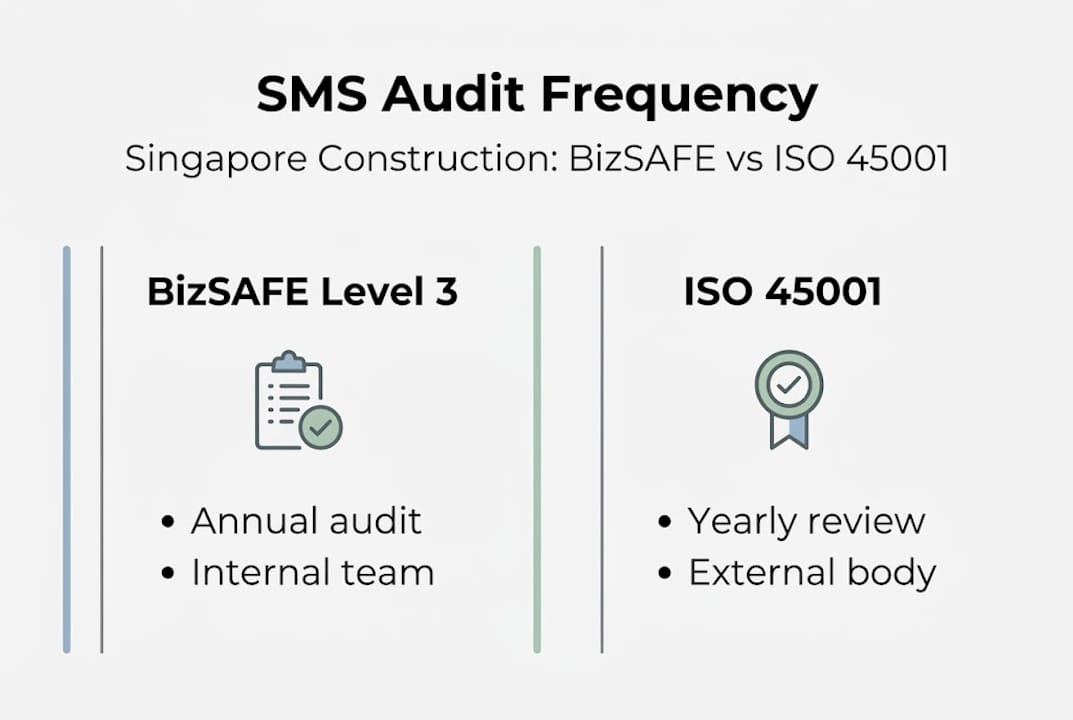
For firms pursuing effective WSH implementation, audit frequency is a critical planning variable. BizSAFE Level 3 requires annual third-party audits, while ISO 45001 mandates internal audits at planned intervals and a management review at least once per year. Non-compliance consequences range from audit score deductions and improvement notices to suspension of BizSAFE certification, which directly impacts tendering eligibility.
| Certification | Audit frequency | Conducted by | Non-compliance consequence |
|---|---|---|---|
| BizSAFE Level 3 | Annual | MOM-approved auditor | Certification suspension |
| ISO 45001 | Annual (internal + external) | Internal team + certification body | Certificate withdrawal |
| ConSASS | Periodic site audits | MOM-appointed auditor | Stop-work order possible |
Common pitfalls and how to strengthen your safety management system
Even the best SMS can deteriorate without constant attention. Here is what to watch for and how to get ahead of the most common failure modes observed across Singapore construction projects.
The most pervasive SMS weakness is tick-box culture, where documentation is completed to satisfy auditors rather than to drive genuine risk reduction. This manifests as risk assessments that are copied from previous projects without review, toolbox meeting records signed by workers who were not present, and corrective actions that are logged as “closed” without verification. Reliance on technology alone can accelerate this problem, turning SMS platforms into repositories of unreviewed data rather than tools for active management.
The top five SMS failure points observed in practice are:
- Siloed documentation: Safety records stored in disconnected systems, making it impossible to trace a hazard from identification through to corrective action closure
- Insufficient feedback loops: Near-miss reports that are filed but never analyzed for patterns, missing the opportunity to prevent more serious incidents
- Lack of top-level buy-in: Project managers who delegate all SMS responsibility to the WSH officer without engaging personally, signaling to the workforce that safety is an administrative function rather than a leadership priority
- Tech overload without process discipline: Digital platforms that generate voluminous data but lack the review workflows needed to convert data into decisions
- Inadequate corrective action follow-through: Findings from audits and inspections that generate action items but no accountability for closure, allowing the same issues to recur across audit cycles
Strengthening your SMS requires embedding corrective action into the operational rhythm of the project. Every audit finding should be assigned to a named individual with a defined closure date. Progress should be reviewed at weekly site meetings, not just at the next formal audit. Risk assessment steps should be revisited whenever work scope changes, new subcontractors mobilize, or an incident occurs, rather than being treated as a one-time pre-construction exercise.
Pro Tip: Use audits as diagnostic tools, not just compliance gates. An audit that identifies ten genuine findings and drives ten corrective actions is far more valuable than an audit that produces a clean score on a system that is not functioning effectively. Engage design-stage risk management early to eliminate hazards before they reach the site, reducing the corrective action burden downstream.
Empowering every worker to participate actively in SMS processes is the most powerful and most frequently overlooked improvement lever. When workers understand that their near-miss reports trigger genuine investigations, and that their feedback shapes the risk controls they work under, participation rates increase and the quality of hazard identification improves substantially.
Our perspective: The real value of a safety management system
Most guides on SMS stop at compliance mechanics, and that is precisely where the most important insight is missed. The organizations that derive the greatest operational value from their safety management systems are not those with the most elaborate documentation or the highest audit scores. They are the ones that treat the SMS as a living framework for organizational learning rather than a static compliance artifact.
After working across Singapore’s construction sector, one pattern becomes clear: projects with lower incident rates consistently share a single characteristic. Safety responsibility is distributed across the entire workforce, not concentrated in the WSH officer’s office. When a project manager reviews audit findings personally, when a site supervisor stops work without hesitation because a control is missing, and when a worker reports a near-miss knowing it will be taken seriously, the SMS is functioning as intended.
The surprising truth is that designing for safety from the earliest project stages produces the most significant SMS performance gains. Hazards eliminated at the design stage do not require controls, training, or monitoring on site. That upstream investment reduces the operational burden on the SMS and allows site teams to focus their attention on the residual risks that genuinely require active management. Leaders who treat SMS integration as continuous, not episodic, consistently see lower incident rates, stronger audit scores, and higher workforce morale.
How we can help you achieve compliance and safety excellence
Translating the principles in this guide into a functioning, audit-ready SMS requires more than a template. It requires experienced consultancy support calibrated to Singapore’s specific regulatory environment.

MOSAIC Ecoconstruction Solutions provides direct, hands-on support for BizSAFE certification at every level, ConSASS audit preparation, and ISO 45001 implementation and gap analysis. Our team assists construction firms in building SMS frameworks that satisfy MOM requirements while functioning as genuine operational tools. Whether you are preparing for an upcoming safety audit, pursuing BizSAFE Star certification, or integrating DfS professional requirements into your project delivery process, our consultants bring the technical depth and regulatory knowledge your project demands.
Frequently asked questions
What are the essential elements of a safety management system?
A safety management system must include policy, risk assessment, mitigation controls, training, documentation, regular checks, and continuous improvement steps, all of which are required to meet local compliance under Singapore’s WSH framework.
Is a safety management system mandatory in Singapore construction?
Yes, all main construction projects must have an SMS to meet BizSAFE, ConSASS, and ISO 45001 requirements, as mandated for legal compliance under MOM regulations and the WSH Act.
How often should you audit your safety management system?
Audits should be conducted at least annually or after any major incident or scope change, ensuring the SMS remains robust for performance evaluation and meets BizSAFE and ISO 45001 requirements.
Can technology fully replace physical safety checks?
No, technology enhances documentation and monitoring efficiency, but feedback and correction remain critical components that require human judgment and active site management to be truly effective.
Recommended
- The Comprehensive Guide to Design for Safety Professionals (DFSP) in Singapore Construction Projects – MOSAIC Eco-construction Solutions Pte Ltd
- Implementing Effective Workplace Safety And Health Management Systems In Singapore Construction Industry – MOSAIC Eco-construction Solutions Pte Ltd
- Risk assessment process: mastering construction safety in Singapore
- Design for Safety in Singapore – MOSAIC Eco-construction Solutions Pte Ltd