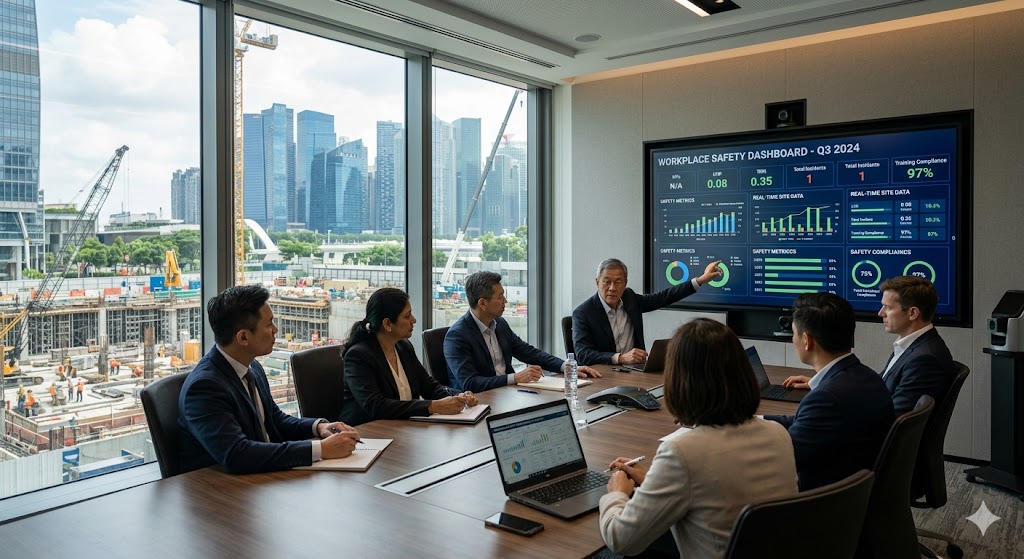
- asure 4: Set WSH as a regular agenda item. WSH must be discussed frequently in management and board meetings.15
- Measure 5: Ensure sufficient resource allocation to WSH initiatives.15
- Measure 6: Facilitate direct reporting of WSH issues. Workers must be able to report directly to company directors safely.15
- Measure 7: Acquire continuous WSH knowledge proactively.15
- Measure 8: Conduct ground engagements actively. Executives must understand processes and workers’ concerns firsthand.15
- Measure 9: Set and demand effective WSH standards from vendors. This ensures safety across the entire external supply chain.15
Principle 3: Effective WSH Management Systems
Principle 3 focuses on robust operational safety frameworks. Executives must ensure WSH management systems are highly effective and reviewed.12
- Measure 10: Ensure effectiveness of WSH management systems. Directors must maintain oversight of compliance with safe work procedures.17
- Measure 11: Ensure suitable, adequate, and timely risk assessment.17
- Measure 12: Recognize and reward workers’ safety efforts. Incentives reinforce positive actions and strengthen workplace safety culture significantly.17
- Measure 13: Endorse immediate remedial actions. Disciplinary measures must address repeated non-compliance with safe procedures decisively.13
Principle 4: Empowering Workers
Principle 4 focuses on grassroots engagement and transparent communication. Executives must empower workers to participate actively in WSH initiatives.12
- Measure 14: Ensure processes exist for timely information sharing. Workers must receive updates on WSH risks and safe procedures.15
- Measure 15: Set up proactive reporting systems. Companies must encourage reporting and ensure proper follow-up on issues.15 Reporting cultures must be free from any fear of reprisal.15
- Measure 16: Commit resources for continuous worker training. Protected time must be given for WSH refresher courses routinely.15
- Measure 17: Involve workers in joint development strategies. Workers must help create programs to improve organizational WSH effectively.15
| ACOP Framework | Strategic Focus Area | Associated Measures |
| Principle 1 | Integration and Clarity of Roles | Measures 1 – 2 |
| Principle 2 | Leadership and WSH Culture | Measures 3 – 9 |
| Principle 3 | Management Systems Oversight | Measures 10 – 13 |
| Principle 4 | Worker Empowerment | Measures 14 – 17 |
Personal Liability: Section 48 of the WSH Act
The legal landscape surrounding executive liability is highly stringent today. Section 48(1) of the Workplace Safety and Health Act (WSHA) is critical. It holds all company officers, including directors, personally accountable for offenses.11 If a company commits a WSH offense, its officers are deemed guilty automatically.
To escape personal liability, an officer must prove two specific conditions. First, the offense was committed without their consent or connivance.14 Second, they exercised all due diligence to prevent the offense.14 Consequently, the heavy burden of proof rests entirely on senior management.15 Senior management’s role has changed because passive ignorance implies legal guilt.
The Landmark Precedent: Public Prosecutor v Yeo Teck Soon
The legal consequences for executives intensified significantly in recent years. The landmark 2025 High Court case, Public Prosecutor v Yeo Teck Soon, defined this.20 This prominent case addressed the liability of a company director directly.20
The case involved defective formwork supplied to a construction site.20 Corroded scaffold frames collapsed, severely injuring a vulnerable worker.21 Investigations revealed the dangerous corrosion had been deliberately painted over.21 Initially, the district court fined the offending company $280,000.21 Concurrently, the director, Yeo Teck Soon, received a personal fine of $150,000.21
The High Court ruling established a critical “two-stage framework” for sentencing.22 Crucially, the court emphasized that a director’s negligence is assessed independently.22 A director cannot hide behind a company’s moderate culpability rating.22 If the director’s personal negligence is egregious, severe individual penalties apply.22 Conversely, automatic guilt is not assumed merely because the company is guilty.22
This ruling issued a stark, undeniable warning to all CEOs. They must demonstrate active, documented engagement with all safety protocols.22 Blind trust in subordinates is no longer a viable legal defense.22 The court assesses culpability specifically through the lens of the director’s role.24 Furthermore, it examines the materiality of their conduct and systemic failures.24
Additional Judicial Precedents Shaping 2026
Other recent cases underscore the judiciary’s increasingly aggressive stance. In Public Prosecutor v Gary Choo Pu Chang, an executive director pleaded guilty.25 The court considered the extent of his organizational responsibilities carefully.25 His direct involvement in the company’s breach determined his final culpability.25
Directors face actual imprisonment for severe WSH negligence now. In 2025, a plant supervisor was sentenced to five months imprisonment.26 He committed a negligent act endangering the safety of others recklessly.26 Furthermore, numerous directors were prosecuted and named publicly by MOM.26 This deliberate public shaming severely damages corporate and personal reputations permanently.
The courts also rely on previous frameworks like Koh Lian Kok.20 This framework evaluates the duties imposed on employers under the WSHA.20 Similarly, Public Prosecutor v Manta Equipment established baseline sentencing principles.20 The cumulative effect of these rulings demands flawless executive oversight.
Increased Penalties and Enforcement in 2026
To deter unsafe practices, MOM escalated financial penalties substantially recently. The government amended the Workplace Safety and Health (Amendment of Penalties) Regulations 2024.28 These updated, harsher regulations took effect on 1 June 2024.29 The financial impact on non-compliant businesses is now absolutely devastating. Senior management’s role has changed to protect corporate financial viability.
Maximum Fines and Court Prosecutions
The maximum fine for serious safety breaches increased dramatically. It rose from $20,000 to $50,000 for a first conviction.30 This applies to breaches resulting in death or serious bodily injury.30 Repeat offenders face even steeper penalties under the revised regulations. A repeat offender can be fined up to $50,000 and imprisoned.28
For general offenses under the WSH Act, corporate bodies face massive fines. A first conviction yields a maximum fine of $500,000.32 A repeat corporate offender faces a staggering $1 million fine.32 Moreover, if a previous offense caused a fatality, fines are doubled.32
Composition Fines and Stop-Work Orders
MOM utilizes a tiered penalty system for immediate field enforcement.33 Composition fines are issued instantly for clear, straightforward safety breaches.33 Since June 2022, these specific fines were doubled by MOM.31 The minimum fine increased from $1,000 to $2,000 per lapse.31
Common composition fines include:
- Failure to conduct risk assessments: $1,000 to $5,000.33
- Inadequate PPE provision: $1,000 to $3,000.33
- Missing safety signage: $500 to $2,000.33
- Failure to report accidents: $1,000 to $5,000.33
- Unsafe scaffolding or fall protection: $2,000 to $5,000.33
In the 2024-2025 period, MOM issued over 3,800 composition fines.33 Over $1.5 million in fines were collected in the first half of 2025.34 MOM also inspected 500 worksites between June and August 2024.35 This intensive effort uncovered 1,253 unsafe observations immediately.35
Furthermore, MOM actively issues strict Stop-Work Orders (SWO). While not a direct fine, an SWO carries an enormous financial impact.33 Companies bear all costs of the operational stoppage directly.33 This includes worker wages, equipment rentals, and project delay penalties.33 A single SWO can cost a major project hundreds of thousands of dollars.33
| Penalty Category | Target Offender | Maximum Fine / Consequence |
| Serious Breach (1st Offense) | Individual/Corporate | Up to $50,000 28 |
| General Offense (1st Offense) | Corporate Body | Up to $500,000 32 |
| General Offense (Repeat) | Corporate Body | Up to $1,000,000 32 |
| General Offense (1st Offense) | Individual Director | Up to $200,000 + 2 years jail 32 |
| Stop-Work Order | Corporate Body | Complete operational halt + massive costs 33 |
Mandatory Video Surveillance Systems (VSS)
Technological oversight is a key pillar of Singapore’s WSH strategy. To deter unsafe behaviors, MOM mandated Video Surveillance Systems (VSS).29 This rule applies to specific high-risk construction projects comprehensively. The mandate officially commenced on 1 June 2024.29 Senior management’s role has changed to mandate systemic technological surveillance.
Scope and Implementation of VSS
All construction worksites with a contract value of $5 million and above must install VSS.29 No grace period was provided after the implementation date.36 VSS installation is required regardless of the estimated project completion date.36
The VSS must monitor locations where high-risk work activities occur continuously.29 Specifically, cameras must be installed in the following crucial areas:
- Every area where lifting operations are carried out.37
- Locations utilizing lifting machines, cranes, or mobile elevated platforms.37
- Areas where industrial trucks, forklifts, or excavators operate.37
- Zones where vehicular traffic poses danger to workers.37
- Every designated loading and unloading area.37
Implementing VSS helps organizations identify risks and facilitate accident investigations efficiently.36 It provides valuable training resources and deters unsafe workplace behavior constantly.29 For isolated locations, companies may utilize portable video cameras to meet requirements.36
| VSS Requirement | Parameter Details |
| Implementation Date | 1 June 2024 37 |
| Contract Threshold | $5 million and above 37 |
| Grace Period | None provided 36 |
| Required Coverage | Lifting, trucking, and vehicular danger zones 37 |
Expanding WSH to Mental Well-being
Workplace safety in 2026 extends far beyond physical hazards. Mental well-being is now a recognized and heavily regulated component of WSH. The 2022 National Population Health Survey highlighted severe mental health challenges.38 Prevalence of poor mental health among residents was a staggering 17.0%.38 Consequently, work stressors were identified as primary factors associated with poor mental health.38
The ACOP specifically addresses mental well-being within its compliance framework.40 Company directors must allocate sufficient resources to promote workplace mental well-being.40 Furthermore, the Code of Practice on WSH Risk Management (RMCP) was expanded.40 The third revision covers mental well-being alongside physical risks and disease outbreaks.40
Employers must evaluate and manage risks related to mental health proactively.40 The Tripartite Advisory on Mental Well-being provides practical guidance for compliance.38 It focuses on managing work content and work context stressors effectively.38 High workloads, poor interpersonal relationships, and rigid schedules are recognized hazards.38 Senior management must implement flexible arrangements and foster supportive environments.38
Technology Integration and Government Grants
Technology adoption is crucial for achieving WSH excellence by 2028.42 However, many Small and Medium Enterprises (SMEs) hesitate due to perceived costs.43 They fear steep learning curves and operational disruptions.43 To counter this, the government offers substantial financial support initiatives.
Government grants heavily subsidize the adoption of WSH technologies today.42 These solutions drastically reduce workplace incidents and improve situational awareness.45
Key WSH Technology Solutions
SMEs are highly encouraged to adopt practical, high-impact technological solutions. These include:
- Electronic Permit-to-Work Systems: These provide better oversight of high-risk activities.42
- Smart Inspection Cameras: 360-degree cameras enhance site supervision capabilities remotely.42
- Wearable Technology: These devices detect slips, trips, and falls instantly.42
- Fleet Safety Management: Solutions improve the situational awareness of vehicle drivers.45
- Lorry Crane Stability Control: These systems actively prevent cranes from toppling.45
Available Funding and Grants
Companies can access several generous grants to defray technology costs.
- Productivity Solutions Grant (PSG): Supports SMEs in adopting IT solutions.42 It provides up to 50% funding support for eligible costs.42 Over 700 companies successfully utilized the PSG for WSH tech recently.45 The total grant amount disbursed was SGD 8.4 million.45
- NTUC Company Training Committee (CTC) Grant: Supports entities forming a CTC.42 It provides funding support of up to 70% of qualifying costs.42 From August 2024, WSH enhancement projects qualify for this specific grant.42
- Built Environment Technology and Capability Grant (BETC): Available for local built environment firms.44 It supports advanced robotics and automation adoption directly.44
- Business Improvement Fund (BIF): Targeted specifically at local tourism businesses.44
- Enterprise Development Grant (EDG): Available for local SMEs and non-SMEs.44
Furthermore, initiatives like the PIER71 Smart Port Challenge drive marine sector innovation.44 The Workplace Safety and Health Institute (WSHI) actively seeks industry feedback for tech solutions.44
| Grant Name | Target Audience | Funding Support | Eligible Tech Examples |
| Productivity Solutions Grant (PSG) | Local SMEs | Up to 50% 42 | e-Permit to Work, Video Analytics 42 |
| NTUC CTC Grant | Entities with CTC | Up to 70% 42 | Transformation plans, WSH upgrades 42 |
| BETC Grant | Built Environment Firms | Variable | Robotics, Digital Solutions 44 |
| Business Improvement Fund (BIF) | Tourism Businesses | Variable | Operational safety upgrades 44 |
WSH 2028 Strategy and 2025/2026 Statistics
The regulatory changes detailed above stem from the WSH 2028 national strategy. This ambitious strategy envisions a healthy workforce within absolutely safe workplaces.46 The strategy relies on three core strategic thrusts fundamentally.46 First, strengthen WSH ownership among all organizational stakeholders.46 Second, enhance the systematic focus on comprehensive workplace health.46 Third, promote technology-enabled WSH practices pervasively.46
Unprecedented Statistical Success in 2025
The aggressive enforcement of the TEWP and ACOP yielded spectacular statistical results. In 2025, Singapore achieved record-low workplace fatality and injury rates.49 The nation’s workplaces are now ranked among the safest globally.49 Singapore stands proudly alongside leading countries like the Netherlands and Sweden.49
In 2025, the workplace fatal injury rate hit an all-time historical low.49 It dropped to 0.96 fatal injuries per 100,000 workers.50 This is a massive, commendable improvement from 1.2 in 2024.50 There were 36 total workplace fatalities in 2025.50 This represents a significant decrease from 43 fatalities in 2024.50
Major injury rates also continued a highly positive trend of sustained improvement. The major injury rate was 15.9 per 100,000 workers in 2025.51 Excluding platform workers, there were precisely 34 fatal injuries.50 Almost all fatalities (94%) were caused by high-risk Type A incidents.50 The top causes remained vehicular incidents, falls from height, and equipment failure.50
Sectoral Performance Breakdown
Construction and Manufacturing remained the top contributors to safety incidents historically. They accounted for 24% and 20% of fatal and major injuries, respectively.51 However, the Construction sector showed massive improvement in 2025. There were only 13 fatal injuries in construction in 2025.50 This was an impressive seven fatalities fewer than in 2024.50 The construction fatality rate decreased from 3.7 to 2.3 per 100,000 workers.50
Platform Workers (PWs) were also included in detailed statistics from 2025.50 There were 76 PW fatal and major injuries reported.50 This included two unfortunate platform worker fatalities.50 The vast majority (84%) occurred during active delivery services.50 Vehicular incidents were the leading cause of PW injuries overwhelmingly.50 Furthermore, there were 23 Dangerous Occurrences (DOs) in 2025.51 This was slightly higher than the 19 DOs recorded in 2024.51
| Key WSH Metric | 2024 Statistic | 2025 Statistic | Trend Analysis |
| Fatal Injury Rate (per 100,000) | 1.2 50 | 0.96 49 | Significant Decrease |
| Total Fatalities | 43 50 | 36 51 | Decrease |
| Construction Fatality Rate | 3.7 50 | 2.3 50 | Significant Decrease |
| Total Major Injuries | 587 35 | ~550 51 | Decrease |
| Dangerous Occurrences (DOs) | 19 51 | 23 51 | Slight Increase |
These statistics prove that holding senior management accountable works undeniably. The combination of the TEWP, ACOP, and harsher penalties drove compliance perfectly. Furthermore, the mandatory integration of VSS minimized on-the-ground risks daily.
Conclusion
The role of senior management in Singapore has evolved irreversibly by 2026. The days of delegating safety entirely to operational officers are permanently over. The Top Executive WSH Programme (TEWP) ensures leaders possess foundational safety knowledge. Simultaneously, the Approved Code of Practice (ACOP) demands proactive, highly visible leadership.
Consequently, Section 48 of the WSH Act enforces these expectations ruthlessly. The Yeo Teck Soon precedent solidifies personal liability for negligent corporate directors. Fines have skyrocketed astronomically, and the judiciary remains uncompromisingly strict. Executives must integrate WSH into every single critical business decision. They must leverage technology, support mental well-being, and build robust safety cultures.
Singapore’s record-breaking safety statistics in 2025 validate this stringent legislative approach. Ultimately, strong, educated leadership saves lives and protects corporate viability simultaneously. Senior management must embrace these duties fully to thrive in 2026.
Works cited
- CEO or Board Director to complete the Top Executive WSH Programme – MOM, accessed June 1, 2026, https://www.mom.gov.sg/workplace-safety-and-health/safe-measures/company-level/ceo-or-board-director-to-complete-the-top-executive-wsh-programme
- Legal Requirement to complete the Top Executive Workplace Safety and Health Programme (TEWP) – MOM, accessed June 1, 2026, https://www.mom.gov.sg/-/media/mom/documents/safety-health/circulars/2024/circular-20240213-legal-requirement-to-complete-tewp-programme.pdf
- Top Executives WSH Programme (TEWP) FAQs (updated on 7 Mar 2025), accessed June 1, 2026, https://www.tal.sg/wshc/-/media/tal/wshc/media/pdf/tewp-faqs-7-mar-2025.pdf
- TEWP Course | Top Executive WSH Programme | In-Person – Absolute Kinetics Consultancy, accessed June 1, 2026, https://www.sg-akc.com/tewp-course-top-executive-wsh-programe/
- BTEP3: TOP EXECUTIVE WSH PROGRAMME (TEWP – SYNCHRONOUS E-LEARNING), accessed June 1, 2026, https://www.ntuclearninghub.com/-/course/top-executive-wsh-programme-tewp-synchronous-e-learning
- Top Executive WSH Programme (TEWP) | Asynchronous Self-paced E-learning, accessed June 1, 2026, https://scal-academy.com.sg/courses/course_detail/TEWP-Asynchronous-Self-paced-E-learning/17059
- Top Executive WSH Programme (TEWP) | English | In-Person – SCAL Academy, accessed June 1, 2026, https://scal-academy.com.sg/courses/course_detail/TEWP-English-In-Person/7983
- BTEP: TOP EXECUTIVE WSH PROGRAMME (TEWP – IN-PERSON TRAINING), accessed June 1, 2026, https://www.ntuclearninghub.com/-/course/bizsafe-top-executive-program
- Develop Your Understanding of Workplace Safety and Health with the Top Executive WSH Programme – DL Ideas, accessed June 1, 2026, https://scal.dlideas.com/courses/course_detail/TopExecutive
- Understand WSH Duties based on Code of Practice – Chief Executives and Board of Directors Course – Avanta Global, accessed June 1, 2026, https://avanta.com.sg/page/courses/understand-wsh-duties-based-on-code-of-practice-chief-executives-board-of-directors/
- Singapore: New Code of Practice details Chief Executive, Director Workplace Safety and Health Statutory Duties – Global Compliance News, accessed June 1, 2026, https://www.globalcompliancenews.com/2022/10/15/employment-compensation-singapore-new-code-of-practice-details-chief-executive-director-workplace-safety-and-health-statutory-duties_10152022/
- Code of Practice on Chief Executives’ and Board of Directors’ WSH …, accessed June 1, 2026, https://singaporelegaladvice.com/law-articles/code-of-practice-workplace-safety-health-employers/
- Launch of the Code of Practice on Chief Executives’ and Board of Directors’ Workplace Safety and Health Duties – Rajah & Tann Asia, accessed June 1, 2026, https://www.rajahtannasia.com/wp-content/uploads/2023/04/2022-09_Launch-of-Code-of-Practice-Chief-Exec-Board-of-Dirs-WSH-Duties.pdf
- Frequently Asked Questions: Code of Practice on Chief Executives’ and Board of Directors’ Workplace Safety and Health Duties, accessed June 1, 2026, https://www.tal.sg/wshc/-/media/tal/wshc/resources/publications/codes-of-practice/files/acop-faq-20220919.ashx
- Code of Practice – Singapore Institute of Directors, accessed June 1, 2026, https://www.sid.org.sg/common/Uploaded%20files/Resources/2022_10_25CodeofPractice.pdf
- Frequently Asked Questions: Approved Code of Practice on Chief Executives’ and Board of Directors’ Workplace Safety and Health Duties – Singapore Institute of Directors, accessed June 1, 2026, https://www.sid.org.sg/common/Uploaded%20files/Resources/2023_01_04_ACOPwshcFAQ.pdf
- board of directors WSH duties, accessed June 1, 2026, https://wshsingapore.blogspot.com/search/label/board%20of%20directors%20WSH%20duties
- Code of Practice, accessed June 1, 2026, https://www.tal.sg/wshc/-/media/tal/wshc/media/pdf/draft-cp-on-chief-executives-and-board-of-directors.ashx
- New Code of Practice Setting Out Top Management’s Workplace Safety and Health Responsibilities – JTJB, accessed June 1, 2026, http://jtjb.com/new-code-of-practice-setting-out-top-managements-workplace-safety-and-health-responsibilities/
- [2025] SGHC 179 – :: eLitigation ::, accessed June 1, 2026, https://www.elitigation.sg/gd/s/2025_SGHC_179
- Singapore Insurance Law Round Up (July- September 2025), accessed June 1, 2026, https://www.ilas.sg/insurance-law-knowledge/singapore-insurance-law-round-up-july-september-2025
- BizSafe Star Certification Singapore Guide Outline, accessed June 1, 2026, https://mosaicsafety.com.sg/bizsafe-star-certification-singapore-guide-outline/
- 145 – SG Courts Judgments, accessed June 1, 2026, https://www.elitigation.sg/gd/Home/Index?Filter=SUPCT&YearOfDecision=All&SortBy=Score&SearchPhrase=%22Resoluci%C3%B3n%20que%20establece%20las%20reglas%20de%20car%C3%A1cter%20general%20aplicables%20a%20los%20impuesto%20y%20derechos%20federales%2C%20excepto%20a%20los%20relacionados%20con%20el%20comercio%20exterior&CurrentPage=145&SortAscending=False&PageSize=0&Verbose=False&SearchQueryTime=0&SearchTotalHits=0&SearchMode=False&SpanMultiplePages=False
- Public Prosecutor v Yeo Teck Soon [2025] SGHC 179 | Legal Wires, accessed June 1, 2026, https://legal-wires.com/singapore/public-prosecutor-v-yeo-teck-soon-2025-sghc-179/
- JUDGMENT – eLitigation, accessed June 1, 2026, https://www.elitigation.sg/gd/gd/2025_SGHC_179/pdf
- List of Offenders Convicted under Workplace Safety and Health Act, 2025 – MOM, accessed June 1, 2026, https://www.mom.gov.sg/-/media/mom/documents/safety-health/reports-stats/list-of-offenders-convicted-under-wsha-2025.pdf
- Employers convicted under the Employment Act – MOM, accessed June 1, 2026, https://www.mom.gov.sg/employment-practices/employers-convicted-under-employment-act
- Workplace Safety and Health (Amendment of Penalties) Regulations 2024 – Singapore Statutes Online, accessed June 1, 2026, https://sso.agc.gov.sg/SL-Supp/S434-2024/Published/20240527?DocDate=20240527
- New WSH Measures from 1 June 2024: Increase in Maximum Fines, Mandatory Video Surveillance Systems for Relevant Construction Projects | Rajah & Tann Asia, accessed June 1, 2026, https://www.rajahtannasia.com/viewpoints/new-wsh-measures-from-1-june-2024-increase-in-maximum-fines-mandatory-video-surveillance-systems-for-relevant-construction-projects/
- MOM implements increases in maximum fines and mandatory video surveillance to improve workplace safety and health – Allen & Gledhill, accessed June 1, 2026, https://www.allenandgledhill.com/sg/publication/articles/28276/mom-implements-increases-in-maximum-fines-and-mandatory-video-surveillance-to-improve-workplace-safety-and-health
- Action against errant companies – MOM, accessed June 1, 2026, https://www.mom.gov.sg/workplace-safety-and-health/safe-measures/action-against-errant-companies
- WSH Act: liabilities and penalties – MOM, accessed June 1, 2026, https://www.mom.gov.sg/workplace-safety-and-health/workplace-safety-and-health-act/liabilities-and-penalties
- Workplace Safety Fines in Singapore: MOM Penalties and How to Avoid Them, accessed June 1, 2026, https://sageshield.com/workplace-safety-fines-mom-singapore/
- MOM uncovers nearly 7,000 safety breaches in the first half of 2025 – NTUC, accessed June 1, 2026, https://www.ntuc.org.sg/pme/news/MOM-uncovers-nearly-7000-safety-breaches-in-the-first-half-of-2025/
- MOM issues fines for workplace safety lapses from June to August | The Straits Times, accessed June 1, 2026, https://www.straitstimes.com/singapore/165100-in-fines-issued-by-mom-after-safety-health-checks-at-500-worksites-from-june-to-august
- FAQs for video surveillance system (VSS) for construction worksites with contract value of $5 million and above – MOM, accessed June 1, 2026, https://www.mom.gov.sg/-/media/mom/documents/safety-health/faqs-for-vss.pdf
- Video surveillance system (VSS) for construction sector – MOM, accessed June 1, 2026, https://www.mom.gov.sg/workplace-safety-and-health/safe-measures/sectoral-level/video-surveillance-system-for-construction-sector
- Tripartite advisory on mental health and well-being at workplaces – MOM, accessed June 1, 2026, https://www.mom.gov.sg/employment-practices/tripartism-in-singapore/tripartite-guidelines-and-advisories/tripartite-advisory-on-mental-well-being-at-workplaces
- TRIPARTITE ADVISORY ON MENTAL WELL-BEING AT WORKPLACES – Baker McKenzie, accessed June 1, 2026, https://insightplus.bakermckenzie.com/bm/attachment_dw.action?attkey=FRbANEucS95NMLRN47z%2BeeOgEFCt8EGQJsWJiCH2WAWHb/PDBPVvgqhOYPRAWh/b&nav=FRbANEucS95NMLRN47z%2BeeOgEFCt8EGQbuwypnpZjc4%3D&attdocparam=pB7HEsg/Z312Bk8OIuOIH1c%2BY4beLEAe/AuZuZP8E4o%3D&fromContentView=1
- Mental Health in the Workplace – fivehundred – Legal 500, accessed June 1, 2026, https://www.legal500.com/fivehundred-magazine/employment/mental-health-in-the-workplace/
- Code of Practice on – Workplace Safety and Health (WSH) Risk Management – Tripartite Alliance Limited, accessed June 1, 2026, https://www.tal.sg/wshc/-/media/tal/wshc/resources/publications/codes-of-practice/files/code-of-practice-risk-management-third-revision-2021.ashx
- Leveraging WSH Technology and Grants in Construction – Singapore Contractors Association, accessed June 1, 2026, https://www.scal.com.sg/uploads/files/Leveraging%20WSH%20Technology%20and%20Grants%20in%20Construction.pdf
- Debunking Myths, Boosting Safety: Guide to WSH Tech & Grants for SMEs – Hubble.Build, accessed June 1, 2026, https://hubble.build/newsroom/workplace-safety-health-wsh-tech-sme-grants-guide
- Workplace Safety and Health (WSH) Technology – Singapore – MOM, accessed June 1, 2026, https://www.mom.gov.sg/workplace-safety-and-health/wsh-technology
- Written Answer to PQ on Grants for Workplace Safety and Health Technology – MOM, accessed June 1, 2026, https://www.mom.gov.sg/newsroom/parliament-questions-and-replies/2024/0110-written-answer-to-pq-on-grants-for-wsh-technology
- WORKPLACE SAFETY AND HEALTH 2028 TRIPARTITE STRATEGIES COMMITTEE’S REPORT Executive Summary Introduction 1. Singapore has made – MOM, accessed June 1, 2026, https://www.mom.gov.sg/-/media/mom/documents/safety-health/publications/executive-summary.pdf
- WSH 2028 Vision – A Healthy Workforce in Safe Workplaces; A Country Renowned for “Best Practices in Workplace Safety and Health.” – Eversafe Academy, accessed June 1, 2026, https://eversafe.edu.sg/wsh-2028-vision-a-healthy-workforce-in-safe-workplaces-a-country-renowned-for-best-practices-in-workplace-safety-and-health/
- WSH 2028 – Singapore – MOM, accessed June 1, 2026, https://www.mom.gov.sg/-/media/mom/documents/safety-health/publications/wsh2028-report.pdf
- 0325 WSH Report 2025 – Singapore – MOM, accessed June 1, 2026, https://www.mom.gov.sg/newsroom/press-releases/2026/0325-wsh-report-2025
- Singapore workplaces rank among the safest globally: 2025 WSH statistics, accessed June 1, 2026, https://www.humanresourcesonline.net/singapore-workplaces-rank-among-the-safest-globally-2025-wsh-statistics
- Workplace Safety and Health Report 2025 – Singapore – MOM, accessed June 1, 2026, https://www.mom.gov.sg/-/media/mom/documents/safety-health/reports-stats/wsh-national-statistics/wsh-national-stats-2025.pdf
WSH Advisory for Fatal Accidents in Second Half of 2025, accessed June 1, 2026, https://www.tal.sg/wshc/media/announcements/2026/wsh-advisory-for-fatal-accidents-in-second-half-of-2025