
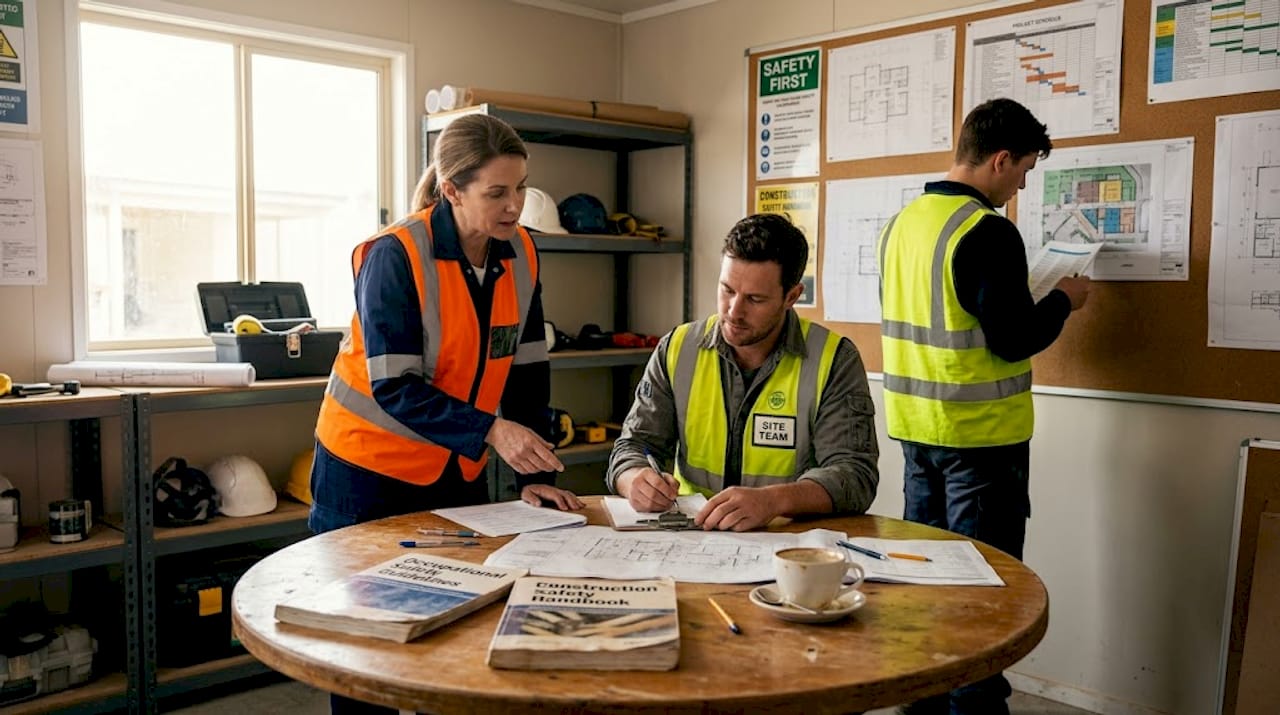
Contractor safety assessments are frequently dismissed as procedural formalities — submission forms filed before work begins, reviewed once, then shelved. That misconception carries serious consequences. The role of contractor safety assessment in construction extends far beyond initial paperwork: it functions as the operational backbone of risk management on multi-employer worksites, governing contractor selection, hazard coordination, legal compliance, and continuous performance oversight. For project managers and general contractors who supervise trade contractors and specialist subcontractors, understanding this distinction is not academic. It directly determines site safety outcomes and regulatory exposure.
Table of Contents
- Key Takeaways
- The role of contractor safety assessment in regulatory compliance
- Core components of a thorough contractor safety assessment
- Ongoing monitoring and communication during project execution
- Integrating assessments into project safety management
- My perspective on where contractor safety assessments actually fail
- How MOSAIC can strengthen your contractor safety program
- FAQ
Key Takeaways
| Point | Details |
|---|---|
| Assessments are legally mandated | OSHA and national frameworks require written contractor evaluation criteria, documentation, and periodic performance reviews. |
| Prequalification precedes mobilization | Contractor health and safety self-assessments must be submitted before work begins, not after, to qualify for site access. |
| Three-tier hazard system governs work | FHA, JHA, and daily FLHA form a structured workflow that integrates contractors at every project stage. |
| Ongoing monitoring is non-negotiable | Contractor safety assessment does not end at onboarding; dynamic daily checks and periodic evaluations drive continuous compliance. |
| Assessments influence contract decisions | Performance data from evaluations directly affects contractor eligibility, supervision intensity, and future contract terms. |
The role of contractor safety assessment in regulatory compliance
Construction operates under a web of statutory obligations that assign explicit responsibility for contractor oversight. In the United States, OSHA 29 CFR 1910.119(h) requires host employers to establish written contractor safety evaluation criteria covering injury and illness metrics, safety program documentation, and ongoing performance verification. These are not suggestions. Non-compliance with documented evaluation requirements exposes general contractors to stop-work orders, significant financial penalties, and, in cases involving fatalities, criminal liability.
The consequences of neglecting contractor safety evaluation are documented extensively across jurisdictions. In Canada, two mining firms were fined $210,000 collectively after a fatal helicopter incident where the central regulatory finding was the failure to conduct documented risk assessments for contractor-supported tasks. Authorities required that such assessments be reviewed whenever site conditions or contractors change. That case clarified a critical legal principle: documented contractor safety review is not a one-time formality but an ongoing statutory duty.
Regulatory scrutiny has also shifted its focus beyond individual contractors. General contractors now face increasing oversight for how they coordinate and supervise subcontractor safety, with fines and orders issued against prime contractors whose subcontractor management systems are deficient. This dual accountability model means project managers carry legal exposure for both their own safety programs and the safety management quality of every contractor they bring to site.
The key legal obligations project managers should document and verify include:
- Written contractor safety evaluation criteria, including safety performance metrics and program documentation
- Pre-mobilization hazard identification and risk assessment, completed before any contractor begins work
- Contractor acknowledgment and sign-off on site-specific health and safety rules
- Periodic documented evaluations of contractor safety performance during project execution
- Records of contractor training, certifications, and incident history accessible to the host employer
Pro Tip: Retain all contractor safety evaluation records for the full duration of the project plus the applicable statutory limitation period in your jurisdiction. Regulatory investigations can occur months or years after an incident, and documentation gaps are treated as evidence of non-compliance.
Core components of a thorough contractor safety assessment
A contractor prequalification safety assessment is not a single form. It is a structured evaluation sequence that operates across three distinct levels, each serving a different function within the overall hazard management system.
The three-tier hazard assessment workflow — Formal Hazard Assessment (FHA), Job Hazard Analysis (JHA), and Frontline Hazard Assessment (FLHA) — integrates contractor safety requirements at each project stage. The FHA is completed before contractor mobilization and establishes site-wide hazard baselines. JHAs are developed before major work activities and require contractors to map task-specific hazards against defined control measures. FLHAs are completed daily by frontline workers, including contractor personnel, to capture micro-changes in site conditions that static documents cannot anticipate.
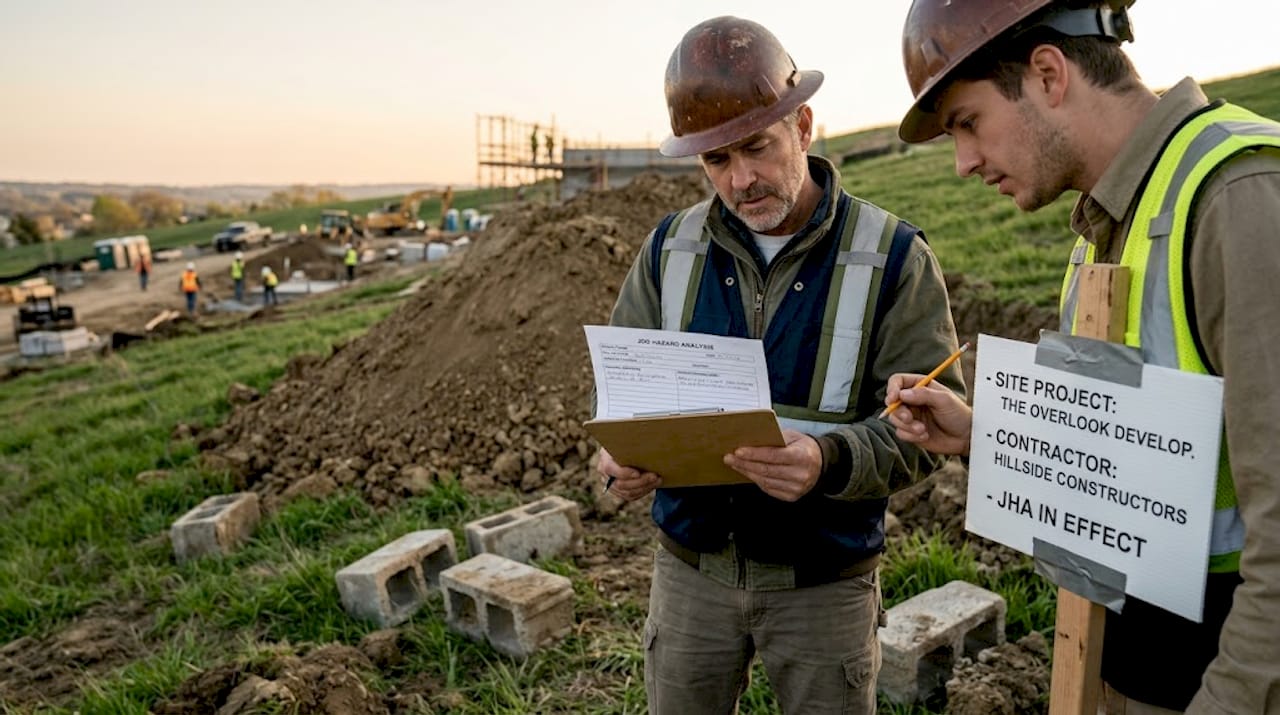
The prequalification component specifically addresses contractor eligibility before any work authorization is granted. Contractor health and safety self-assessments require submission at least two weeks before work begins, remain valid for two years, and must document the contractor’s approach to hazard identification and control. Beyond the self-assessment, contractors must review site health and safety rules and sign a Statement of Understanding confirming informed acceptance of project safety conditions before mobilization is authorized.
The quantitative evaluation criteria that form the backbone of contractor safety evaluation include:
| Metric | What It Measures | Acceptable Benchmark |
|---|---|---|
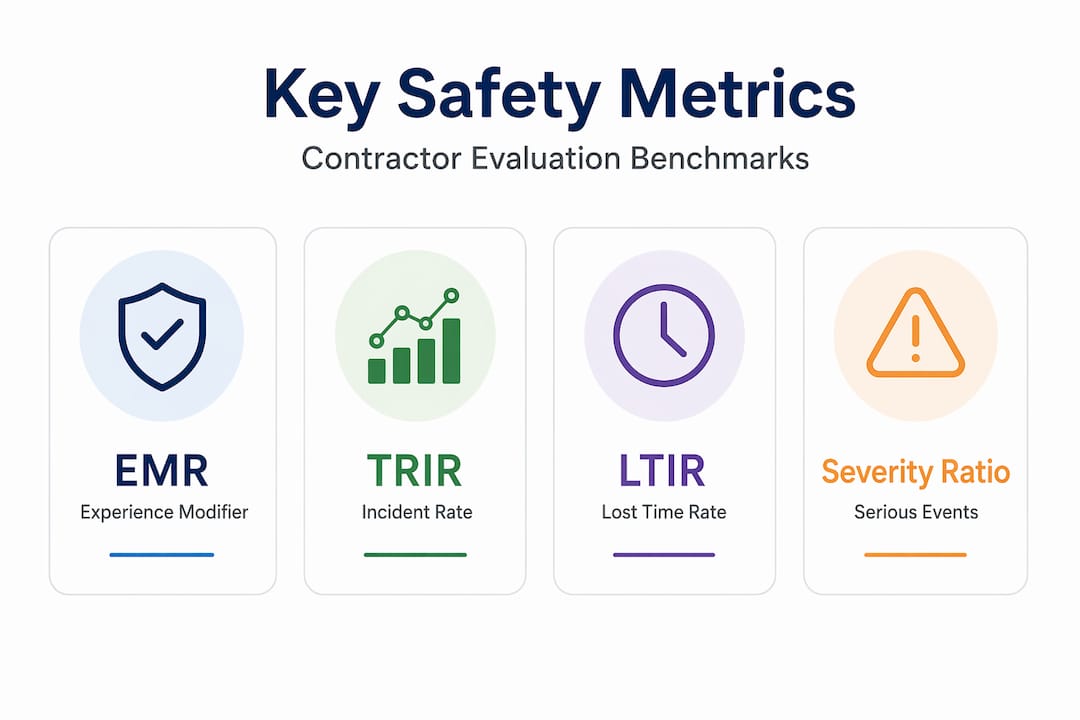
| Experience Modification Rate (EMR) | Workers’ compensation cost relative to industry peers | Below 1.0 for most commercial projects |
| Total Recordable Incident Rate (TRIR) | Frequency of OSHA-recordable injuries per 200,000 work hours | Below industry average for trade category |
| Days Away, Restricted, Transferred (DART) | Severity-weighted incident frequency | Below 1.5 for most construction scopes |
| Safety program documentation | Written programs, procedures, training records | Complete and current |
| Incident history | Near-misses, stop-work events, regulatory citations | Disclosed and remediated |
Pro Tip: Do not rely solely on EMR. A contractor with a low EMR but a pattern of high-severity incidents that were resolved through restricted duty reassignment rather than genuine injury prevention may carry disproportionate site risk. Review the full incident narrative, not just the rate.
Ongoing monitoring and communication during project execution
The prequalification process establishes a baseline. What happens after mobilization determines whether that baseline holds. Contractor safety assessments must function as dynamic documents, with daily hazard checks that capture the risk changes contractors actively introduce as they sequence their work, bring new equipment to site, and interact with other trade contractors in shared work zones.
Project managers who treat contractor safety as a front-loaded administrative exercise tend to discover its gaps during incidents rather than through proactive monitoring. The following structured approach supports continuous contractor safety management across the project lifecycle:
- Daily FLHA review: Require contractor supervisors to submit completed Frontline Hazard Assessments before each shift commences. Review flagged hazards before authorizing work to proceed.
- Weekly safety coordination meetings: Hold formal coordination sessions with all active contractor safety representatives to surface hazard interactions between concurrent trades. Document attendance and action items.
- Periodic formal evaluations: Conduct scheduled contractor performance reviews at defined project milestones. Assess safety metrics, documentation currency, near-miss reporting frequency, and toolbox talk compliance against the written evaluation criteria established at prequalification.
- Non-conformance tracking: Log all safety deficiencies observed during site inspections and assign corrective actions with defined timelines. Track closure rates as a leading performance indicator.
- Escalation protocol activation: Define threshold criteria that trigger increased supervision intensity, formal warnings, or suspension of work authorization. Apply these thresholds consistently and document every escalation decision.
Communication protocols between host employers and contractors are a recurring weakness on multi-employer worksites. Hazard information generated by one contractor frequently fails to reach adjacent trade contractors working in the same zone. A formal hazard communication register, updated daily and made accessible to all active contractors, closes that information gap and creates a documented chain of responsibility for hazard notification.
For construction site managers building out their contractor safety monitoring systems, the key distinction between a functional program and a compliant-on-paper program is whether the daily FLHA data is actually reviewed, acted upon, and fed back into the project’s overall hazard management record.
Integrating assessments into project safety management
The most operationally mature understanding of contractor safety assessment treats it as decision-making infrastructure, not an isolated compliance requirement. Assessment results govern contractor eligibility, shape contract terms, determine the intensity of site supervision, and inform continuous improvement of the overall project safety system.
When a contractor’s periodic evaluation surfaces deteriorating safety metrics, the appropriate response is not simply to issue a corrective action notice. Documented performance data should trigger a formal review of whether that contractor’s scope of work should be modified, whether supervision resources need to be redirected, or whether contract continuation is appropriate. Periodic evaluations and documentation of contractor performance are explicitly required under process safety management frameworks and should be treated as binding operational inputs, not post-incident records.
On multi-employer worksites, the best practices for integrated safety management include:
- Designating a named safety coordinator responsible for contractor safety interface at the project level
- Maintaining a unified hazard register accessible to all contractors, updated in real time as new hazards are identified
- Including contractor safety performance clauses in subcontract agreements, specifying the performance thresholds that constitute material breach
- Conducting joint incident reviews involving both the host employer and the relevant contractor when safety events occur, to prevent siloed root cause analysis
- Using contractor safety performance data from completed projects to build a contractor competency registry that informs future prequalification decisions
The table below summarizes how contractor safety compliance elements directly correlate with measurable project safety outcomes:
| Safety Compliance Element | Project Safety Outcome |
|---|---|
| Thorough prequalification screening | Reduced mobilization of underqualified contractors |
| Daily FLHA submissions reviewed | Earlier hazard detection before incidents occur |
| Periodic performance evaluations | Documented basis for contract continuation or termination |
| Shared hazard register | Reduced interface incidents between concurrent trades |
| Incident history analysis at selection | Lower site TRIR throughout project duration |
A well-structured safety audit for contractors conducted at defined intervals provides the external verification layer that internal monitoring alone cannot deliver. External audits identify systemic gaps in contractor safety management that become normalized within project teams through familiarity.
My perspective on where contractor safety assessments actually fail
I’ve worked with construction organizations across project types and sizes, and the pattern is consistent. The technical components of contractor safety assessment — the forms, the metrics, the prequalification checklists — are usually present. What fails is the organizational commitment to act on what those documents reveal.
I’ve seen project managers hold contractor performance data showing deteriorating TRIR trends and choose not to escalate because the contractor was behind schedule and increasing supervision would slow the work further. That decision always costs more than it saves. The incident comes, the project delays extend beyond anything a supervision intervention would have caused, and the regulatory consequences compound everything.
What I’ve learned is that the best practices for contractor safety assessment are not primarily technical. They are behavioral. The project managers and safety leads who generate genuinely strong contractor safety outcomes treat the assessment data as operational intelligence, not compliance currency. They act on what the data shows, even when it is inconvenient. They build contractor relationships where near-miss reporting is normalized rather than penalized. They understand that the importance of safety assessments is proportional to the organizational willingness to act on what those assessments surface.
The other pattern I’ve observed is the misalignment between prequalification rigor and post-mobilization follow-through. Organizations invest significant effort in the initial contractor safety evaluation and then apply minimal oversight once the contractor is on site. Effective contractor safety management requires the same discipline throughout the project lifecycle that it demands at the front end.
— Aman
How MOSAIC can strengthen your contractor safety program

Construction projects carry contractor safety management obligations that grow more complex as regulatory scrutiny intensifies and project scopes expand. Com, operating as MOSAIC Ecoconstruction Solutions, provides specialized safety consultancy for construction compliance that covers the full contractor safety assessment lifecycle, from prequalification system design and hazard assessment framework development to periodic safety audits and performance monitoring protocols.
MOSAIC’s consultancy services support construction companies in building contractor safety assessment programs that satisfy BizSAFE, ISO, and statutory requirements while generating the kind of operational data that drives genuine risk reduction. The team conducts safety audits for contractors at project milestones and provides documented findings that hold up to regulatory review. For organizations pursuing BizSAFE Star certification, contractor safety management competency is a defined evaluation criterion, and MOSAIC’s advisory track record covers that requirement directly.
FAQ
What is the role of contractor safety assessment?
The role of contractor safety assessment is to evaluate contractor safety competency before mobilization, verify compliance with site-specific hazard controls during execution, and document performance for regulatory compliance and future contractor selection decisions. It functions as the operational infrastructure connecting contractor oversight to project safety outcomes.
What metrics are used in a contractor safety evaluation?
Contractor safety evaluation relies on quantitative metrics including Experience Modification Rate (EMR), Total Recordable Incident Rate (TRIR), and Days Away, Restricted, Transferred (DART) rate, alongside qualitative review of safety program documentation, training records, and incident history. OSHA 29 CFR 1910.119(h) mandates that host employers establish and document these written evaluation criteria.
How does contractor prequalification differ from ongoing assessment?
Contractor prequalification safety assessment occurs before work begins and establishes eligibility for site access based on documented safety performance and program quality. Ongoing assessment involves daily hazard checks, periodic performance evaluations, and real-time monitoring throughout the project, forming a continuous safety management cycle rather than a single gate review.
What happens when contractor safety assessments are not completed?
Failing to conduct proper hazard assessments constitutes a regulatory violation that can result in stop-work orders, substantial fines, and criminal liability in fatality cases. Jurisdictional precedents, including documented Canadian cases involving fines exceeding $200,000, confirm that both the contractor and the host employer carry shared legal exposure for assessment failures.
How often should contractor safety performance be formally reviewed?
Formal contractor safety performance reviews should occur at defined project milestones and whenever site conditions, contractor scope, or personnel change significantly. Under process safety management frameworks, periodic evaluations and documentation of contractor performance are a mandatory requirement, not an optional management practice.
Recommended
- ConSASS Assessment for Contractors Explained – MOSAIC Eco-construction Solutions Pte Ltd
- How to Improve Contractor Safety Culture – MOSAIC Eco-construction Solutions Pte Ltd
- Risk assessment process: mastering construction safety in Singapore
- Workplace risk assessment in Singapore construction: A practical guide