

Behavioral safety is defined as a proactive discipline that targets observable employee actions to prevent workplace accidents before they occur. Unlike reactive safety systems that measure failure after the fact, behavior-based safety (BBS) intervenes at the point where risk originates: human behavior. The role of behavioral safety extends beyond compliance checklists. It creates a feedback loop between management and workers that shifts organizational culture toward shared accountability. OSHA and industry safety bodies recognize BBS as a leading indicator framework, meaning it generates preventive data rather than post-incident statistics. For safety professionals and organizational leaders in high-risk sectors like construction, understanding this distinction is the foundation of effective risk management.
What evidence supports the effectiveness of behavioral safety programs?
Behavior-based safety programs produce measurable results. A BBS intervention in a high-risk logistics environment increased safe behavior observations from 56% to 85% within four weeks. That is a 29-percentage-point improvement in observable safe conduct within a single month of structured intervention.
The mechanism behind this result is the ABC model: Antecedent, Behavior, Consequence. An antecedent is any condition or cue that precedes a behavior, such as a safety briefing or a posted procedure. The behavior is the observable action itself. The consequence is what follows, whether positive reinforcement, corrective feedback, or no response at all. BBS programs use this model to design interventions that make safe behavior the path of least resistance for workers.

Experts classify BBS as a leading indicator that provides proactive incident visibility, unlike lagging indicators such as injury rates or OSHA recordable counts. Lagging indicators tell you what went wrong. Leading indicators tell you where risk is accumulating before an incident occurs. That distinction matters enormously for organizations trying to prevent harm rather than document it.
| Safety Metric | Before BBS Implementation | After BBS Implementation |
|---|---|---|
| Safe behavior observation rate | 56% | 85% |
| Incident visibility | Lagging (post-event) | Leading (pre-event) |
| Data type | Injury counts, OSHA recordables | Behavioral observation scores |
| Management response | Reactive investigation | Proactive corrective action |
Pro Tip: Track behavioral observation scores weekly during the first 90 days of a BBS program. Early trend data reveals which tasks or shifts carry the highest behavioral risk, allowing targeted intervention before incidents accumulate.
How does behavioral safety differ from traditional safety approaches?
Traditional safety management centers on compliance audits, incident reports, and lagging indicators. These tools are necessary but insufficient. They measure what has already gone wrong. BBS focuses on behaviors as leading indicators that enable earlier intervention, before a near-miss becomes a fatality.
A common misconception is that BBS programs are surveillance tools designed to catch workers making mistakes. That framing destroys program credibility. Effective BBS is a safety partnership between management and the workforce, not a disciplinary mechanism. BBS applies behavior science principles to real-world safety by analyzing antecedents and consequences to change actions, fostering positive behavior change rather than punitive compliance.
Psychological safety is the prerequisite that traditional safety systems rarely address. If workers fear disciplinary action for honest reporting, the data they generate is sanitized and useless. Traditional compliance frameworks often create exactly that fear. BBS, when implemented correctly, removes it.
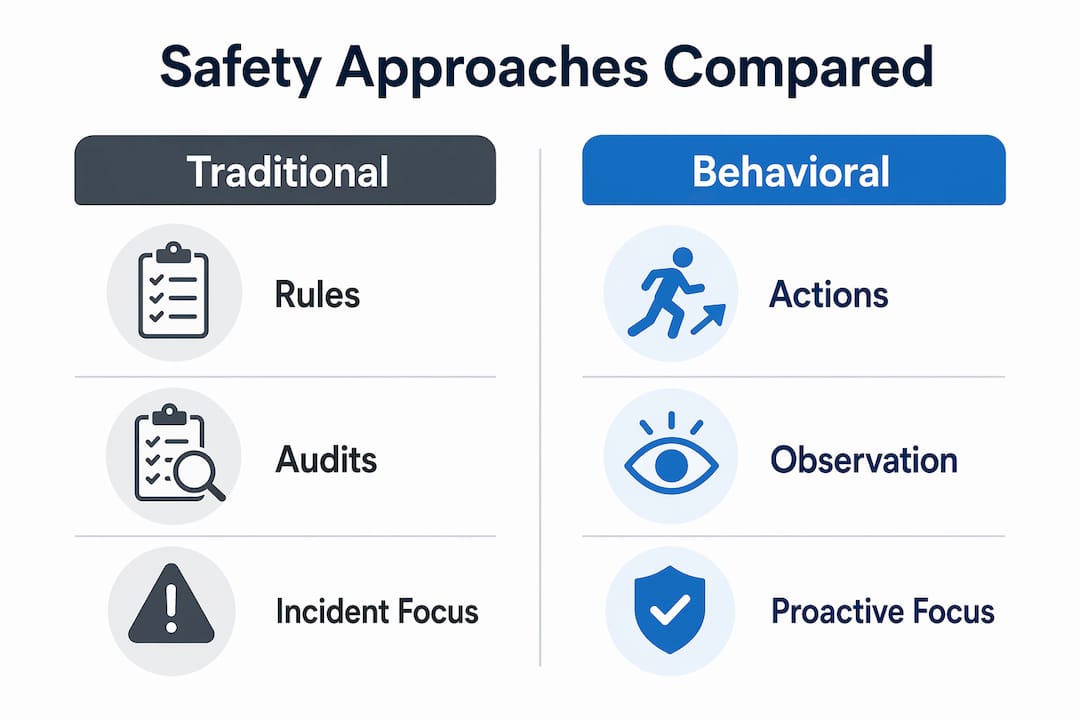
| Dimension | Traditional safety management | Behavior-based safety |
|---|---|---|
| Primary focus | Rules, procedures, equipment | Observable worker behaviors |
| Indicator type | Lagging (injury rates, incidents) | Leading (safe behavior observations) |
| Response timing | Post-incident investigation | Pre-incident intervention |
| Worker role | Compliance subject | Active safety partner |
| Cultural outcome | Fear-based compliance | Trust-based engagement |
Pro Tip: When introducing BBS to a workforce accustomed to punitive safety culture, hold a joint session with frontline workers and supervisors to co-design the observation checklist. Shared ownership of the tool removes the surveillance perception from the start.
What are best practices for implementing an effective behavioral safety program?
Effective BBS implementation follows a structured process. The eight-step BBS process uses the ABC model to shift organizations from reactive to proactive safety management. Each step builds on the last, and skipping any one of them weakens the entire program.
The eight critical steps are:
- Define target behaviors. Identify the specific observable actions that most directly correlate with incident risk on your site. Focus on high-frequency, high-consequence behaviors first.
- Develop an observation checklist. Build a structured tool that observers use consistently. Checklist items must be observable and measurable, not attitudinal.
- Train observers. Observers must understand the ABC model, how to deliver feedback without blame, and how to record data accurately. Training takes time and cannot be condensed into a single briefing.
- Conduct structured observations. Observers watch workers performing tasks and record safe and at-risk behaviors. Observations must be frequent enough to generate statistically meaningful data.
- Deliver immediate, constructive feedback. Feedback given at the point of observation is the most powerful behavioral reinforcement tool available. Delayed feedback loses most of its impact.
- Aggregate and analyze data. Individual observation sheets are not the product. The aggregated dataset is. BBS treated as a clipboard-and-checklist exercise without structured analysis leads to failure. True BBS requires data aggregation, corrective action linkage, and management follow-through.
- Identify systemic root causes. Data analysis must focus on systemic contributors to unsafe behaviors rather than individual blame. A worker consistently skipping PPE is a symptom. The root cause may be equipment availability, time pressure, or supervisor modeling.
- Implement and track corrective actions. Every identified root cause requires a documented corrective action with an owner and a deadline. Visible management follow-through is what sustains workforce trust in the program.
For construction environments, integrating BBS with your safety management system ensures that behavioral data feeds directly into your broader risk control framework rather than sitting in isolation.
What challenges can organizations face in applying behavioral safety?
BBS programs fail in predictable ways. Recognizing these failure modes before they occur is the most direct path to avoiding them.
- The checklist trap. Organizations that treat BBS as a paperwork exercise generate data that no one analyzes and corrective actions that no one tracks. The program becomes a compliance theater performance rather than a genuine risk reduction tool.
- Punitive culture undermining data integrity. Psychological safety is critical to BBS success. If employees fear disciplinary action, behavioral reporting data will be sanitized and useless. Workers will report what they think management wants to see, not what is actually happening.
- Zero tolerance policies that backfire. Disciplinary actions and zero tolerance policies often fail to reduce risk-taking behaviors. Understanding employee motivations and organizational culture has greater impact on behavioral safety outcomes than rigid enforcement.
- Observer fatigue and inconsistency. Observation programs that rely on a small group of designated observers burn out quickly. Rotating observers and embedding observation into normal supervisory routines sustains program momentum.
- Lack of visible management response. Workers disengage when they submit observation data and see no corrective action. Moving from surveillance-style safety walks to constructive feedback with visible corrective actions is what sustains engagement.
Addressing these challenges requires more than procedural fixes. It requires leaders to model the behaviors they expect from their workforce. A supervisor who completes observation forms but never delivers feedback or follows up on corrective actions communicates that the program is not serious. That signal travels fast through any organization.
How does behavioral safety impact employee engagement and safety culture?
Behavioral safety programs, when functioning correctly, change the quality of communication between management and workers. That communication shift is the mechanism through which safety culture improves. BBS efficacy is contingent on organizational culture readiness. Evidence balancing and genuine partnership with the workforce are the conditions that make sustainable success possible.
The benefits that follow from a well-functioning BBS program extend well beyond incident rate reduction:
- Reduced absenteeism. Workplaces where workers feel genuinely protected and heard report lower rates of injury-related and stress-related absence.
- Lower incident costs. Proactive behavioral intervention reduces the frequency and severity of incidents, directly reducing workers’ compensation claims, investigation costs, and project delays.
- Improved morale. Workers who participate in safety observations as partners rather than subjects report higher job satisfaction and greater trust in management.
- Stronger safety culture. Safety culture is the shared set of beliefs, norms, and practices that govern how an organization actually behaves around risk. BBS builds that culture through repeated, positive interactions between observers and workers on the floor.
For construction professionals managing construction site hazards, the behavioral dimension is often the difference between a site that meets compliance standards on paper and one that genuinely protects its workforce. Improving contractor safety culture requires exactly the kind of sustained behavioral reinforcement that a well-designed BBS program delivers.
Key Takeaways
Behavioral safety programs succeed when they combine structured observation, honest data, and visible management follow-through within a psychologically safe organizational culture.
| Point | Details |
|---|---|
| BBS is a leading indicator tool | It generates pre-incident behavioral data, unlike lagging indicators that only measure past failures. |
| The ABC model drives intervention | Structuring observations around Antecedent, Behavior, and Consequence enables targeted, evidence-based corrective action. |
| Psychological safety is non-negotiable | Workers who fear punishment produce sanitized data, which makes the entire program ineffective. |
| Data aggregation separates BBS from checklists | Individual observation sheets have no value without aggregated analysis linked to corrective actions. |
| Culture determines program sustainability | Zero tolerance policies undermine BBS; leadership modeling and genuine partnership sustain it. |
Why most BBS programs fail before they start
The most common mistake I see organizations make with behavioral safety is treating it as a measurement program rather than a communication program. They invest in observation checklists, train a cohort of observers, and then wait for the data to produce results. It never does. Data without dialogue is just paperwork.
The organizations that get BBS right understand that the observation itself is the intervention. The conversation between an observer and a worker at the point of an at-risk behavior is where behavior change actually happens. The form is just the record. When leaders focus on the quality of that conversation rather than the volume of completed checklists, the program starts to work.
I also think the industry underestimates how much leadership behavior shapes BBS outcomes. A senior manager who visibly acts on behavioral data, who stands in front of the workforce and says “we observed this pattern, and here is what we changed,” creates more program momentum than any training session. Workers watch what leaders do, not what they say. BBS programs that lack that visible leadership response stall within six months, regardless of how well they were designed.
The future of behavioral safety lies in integrating observation data with digital safety management systems. When behavioral trends feed directly into risk assessments and incident prevention planning, BBS stops being a standalone program and becomes part of the organization’s core safety intelligence. That integration is where the real long-term value sits.
— Aman
How Com supports behavioral safety in Singapore construction
Com, operating as MOSAIC Ecoconstruction Solutions, brings specialist expertise to embedding behavioral safety within the safety management systems of Singapore’s construction sector. For organizations navigating BizSAFE certification, ISO compliance, and the specific risk profile of high-hazard construction environments, generic BBS frameworks are rarely sufficient.

Com’s safety consultancy services are designed to integrate behavioral observation programs into your existing compliance and risk management architecture. From observation checklist design to data analysis protocols and corrective action tracking, Com provides the structured support that turns a BBS program from a compliance exercise into a genuine risk reduction system. Contact Com to discuss how behavioral safety can be embedded into your site’s safety management framework.
FAQ
What is behaviour-based safety in simple terms?
Behaviour-based safety is a proactive approach that uses structured observation and feedback to reinforce safe worker actions and reduce at-risk behaviors before incidents occur. It applies the ABC model (Antecedent, Behavior, Consequence) to identify and address the root causes of unsafe conduct.
How quickly can a BBS program show results?
A structured BBS intervention can produce measurable improvement in safe behavior observations within four weeks, as demonstrated by a logistics sector case study that recorded an increase from 56% to 85% safe behaviors in that timeframe.
Why do BBS programs fail?
BBS programs most commonly fail when treated as a checklist exercise without data analysis, when punitive culture prevents honest reporting, or when management does not visibly act on observation findings. Psychological safety and leadership follow-through are the two most critical success factors.
How does behavioral safety differ from a safety audit?
A safety audit evaluates compliance with procedures and standards at a point in time. Behavioral safety continuously monitors and reinforces the actual actions workers take during normal operations, generating leading indicator data rather than a periodic compliance snapshot.
Can behavioral safety work in construction environments?
Behavioral safety is particularly effective in construction environments because high-hazard tasks involve frequent human decisions under time and production pressure. Integrating BBS with a formal safety risk assessment workflow ensures behavioral data directly informs hazard control priorities on site.
Recommended
- Workplace Safety Management Steps for Every Industry
- Enhancing Workplace Safety Through Effective Audit Checklists And Risk Management Systems – MOSAIC Eco-construction Solutions Pte Ltd
- Case Studies in Safety: Essential Lessons from Recent MOM WSH Alerts – MOSAIC Eco-construction Solutions Pte Ltd
- Dynamic Risk Assessment in Singapore: A WSH Framework for High-Paced Industries – MOSAIC Eco-construction Solutions Pte Ltd