Safety signage in Singapore is governed by a layered set of rules rather than a single signage regulation. Since 1 January 2025, all five parts of the SS 508 standard on safety colours and safety signs have been approved as WSH Codes of Practice. Fire signs follow the SCDF Fire Code, and public-sector construction contracts add their own sign requirements. A compliant site therefore needs signs that match SS 508 formats, meet the size and placement rules of the authority that applies, and stay legible and unobstructed for as long as the work runs.
This guide is written for contractors, developers, safety managers and WSH officers who must get signage right and prove it at inspection. It sets out which rules apply, what each sign category looks like, the minimum sizes the official sources state, and how to keep signage in order.
TL;DR
- SS 508 (Parts 1 to 5) became part of Singapore’s notified WSH Codes of Practice on 1 January 2025, so it is the reference for sign colours, shapes and symbols.
- Fire safety signs and exit signs are set by the SCDF Fire Code: for example, symbol heights of 60 mm to 150 mm depending on viewing distance, and exit-staircase signs of at least 300 x 300 mm at each storey landing.
- LTA-linked construction contracts require Danger, Warning, Caution or Information signs of at least 1.5 m x 1.0 m at public access points, in the four official languages.
- From 1 January 2025, combustible-dust packages and containers must carry hazard and safe-use labels, and the duty reaches suppliers as well as occupiers.
- Signs must be kept legible and must never obstruct fire installations or escape routes.
Table of Contents
- The legal basis: what makes signage mandatory
- The five sign categories and how each is formatted
- Fire safety signs: colour, size and placement
- Construction sites: what the contract adds
- What changed from 1 January 2025
- Keeping signs compliant after installation
- Where an audit helps
- Perspective
- FAQ
- Sources
The legal basis: what makes signage mandatory
The Workplace Safety and Health Act 2006 applies to all workplaces, except where the Act says otherwise. It places general duties on employers, occupiers and principals to take reasonably practicable measures to protect people at work, and hazard communication is part of meeting those duties. Signs are one of the most visible forms of evidence that a site has done so.
The practical reference for how signs should look is the Singapore Standard SS 508, Graphical symbols: Safety colours and safety signs. A WSH Council notification effective 1 January 2025 lists all five parts of SS 508 among the approved Codes of Practice. A Code of Practice is guidance approved under the Act. It is not a statute, but it sets the standard of practice that inspectors and auditors expect, so a site that departs from it must be able to show an equally safe alternative.
Part 1 of the standard, SS 508-1:2013 with the 2016 amendment, is identical to ISO 3864-1:2011. It sets the safety colours and design principles for signs and markings used for accident prevention, fire protection, health hazard information and emergency evacuation in workplaces and public areas. Two boundaries matter:
- It does not cover rail, road, river, maritime or air traffic signalling.
- Chemical and dangerous-goods labels fall under SS 586 and the GHS (Globally Harmonized System) rather than SS 508.
The SCDF Fire Code 2023 also lists SS 508 among its referenced standards, so one standard connects the WSH framework and the fire regime. For the wider picture of what a contractor must satisfy, see our overview of statutory safety requirements in Singapore.
The five sign categories and how each is formatted
SS 508 follows the ISO convention that colour and shape tell the reader what kind of message a sign carries before any wording is read. The categories most sites use are:
| Category | Meaning | Format |
|---|---|---|
| Prohibition | An action that must not be done | Red circle with a diagonal slash over a black symbol |
| Mandatory action | An action that must be done, such as wearing PPE | White symbol on a blue circle |
| Warning | A hazard is present | Black symbol on a yellow triangle |
| Safe condition | Exits, first aid, assembly points | White symbol on a green rectangle or square |
| Fire equipment | Location of extinguishers, hose reels, alarms | White symbol on a red rectangle or square |
Consistency is the point. A worker who has moved between sites should read a blue circle as an obligation and a red circle as a prohibition without having to stop and think. Mixing homemade formats, such as a yellow rectangle used as a prohibition, undermines that recognition and is a typical finding in a site walk.
Supplementary text is permitted and, on multilingual sites, practically necessary. Where the workforce is diverse, pair the symbol with short wording in the languages your workers read. Keep the text short and keep the symbol dominant.
Fire safety signs: colour, size and placement
Fire signage is where the numbers are most precise, because the SCDF publishes them.
Colour scheme for fire equipment
The SCDF’s Clause 6.7 on the colour scheme of fire protection systems requires items such as fire pumps, sprinkler control valves, fire alarm panels, manual call points, hose reel drums and fire extinguisher cabinets to be painted red. Where pipework is not painted red, it must carry red colour bands at least 20 mm wide, with labelling at intervals of no more than 6 m. If you are fitting out or handing over a building, check this before the inspection and not after.

Minimum symbol heights by viewing distance
The Fire Code sets minimum heights for fire-safety graphical symbols according to how far away the reader will be. According to the Fire Code 2022 excerpt (Table 6.2.9), height and width are equal, and the sizes are based on the luminous factor Z=100 from SS 563:
| Viewing distance | Minimum symbol height |
|---|---|
| 0 to 6 m | 60 mm |
| Over 6 to 9 m | 90 mm |
| Over 9 to 12 m | 120 mm |
| 12 m or more | 150 mm |
Worked example: a warehouse bay where the nearest exit sign is visible from 10 m away needs a symbol at least 120 mm high. A sign sized for a corridor, at 60 mm, would be undersized there even though the design is otherwise correct. Measure the longest realistic sight line, not the nearest one.
Exit staircase signs
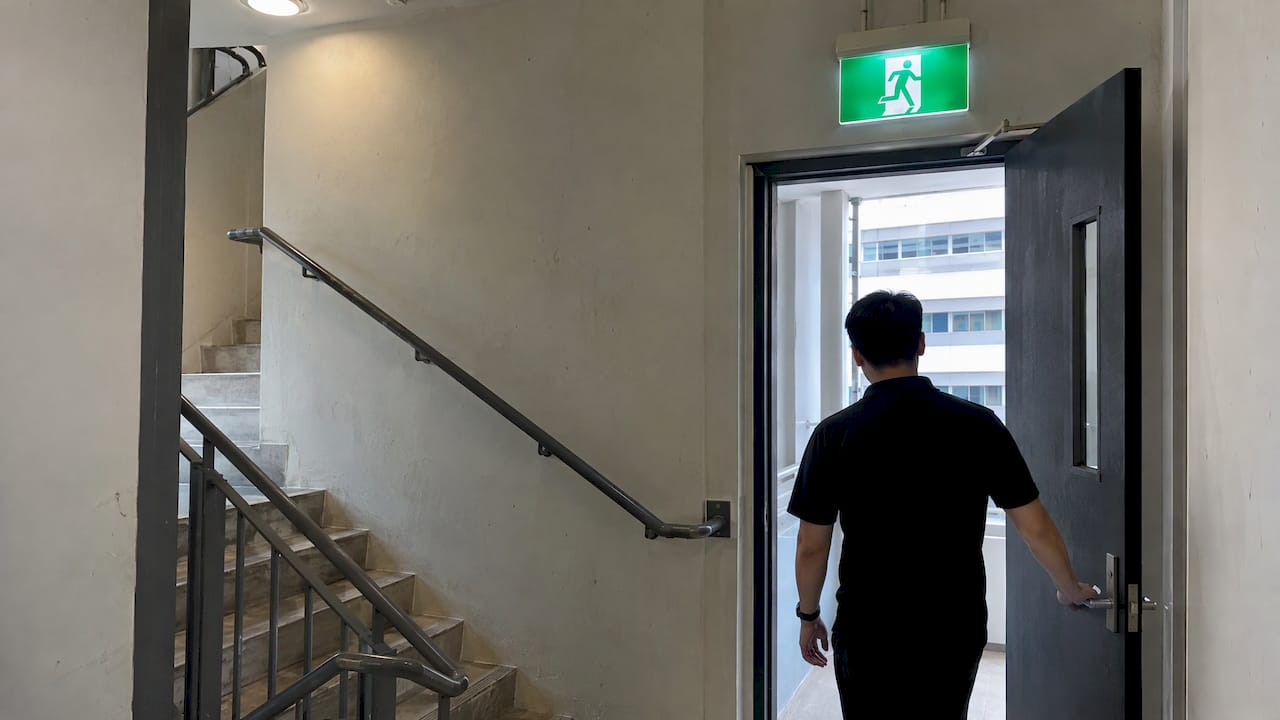
Under Clause 2.3 of the Fire Code 2023 on means of escape, exit-staircase signs must be at least 300 x 300 mm at each storey landing. Storey numbers must be at least 125 mm high and the staircase identification at least 25 mm high. The signs must be visible with the door open and to people moving up or down the stairs. That last point catches many fit-outs: a sign that is correct on paper but hidden behind an open door leaf fails the intent.
Factories and workshops
If you occupy a JTC factory or workshop, the JTC Schedule of Statutory Controls (October 2024) requires exit lighting and exit signs at exit passageways and exits, as stipulated by the Fire Safety and Shelter Department (FSSD). It also requires emergency lighting in occupied areas such as production areas, areas without explicit paths to corridors or exits, and toilets. The same schedule states that qualified professionals must plan, design, supervise and maintain modifications to fire systems, with drawings submitted to FSSD for approval. Relocating an exit sign as part of a layout change can therefore be a regulated modification and not a housekeeping task.
Construction sites: what the contract adds
On a construction site, the baseline is the WSH Act with SS 508 formats, and the contract often adds further detail. The LTA General Specification, Appendix A (June 2022 edition) is a good example for infrastructure work. It requires the contractor to:
- provide, erect, maintain and remove Danger, Warning, Caution or Information signs suited to the site layout;
- make each sign no smaller than 1.5 m x 1.0 m;
- write the signs boldly in the four official languages (English, Chinese, Malay and Tamil);
- place them on existing footpaths and at public access points, in addition to any statutory notices.
The same specification requires compliance with all applicable Singapore safety, health and environment legislation, and submission of a safety, health and environment management system within 12 weeks of contract award, following SS CP79 and, where applicable, ISO 14001 and ISO 45001. Signage should therefore appear in your management system as a controlled item with an owner, a standard and an inspection frequency.
A practical signage schedule for a site
Build the schedule from the site’s hazards and not from a catalogue. A workable sequence:
- List the hazards by zone. Entrances and hoarding, crane and lifting areas, excavations, electrical installations, confined spaces, work at height and noisy plant.
- Assign each hazard a category. Prohibition for what must not happen, mandatory for PPE and actions, warning for hazards present.
- Set size by viewing distance. Use the Fire Code table for fire symbols and the contract’s minimum for public-facing signs.
- Fix locations and heights where the sign is visible from the approach direction, and not hidden by materials, hoarding joints or open doors.
- Record each sign with its location, date installed and the person responsible for checking it.
- Update when the work changes. A sign that describes last month’s hazard is as misleading as a missing one.
The mandatory PPE signs follow the same logic. Where the WSH (Work at Heights) Regulations apply, a harness sign belongs where a fall of two metres or more is possible, and a hearing protection sign belongs where noise is a recognised hazard. The sign is only credible if the control behind it exists, so tie each sign to the risk assessment that justifies it. Our guide to workplace safety in Singapore for construction compliance shows how those controls fit together.
What changed from 1 January 2025
The most notable recent change in hazard communication came with MOM’s enhanced measures for higher-risk machinery and combustible dusts, effective 1 January 2025:
- Suppliers and occupiers must label combustible-dust packages or containers with hazard and safe-use information. For organic dust such as flour or starch, this applies at 25 kg and above.
- WSH Act duties extend to additional classes of higher-risk machinery.
- The measures extend supply-chain accountability, following the inquiry into the 2021 Stars Engineering explosion, so hazard communication now reaches suppliers and not only the occupier on site.
For manufacturers, food processors and any site that stores or handles fine dust, check labelling on incoming and outgoing containers as well as wall signs. For everyone else, the lesson is that hazard communication is expected to be traceable along the supply chain.
Keeping signs compliant after installation
Installation is the easy part. Most findings come later, from fading, damage, obstruction and drift between what the sign says and what is actually on site. The JTC schedule requires occupiers to keep fire alarms, hose reels, extinguishers and emergency lighting operational at all times and not to obstruct any fire-fighting installation or escape route. A sign is part of that system: an exit sign that is blocked by stacked stock fails its purpose.
A routine that works for most sites:
- Weekly walk. Check that signs are present, upright, clean and unobstructed, especially exit signs, fire equipment signs and entrance PPE signs.
- After any change. When a hoarding is moved, a crane is relocated or a floor is re-partitioned, re-check the signs that depended on the old layout.
- Lighting. Confirm that exit signs and emergency lighting work, since a sign that cannot be seen in an outage does not support evacuation.
- Record the check. A dated log with a name is the evidence an auditor will ask for.
- Replace on defect. Faded colour, peeled symbols and cracked panels reduce recognition and should be replaced, not tolerated.
Where an audit helps
Signage rarely fails on its own. It fails because ownership is unclear, the schedule was never tied to the risk assessment, or no one has looked at it since the last layout change. A structured review against the WSH Act, SS 508 and the fire requirements for your premises catches these gaps while they are cheap to fix.
Our WSH audit and inspection service covers workplace safety and health compliance for construction and industrial firms, and our team brings over 20 years of experience to the work. Signage naturally forms part of the site review alongside risk assessments, permits and records. If your firm is pursuing certification, the same discipline supports BizSAFE Level 3, 4 and Star and ISO 45001-aligned systems, because both depend on documented, verifiable controls.

If you want the signage schedule, inspection log and risk assessments reviewed together, speak to our team through our consultancy page.
Perspective
Signage is often treated as a purchasing task: order the signs, fix them to the hoarding, move on. We see it differently. A sign is a control measure that communicates a decision made earlier in the project, and it is only as sound as that decision.
That is why we start from the hazard and the design stage, not the catalogue. When risks are identified through Design for Safety and carried into the site safety management system, the signage schedule follows naturally: each sign has a reason, an owner and a check. When signs are bought first, they tend to drift from the real hazards within weeks.
The 2025 recognition of SS 508 as a Code of Practice makes this more pressing. Auditors and inspectors now have an approved reference for how signs should look, and the supply-chain labelling duties show where regulators are heading: hazard information that is complete, consistent and traceable.
Our approach is to bring signage into the same documented system as your risk assessments, permits and inspections, so that compliance is demonstrated by records and not just by what is on the wall. Our over 20 years of experience in BizSAFE, ISO and WSH compliance is built around that principle.
Aman
FAQ
Is SS 508 compulsory in Singapore?
SS 508 is a Singapore Standard, and its five parts have been approved as WSH Codes of Practice since 1 January 2025. A Code of Practice is not itself a statute, but it is the approved reference for good practice under the WSH Act. Sites that depart from it should be able to justify why their approach is equally safe.
What size must a fire safety symbol be?
The SCDF Fire Code sets minimum symbol heights by viewing distance: 60 mm for 0 to 6 m, 90 mm for over 6 to 9 m, 120 mm for over 9 to 12 m and 150 mm for 12 m or more. Height and width are equal. Measure from the furthest point at which the sign must be read.
What size are exit signs for staircases?
Clause 2.3 of the Fire Code 2023 requires exit-staircase signs of at least 300 x 300 mm at each storey landing. Storey numbers must be at least 125 mm high and the staircase identification at least 25 mm high. The sign must remain visible with the door open.
Do construction sites need signs in more than one language?
For LTA-linked works, the General Specification requires signs written boldly in the four official languages: English, Chinese, Malay and Tamil. Even where a contract does not require it, multilingual wording helps a mixed workforce understand the hazard. Keep the SS 508 symbol as the main message.
Do chemical labels follow SS 508?
No. SS 508 Part 1 excludes chemical and dangerous-goods labels, which are covered by SS 586 and the GHS. Since 1 January 2025, combustible-dust packages and containers also need hazard and safe-use labels, and the duty applies to suppliers as well as occupiers.
Sources
- Workplace Safety and Health Act 2006, Singapore Statutes Online
- WSH Council notification of approved Codes of Practice, effective 1 January 2025
- SS 508-1:2013 with Amendment 1, Singapore Standards preview
- SCDF Fire Code 2023, Chapter 1 related tables and diagrams
- SCDF Clause 6.7, colour scheme of fire protection systems
- Fire Code 2022 excerpt, minimum fire symbol sizes by viewing distance
- SCDF Fire Code 2023, Clause 2.3 means of escape requirements
- JTC Schedule of Statutory Controls for standard factory and workshop customers, October 2024
- LTA General Specification Appendix A, June 2022 edition
- MOM press release: enhanced safety measures for higher-risk machinery and combustible dusts from 1 January 2025