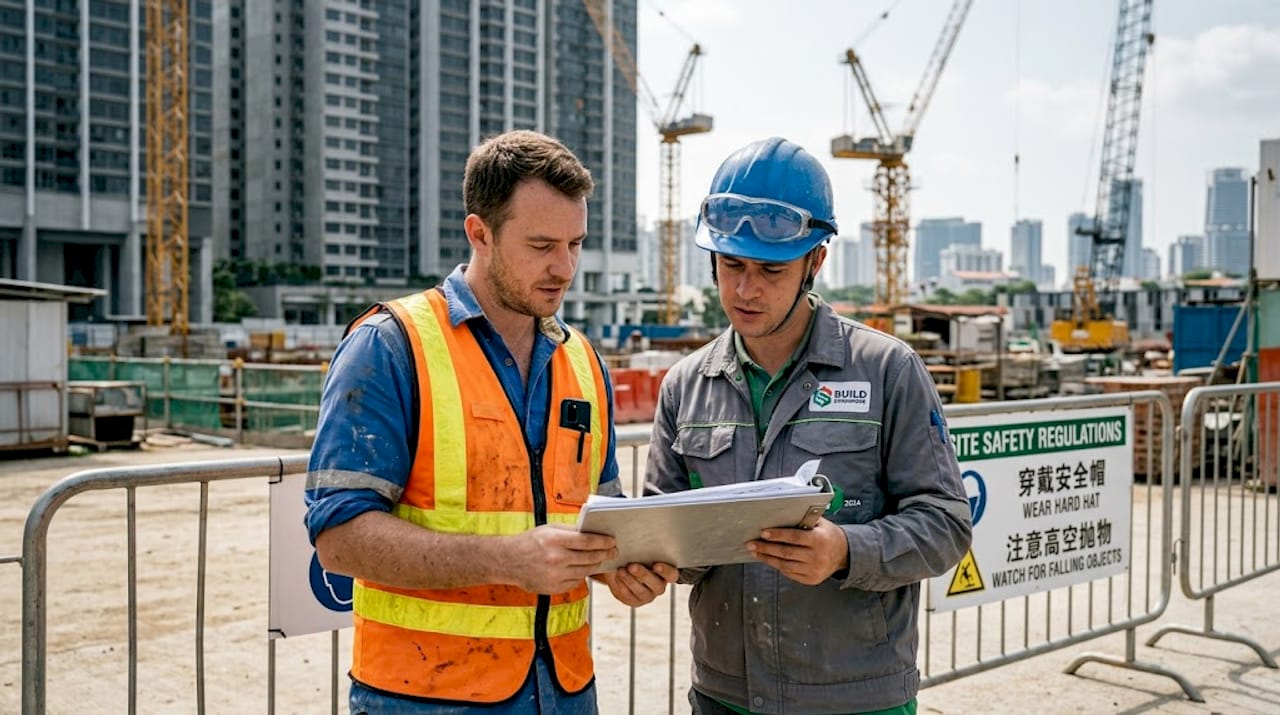
Singapore’s construction sector continues to rank among the highest-risk industries in the country, even as fatal and major injury rates fell to 26.3 per 100,000 workers in 2025 from 31.0 the year prior. For construction firms and project developers, the consequences of non-compliance extend far beyond workplace accidents: failed tenders, regulatory penalties, project stoppages, and reputational damage are all tangible operational risks. This guide systematically addresses every layer of Singapore’s construction safety compliance framework, from foundational legal obligations and BizSAFE certification through to worker training mandates, enforcement trends, and the strategic edge that genuine safety leadership provides in competitive tendering.
Table of Contents
- Core safety compliance requirements for Singapore construction
- Step-by-step: Achieving core certifications and approvals
- Mandatory worker training and supervision
- Common pitfalls, enforcement trends, and how to stay ahead
- What experience teaches about Singapore construction safety compliance
- Take the next step: Expert help with safety compliance
- Frequently asked questions
Key Takeaways
| Point | Details |
|---|---|
| Set clear compliance foundations | Identify all mandatory certifications and approvals before your project begins. |
| Follow structured certification steps | Systematically secure bizSAFE, ASC, and other key credentials to access more tenders. |
| Maintain up-to-date worker training | Track all frontline training and renewals to avoid permit and audit pitfalls. |
| Watch for enforcement changes | Stay alert to new requirements around small projects and public sector WSH enhancements. |
| Go beyond checklists | Shift from box-ticking to a living risk-based approach for sustainable compliance and competitive edge. |
Core safety compliance requirements for Singapore construction
The statutory foundation of workplace safety in Singapore is the Workplace Safety and Health (WSH) Act, administered by the Ministry of Manpower (MOM). Every construction firm operating in Singapore must demonstrate compliance with this Act, its subsidiary legislation, and the approved codes of practice published by the WSH Council. Regulatory oversight spans MOM’s WSH Inspectorate, the Building and Construction Authority (BCA), and sector-specific authorities for infrastructure projects. Understanding construction safety standards across these bodies is the non-negotiable starting point for any firm seeking tender eligibility and operational continuity.
BizSAFE: the compliance ladder every firm must climb
The BizSAFE program, structured as a five-level ladder, is the practical gateway to legal operation and competitive tendering in Singapore construction. While Levels 1 and 2 establish foundational risk management awareness, BizSAFE Level 3 is the critical threshold. At Level 3, a firm must implement a Risk Management (RM) plan certified by a MOM-approved WSH auditor, and this certification is a prerequisite for most government and institutional tenders. Level 4 requires a full WSH Management System audit, while Star certification (the highest level) signals sector-leading safety governance.
For firms tendering on public projects or major private developments, BizSAFE Level 3 is not optional: it is a gating requirement, and many project owners now weight safety certification scores of 5% or more in their tender evaluation matrices. Smaller firms often underestimate the preparation required for the Level 3 audit, particularly in documenting hazard identification, risk assessment, and risk control (HIRAC) processes for all work activities on site.
Specialist approvals: ASC and crane contractor requirements
Beyond BizSAFE, certain high-risk activities require additional statutory approvals. The specialist approval processes for scaffolding and crane operations are especially significant. The Approved Scaffold Contractor (ASC) and Approved Crane Contractor designations require BizSAFE Level 3 or higher, demonstrable competent personnel, structured training programs, a $150 application fee, and carry lifetime validity upon approval. These designations are often the deciding factor in winning subcontracting packages on major infrastructure and commercial projects.
Key mandatory compliance elements
| Requirement | Governing body | Threshold/notes |
|---|---|---|
| WSH Act compliance | MOM | All firms |
| BizSAFE Level 3 | WSH Council / MOM | Mandatory for most tenders |
| Risk Management plan | MOM-approved auditor | Certified HIRAC documentation |
| Approved Scaffold Contractor | MOM | Required for all scaffolding works |
| Approved Crane Contractor | MOM | Required for all lifting operations |
| WSH Management System | SAC-accredited auditor | Required for BizSAFE Level 4+ |
Mandatory documentation includes the RM plan, safe work procedures (SWPs) for each work activity, emergency response plans, WSH performance records, and training registers. Firms should also review site safety tips regularly, particularly as MOM updates its approved codes of practice. For projects with significant design risk, Design for Safety (DfS) obligations must be integrated at the planning stage, with developers bearing primary accountability under the statutory framework.
Pro Tip: Establish a compliance calendar that maps each certification’s audit cycle, renewal date, and responsible officer to upcoming project tender schedules. A lapse in BizSAFE status as little as two weeks before a tender submission can disqualify your firm entirely.
Step-by-step: Achieving core certifications and approvals
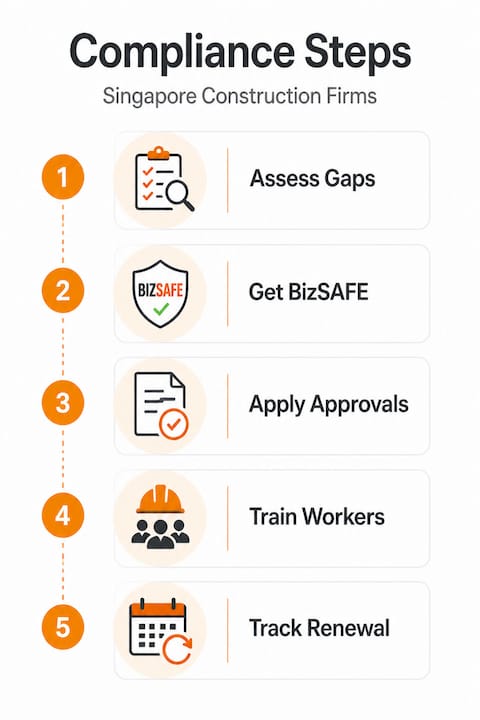
Systematic certification is not a bureaucratic exercise. It is a structured operational investment that determines which projects your firm can legally bid on and execute. The process for each major certification follows a defined sequence, and firms that approach it methodically avoid the costly delays that come from incomplete applications or failed audits.
Securing BizSAFE Level 3
- Register your firm on the WSH Council’s BizSAFE portal and ensure CEO/top management has completed the BizSAFE Level 1 risk management workshop.
- Assign a Risk Management Champion (RMC) who completes the MOM-approved RMC training course, typically two days in duration.
- Develop a comprehensive RM plan covering all work activities, hazard categories, and control measures, structured as a living HIRAC register rather than a static document.
- Engage a MOM-approved WSH auditor to conduct the Level 3 certification audit. The auditor will assess documentation quality, management commitment, and HIRAC implementation against MOM’s benchmarks.
- Address any non-conformances identified during the audit and obtain the certified BizSAFE Level 3 certificate, valid for three years.
Understanding the full bizSAFE 3 process is essential before initiating the application, particularly for firms with complex or multi-activity project portfolios.
Obtaining ASC and crane contractor approvals
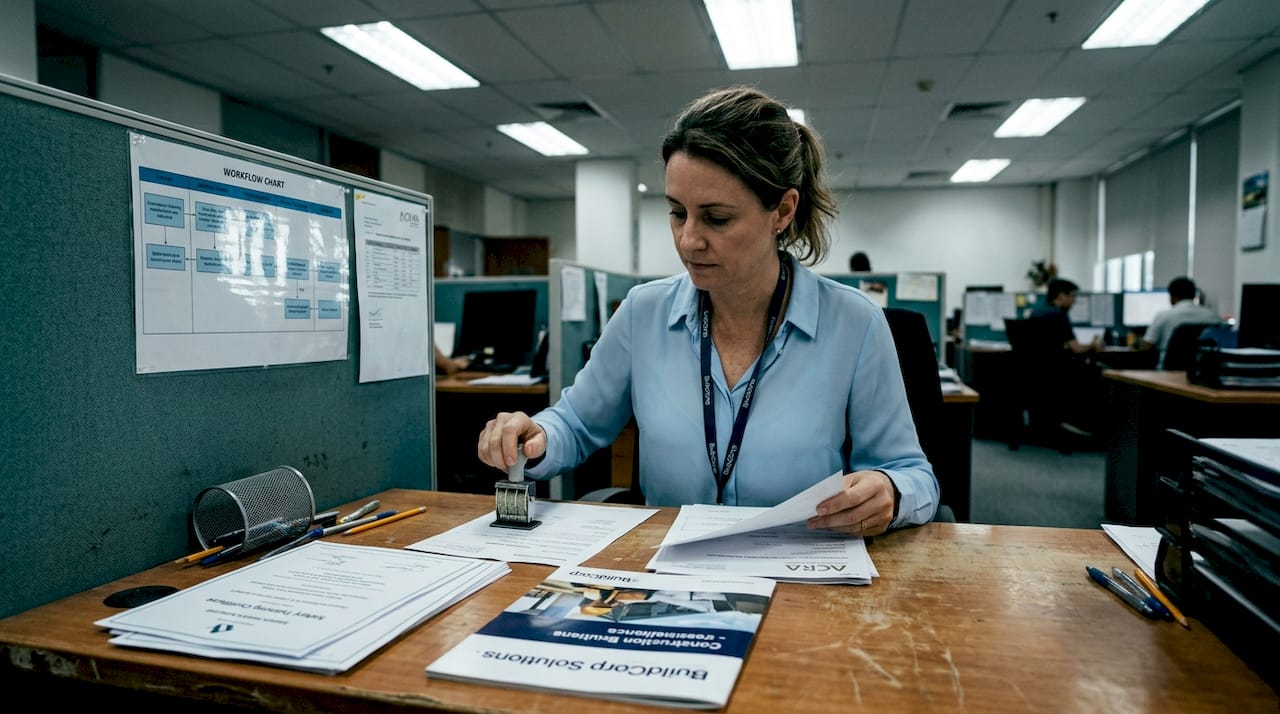
The ASC application requires ACRA business registration, submission of evidence of BizSAFE Level 3 or higher, a list of competent supervisory personnel with valid scaffolding supervisor certificates, a structured in-house training program for scaffold erectors, and the $150 MOM application fee. The SAC accreditation body may conduct site and document audits as part of the evaluation. Crane contractor approval follows an analogous pathway with additional requirements for lifting supervisor competencies and equipment inspection records.
Certification comparison: who needs what
| Certification | Who needs it | Audit type | Validity |
|---|---|---|---|
| BizSAFE Level 3 | All construction firms tendering on projects | RM plan audit | 3 years |
| BizSAFE Level 4 | Firms on larger public/complex projects | WSH Management System audit | 3 years |
| Approved Scaffold Contractor | Firms erecting/dismantling scaffolding | Document and site audit | Lifetime |
| Approved Crane Contractor | Firms conducting crane lifting operations | Document and site audit | Lifetime |
Technology adoption is increasingly relevant to both achieving and maintaining these certifications. As WSH technology adoption accelerates across Singapore’s construction sector, drones for site inspection, IoT sensors for real-time hazard monitoring, and digital permit-to-work (ePTW) platforms are now recognized tools that can strengthen audit evidence and demonstrate a firm’s commitment to proactive risk control. Firms that integrate these tools into their WSH management framework frequently find that audit preparation is substantially less burdensome, as data is continuously captured rather than reconstructed at audit time.
A thorough review of audit steps guide before engaging your auditor ensures that documentation gaps are closed well in advance, reducing the likelihood of costly re-audits.
Pro Tip: Map your firm’s certifications against the work scopes of your three next most likely tenders. Identify which approvals each tender requires and back-calculate the minimum lead time needed to secure them. For BizSAFE Level 3, allow a minimum of eight to ten weeks from initial registration to certified status.
Mandatory worker training and supervision
Company-level certifications are necessary but not sufficient. Singapore’s regulatory framework imposes specific, non-negotiable training obligations on individual workers, supervisors, and managers that must be maintained throughout the duration of any construction project.
Who must complete which training
Migrant construction workers must complete the Construction Safety Orientation Course (CSOC) or an equivalent MOM-approved safety course as a condition of their work permit. Renewal cycles are tied to experience: workers with fewer than six years in construction must renew every two years, while those with six or more years renew every four years. All certificates must retain at least one month of validity at the point of work pass renewal, or renewal will be refused.
Supervisors and managers must complete relevant WSQ (Workforce Skills Qualifications) programs, with “Supervise WSH in Construction” being the most commonly mandated course for site supervisors. Senior managers responsible for WSH governance should hold higher-level qualifications aligned with the WSH (Incident Reporting) Regulations.
Training requirements by role
| Role | Required training | Renewal cycle |
|---|---|---|
| Migrant construction worker | CSOC or equivalent | Every 2 years (under 6 years) / 4 years (6+ years) |
| Local construction worker | Site-specific WSH induction | As per firm’s WSH plan |
| Site supervisor | WSQ Supervise WSH in Construction | As per WSQ validity |
| Safety officer | WSH Officer registration (MOM) | Annual CPD requirements |
| Top management | BizSAFE Level 1 / RM workshop | As per BizSAFE renewal |
Administrative systems for audit readiness
Maintaining an accurate, up-to-date training register is one of the most operationally critical tasks for construction firms. MOM inspectors routinely request training records during site inspections, and expired certificates are among the most frequently cited infractions.
An expired CSOC certificate for even a single worker on site constitutes a regulatory breach that can trigger stop-work orders, work permit cancellations, and financial penalties, regardless of how strong your BizSAFE certification may be.
Firms should implement a digital training management system that flags expiring certificates at least 60 days before their validity lapses, cross-references worker lists against active project assignments, and maintains digital copies of all certificates accessible to site supervisors. Understanding common workplace hazard guide categories also helps firms prioritize which supplementary training programs add the most measurable risk reduction for their specific project types.
Pro Tip: Assign a dedicated administrative officer or WSH coordinator the sole responsibility of tracking training expiry across all workers on active projects. A shared spreadsheet is insufficient for firms with more than 20 workers; purpose-built workforce compliance software pays for itself after the first avoided penalty.
Common pitfalls, enforcement trends, and how to stay ahead
Even firms with strong certification portfolios and trained workforces can fall into compliance gaps driven by enforcement priority shifts, administrative oversight, or the mistaken belief that passing an audit is the endpoint rather than the baseline.
The small-scale works problem
The data is stark: small-scale works account for over 60% of major safety incidents in Singapore’s construction sector, a pattern that has persisted even as the industry’s overall fatality rate reached a low of 0.96 per 100,000 workers. Small contractors and subcontractors are disproportionately represented in incident statistics because they often lack dedicated safety officers, have less rigorous documentation practices, and operate with tighter margins that can tempt shortcuts. MOM has responded with targeted inspections of small-scale and renovation works, with enforcement action increasingly swift and consequential.
The construction fatal and major injury rate fell to 26.3 per 100,000 workers in 2025, but this improvement masks persistent concentration of incidents in small-scale and subcontract environments where WSH governance is structurally weaker.
Public project nuances and tender consequences
For firms pursuing public sector work, the compliance environment has tightened significantly. WSH Circulars now mandate enhanced WSH measures for public projects, including electronic permit-to-work (ePTW) systems, vehicular safety technology, and higher baseline WSH standards. The Contractor Registration System (CRS) was expanded in 2025 with elevated Performance Unit Credits (PUC) and Tender Reliability ratings (TR), meaning that poor safety records now carry measurable negative scoring in public tender evaluations. Firms that have historically treated safety compliance as a cost center rather than a strategic asset are finding themselves progressively excluded from public tendering opportunities.
Most common infractions and how to avoid them
- Expired worker training certificates not detected before site inspections
- HIRAC registers that are static documents rather than actively maintained risk tools
- Missing or outdated safe work procedures for non-routine activities
- Inadequate emergency response plans that have not been tested or updated
- Failure to notify MOM of notifiable incidents within the mandatory timeframe
- Subcontractor WSH documentation not integrated into the principal contractor’s management system
A risk-based safety approach treats HIRAC as a dynamic management tool reviewed whenever work activities, site conditions, or personnel change. Firms with robust WSH management systems consistently outperform in both incident rates and tender scoring because they embed ongoing risk reviews rather than relying on static checklists that become obsolete within weeks of being written.
What experience teaches about Singapore construction safety compliance
The most persistent misconception among construction firms approaching certification is that compliance is a periodic event: something you do to pass an audit, then set aside until the next renewal cycle. This framing is both operationally dangerous and strategically self-defeating.
Genuine safety performance, the kind that drives incident rates toward zero and wins repeat client relationships, is built on HIRAC as an organizational habit rather than a documentation exercise. The WSH Report 2025 reinforces the regulatory direction: a risk-based approach, where hazard control is continuously reviewed and improved rather than prescribed by a static rulebook, is what the statutory framework is designed to incentivize. Firms that internalize this approach find that their audit preparation becomes significantly less intensive over time, because the evidence of genuine risk control accumulates naturally rather than being assembled under pressure.
The competitive advantage is real and measurable. Firms that proactively integrate DfS best practices at the project planning stage, rather than retrofitting safety measures during construction, consistently report fewer design-stage change orders, lower incident rates, and stronger tender scores. The developer’s primary accountability for DfS under Singapore’s statutory framework means that construction partners who can demonstrate upstream safety integration are valued far beyond firms that simply meet the minimum certification threshold.
The firms that will define Singapore’s next decade of construction excellence are not those who pass audits. They are those who build safety into every project decision, from design brief to site closeout, treating WSH governance as the central nervous system of their operational model rather than a compliance burden to be managed periodically.
Take the next step: Expert help with safety compliance
Navigating Singapore’s layered construction safety compliance framework demands more than a checklist. It requires structured expertise, current regulatory knowledge, and the operational experience to close gaps before they become enforcement actions or tender disqualifications.

MOSAIC Ecoconstruction Solutions provides end-to-end support for construction firms and developers seeking to strengthen their compliance posture, from initial BizSAFE certification through to advanced audit readiness and specialist approvals. Whether your firm is preparing for a first certification audit or addressing non-conformances from a recent inspection, our consultants work systematically to close every gap. Explore our safety audit preparation resources and our specialized bizSAFE 4 audit solutions to understand how targeted, expert-led support can reduce your compliance risk and strengthen your competitive position before your next tender.
Frequently asked questions
What certifications are essential for Singapore construction safety compliance?
The core certifications are BizSAFE Level 3 or higher, the Approved Scaffold Contractor designation, and Approved Crane Contractor status, each requiring specific audits, competent personnel, and training programs as prerequisites.
How often must construction workers renew safety training in Singapore?
Migrant workers with fewer than six years of construction experience must renew CSOC every two years, while those with six or more years renew every four years, with certificates requiring at least one month of validity remaining at work pass renewal.
Why are small-scale works a compliance focus in Singapore?
Small-scale construction works account for over 60% of incidents in Singapore’s construction sector due to structurally weaker WSH governance among smaller contractors, driving targeted MOM enforcement in this segment.
What is the difference between an audit and a WSH management system?
An audit is a point-in-time assessment of compliance against defined criteria, while a WSH management system is a continuous organizational process that embeds risk identification, control, monitoring, and improvement into daily operations.
How does safety compliance affect tender eligibility for public projects?
Public sector tenders incorporate enhanced WSH requirements and weight safety records in scoring, with poor WSH performance directly reducing Performance Unit Credits and Tender Reliability ratings under the Contractor Registration System.
Recommended
- Essential Guide: Singapore Construction Safety Standards
- Workplace safety in Singapore: A guide for construction compliance
- Construction site safety tips for Singapore: stay compliant
- Construction safety audit steps: A complete Singapore guide
- Fixings in building safety: essential guide for secure structures – Aussie Nails and Fasteners Warehouse
- Understanding Safety Regulations in Construction – WorkWearComfort