Safe Management of Machinery: Analyzing 2025 and 2026 Updates to the Approved Code of Practice
Introduction to the Safe Management of Machinery
The Safe Management of Machinery is a critical industrial priority. Singapore continually enhances its rigorous workplace safety frameworks. Consequently, regulators introduced the 2025 and 2026 ACOP updates. These Approved Code of Practice (ACOP) updates target high-risk machinery. The Safe Management of Machinery prevents fatal workplace injuries. Industrial machines possess rapidly moving parts. These parts can easily cause severe bodily harm. Therefore, the 2025/2026 updates enforce strict new safety regulations.
Companies must implement these ACOP updates immediately. The Safe Management of Machinery requires robust engineering controls. Furthermore, administrative procedures must support these physical safeguards. Strong safety cultures prevent minor incidents from escalating.1 The Workplace Safety and Health (WSH) Council refines these guidelines.2 Their primary goal is reducing fatal workplace injuries.2
The regulatory landscape experienced significant transformations recently. Authorities gazetted several new ACOPs for the industry.3 These notifications enforce better compliance across manufacturing sectors. The Safe Management of Machinery demands rigorous risk assessments. Additionally, the guidelines enforce strict machine guarding requirements. Companies must adopt the latest international ISO standards. For instance, SS ISO 12100 dictates risk reduction principles.4 Similarly, SS ISO 14120 governs physical machine guards.5
This comprehensive report explores the Safe Management of Machinery deeply. It breaks down the critical 2025/2026 ACOP updates. Furthermore, the report evaluates current workplace injury statistics. It identifies the root causes of major machinery accidents. Stakeholders will understand the newly expanded Fifth Schedule.6 The analysis explores the three-step risk assessment method.7 It also outlines the Ministry of Manpower inspection programme.8
Comprehensive 2025 Workplace Safety Statistics
Safety statistics directly drive the Safe Management of Machinery. The 2025 WSH report reveals significant overall improvements.9 However, specific industrial sectors still face substantial safety challenges.9 Singapore achieved an all-time low workplace fatal injury rate.9 The rate fell to exactly 0.96 fatal injuries per 100,000 workers.9 This places Singapore among the safest global jurisdictions.10 It ranks proudly alongside the Netherlands and Sweden.10
Despite these improvements, the Safe Management of Machinery remains urgent. Total workplace fatalities decreased to 36 in 2025.9 This was a notable drop from 43 fatalities in 2024.9 Excluding platform workers, there were 34 fatal injuries.9 However, the manufacturing sector experienced a concerning upward trend.9 Manufacturing recorded four workplace fatal injuries in 2025.9 This represents a twofold increase from the previous year.9 Consequently, its fatal injury rate increased to 0.93.9
Almost all fatalities resulted from high-risk Type A incidents.9 These incidents inherently carry a higher risk of fatality.9 The top causes included vehicular incidents and equipment collapse.9 Falls from height also contributed heavily to the death toll.9 These statistics justify the 2025/2026 updates to the ACOP.
Major and Minor Injury Trends
Major injuries cause severe and permanent long-term disability. In 2025, there were 586 major workplace injuries recorded.9 This number excludes newly regulated platform workers.9 This figure closely mirrors the 587 major injuries from 2024.9 The major injury rate hit a low of 15.7.9 The construction sector contributed the highest number of major injuries.9 It recorded 135 major injury cases.9
Manufacturing followed closely as the second top contributor.9 The manufacturing sector recorded 120 major injuries in 2025.9 Machinery incidents remain a persistent cause of these injuries.9 They rank among the top three leading causes.9 Slips, trips, and falls also rank highly.9 Falls from height complete this dangerous top-three list.9 Together, these causes accounted for 61% of major injuries.9
Minor injuries also require careful analysis and tracking. The manufacturing sector recorded 3,524 minor injuries in 2025.9 The Safe Management of Machinery addresses these minor incidents directly. Machinery incidents heavily influenced these minor injury statistics.9 They accounted for thousands of specific minor injury events.9
| Safety Metric | 2024 Data | 2025 Data | Trend Direction |
| Overall Fatalities | 43 | 36 | Decrease 9 |
| Fatal Injury Rate | 1.2 per 100,000 | 0.96 per 100,000 | Decrease 9 |
| Manufacturing Fatalities | 2 | 4 | Increase 9 |
| Manufacturing Fatal Rate | 0.47 per 100,000 | 0.93 per 100,000 | Increase 9 |
| Overall Major Injuries | 587 | 586 | Stable 9 |
| Manufacturing Major Injuries | N/A | 120 | High Concern 9 |
Platform Worker Safety Statistics
The Safe Management of Machinery concepts extend to delivery logistics. In 2025, platform workers (PWs) faced strict new reporting rules.9 There were 76 PW fatal and major injuries recorded.9 This included two tragic workplace fatalities.9 The injury rate was 84.6 per 100,000 workers.9
Delivery services accounted for 84% of these severe injuries.9 Vehicular incidents were the leading cause of PW injuries.9 They caused 82% of the reported incidents.9 Furthermore, platform workers suffered 1,277 minor injuries.9 One occupational disease case involved a musculoskeletal disorder.9 The ACOP updates in 2025 specifically addressed platform services.11
Legislative Enhancements in the WSH Act
The Ministry of Manpower announced critical legislative enhancements recently. These measures specifically target higher-risk machineries.12 The Safe Management of Machinery requires robust legal backing. These legal enhancements took effect on January 1, 2025.12 The primary objective is holding the supply chain accountable.13 Worker safety must begin at the earliest procurement stages.
The Fifth Schedule of the WSH Act dictates statutory equipment.6 This schedule previously covered lifting equipment and pressure vessels.6 It also covered scaffolds and explosive powered tools.6 Furthermore, it included equipment containing corrosive or toxic substances.6 Welding equipment and abrasive blasting tools were also listed.6 The 2025 enhancements drastically expanded this regulatory scope.12 Many common manufacturing machines are now heavily regulated.
Expansion of the Fifth Schedule
The newly regulated machinery classes present severe physical hazards. Sheet benders and sheet rollers are now officially included.12 These machines cause devastating crushing and severe amputation injuries. Lathes and milling machines also joined the strict schedule.12 These devices feature rapidly rotating spindles and cutting tools. They pose extreme entanglement risks for unaware operators. Loose clothing can easily be pulled into the machinery.
Furthermore, industrial cutting machines are now heavily regulated.12 This category includes highly dangerous table saws and slicing machines.12 Table saws frequently cause severe lacerations and finger amputations. Packaging machinery also faces intense new regulatory scrutiny.12 Palletisers, balers, and compactors are explicitly listed now.12 Compactors utilize massive hydraulic forces to compress waste materials. Workers caught inside face almost certain death.
Mechanical mixers represent another newly regulated high-risk category.12 Paddle mixers and ribbon mixers are now scheduled machinery.12 Finally, food processing equipment completes the newly expanded list.12 This covers industrial grinders, mincers, blenders, and juicers.12 Cleaning these machines often requires removing protective guards. Accidental activation during cleaning causes horrific physical injuries.
| Regulated Machinery Class | Specific Examples Added | Primary Hazard Type |
| Metal Forming | Sheet benders, sheet rollers 12 | Crushing, shearing |
| Machining Tools | Lathes, milling machines 12 | Entanglement, cutting |
| Cutting Equipment | Table saws, slicing machines 12 | Amputation, laceration |
| Packaging Systems | Palletisers, balers, compactors 12 | Crushing, asphyxiation |
| Industrial Mixing | Paddle mixers, ribbon mixers 12 | Entanglement, shearing |
| Food Processing | Grinders, mincers, blenders 12 | Amputation, crushing |
Supply Chain Accountability
The legislation shifts heavy responsibility across the supply chain. Manufacturers and suppliers bear significant new legal duties.14 They must ensure machines are designed safely originally.14 Furthermore, machines must be examined and tested thoroughly.14 Suppliers must provide extremely comprehensive safety information.14 This includes detailed operating manuals and preventative maintenance guidelines.
Installers and modifiers also face strict new regulations.14 They must ensure installations do not compromise machine safety.14 Unauthorized modifications frequently bypass original protective safety interlocks. Buyers of machinery gain assurance from these rigorous standards.14 However, buyers must procure equipment only from compliant sources. They must appoint adequately trained operators for the machinery.15
Combustible Dust Regulations
Combustible dust presents severe fire and sudden explosion risks.14 The Safe Management of Machinery addresses associated environmental hazards. A 2021 factory explosion highlighted this deadly industrial hazard.14 Consequently, MOM introduced stringent combustible dust legislative enhancements.14 Suppliers must vividly label all packages containing combustible dust.14
Labels must explicitly state the associated severe explosion hazards.14 Furthermore, labels must communicate safe workplace usage procedures.14 Organic dusts, such as flour and starch, are regulated.14 The labeling requirement applies to packages exceeding 25kg.14 Occupiers also face strict new mandatory notification requirements.14 They must notify MOM of specific dangerous dust quantities.14 Building owners and landlords must also receive this notification.14
The 2024 and 2025 Approved Code of Practice Updates
The Approved Code of Practice provides practical regulatory guidance. ACOPs serve as industry yardsticks for workplace safety standards.16 They help assess whether reasonably practicable measures were taken.16 The WSH Council regularly updates these essential safety codes.17 Technological advancements and detailed injury data drive these revisions. The 2025/2026 ACOP updates reflect a massive regulatory shift.
The notification process utilizes the official Government Electronic Gazette. The WSH Council published a notification in December 2024.11 This specific notification became effective on January 1, 2025.11 Consequently, the older 2023 ACOP notification was officially revoked.11 The total number of active ACOPs stood at 102.11 This update introduced SS ISO 12100:2024 for machinery safety.11 It also introduced a new code for Platform Services.11
However, regulatory changes continued rapidly into late 2025. Another notification was published on November 28, 2025.3 It officially took effect shortly after on December 8, 2025.3 Consequently, the January 2025 notification was quickly revoked.3 Therefore, the total number of approved ACOPs reached 103.3 This latest update added the highly anticipated SS ISO 14120:2025.3
Exhaustive Review of Updated ACOPs
The 2025/2026 ACOP updates covered many crucial safety domains. The Safe Management of Machinery relies on these interconnected standards. Authorities updated several existing codes to their latest revisions. For instance, SS 485 relates to pedestrian surface materials.11 It provides slip resistance classification to prevent dangerous falls.11 Slips and trips are leading causes of major injuries.9
Additionally, SS 513 was updated for personal protective equipment.11 Part 1 covers general safety footwear requirements.11 Part 2 covers specific test methods for this footwear.11 SS 532 regulates the safe storage of flammable liquids.11 SS 536 dictates the safe use of mobile cranes.11 Mobile cranes frequently operate near heavy manufacturing machinery.
The ACOP schedule contains many other critical safety codes.18 The Code of Practice for Working Safely at Heights is vital.18 The Code of Practice on WSH Risk Management is foundational.18 Safe Lifting Operations in the Workplaces has its own code.18 SS 98 specifies rigorous requirements for industrial safety helmets.18 SS 280 covers metal frame and modular scaffoldings safely.18
Furthermore, SS 311 regulates steel tubes for tubular scaffolding.18 SS 343 provides specifications for critical lifting gear.18 This includes wire rope slings, heavy hooks, and shackles.18 SS 473 dictates requirements for personal protective eye-protectors.18 All these codes support the overall Safe Management of Machinery.
Legal Standing of Approved Codes
Understanding the legal standing of ACOPs is absolutely essential. Section 40C of the WSH Act outlines this framework.19 Failing to observe an ACOP is not inherently criminal.19 However, ACOPs hold significant evidentiary weight in criminal court.19 In criminal proceedings, ACOPs are fully admissible as evidence.19 Prosecutors use them to establish the commission of offenses.19
If an incident occurs, investigators evaluate strict ACOP compliance. Non-compliance suggests a failure to take reasonably practicable measures. Employers must prove they implemented equally effective alternative controls. This is often extremely difficult against established national standards. Therefore, adopting SS ISO 12100 and SS ISO 14120 is recommended. It represents the most reliable path to strict legal compliance.
SS ISO 12100:2024 – General Principles for Design
SS ISO 12100:2024 is a foundational machinery safety standard. It establishes general principles for safe industrial machinery design.4 The standard focuses heavily on comprehensive risk assessment methodologies.4 It also dictates structured procedures for overall risk reduction.4 Designers use this standard to achieve safe operating conditions.4 The principles derive from extensive global incident and accident experience.4
The standard requires analyzing the entire machine life cycle.4 This includes acquisition, careful installation, operation, and heavy maintenance. Troubleshooting and dismantling phases must also be rigorously evaluated. The first phase involves determining the limits of the machinery.20 This includes intended use and any reasonably foreseeable misuse.20 Operators often bypass safeguards to increase daily production speed. Designers must foresee and engineer against this dangerous human behavior.
Estimating and Evaluating Risk
Hazard identification immediately follows the machinery limits determination.20 Engineers meticulously identify all associated hazardous situations and scenarios.20 They then estimate the risk for each uniquely identified hazard.20 Risk is a function of two highly distinct elements.7 The first element is the severity of potential physical harm.7 The second element is the mathematical probability of occurrence.7
High severity involves catastrophic amputations, fatalities, or permanent disabilities. Probability relates directly to the frequency of worker hazard exposure. It also considers the possibility of actively avoiding the hazard. Once estimated, the risk must be evaluated very meticulously.20 Engineers decide if formal risk reduction is strictly necessary.20 If the risk is unacceptable, mandatory mitigation strategies are deployed.
The Three-Step Method
SS ISO 12100:2024 mandates a highly strict hierarchy of control. This is formally known as the three-step method.7 All risk reduction measures must follow this exact sequence.7 Deviating from this sequence severely compromises overall machinery safety.
Step 1: Inherently Safe Design Measures. This is the most critical and highly effective step.7 Engineers must eliminate hazards through fundamental physical design choices.7 This involves modifying the machine’s core internal operational characteristics. For example, replacing exposed external gears with enclosed drive systems. Reducing the maximum physical force of a pneumatic press helps. Inherently safe designs remain permanently effective over time.7 They do not rely on operator compliance or maintenance schedules.
Step 2: Technical Protective Measures. Hazards that cannot be eliminated require physical technical safeguarding.7 This step involves installing structural guards and protective devices.7 Technical measures protect workers when inherently safe design falls short.20 Examples include electronic light curtains, fixed enclosures, and laser scanners. However, experience clearly shows that technical safeguards can fail mechanically.7 Operators sometimes defeat them intentionally to clear internal machine jams.7 Therefore, Step 2 is inherently weaker than Step 1.
Step 3: Information for Use. The final step addresses all remaining residual risks.20 These are risks remaining after implementing Steps 1 and 2.20 If technical measures are not entirely effective, operators need warnings.20 Information for use includes highly visible signs and pictograms.20 It encompasses loud audible warning devices and bright operational markings.20 Comprehensive operating instructions and training fall under this category.20 Crucially, information cannot ever substitute technical protective measures.20 It is solely a supplementary administrative risk reduction strategy.
SS ISO 14120:2025 – Fixed and Movable Guards
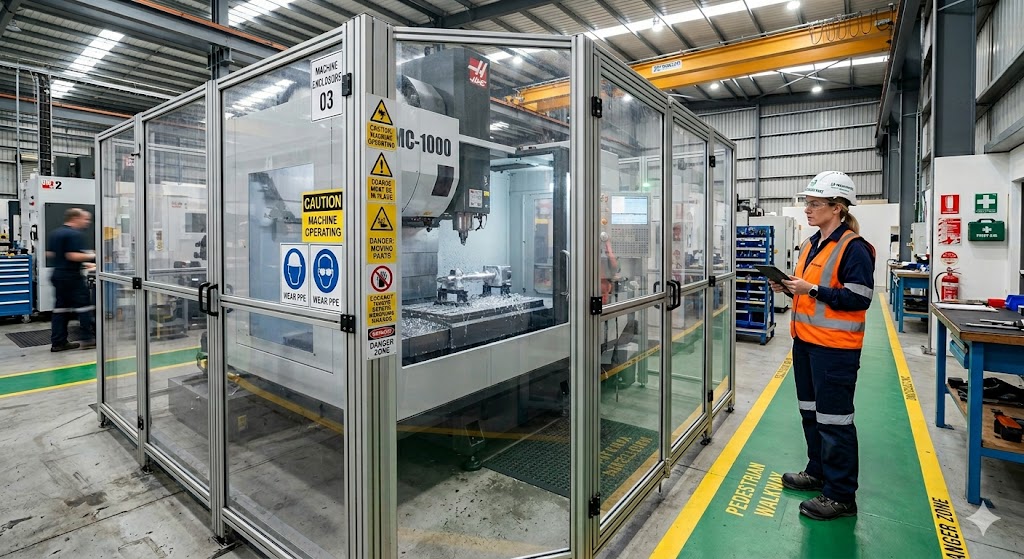
The December 2025 ACOP update introduced SS ISO 14120:2025. This vital standard details general requirements for machine guards.5 It protects personnel primarily from severe physical mechanical hazards.5 However, it also addresses other dangerous hazard types.5 Guards can mitigate toxic fluid ejections or hazardous noise levels. The standard provides extremely clear rules for design and construction.5
Fixed vs. Movable Guards
Physical guards fall into two primary mechanical design categories. Fixed guards provide a highly permanent physical structural barrier. The standard dictates they must actively prevent easy manual removal.21 Demountable fixed parts must require specific heavy tools for removal.21 This prevents unauthorized or untrained operators from exposing dangerous parts. Retained fasteners are heavily recommended during any guard disassembly.21 This ensures screws or bolts are not lost during maintenance.
Movable guards can be opened without utilizing specialized tools.22 They provide frequent required access for loading or adjustment tasks.23 However, they present significantly higher risks if improperly designed. Movable guards must associate with highly sophisticated interlocking devices.22 Opening the safety gate must halt hazardous machine functions immediately.24 Furthermore, the system must reliably prevent any unexpected machine restarts.24 The machine absolutely cannot operate while the guard remains open.24
Design and Construction Requirements
SS ISO 14120 outlines incredibly strict structural construction rules. Guards must feature highly robust and durable mechanical construction.23 They must be securely held in their designated physical place.23 Crucially, a guard must not create additional secondary hazards.23 For instance, a guard must not possess sharp, dangerous edges.
Guards must be located at an adequate physical safe distance.23 This distance prevents human limbs from reaching the hazard zone. Designers must consider the approach speeds of human limbs carefully. Guard materials must withstand reasonably foreseeable severe physical impacts.21 They must safely contain ejected parts or broken tooling fragments.21
Visibility remains a highly critical daily operational factor. Guards must allow totally clear visibility of production processes.21 Minimum visual obstruction ensures operators do not bypass the guards.23 If operators cannot see the process, they remove the protection. Material selection is also vitally important for environmental worker comfort. Where necessary, materials must provide significant noise and vibration reduction.21
Furthermore, structural guards must defeat intentional human tampering. They should be constructed specifically to prevent any climbing.21 Eliminating horizontal structural members makes climbing physically very difficult.21 The external surface of mesh fabrics should lack any footholds.21 Electronic interlocking devices must be entirely concealed or tamper-resistant. Bypassing safety systems should require extremely significant, deliberate effort.
| Guard Feature | SS ISO 14120:2025 Requirement | Hazard Mitigated |
| Fixed Guard Fasteners | Require tools for manual removal 21 | Unauthorized zone access |
| Movable Guards | Must use interlocking safety devices 22 | Unexpected machine restarts |
| Material Strength | Must withstand foreseeable heavy impacts 21 | Ejected tooling fragments |
| Structural Design | Must lack horizontal climbing members 21 | Intentional guard bypassing |
| Visual Transparency | Must allow clear process visibility 21 | Guard removal for viewing |
Code of Practice for Safe Use of Machinery (SS 537)
Beyond ISO adoptions, local Singapore Standards govern machinery safety. SS 537 dictates the safe use of general industrial machinery. SS 537-1 provides comprehensive guidelines for safeguarding dangerous parts.25 It enhances overall safety during general, daily machinery use.25 The standard covers fundamental design and heavy manufacturing requirements.25 It ensures machinery used locally incorporates baseline physical safety features.25
The code emphasizes safety across all daily operational phases. It includes guidelines for installation, testing, and regular preventative maintenance.25 It primarily covers mechanical hazards encountered on the factory floor.25 The standard mandates risk assessments before any physical work commences.26 It requires the establishment of formalized, written safe work practices.26
SS 537-1 also dictates the extensive use of warning devices. Machines should indicate when highly hazardous operational situations exist.27 Warning signals can be highly audible, like loud industrial sirens.27 They can also be visual, such as bright flashing strobe lights.27 These systems quickly alert operators to impending danger or malfunctions. The standard promotes a consistently high baseline for machine safety.28
Energy Lockout and Tagout Procedures (SS 571)
Maintenance activities pose extremely unique and severe fatal risks. Workers must often bypass guards to service internal machine components. SS 571 establishes safety requirements for controlling hazardous energy sources.29 It applies to activities like repairing, cleaning, and manual unjamming.29 If a machine restarts unexpectedly, the worker faces certain death.
Energy lockout and tagout (LOTO) prevents these catastrophic unexpected restarts. SS 571 provides detailed guidance on executing LOTO safely.30 Management bears the immense responsibility to implement these critical procedures.30 They must develop specific, written safe work procedures for isolation.31 Training all affected workers on these protocols is legally mandatory.31
A proper LOTO procedure involves several strict sequential steps. First, workers notify all affected personnel of the impending shutdown.31 Next, they safely isolate the machine from all energy sources. This includes dangerous electrical, hydraulic, pneumatic, and kinetic physical energy. Workers apply heavy physical locks to the energy isolation devices. Highly visible tags alert others that maintenance is currently in progress. Finally, workers verify the complete isolation by attempting a restart. Only then is it truly safe to commence maintenance work.
Future Revisions to SS 571
Enterprise Singapore plans to update several vital safety standards. SS 571:2011 is scheduled for a highly comprehensive future revision.32 Expected completion for this specific revision is the first half of 2026.32 This ensures the LOTO code remains technologically and operationally relevant. Modern machinery often utilizes highly complex programmable logic controllers. Isolating energy in automated environments requires updated, highly specialized methodologies.
The MOM Inspection Programme for Safe Machines
Regulatory standards hold very little value without strict field enforcement. MOM established the comprehensive Inspection Programme for Safe Machines.8 This program helps occupiers verify if their machines meet standards.8 It heavily targets machinery covered under the expanded Fifth Schedule. The program evaluates strict compliance with SS 537 and SS ISO 12100.33
The inspection framework utilizes a highly comprehensive verification checklist.8 This rigorous checklist ensures machines operate safely across all life cycles.34 It covers acquisition, installation, daily operation, and heavy maintenance phases.34 The program offers two highly distinct pathways for verification compliance.
Part A: Operational Self-Verification
Occupiers can initially conduct a highly detailed operational self-check.8 Part A of the checklist determines basic physical safety compliance.35 Owners must evaluate the physical appearance and past operational history.34 They verify if the machinery displays legally recognized safety marks.33 CE Marks or UKCA Marks indicate strict international manufacturing compliance.33
Owners also check for third-party inspection or structural test reports.33 They must ensure operating and user manuals are readily available.33 A highly critical check involves the machine’s true original condition.33 Unauthorised modifications severely compromise basic structural and operational safety.33 Owners must verify that qualified personnel performed any past repairs.33 Furthermore, all warning labels must be highly visible and legible.33 Safe operating speeds and physical pressure ratings must be clearly displayed.33
Part B: Independent Third-Party Verification
If doubts exist, owners absolutely must proceed to Part B.8 They must engage approved, highly specialized third-party inspection companies.8 These approved companies conduct rigorous, independent, and highly technical evaluations. They review the machinery against all stringent SS 537 requirements.8
If a machine completely fails, the inspector recommends follow-up actions.8 The owner must rectify all identified hazards before any re-verification.33 Alternatively, the owner must immediately cease using the unsafe machine.33 A completed successful verification is valid until the machine’s design changes.35
However, verification does not replace daily operational safety duties.35 Occupiers must still conduct highly task-specific workplace risk assessments.35 They must establish and enforce comprehensive safe work procedures constantly.35 Verification merely ensures the physical hardware is capable of safety. Management ensures the human operators utilize the hardware safely always.
Industrial Case Studies and Machinery Failure Analysis
Theoretical safety standards translate directly into life-saving practical applications. Examining past industrial accidents highlights the ultimate cost of non-compliance. WSH Council case studies provide critical learning points for professionals.36 These reports depict exactly how fatal accidents occurred in Singapore.36 Furthermore, they explain how strict code compliance could have prevented them.
Fatal Entanglement and Crushing Incidents
Entanglement represents a horrific and common category of machinery accidents. In one tragic case, a worker died testing a loader.37 He was performing functional checks on the loader’s hydraulic systems.37 Unexpectedly, the heavy hydraulic lift arm suddenly lowered downward rapidly.37 The worker’s head was caught tightly between the machinery parts.37 He unfortunately died instantly at the scene of the accident.37
This incident highlights a complete failure of energy isolation procedures. Proper LOTO procedures were likely bypassed entirely or poorly executed. Mechanical blocking devices should have firmly secured the lifted arm. Relying solely on hydraulic pressure during maintenance is lethally dangerous.
Heavy machinery movements pose massive, deadly kinetic impact risks. In 2019, a worker walked near a rail-guided ladle car.38 He was caught between the moving machinery and a solid wall.38 The massive crushing force killed the worker almost immediately.38 This vividly demonstrates a failure in spatial workplace risk assessment. Pedestrian walkways must be physically segregated from heavy machinery paths. Laser scanners or safety bumpers should halt autonomous moving equipment.
Forklifts also contribute significantly to machinery-related fatalities in factories. In 2022, a worker was crushed guiding a forklift operation.39 The heavy forks were raised before being fully inserted underneath.39 This dangerous error caused the heavy machine load to topple.39 The heavy toppled machine crushed the worker guiding the lift.39 Unsafe operational practices and poor spatial awareness caused this tragedy.
Other lifting operations present similarly severe and deadly workplace hazards. In another case, a worker was struck by a pile.40 A heavy sheet pile was being lifted by a crane.40 It violently dislodged from its lifting clamp and fell downward.40 It hit a nearby worker, who was pronounced dead immediately.40 Similarly, a fatal accident involved the failure of a crane.41 A tower crane collapsed, highlighting the need to eliminate entanglement.41
Amputations in Food Manufacturing
Food processing machinery causes frequent and highly severe amputation injuries. A worker tragically lost a finger operating a frozen meat bandsaw.42 The detailed incident investigation revealed multiple systemic workplace safety failures.42 Ten centimeters of the highly sharp cutting blade remained exposed.42 The untrained operator did not use a sliding table or pusher.42
Ineffective machine guarding directly caused this incredibly severe physical injury.42 The exposed blade severely violated basic physical safeguarding design principles. Furthermore, there was no safe engineering control implemented at all.42 Handling irregular-shaped frozen meat requires highly specialized safety jigs. The worker’s gloves were also completely unsuitable for the task.42 A proper risk assessment under ISO 12100 would flag these hazards.
In another horrific instance, a worker’s hand caught in a mincer.42 Cleaning and clearing jams in mincers require extreme daily caution. Cleaning operations often necessitate the temporary removal of physical guards. This directly exposes the operator to the dangerous crushing auger mechanism. Interlocking devices must disable the motor when guards are removed. If interlocks are bypassed, cleaning becomes a highly hazardous task.
Digital Safety Communication and Industrial SEO
The Safe Management of Machinery relies heavily on effective communication. Safety equipment suppliers must effectively reach industrial machinery buyers globally. Consequently, communicating the Safe Management of Machinery via SEO is vital. Industrial SEO helps promote the Safe Management of Machinery online.43 Safety equipment suppliers must optimize their digital websites for search.43
High-quality, relevant content is the foundation of successful SEO strategies.44 Therefore, optimizing for specific safety keywords drives organic online traffic.45 The best industrial SEO keywords include highly product-specific technical terms.43 For example, buyers search for highly compliant safety guarding equipment. Keyword analysis evaluates the most relevant keywords for your content.45
Consequently, safety suppliers must target high-traffic, relevant industry keywords.45 For instance, a safety supplier might target specific contractor keywords. Terms like “excavation contractors near me” highlight local service intent.46 A company selling ISO 14120 compliant guards must rank highly. They must use targeted SEO to reach facility safety managers.
Industrial SEO differs significantly from regular, standard B2B SEO practices.43 It focuses intensely on highly technical keywords and compliance documentation.43 It targets engineers who search using highly specific product requirements.43 Without proper SEO, safe machinery suppliers cannot reach vulnerable factories. Therefore, strong SEO directly supports the Safe Management of Machinery.
Conclusion and Strategic Recommendations
The Safe Management of Machinery remains a highly complex industrial challenge. Singapore’s 2025 and 2026 regulatory updates signify a critical evolution. The authorities have clearly signaled zero tolerance for preventable accidents. The expansion of the WSH Act Fifth Schedule broadens legal accountability. Manufacturers, suppliers, and buyers must prioritize safety before operations begin.
The introduction of SS ISO 14120:2025 sets highly rigorous guarding standards. Physical barriers must now meet stringent design and construction requirements. Simultaneously, SS ISO 12100:2024 enforces a highly systematic risk reduction hierarchy. The three-step method prioritizes inherently safe design absolutely above all else. Technical safeguards and warning labels are merely secondary defense layers. Furthermore, the MOM inspection programme ensures active, continuous field compliance.
Industrial operators must adopt highly proactive compliance strategies immediately today. Waiting for a catastrophic accident or inspection is strategically unacceptable. Facilities must conduct exhaustive safety audits of all existing machinery. They must utilize the official MOM verification checklist to identify gaps. Missing fixed guards must be expertly engineered and installed promptly. Bypassed interlocking devices require immediate replacement and functional safety testing.
Training programs require substantial, immediate upgrades to match new regulations. Workers must intimately understand the absolute necessity of LOTO procedures. SS 571 guidelines must be deeply embedded into daily maintenance cultures. Furthermore, management must cultivate an environment where reporting near-misses is encouraged.
The future of manufacturing safety relies on embracing technological advancements. Automation greatly reduces the frequency of highly dangerous human-machine interactions. Smart vision systems and AI can detect unauthorized hazard zone entries. As we move rapidly toward 2026, regulatory expectations will only intensify. Companies that integrate safety into their core engineering processes will thrive. Those who rely on outdated, reactive measures face severe legal liabilities. Ultimately, safely safeguarding machinery protects a company’s most incredibly valuable asset.
Works cited
- Factory Machinery Entanglement Accidents in Singapore Factorie… – Sage Shield Safety Consultants, accessed June 3, 2026, https://sageshield.com/factory-machinery-entanglement-accidents-singapore-workplace-safety/
- WSH Guidelines Safe Use of Machinery, accessed June 3, 2026, https://wshsingapore.blogspot.com/p/wsh-guidelines-safe-use-of-machinery.html
- Workplace Safety and Health Approved Codes of Practice Notification 2025, accessed June 3, 2026, https://www.tal.sg/wshc/media/announcements/2025/workplace-safety-and-health-approved-codes-of-practice-notification-2025
- SS ISO 12100:2024 Safety of machinery – General principles for design – Risk assessment and risk reduction – Singapore Standards, accessed June 3, 2026, https://www.singaporestandardseshop.sg/Product/SSPdtDetail/a5e80ee8-ad05-4737-b9fc-39b5c7bf3734
- SS ISO 14120:2025 Safety of machinery – Guards – Singapore Standards, accessed June 3, 2026, https://www.singaporestandardseshop.sg/Product/SSPdtDetail/b8b0d443-5bbd-4fd8-8ccb-ae306ee6e901
- WSH Act: machinery and equipment – MOM, accessed June 3, 2026, https://www.mom.gov.sg/workplace-safety-and-health/workplace-safety-and-health-act/machinery-and-equipment
- White Paper, 8024038 – SICK, accessed June 3, 2026, https://www.sick.com/media/docs/2/92/292/whitepaper_risk_assessment_and_risk_reduction_for_machinery_part_3_conducting_risk_estimation_en_im0082292.pdf
- Inspection Programme for Safe Machines – MOM, accessed June 3, 2026, https://www.mom.gov.sg/workplace-safety-and-health/inspection-programme-for-safe-machines
- Singapore workplaces rank among the safest globally: 2025 WSH …, accessed June 3, 2026, https://www.humanresourcesonline.net/singapore-workplaces-rank-among-the-safest-globally-2025-wsh-statistics
- 0325 WSH Report 2025 – Singapore – MOM, accessed June 3, 2026, https://www.mom.gov.sg/newsroom/press-releases/2026/0325-wsh-report-2025
- Workplace Safety and Health (Approved Codes of Practice) Notification 2024, accessed June 3, 2026, https://www.tal.sg/wshc/media/announcements/2025/workplace-safety-and-health-approved-codes-of-practice-notification-2024
- Safe use of machineries and combustible dust – MOM, accessed June 3, 2026, https://www.mom.gov.sg/workplace-safety-and-health/safe-measures/sectoral-level/safe-use-of-machineries-and-combustible-dust
- Singapore’s enhanced safety measures for higher-risk machinery and combustible dusts take effect on 1 Jan 2025, accessed June 3, 2026, https://www.humanresourcesonline.net/singapore-s-enhanced-safety-measures-for-higher-risk-machinery-and-combustible-dusts-take-effect-on-1-jan-2025
- Enhanced Safety Measures for Higher-Risk Machinery and Combustible Dusts from 1 January 2025 – MOM, accessed June 3, 2026, https://www.mom.gov.sg/newsroom/press-releases/2024/1129-enhanced-safety-measures-for-higher-risk-machinery-and-combustible-dusts-from-1-january-2025
- Enhanced Safety Measures for Higher-Risk Machinery, accessed June 3, 2026, https://www.tal.sg/wshc/-/media/tal/wshc/resources/collaterals/posters/pdf/enhanced-safety-measures-for-higher-risk-machinery.pdf
- Legislation for workplace safety and health – Singapore – MOM, accessed June 3, 2026, https://www.mom.gov.sg/legislation/workplace-safety-and-health
- Safety of machinery – Guards – General requirements for the design and construction of fixed and movable guards – Singapore Standards, accessed June 3, 2026, https://www.singaporestandardseshop.sg/Product/GetPdf?fileName=250428094822SS%20ISO%2014120-2025%20Preview.pdf&pdtid=b8b0d443-5bbd-4fd8-8ccb-ae306ee6e901
- FRIDAY, NOVEMBER 28, 2025 1 No. 5740 –– WORKPLACE SAFETY AND HEALTH ACT 2006 WORKPLACE SAFETY AND HEALTH (APPROVED CODES OF – Singapore Government Gazette, accessed June 3, 2026, https://assets.egazette.gov.sg/2025/Government%20Gazette/Notices%20under%20other%20Acts/5740.pdf
- Workplace Safety and Health Act 2006 – Singapore Statutes Online, accessed June 3, 2026, https://sso.agc.gov.sg/Act/WSHA2006?ProvIds=pr40C-
- EN ISO 12100 and its relation to the Machinery Directive – cen-cenelec, accessed June 3, 2026, https://www.cencenelec.eu/media/CEN-CENELEC/Areas%20of%20Work/CENELEC%20sectors/Mechanical%20and%20Machines/Documents/Quicklinks/eniso12100relationmachinerydirective.pdf
- Safety Standards – ANSI/RIA R15.06, EN ISO 14120 | Satech US, accessed June 3, 2026, https://usamachineguards.com/reference-standards-ansi-ria-r-15-06/
- EN ISO 14120: design and construction of fixed and movable guards – Gt-Engineering, accessed June 3, 2026, https://www.gt-engineering.it/en/technical-standards/en-iso-standards/en-iso-14120/
- ISO STANDARDS AND THE MACHINERY DIRECTIVE 2006/42/EC – Troax, accessed June 3, 2026, https://www.troax.com/app/uploads/Brochure-Guide-to-better-safe-guarding_EN_2025.pdf
- Movable guards – EN ISO 14120 – Pilz US, accessed June 3, 2026, https://www.pilz.com/en-US/support/law-standards-norms/iso-standards/choosing-guards/movable
- SS 537-1:2008 Code of practice for the safe use of machinery – Singapore Standards, accessed June 3, 2026, https://www.singaporestandardseshop.sg/Product/SSPdtDetail/f19a8980-a2b3-4a42-b2db-ada348a8c048
- Safety Use of Machinery SS 537 Part 1 – 2003 | PDF – Scribd, accessed June 3, 2026, https://www.scribd.com/document/703686356/Safety-Use-of-Machinery-SS-537-Part-1-2003
- WSH Guidelines on Safe Use of Machinery, accessed June 3, 2026, https://www.tal.sg/wshc/-/media/tal/wshc/resources/publications/wsh-guidelines/files/wsh_guidelines_on_safe_use_of_machinery.pdf
- Code of practice for the safe use of machinery – Singapore Standards, accessed June 3, 2026, https://www.singaporestandardseshop.sg/Product/GetPdf?fileName=180331132734SS%20537-1-2008_Preview.pdf&pdtid=f19a8980-a2b3-4a42-b2db-ada348a8c048
- Code of practice for energy lockout and tagout – Singapore Standards, accessed June 3, 2026, https://www.singaporestandardseshop.sg/Product/GetPdf?fileName=180331121748SS%20571-2011_Preview.pdf&pdtid=7360d270-0184-4c8e-8098-b31709208a86
- SS 571-2011 CP For Energy LOTO | PDF – Scribd, accessed June 3, 2026, https://www.scribd.com/document/833183348/SS-571-2011-CP-for-Energy-LOTO
- Working Safely with Machines: Strengthening Lockout Tagout Practices, accessed June 3, 2026, https://www.tal.sg/wshc/-/media/tal/wshc/resources/newsletters/wsh-bulletins/files/20260409_wsh_insights.pdf
- Work Programme for the Development of Singapore Standards (Information is updated every 6 months, accessed June 3, 2026, https://www.enterprisesg.gov.sg/-/media/esg/files/quality-and-standards/standards/singapore_standards_work_programme.pdf
- INSPECTION PROGRAMME FOR MACHINERY SAFETY – MOM, accessed June 3, 2026, https://www.mom.gov.sg/-/media/mom/documents/safety-health/verification-checklist-inspection-of-machines.pdf
- Machine Safety Verification Checklist | PDF – Scribd, accessed June 3, 2026, https://www.scribd.com/document/816395888/Verification-checklist-inspection-of-machines
- FAQS ON INSPECTION PROGRAMME FOR SAFE MACHINES – MOM, accessed June 3, 2026, https://www.mom.gov.sg/-/media/mom/documents/safety-health/faq-safe-machines.pdf
- WSH Case Studies- For WSH Professionals – Workplace Safety And Health ,WSH Safety Resources Blog, accessed June 3, 2026, https://wshsingapore.blogspot.com/p/wsh-case-studies-for-wsh-professionals.html
- Worker Caught In Between Machinery Parts of a Loader | Zap Piling Pte Ltd, accessed June 3, 2026, https://www.zappiling.com.sg/journal-case-study-wsh-alert%E2%80%93worker-caught-in-between-machinery-parts-of-a-loader.html
- Alert Advisory: Worker caught in between moving machinery and wall – ASPRI, accessed June 3, 2026, https://aspri.com.sg/alert-advisory-worker-caught-in-between-moving-machinery-and-wall/
- Unsafe use of forklift: Worker struck by toppled machine, accessed June 3, 2026, https://www.tal.sg/wshc/-/media/tal/wshc/resources/newsletters/wsh-bulletins/files/20230105a.pdf
- Worker struck by sheet pile – ASPRI, accessed June 3, 2026, https://aspri.com.sg/worker-struck-by-sheet-pile/
- WSH Case Studies -Fatal Tower Crane Accident, accessed June 3, 2026, http://wshsingapore.blogspot.com/2023/03/wsh-case-studies-fatal-tower-crane.html
- Case Studies Food Manufacturing, accessed June 3, 2026, https://www.tal.sg/wshc/-/media/tal/wshc/resources/training-materials/pdf/case-studies_food-manufacturing.pdf
- SEO for Industrial Companies: Strategies That Drive Growth – Ranking By SEO India, accessed June 3, 2026, https://www.rankingbyseo.com/blog/seo-guide-for-industrial-companies/
- 10 SEO best practices: Boost organic traffic on a global scale, accessed June 3, 2026, https://www.smartling.com/blog/seo-best-practices
- Effective Strategies for SEO Keyword Analysis – SEO Bot, accessed June 3, 2026, https://seobotai.com/blog/effective-strategies-for-seo-keyword-analysis/
50 Best SEO Keywords for an Excavating Business (Updated for 2026), accessed June 3, 2026, https://www.excavatinginsurancepartners.com/post/50-best-seo-keywords-for-an-excavating-business-updated-for-2025