Introduction
A Return to Work (RTW) programme is a structured framework for reintegrating injured employees after a workplace injury or illness, combining medical guidance, modified duties, and coordinated support from employers, healthcare professionals, and RTW coordinators. Singapore’s national Return to Work programme, launched by the Ministry of Manpower (MOM) and the Workplace Safety and Health Council in November 2017, provides these services through public hospitals; over 3,700 injured workers have benefitted from RTW programmes, with about 95% placed back to work. For HR Managers, Claims Officers, and Rehabilitation Coordinators, understanding both the MOM RTW ecosystem and the injured worker light duty policy is essential to reducing lost-time claims, controlling workers compensation costs, and meeting workplace safety and health obligations.
This article focuses on structured RTW programmes aligned with MOM’s framework and the Work Injury Compensation Act (WICA), not general medical rehabilitation. It is written for professionals in Singapore who manage injury claims, design return to work policies, or coordinate recovery and reintegration on site.
A concise answer: RTW programmes help injured workers transition back safely by matching work demands to the worker’s functional capacity at each recovery stage, using light duty assignments, workplace modifications, and coordinated case management among all stakeholders, often with MOM-supported grants covering costs between S$600 and S$1,000 per employee.
By the end of this article, you will understand:
-
How MOM’s national RTW programme and WICA interact to support injured employees
-
How to design compliant light-duty roles that respect medical restrictions
-
What grants and claimable costs are available under WICA for RTW-related expenses
-
How to coordinate stakeholders (doctors, insurers, workers, supervisors) for better outcomes
-
How MOSAIC Ecoconstruction Solutions Pte Ltd can support RTW implementation in construction and industrial settings

Understanding Return to Work (RTW) Programmes in Singapore
A workplace RTW programme is a written, structured plan within broader work programs that enables injured or ill workers to return to their pre injury job, or to modified duties, safely and progressively. Rather than waiting until a worker is fully recovered before allowing any work return, RTW programmes use early intervention, functional assessments, and graduated task assignments to shorten the gap between injury and productive employment.
Singapore’s push toward formalised RTW stems from research by the WSH Institute showing that among workers with more than 14 days of medical leave, one in four lost their jobs and two in five could not perform at their previous capacity. As the national programme expanded, it also drove increasing awareness of formal RTW approaches in Singapore. Before the national RTW programme, only about 75% of injured workers remained employed after injury. The RTW programme raised that figure to approximately 95% within its pilot cohort.
RTW connects directly to the Work Injury Compensation Act (WICA), which governs compensation for medical expenses, medical leave wages, and light duty wage shortfalls. Light-duty certificates, distinct from medical leave certificates (MC), allow doctors to permit workers to return in a restricted capacity. The employer’s internal RTW policy then determines how those restrictions are translated into actual tasks on the ground.
MOSAIC Ecoconstruction Solutions supports companies in formalising and operationalising these RTW policies, connecting the clinical framework to practical, site-level implementation.
Key Components of an Effective RTW Programme
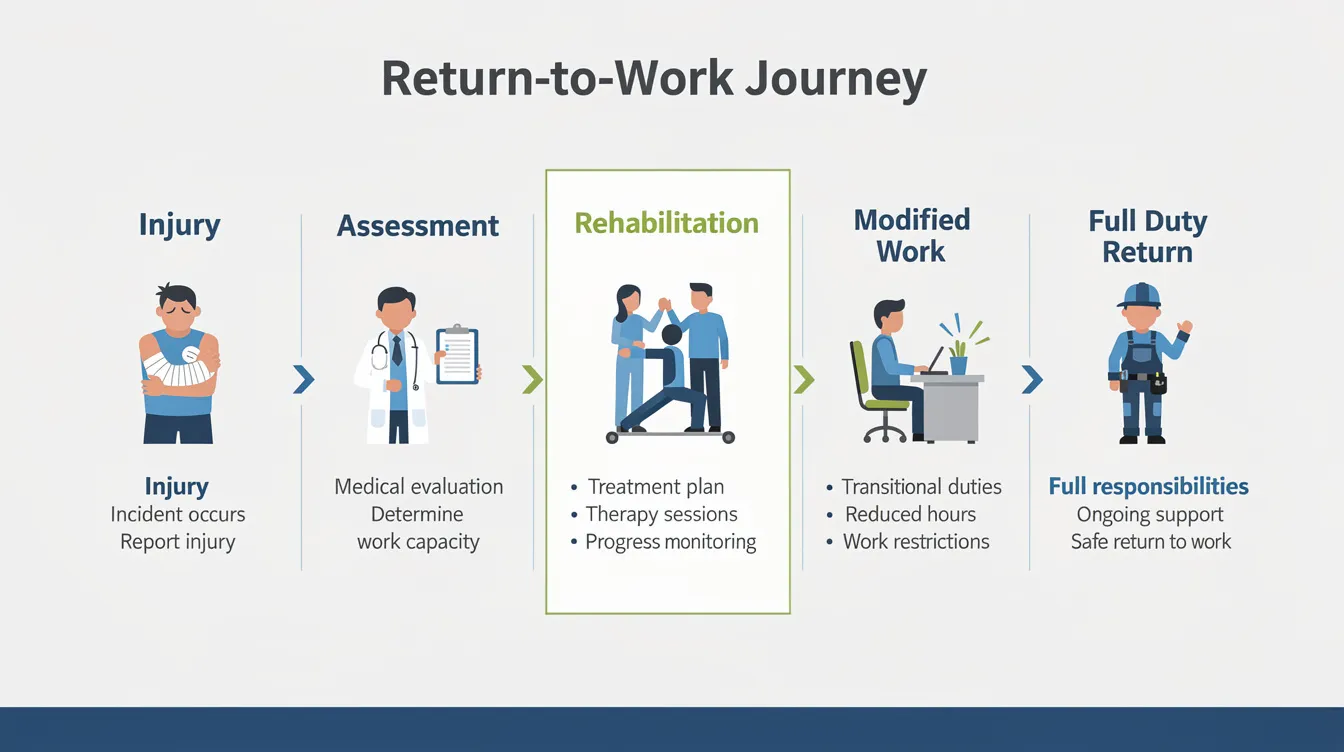
Five building blocks define an effective RTW programme:
-
Early contact after injury. Early intervention is critical for the effectiveness of RTW programmes. A randomised controlled trial at a Singapore public hospital showed that the intervention group returned to work 59.5 days earlier than the control group, with 84% able to return at six months versus 63% without RTW coordination.
-
Designated RTW coordinator. RTW coordinators are responsible for overseeing the return to work process and communication. A systematic review showed RTW coordinators improve RTW rates across multiple studies and settings.
-
Individual RTW plan. Written RTW plans should specify duties, timelines, and conditions for transitioning back to full capacity. Generic policies are insufficient; each plan must be tailored to the specific injury, the worker’s functional capacity, and the job demands of the role.
-
Light duty and modified duties. Customized duty assignments are a core mechanism of RTW programmes, matching available tasks to what the worker can safely perform at each recovery stage so the worker can work safely throughout recovery.
-
Monitoring and review. Monitoring and adjusting the RTW plan based on feedback is essential for successful reintegration. The RTW coordinator reviews progress, confirms readiness for increased workload, and addresses re injury risks or psychosocial barriers.
The difference between a generic policy and an effective RTW plan lies in specificity. A policy says “we support return to work.” A plan says “Worker X will perform document quality checks at the site office from 8am to 12pm for three weeks, with no lifting above 5 kg, reviewed fortnightly by the Safety Officer and RTW Coordinator.”
Written procedures must assign clear roles to HR, the line manager, the Safety Officer, the return to work coordinator, and the worker. Without role clarity, case management breaks down, and the RTW process stalls.
The Role of RTW Coordinators and the National RTW Programme
In the Singapore context, RTW coordinators are typically hospital-based allied health professionals, often occupational therapists or physiotherapists, trained under the national RTW programme. Over 80 healthcare professionals have been trained since 2016, and coordinators hold credentials such as the Certified Disability Management Professional (CDMP) and Functional Capacity Evaluation (FCE) certifications. The RTW Coordinator course lasts 2.5 days, and participants receive a Certificate of Attainment upon completion, supporting facilitating RTW across clinical and workplace stakeholders.
Case managers understand medical, functional, and workplace aspects of injuries. They bridge communication between treating doctors, employers, insurers, and workers, translating medical restrictions into practical job adjustments. Case managers facilitate communication among all stakeholders involved, and case managers identify barriers to successful return-to-work outcomes that might otherwise go unaddressed.
Since 2017, seven public hospitals have offered RTW services: Changi General Hospital, Khoo Teck Puat Hospital, Ng Teng Fong General Hospital, National University Hospital, Sengkang General Hospital, Singapore General Hospital, and Tan Tock Seng Hospital. These hospitals have multiple trained RTW coordinators listed on the WSHC website.
For construction and industrial workplaces, the hospital-based coordinator’s role complements what internal HR, Safety, or rehabilitation staff do on site. The coordinator assesses functional capacity and recommends restrictions; the employer’s team must then identify or create suitable light duty roles, monitor compliance, and communicate progress. This is where companies in sectors that MOSAIC serves benefit from having both clinical RTW coordination and workplace-level RTW support aligned.

How RTW Programmes Help Injured Workers Transition Safely Back to the Job
The outcomes of a well-run RTW programme are measurable. Return to work programmes can reduce lost workdays and improve productivity, and they help control workers compensation costs for employers. RTW programmes can also prevent prolonged isolation and mental health deterioration in injured workers; extended absence correlates with poorer work ability, reduced confidence, and higher drop-out rates.
A safe transition means matching work demands to functional ability at each stage, not simply sending workers back once MC ends. Gradual reintegration through RTW programmes helps minimize the risk of re injury by ensuring the worker’s recovery stage determines task intensity, not operational urgency.
From Medical Leave to Light Duty: Managing the Critical Transition
Under WICA, the typical journey unfolds as follows: the worker sustains a work related injury, receives medical treatment, and the treating doctor issues either medical leave (MC) or a light-duty certificate. Medical leave wages are compensated at full average monthly earnings (AME) for up to 60 days, then at two-thirds of AME from day 61 up to one year.
The days immediately after MC ends are high-risk. The transition should therefore be managed in a timely manner, with task modification and close monitoring put in place without delay; if the worker returns to full duties without functional assessment, the chance of re injury rises.
Obtaining clear functional capacity information from the treating doctor or RTW coordinator is critical. Doctors must specify functional limitations (what cannot be done), not just diagnoses. Under MOM Circular 001/2018, medical practitioners must consider whether appropriate duties are available and whether the worker’s condition allows performing them without aggravation.
For common injuries in construction and industrial contexts, example light-duty roles include:
-
Lower back strain: Site documentation, photographic quality inspection, inventory management at a desk or standing workstation with no bending or lifting above a specified weight limit
-
Upper limb fracture: Safety observation rounds (verbal reporting only, no climbing or overhead tasks), training or mentoring of new workers, managing logs
Designing Light-Duty and Modified Roles that Comply with MOM Expectations
In practical terms, light duty means reduced physical load, adjusted posture, limited hours, or task substitution. The tasks must be meaningful work that respects medical limits. Re-labelling a full-duty role as “light” without changing the actual physical demands violates both the spirit of the injured worker light duty policy and MOM’s guidance.
Employers should develop functional job descriptions to assist in designing RTW programmes. Aligning internal light-duty policies with WICA reporting requirements means documenting what the worker is doing, what restrictions apply, and how the assigned tasks differ from the original role. This documentation matters for MOM inspections, insurer claims, and dispute resolution.
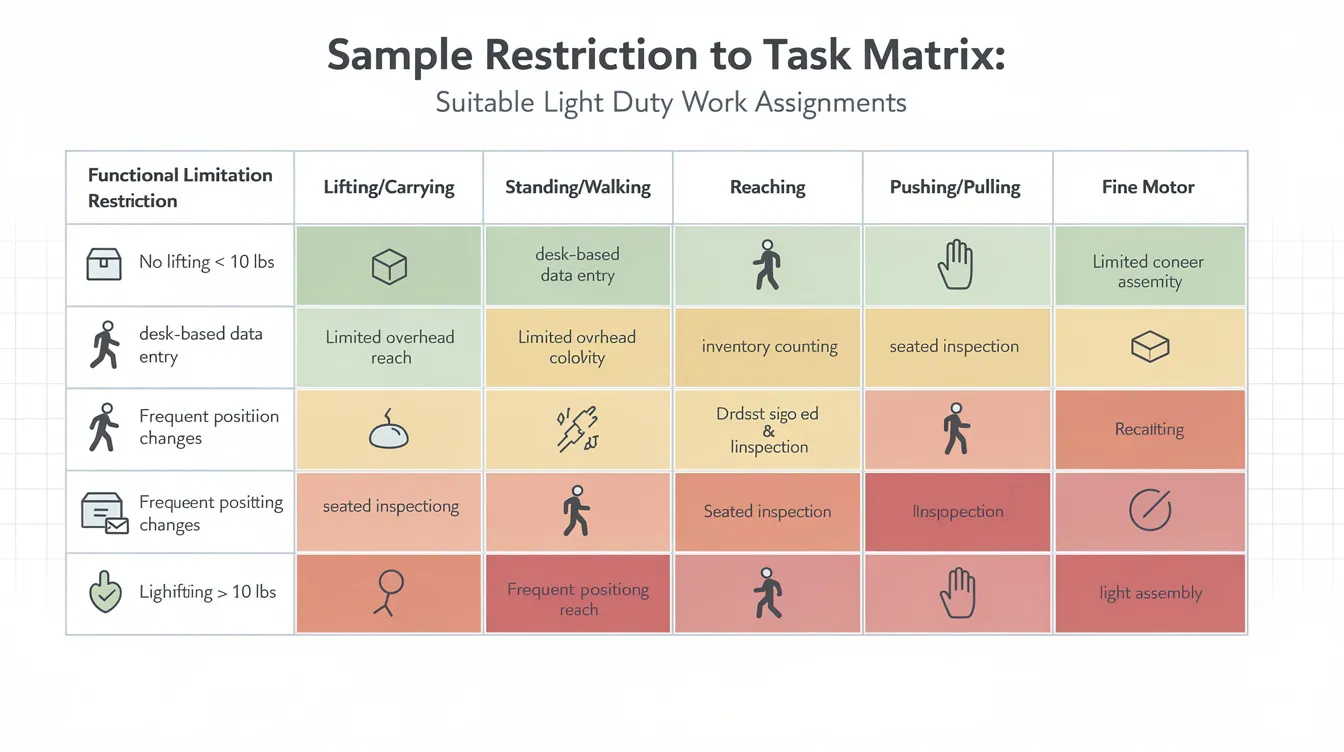
A useful approach is a restriction-to-task matrix. For example: a restriction of “no lifting above 10 kg, no bending, no standing for more than 2 hours” maps to tasks such as document control, digital photo-based quality checks, or toolbox meeting facilitation at a seated or adjustable workstation.
Workplace Modifications and Job Redesign to Support Recovery
Workplace adjustments may include ergonomic changes to aid employees returning from injury. Many modifications are low-cost: mechanical lifting tools, adjustable workstations, task rotation schedules, or auxiliary equipment that reduces repetitive strain.
In construction settings typical of MOSAIC’s client base, examples include using a trolley for material transport instead of manual carrying, repositioning rebar tying work to a height that avoids sustained bending, or assigning pre-cast inspection tasks that do not require climbing scaffolding.
When the worker cannot safely return to the original job even with modifications, more substantial job redesign or redeployment may be necessary. This could mean temporary assignment to a head office, a different project site with lighter physical demands, or a supervisory-assist role. The key is that the worker continues contributing meaningfully, which supports both the injured worker and maintaining productivity for the organisation.
For guidance on conducting the risk assessments needed to validate modified roles, a structured hazard identification approach is essential.
Implementing an RTW Programme in Your Organisation
This section provides a practical framework for building or strengthening an RTW programme. The steps apply to SMEs and larger organisations alike, especially those in construction and manufacturing where workplace injury frequency is higher and suitable light-duty roles require deliberate design.
Step-by-Step Framework for Setting Up a Company RTW Policy
RTW policies should be formalized in writing with clear expectations and processes. A written policy creates consistency, supports compliance during MOM WSH inspections, and gives insurers confidence that claims are managed properly.
-
Map current injury management and claims processes. Review WICA cases from the last 12 to 24 months. Identify where communication broke down, where workers remained on extended MC without light-duty options, and where claims costs exceeded expectations.
-
Draft a written RTW policy. State objectives, scope (work-related injuries under WICA, and whether non-work conditions are included), responsibilities for each role, and escalation paths. Effective communication among all stakeholders is vital for successful RTW outcomes; the policy should specify who communicates with whom, and when.
-
Appoint an internal RTW lead. This person, often from HR or the Safety team, acts as the workplace-side counterpart to hospital-based RTW coordinators. Define their authority to approve modified duties and their obligation to liaise with treating doctors.
-
Develop standard operating procedures (SOPs). Cover early contact with the injured worker (within 48 hours of the incident), medical information flow, and RTW case conferences. RTW programmes should respect employee confidentiality and focus on their functional capabilities rather than diagnoses.
-
Create a library of pre-approved light-duty roles. Each department should have two to three validated light-duty templates, reviewed by line managers and the WSH Officer. Examples: site documentation assistant, quality checker, training aide.
-
Train supervisors and HR. Supervisors need to understand how to conduct RTW discussions, monitor restrictions on site, and avoid pressuring workers into tasks outside their medical clearance. This training is an area where MOSAIC adds value by integrating RTW into broader safety training programmes.
-
Set up KPIs and review mechanisms. Track average days lost per case, recurrence rate, worker satisfaction, and percentage of cases where light duty was provided within five days of medical clearance. Regular evaluations of RTW programme effectiveness are necessary to improve processes and outcomes.
Designing and Documenting Light-Duty Roles
This subsection focuses on a repeatable method for creating light-duty assignments that withstand scrutiny from MOM, insurers, and internal auditors.
Start with task analysis for your highest-risk roles. Break each role into discrete tasks: lifting requirements (weight, frequency, height), repetitive motions, exposure to specific hazards (heights, chemicals, noise), and cognitive demands. Group these tasks by physical intensity to create a “task bank” that the RTW lead can draw from when designing modified duties.
Develop standard templates. A “site documentation assistant” template, for example, specifies: maximum four hours on site, no climbing, no lifting above 5 kg, tasks limited to photographic recording, form completion, and verbal reporting to the site supervisor. Each template should align with common medical restrictions and note which restrictions disqualify the role.
Ensure documentation is clear enough for a third party to understand. If an MOM inspector or insurer asks what a worker on light duty was doing, the documentation should answer in one page: the restriction source (doctor’s memo), the assigned tasks, the review date, and the supervisor responsible.
Coordinating Stakeholders: Employer, Worker, Doctor, Insurer
RTW programmes involve collaboration among workers, employers, and healthcare professionals. Breakdowns typically happen at handoff points: the doctor issues a light-duty certificate, but the employer never receives it; or the employer assigns modified duties, but the insurer disputes whether the tasks qualify under WICA.
Practical steps to prevent these gaps:
-
Case conferences. Bring together HR, the line manager, the RTW coordinator, and the worker (when appropriate) at defined intervals: within one week of light-duty start, then fortnightly until discharge. Case managers help injured workers regain independence and productivity by keeping all parties aligned.
-
Shared RTW plans. Written RTW plans should specify duties, timelines, and conditions for transitioning. All parties sign off, creating a single reference document that both the employer and worker can point to if questions arise.
-
Structured medical communication. Request functional limitations from doctors, not diagnoses. A concise functional requirement summary of the worker’s role, sent to the treating doctor, helps the doctor issue actionable recommendations rather than vague instructions like “avoid heavy work.”
-
Insurance alignment. Under WICA, costs such as case management, functional capacity evaluation (FCE), and worksite assessment are explicitly claimable as part of medical expenses. Documenting these activities at the time they occur, not retroactively, ensures claims are defensible. For guidance on reporting and documentation requirements, having a clear internal process is essential.
Leveraging MOM’s RTW Grants and Support Ecosystem
The Singapore Ministry of Manpower and related agencies provide financial and programme support to encourage early RTW. Here is what is available and how to access it.
Hospital-based RTW coordinator services. The RTW programme costs between S$600 and S$1,000 per employee, depending on injury severity. This cost is fully claimable from the employer’s WICA insurer for eligible workers. To access the programme, the employer or worker contacts one of the seven participating public hospitals with a doctor’s referral and insurance details.
Claimable medical and rehabilitation costs under WICA. For accidents occurring on or after 1 November 2025, medical expenses related to a work accident are claimable up to S$53,000 or within one year of the accident date, whichever occurs first. Claimable expenses include treatment, case management, functional capacity evaluation, and worksite assessment.
Medical leave wage compensation. Employers pay full AME for the first 60 days of medical leave; from day 61 up to one year, two-thirds of AME. For workers on light duty, the wage shortfall between actual wages paid and full AME is claimable.
Accessing the programme step by step:
-
Check if the worker’s injury falls under WICA eligibility.
-
Obtain a referral to the RTW clinic at one of the seven participating hospitals.
-
Coordinate with the hospital RTW coordinator to develop the RTW plan.
-
Document all RTW-related expenses (coordinator fees, FCE, worksite assessments) for WICA claims.
-
Work with consultants like MOSAIC to align RTW initiatives with existing bizSAFE and ISO management systems to ensure documentation meets both WSH and insurance standards.
RTW programmes can help organizations reduce costs associated with long-term disability by facilitating timely employee reintegration, making these grants and claimable costs a direct return on the administrative effort involved.
Common Challenges in RTW and How to Overcome Them
Even with a clear policy, HR teams and RTW coordinators encounter recurring obstacles. This section addresses four of the most common, with solutions drawn from Singapore’s RTW experience.
Challenge 1: Lack of Suitable Light-Duty Work in Labour-Intensive Roles
In construction and process industries, most tasks involve physical demands that injured workers cannot perform. The 2014-2015 study of 407 workers with more than 14 days of MC found that two-thirds of unemployed injured workers came from SMEs, which often lack the role diversity to offer modified duties.
Solutions:
-
Create cross-departmental light-duty posts. Safety observation, document control, toolbox meeting coordination, and quality inspection are available on most sites and do not require heavy physical exertion.
-
Use temporary re-deployment to head office or a less physically demanding site. A worker recovering from a lower-limb injury can contribute to procurement documentation or training material preparation.
-
Engage external consultants to conduct job and risk analysis that identifies tasks suitable for restricted workers. MOSAIC performs these assessments as part of its WSH advisory services.
Challenge 2: Misalignment Between Doctor’s Advice and Workplace Reality
Vague medical advice (“avoid heavy lifting”) makes it difficult for employers to design compliant light-duty roles. The 2018 MOM-MOH circular explicitly addresses this, warning against employers influencing doctors to understate MC or issue light duty improperly.
The fix is bidirectional communication. Send concise job descriptions and functional requirement summaries to the treating doctor or RTW coordinator. Request a functional capacity evaluation rather than a diagnosis; this gives you specific parameters (no lifting above X kg, no standing for more than Y hours) that map directly onto your task bank. When uncertainty remains, use trial placements lasting one to two weeks with daily monitoring and a feedback loop to the medical team.
Challenge 3: Worker Resistance or Anxiety About Returning
Fear of pain, fear of re injury, concern about job loss, and stigma among co-workers are real barriers. RTW programmes can prevent prolonged isolation and mental health deterioration in injured workers, but only if the worker participates willingly.
Clear communication helps. Explain the RTW plan objectives and safeguards: gradual workload increases, no penalty for raising concerns, and scheduled review points. Involve the worker in designing their RTW plan, including pace and assigned duties. When psychosocial barriers are pronounced, referral to mental wellbeing support resources can address underlying anxiety.
Supervisors play a critical role. Training them to avoid pressuring behaviours and instead support recovery-focused expectations reduces drop-out rates. In hospital studies, migrant workers had higher dropout rates from RTW programmes, making supervisor sensitivity and clear communication particularly important for this group.
Challenge 4: Inconsistent Implementation Across Sites and Supervisors
When different supervisors apply RTW policies differently, the organisation faces both legal risk and worker safety risk. One site may provide genuine modified duties while another assigns the worker to full physical tasks under a “light duty” label.
Standardise RTW forms, checklists, and approval processes across all projects and sites. Embed RTW responsibilities into supervisors’ KPIs so compliance is tracked alongside productivity. Conduct periodic internal audits of RTW cases; this is an area where MOSAIC supports clients through WSH audit and management system reviews, ensuring that what the policy says and what happens on site are the same thing.
Conclusion and Next Steps
Structured RTW programmes, backed by MOM’s national ecosystem and well-designed light-duty policies, protect both the injured worker and the organisation. The evidence from Singapore’s pilot is clear: the programme raised post-injury employment rates from about 75% to 95%, and the intervention group in hospital trials returned to work 59.5 days earlier than workers receiving usual care. For both the employer and the worker, a well-coordinated RTW process translates directly into fewer lost workdays, lower work injury compensation costs, and a safer return to productive work.
HR Managers, Claims Officers, and Rehabilitation Coordinators in Singapore have a defined framework to follow. The practical next steps are:
-
Review WICA and RTW cases from the last 12 to 24 months to identify barriers and gaps in your current process.
-
Draft or update a written RTW and light-duty policy aligned with MOM guidance.
-
Build a library of pre-approved light-duty roles for key departments, validated through task analysis.
-
Reach out to hospital RTW coordinators at participating public hospitals for complex cases.
-
Engage MOSAIC Ecoconstruction Solutions to integrate RTW into your WSH, bizSAFE, and ISO management systems.
Adjacent topics worth exploring include risk management for partially fit workers, integrating RTW data into WSH performance dashboards, and using design for safety principles to prevent future workplace injuries at the source.
Frequently Asked Questions about RTW Programmes and Light-Duty Policies in Singapore
Is a written RTW programme mandatory under Singapore law?
MOM promotes RTW through its national programme and good practice guidance, but does not currently mandate a specific written RTW document by statute. Having one, however, directly supports compliance under WICA and WSH obligations. A written programme provides defensible evidence during MOM inspections, strengthens your position in insurer discussions, and creates a consistent process that reduces disputes. Companies pursuing bizSAFE or ISO 45001 certification will find that a formalised RTW policy aligns with the management system requirements those standards demand.
How does the MOM-supported Return to Work programme differ from our in-house RTW policy?
MOM’s RTW programme is delivered through seven participating public hospitals and staffed by certified RTW coordinators who handle clinical assessment, personalised case management, functional capacity evaluation, and medical appointments coordination. An employer’s in-house RTW policy covers placement into suitable duties, site-level risk controls, supervisor responsibilities, and documentation for WICA claims. The two complement each other: the hospital coordinates the clinical RTW coordination, while the employer implements the workplace-side adjustments and monitoring. Companies get the best outcomes when both systems are aligned and communicating through shared RTW plans.
What counts as acceptable “light duty” under MOM and WICA?
Acceptable light duty must respect documented medical restrictions and meaningfully reduce exposure to aggravating tasks or hazards. A compliant example: a worker recovering from a back strain is assigned to safety observation rounds and digital documentation, tasks that involve no bending, lifting, or prolonged standing. A non-compliant example: the same worker is assigned to “light” material sorting that still requires lifting 15 kg boxes, with the label changed but not the physical demand. Doctors should prescribe light duties only when tasks are available and the worker’s medical conditions allow performing them without aggravation.
Can RTW programmes cover non-work-related injuries or illnesses?
Many employers extend RTW support to non-work-related conditions for consistency and workplace health. This approach supports employee retention and reduces the risk of prolonged absence regardless of injury cause. WICA funding, however, applies only to work-related injuries. Companies should use clear policy wording to distinguish WICA-eligible claims from internally funded RTW support, while keeping the RTW process itself consistent. Singapore’s “Bounce Back Lab” pilot (2023-2025) explored RTW-style support for workers recovering from non-work health setbacks, signalling a broader trend toward occupational rehabilitation that extends beyond WICA boundaries.
How can MOSAIC Ecoconstruction Solutions support our RTW strategy?
MOSAIC supports RTW implementation through four core services:
-
RTW and light-duty policy reviews. Assessing your current policy against MOM expectations, WICA requirements, and industry good practice.
-
Light-duty role design and risk assessments. Conducting task analysis in construction and industrial settings to create validated light-duty templates matched to common injury types.
-
WSH management system integration. Embedding RTW procedures into your bizSAFE, ISO 45001, or WSHMS framework so that RTW is part of your continuous safety improvement cycle, not a standalone process.
-
Supervisor and HR training. Delivering practical training on RTW discussions, restriction monitoring, and professional advice on communicating with healthcare professionals and insurers. Informed decisions by frontline managers reduce the risk of non-compliance and support a smooth return to work for injured employees.