
Introduction
ISO 27001 data privacy safeguards provide the structural backbone for protecting sensitive information when deploying large language models in regulated Singapore industrial firms. As manufacturing plants, petrochemical facilities, and construction companies increasingly integrate generative AI into operations-from predictive maintenance to safety documentation-the risk of data exposure, regulatory violation, and intellectual property loss escalates sharply. ISO 27001 certification demonstrates systematic management of sensitive information, but adapting its controls to the unique threats posed by LLM deployments requires deliberate, sector-aware planning.
This article covers how Singapore’s regulated industries-manufacturing, construction, petrochemical, and adjacent sectors-can apply ISO 27001 Annex A controls to secure LLM deployment against data privacy risks. It is written for IT managers, compliance officers, and HSE professionals applying the core principles of data privacy and information security to LLM deployments in regulated industrial settings. Topics outside this scope include general AI ethics philosophy and non-industrial deployment contexts.
The core answer: ISO 27001 Annex A controls A.8 (Asset Management), A.13 (Communications Security), and A.18 (Compliance) form the primary framework for LLM data protection in Singapore industrial firms, complemented by PDPA obligations, CSA AI security guidelines, and sector-specific workplace safety regulations.
By the end of this article, you will have:
-
A clear regulatory compliance roadmap mapping ISO 27001 to Singapore’s data protection landscape
-
Technical implementation guidance for securing enterprise LLM deployments in industrial settings
-
Risk mitigation strategies addressing the biggest data privacy risks specific to LLM use in regulated industries
-
Practical steps toward audit readiness incorporating AI system controls
-
Awareness of common challenges and proven solutions for industrial LLM adoption
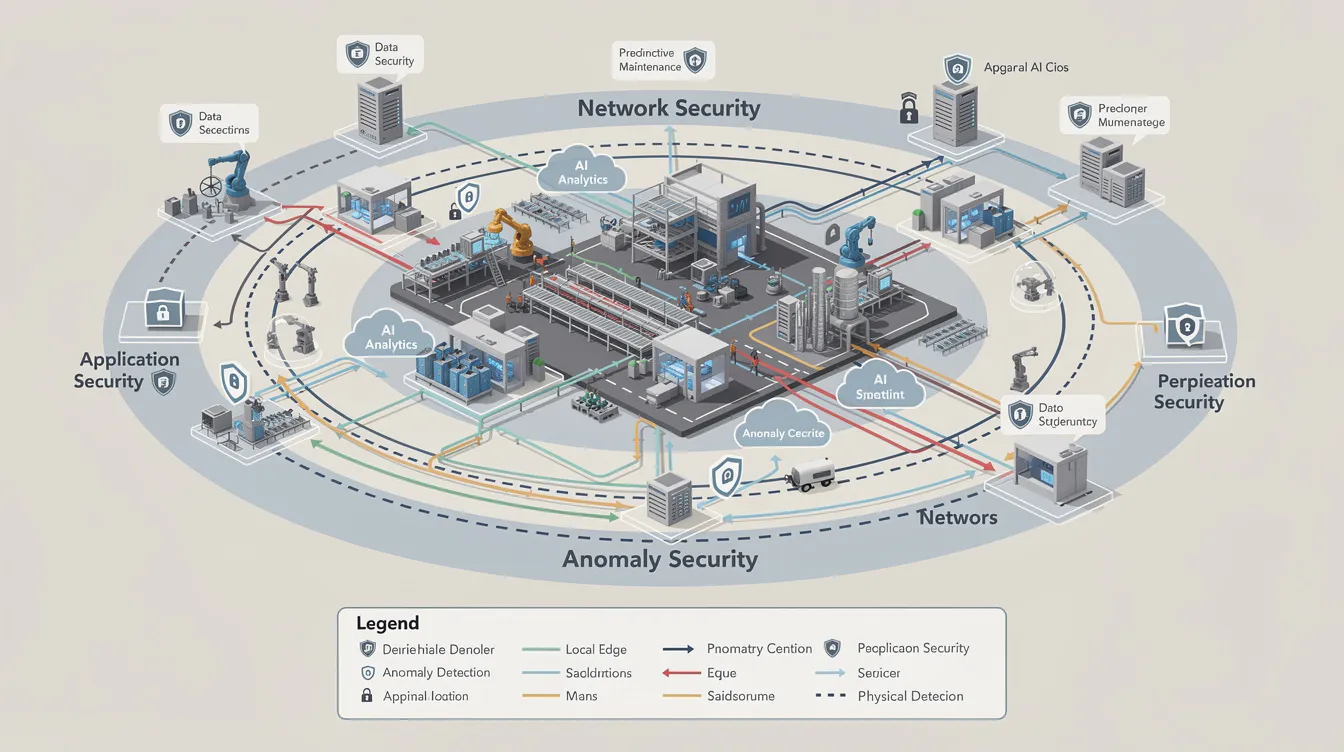
Understanding ISO 27001 in the Context of LLM Deployments
ISO 27001 defines the requirements for establishing, implementing, maintaining, and continually improving an Information Security Management System (ISMS). Singapore adopts this as SS ISO/IEC 27001:2023 +A1:2024, covering 14 control sets across Annex A-from asset management and cryptography to supplier relationships and compliance. ISO 27001 provides rules for information security management systems that, when properly extended, address modern AI systems including large language models deployed in industrial contexts.
Yet LLMs introduce data processing risks that stretch traditional ISMS boundaries. Unlike static databases, LLMs dynamically ingest training data, process prompts containing potentially sensitive information, and generate model outputs that may inadvertently disclose confidential details. Fine-tuning can lead to memorization of sensitive proprietary data, while training data leakage can expose personal information even if anonymized. Researchers found that 12,000 live API keys were discovered embedded in LLM training data-illustrating how raw data ingested without rigorous controls creates cascading security failures. For industrial firms handling proprietary data such as engineering blueprints, safety procedures, and operational sensor readings, these risks carry both commercial and physical safety consequences.
Core ISO 27001 Controls Applicable to LLMs
Annex A.8: Asset Management requires organizations to identify, classify, and assign ownership to all information assets. In an LLM context, this extends to training data, model parameters, fine-tuned models, prompt logs, and AI-generated outputs. For Singapore industrial firms, proprietary manufacturing processes, incident investigation reports, and operational data (temperatures, pressures, chemical concentrations) must be inventoried as information assets subject to handling rules. Data classification is necessary to manage sensitive information in AI workflows-without it, firms cannot enforce appropriate safeguards at each stage of the AI pipeline.
The connection to data sensitivity is direct: unless training sets and model inputs are classified according to a schema (Public / Internal / Restricted / Proprietary / Highly Sensitive), there is no basis for applying proportionate security controls to LLM operations.
Data Privacy Principles in Industrial Settings
Confidentiality in industrial settings extends well beyond personal data. Proprietary manufacturing processes, safety procedures documented after incident investigation, and operational data from sensors all carry significant commercial and regulatory weight. LLMs can unintentionally disclose confidential information in outputs-a safety procedure summary generated by an LLM could reveal trade-secret formulations if the underlying model was trained on unclassified internal documents.
Data minimization-ensuring only the minimum necessary data enters the LLM pipeline-is a core principle that intersects with both ISO 27001 and Singapore’s PDPA. When an individual’s data appears in prompts or training sets without strict purpose limitation, the firm risks violating data protection obligations. This principle connects directly to Singapore’s broader regulatory landscape, which layers additional requirements on top of ISO 27001’s framework.
Singapore Regulatory Landscape for Industrial LLM Deployments
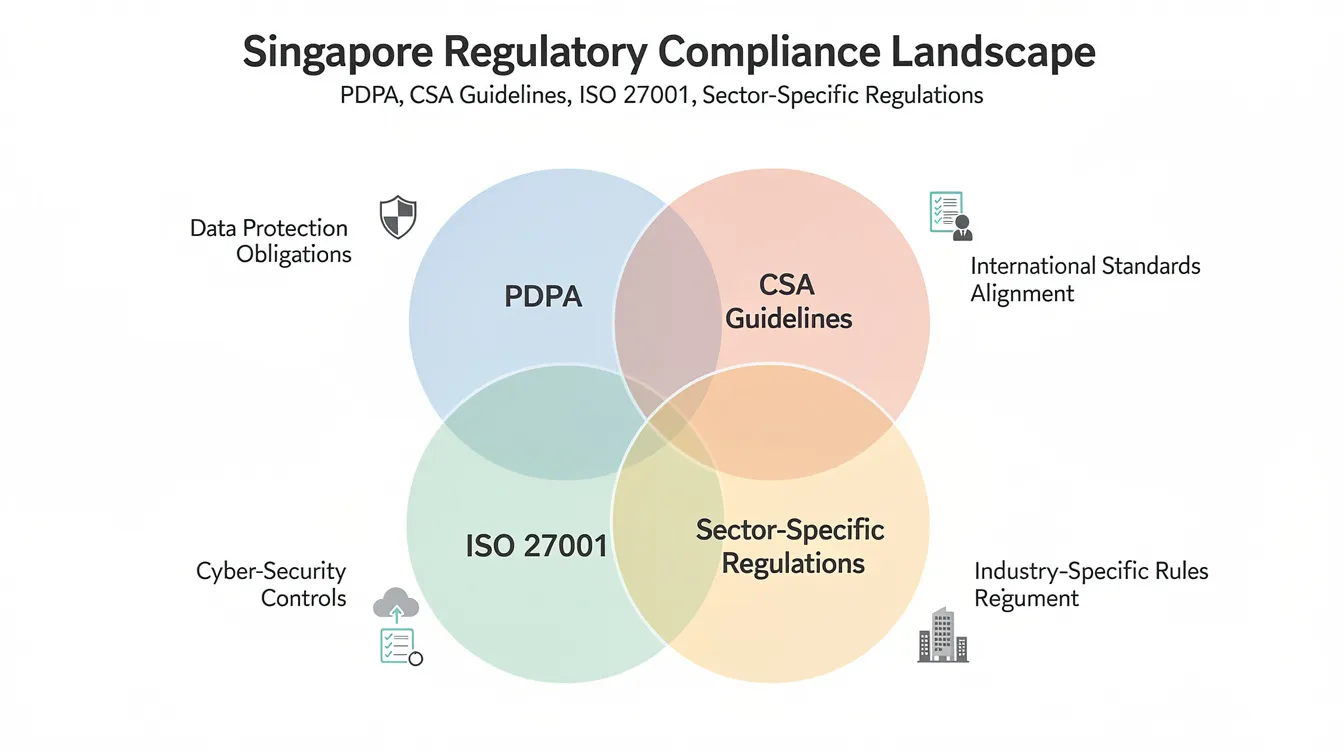
Singapore has constructed a multi-layered regulatory environment where ISO 27001 controls intersect with national data protection laws, AI-specific guidelines, and industry-specific safety legislation. Industrial firms deploying LLMs must navigate all of these simultaneously, creating a significant compliance burden that demands structured planning.
Personal Data Protection Act (PDPA) Compliance
PDPA governs personal data collection and usage in Singapore and is the primary statute affecting how industrial firms handle employee, contractor, and third-party data within LLM systems. Compliance with Singapore’s PDPA is crucial for organizations using LLMs-financial penalties for PDPA breaches can reach S$1 million.
Cross-border data transfer restrictions present particular challenges for cloud-based LLM services. When engineering or employee data leaves Singapore to reach overseas LLM providers, the recipient must hold specified certification (such as APEC CBPR or Global Privacy Rules) or enforce legally binding obligations comparable to PDPA’s protection standards. This data residency concern affects nearly every enterprise LLM deployment relying on external API services hosted in the United States, Europe, or elsewhere. Industrial firms must implement data residency controls or adequate protection measures before routing any personal data to overseas cloud providers.
Employee personal data in training datasets and prompts creates direct PDPA exposure. When a supervisor asks an LLM “What incidents did worker X report last quarter?”, the prompt itself may contain personal data that, combined with operational logs, could uniquely identify individuals. Consent and notification requirements apply: data collected for workplace safety purposes cannot be repurposed for unrelated model training without explicit notice and, where required, consent.
The DS Human Resource case demonstrates the PDPC’s approach: the firm was fined for breaching PDPA sections 12 (security) and 24 (data retention) after a data breach caused by open-source database misconfigurations. This precedent confirms that default settings and poor technical configurations-whether in databases or AI systems-attract regulatory consequences.
Industry-Specific Regulations
Industrial firms operate under additional sector regulators that impose data-related obligations intersecting with LLM deployment:
-
Workplace Safety and Health Act (WSHA): Firms must maintain safety incident records and health logs. When LLMs process or generate safety advice or training materials, both confidentiality and accuracy become regulatory requirements. An LLM producing incorrect safety instructions from corrupted training data could trigger WSHA liabilities. Understanding how risk assessment obligations apply to AI-generated safety outputs is essential.
-
Building Control Act: Construction firms using LLMs for design compliance or code checking must ensure data integrity-errors in AI-generated structural assessments could cause physical harm or regulatory non-conformance.
-
Environmental Protection and Management Act: Manufacturing firms using AI for emissions monitoring or pollutant analysis must maintain data lineage tracking that documents the complete journey of information from sensor to model output, ensuring provenance and traceability.
MAS Guidelines for Financial Data
While the Monetary Authority of Singapore’s AI Risk Management Guidelines target financial institutions, they establish precedents that industrial firms with financial operations should monitor. SOC 2 emphasizes security, availability, and confidentiality of customer data, and SOC 2 focuses on managing customer data security-standards that industrial firms handling financial data or payroll through LLM systems should consider alongside ISO 27001. The MAS toolkit’s emphasis on AI inventories, materiality assessment, and lifecycle controls provides a blueprint that sector regulators may extend to industrial firms in the near future.
Singapore’s broader AI governance ecosystem-including the Infocomm Media Development Authority’s Model AI Governance Framework, the AI Verify Foundation, and the Global AI Assurance Sandbox-reinforces expectations around explainability, accountability, and human oversight. The CSA Guidelines on Securing AI Systems (October 2024) provide lifecycle-specific security controls that directly overlap with ISO 27001 requirements, drawing from OWASP Top-10 for ML and MITRE ATLAS threat frameworks. These guidelines apply alongside global data protection benchmarks such as the General Data Protection Regulation for EU operations-GDPR applies to organizations processing EU residents’ personal data, and cumulative GDPR fines reached €5.88 billion by 2026-and frameworks like the EU AI Act governing high risk AI systems.
Implementing ISO 27001 Controls for LLM Data Privacy
With the regulatory landscape mapped, the practical question becomes: how do industrial firms translate these overlapping requirements into concrete security controls and operational procedures? Organizations must document security controls and risk management processes to satisfy both ISO 27001 auditors and Singapore regulators. Privacy-by-design principles should be integrated into AI model deployments from the outset, not retrofitted after deployment.
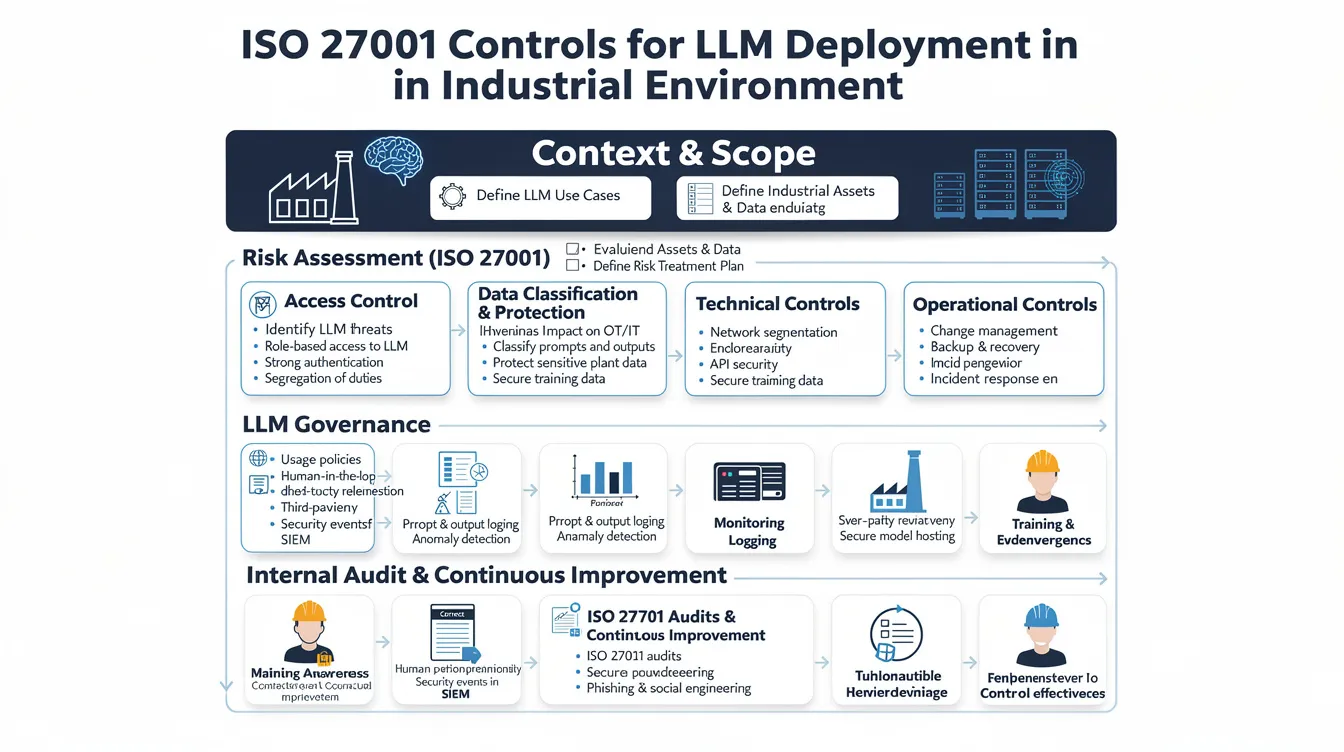
Risk Assessment and Treatment (ISO 27001 Clause 6.1.2)
Risk assessments are necessary when integrating LLMs into operational workflows. ISO 27001 Clause 6.1.2 requires a structured approach tailored to the specific threats LLMs introduce. A thorough risk assessment for LLM deployment should follow these steps:
-
Identify data assets exposed to LLM processing: Map all data sources that could enter the system-design blueprints, sensor data, safety logs, employee personal data, customer data, and contractor records. Determine whether each asset qualifies as personal data, proprietary data, safety-critical information, or restricted content. Strong data governance ensures organizations understand data origins and access patterns.
-
Assess threats specific to industrial environments: Evaluate IP theft from engineering documents, sabotage via manipulated safety guidance, environmental compliance data falsification, and unauthorized data usage. Prompt injection attacks can override LLM guardrails easily-consider scenarios where malicious inputs extract sensitive data from the underlying model or corrupt safety-critical outputs.
-
Evaluate vulnerabilities in the AI pipeline: Examine data leakage risks from training data, model inversion attacks that reconstruct sensitive inputs, weak vendor contracts with cloud providers, and insufficient logging. Data Leakage Prevention technologies are critical for securing LLM deployments. Assess whether the LLM provider retains prompt data, retrains on customer inputs, or stores audit logs by default.
-
Determine risk treatment options: Mitigate through encryption, data masking, role based access controls, and human review loops. Transfer risk through cyber insurance or business associate agreements with vendors. Avoid deploying LLMs for use cases with unacceptable data sensitivity levels. Accept residual risk only where impact is minimal and documented.
Technical Controls Implementation
The following table maps ISO 27001 controls to LLM-specific implementations with industrial use cases:
|
ISO 27001 Control |
LLM-Specific Implementation |
Industrial Use Case |
|---|---|---|
|
A.8.2.1 Information Classification |
Develop classification schema labeling training data, model inputs, and LLM outputs as Public / Internal / Restricted / Proprietary. Apply automated tagging at data ingestion. |
Safety procedures and incident reports classified as “Restricted”-cannot enter cloud LLM without prior anonymization. Prevents proprietary process data from entering model training. |
|
A.9 Access Control |
Implement strict access controls with role based access controls for prompt interfaces, fine-tuning tools, and inference endpoints. Enforce separation of duties between data engineers and operations staff. |
Only authorized safety engineers can query LLMs about incident investigation records; production operators cannot access design IP through the same system. Access Control is essential to prevent unauthorized data access in LLMs. |
|
A.10 Cryptography |
Encrypt data at rest and in transit; use secure enclaves for inference; apply salted hashing for PII in training corpora. HIPAA requires encryption of protected health information at rest and in transit-apply equivalent rigor to employee health data. |
Employee biometrics and identity records in safety monitoring systems encrypted and masked data stored in logs to prevent exposure. |
|
A.13.2.1 Information Transfer Policy |
API interactions restricted to whitelisted endpoints via private cloud or Virtual Private Cloud (VPC); enforce geo-fencing of data flows; monitor cross border transfer activity. |
Manufacturing firm ensuring operational data sent to external API services meets Singapore’s data sovereignty requirements under PDPA cross-border rules. |
|
A.14 System Acquisition / Secure Development |
Vendor risk assessments; secure SDLC; dependency management; verify third-party model licenses; adversarial robustness testing. Organizations must ensure explicit contractual terms regarding data handling with vendors. |
Open-source LLM validated for license compliance, tested for training data leakage, and reviewed for hidden backdoors before deployment in production environment. |
|
A.15 Supplier Relationships |
Vendor management is critical when using external LLM providers. Supplier relationships must be managed to ensure data processing compliance under ISO 27001. Require contractual guarantees on data retention, model update cycles, and whether vendors retrain on customer data. |
Cloud LLM vendor contractually prohibited from using manufacturing firm’s prompts for model training; verified through annual audit. |
|
A.18.1.4 Privacy & Protection of PII |
Implement anonymization/pseudonymization; define data retention policies; maintain consent records; ensure audit trails capture prompts, responses, and human interventions. |
Personal data in predictive maintenance logs or worker health records masked before LLM processing; workers given transparent notice; retention schedule aligned with PDPA requirements. |
Additional technical safeguards include: differential privacy during fine-tuning to prevent memorization of sensitive data, federated learning across multiple industrial sites to avoid centralizing raw data, watermarking of model outputs for traceability, and continuous monitoring for model drift or unexpected behavior. Privacy enhancing technologies such as retrieval augmented generation (RAG) architectures with a controlled retrieval layer can limit LLM access to only pre-approved, classified data sources rather than exposing the full training corpus.
Audit logs must track every interaction with AI systems for accountability-logging and monitoring are required to ensure compliance in LLM usage. Audit trails must capture prompts, responses, and human interventions to create a defensible record for regulators and auditors. Data lineage tracking documents the complete journey of information from source through processing to output.
Governance platforms automate compliance tasks and maintain documentation, reducing manual effort while ensuring that data retention policies are consistently enforced. Data retention policies must be established to comply with local data protection regulations-define how long prompt logs, fine-tuning datasets, and model outputs are retained and when they are securely destroyed.
For firms operating across multiple jurisdictions-including EU operations subject to GDPR-the compliance framework must also address requirements like explicit consent for data collection and processing. GDPR requires that data must be processed lawfully, fairly, and transparently. While HIPAA mandates strict safeguards for patient health information and encryption of protected health information, Singapore industrial firms handling any protected health information (such as employee medical records in safety monitoring) should apply equivalent rigor. Both ISO 27001 and SOC 2 require regular audits and continuous monitoring.
Common Challenges in Industrial LLM Deployments
Implementing ISO 27001 controls for LLM data privacy in industrial environments presents obstacles that differ markedly from office-based or financial sector deployments. Understanding these challenges and their proven solutions helps security teams plan realistic implementation timelines.
Legacy System Integration
Industrial sites often operate on operational technology (OT) networks designed decades before modern AI systems existed. These legacy systems-SCADA, DCS, PLCs-were never architected for cybersecurity, let alone for integration with cloud-based generative AI services.
Solution: Deploy API gateways and data preprocessing layers that sit between OT/IT networks and LLM infrastructure. These intermediary layers sanitize, filter, and classify data before any information reaches the AI model-enforcing the minimum necessary principle by stripping identifiers such as phone numbers, badge IDs, and location data that could uniquely identify individuals. Network segmentation ensures that even if the LLM-facing layer is compromised, OT systems remain isolated. This approach maintains ISO 27001 controls while enabling regulated workloads to benefit from AI capabilities. Firms implementing these architectures should ensure alignment with WSH technology integration requirements.
Multi-Site Data Governance
Industrial firms with multiple plants-each potentially running different systems, data classifications, and local vendors-face significant challenges maintaining consistent ISMS governance across the organization. Data sources from different facilities may have incompatible formats, classification levels, or retention schedules.
Solution: Implement federated learning approaches that allow AI models to train on distributed data across manufacturing facilities without centralizing raw data in a single location. Complement this with a distributed ISMS implementation using harmonized classification policies and a centralized governance platform that enforces consistent access controls, data masking rules, and audit trail requirements across all sites. This approach respects data sovereignty requirements while maintaining the benefits of enterprise deployments. As firms scale from risk management to system management, federated approaches become increasingly practical.
Skilled Personnel Shortage
Industrial firms typically employ safety engineers, process engineers, and operations managers-but rarely have dedicated AI security experts or data privacy specialists on staff. This gap between operational expertise and AI infrastructure knowledge can undermine even well-designed security frameworks.
Solution: Partner with specialized HSE consultancies that combine ISO 27001 compliance expertise with understanding of industrial AI workflows and LLM data privacy requirements. Invest in cross-functional training programs that equip existing compliance officers and safety professionals with AI risk literacy. Establish governance committees spanning IT, safety, legal, and operations functions. Internal training should cover topics from continuous improvement in safety to AI-specific threat recognition. When selecting certification partners, use a structured approach to choosing an ISO certification body that understands AI system auditing.
Vendor-Model Opacity and Third-Party Risk
When using third-party LLMs via external API services, industrial firms often have limited visibility into vendor practices-what logging occurs, how long data is retained, whether the vendor retrains on customer inputs, and what security controls protect the ai infrastructure hosting the model. Organizations deploying LLMs in regulated sectors must comply with local data protection laws, and this extends to their vendors.
Solution: Require comprehensive vendor due diligence before deployment. Contract terms should explicitly address data handling, retention periods, retraining policies, and breach notification obligations. Consider the Data Protection Trustmark certification as a baseline indicator of vendor trustworthiness. Implement automated decision making monitoring to flag anomalous vendor behavior. SOC 2 focuses on customer data management and security standards-require SOC 2 reports from LLM vendors as evidence of appropriate safeguards.

Conclusion and Next Steps
ISO 27001 provides the most robust available framework for securing LLM deployment in Singapore’s regulated industrial firms-but only when its controls are deliberately extended to address the unique data privacy risks of generative AI. The intersection of Annex A controls with Singapore’s PDPA, CSA AI security guidelines, and sector-specific regulations creates a comprehensive but navigable compliance structure. ISO 27001 certification demonstrates systematic management of sensitive information, and extending that certification to cover enterprise LLM deployments positions industrial firms ahead of tightening regulatory expectations.
Immediate next steps:
-
Conduct a gap analysis of your current ISO 27001 ISMS against LLM deployment requirements-identify where existing controls fall short for AI-specific threats like prompt injection, data leakage, and model inversion.
-
Engage with PDPA-experienced consultants for Singapore-specific compliance guidance on cross border transfer restrictions, consent requirements, and data retention obligations for AI systems.
-
Pilot LLM deployment in a controlled environment with full audit trails, strict access controls, and human review protocols before scaling to production regulated workloads.
-
Prepare for ISO 27001 surveillance audits incorporating AI system controls-ensure documentation covers risk assessment records, data classification matrices, API security configurations, and incident response procedures specific to LLM vulnerabilities.
Related topics worth exploring include bizSAFE integration with AI governance requirements, WSH compliance for AI-assisted safety systems, and ongoing regulatory developments from Singapore’s CSA and IMDA that may formalize statutory obligations for high risk AI systems across all industrial sectors.
Frequently Asked Questions
Which ISO 27001 controls are most critical for LLM deployments in Singapore manufacturing?
A.8.2.1 (Information Classification), A.13.2.1 (Information Transfer Policies), and A.18.1.4 (Privacy and Protection of PII) form the core triad for manufacturing LLM deployments. Together, they ensure that training data and model outputs are classified according to data sensitivity, that cross-border data flows comply with PDPA requirements, and that personal data receives appropriate safeguards throughout the LLM processing lifecycle. Complementary controls under A.9 (Access Control) and A.15 (Supplier Relationships) are equally important in practice-particularly for firms using external API services from overseas cloud providers.
How do PDPA cross-border transfer restrictions affect cloud-based LLM services?
Industrial firms must verify that any overseas LLM provider receiving personal data holds recognized certification (such as APEC CBPR) or enforces legally binding obligations comparable to PDPA’s protection standards. This means organizations cannot simply route employee data, customer data, or contractor records to cloud-based inference endpoints hosted abroad without contractual and technical controls in place. Practical approaches include deploying private cloud LLM instances within Singapore, implementing data masking to remove identifiers before data leaves the jurisdiction, or using retrieval augmented generation architectures that keep sensitive data on-premises while sending only de-identified queries to external services.
What documentation is required for ISO 27001 audits covering LLM systems?
Auditors expect risk assessment records specific to LLM threats, data classification matrices covering all data sources entering the AI pipeline, API security configurations including API keys management procedures, comprehensive audit logs tracking every interaction with the system, and incident response procedures addressing AI-specific vulnerabilities such as prompt injection and training data leakage. Organizations must document security controls and risk management processes thoroughly-including evidence of vendor due diligence, business associate agreements with LLM providers, and records demonstrating that data retention policies align with PDPA requirements.
How can industrial firms balance operational efficiency with ISO 27001 LLM compliance?
Implement privacy enhancing technologies such as differential privacy during fine-tuning and federated learning to maintain productivity while meeting regulatory requirements. A case evaluation tool approach-where each proposed LLM use case is assessed against a standardized risk matrix before deployment-prevents over-restriction of low-risk applications while ensuring high-risk data usage receives proportionate controls. Automated governance platforms reduce manual compliance effort, while well-designed role based access controls allow different teams to use LLM capabilities appropriate to their authorization level without creating bottlenecks. The goal is not to eliminate all data privacy risks but to manage them systematically within the ISO 27001 framework-maintaining continuous monitoring while enabling the operational benefits that motivated LLM adoption in the first place.