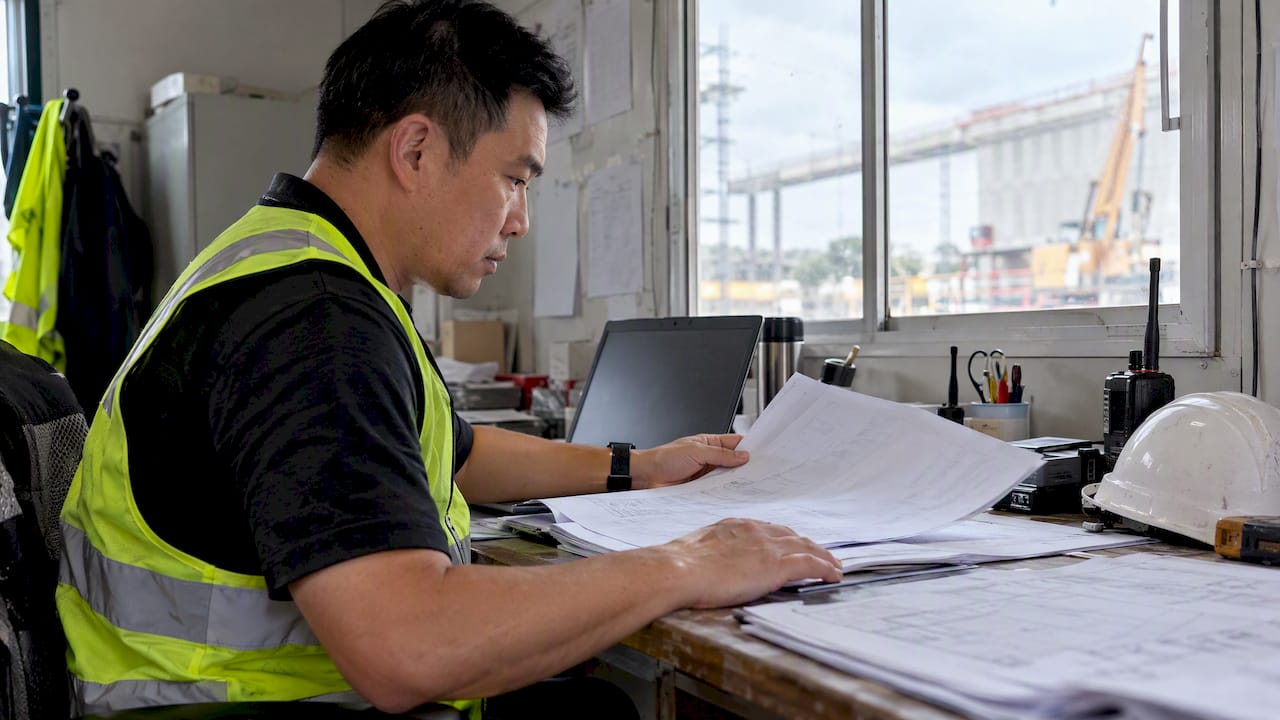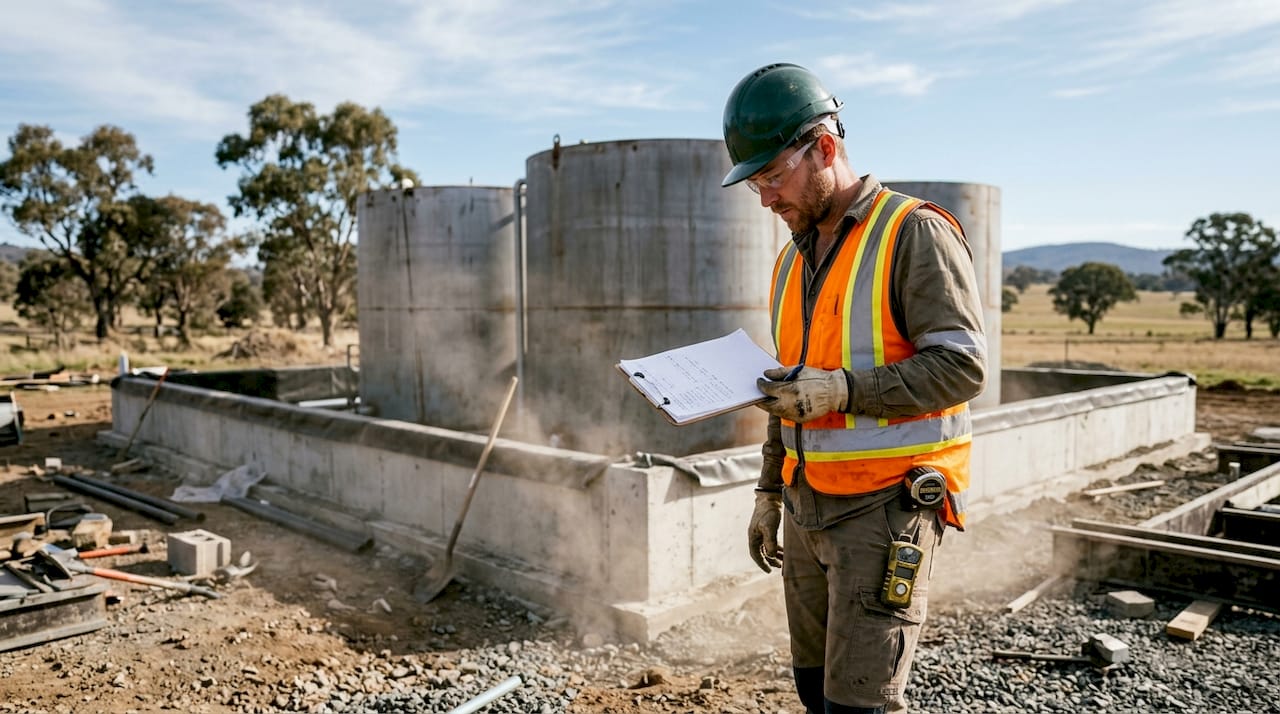
Environmental risk mitigation is the systematic application of controls to prevent or minimize environmental harm during construction operations. Regulatory bodies including the EPA and OSHA require proactive hazard controls on every active site, and the stakes are high. Engineering controls combined with staff training reduce environmental incidents by 50–75%. That figure alone makes the case for treating environmental risk mitigation tips not as a compliance checklist but as a core operational discipline. Construction professionals and environmental safety officers who embed these controls into daily workflows gain a measurable edge in safety performance, regulatory standing, and project cost control.
1. Identify every environmental risk and assign clear ownership
Risk identification is the foundation of any credible environmental management program. Environmental risks often start as unnoticed small inefficiencies or leaks that escalate if not managed early. Conduct a formal environmental risk assessment before mobilization, covering soil contamination, stormwater runoff, hazardous material storage, noise, and dust. Assign a named responsible person to each identified risk. Without named ownership, corrective action stalls.
2. Eliminate or substitute hazardous chemicals wherever possible
Substitution sits at the top of the hazard control hierarchy for a reason. Replacing a solvent-based primer with a water-based alternative removes the contamination pathway entirely. Review your site’s chemical register quarterly and challenge every hazardous substance on it. Ask whether a less toxic alternative exists that meets the same technical specification. Elimination and substitution cost nothing compared to a spill remediation event.
3. Install secondary containment sized to the correct standard
Secondary containment is the most critical physical barrier between a fuel or chemical spill and the surrounding environment. Bunding must be sized to hold the volume of the largest storage tank plus 25% freeboard to account for precipitation. This requirement is frequently underestimated on construction sites, where temporary fuel tanks are set up quickly without proper bund design. Double-walled tanks and impermeable liners provide additional protection for high-volume storage. Get the sizing right before the tank arrives on site, not after the first inspection.
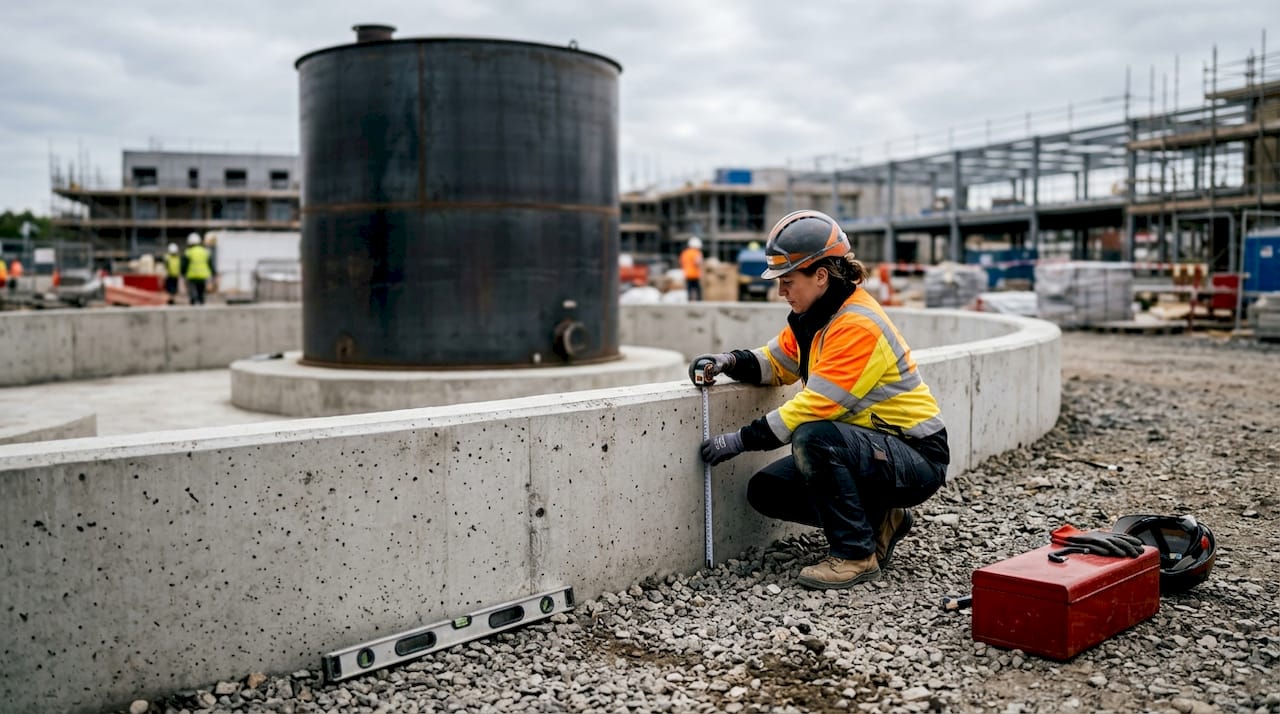
Pro Tip: Photograph every bund installation with a measuring tape visible in the frame. That image becomes your compliance evidence if an inspector questions the sizing.
4. Deploy continuous monitoring and leak detection systems
Sensors and telemetry convert passive containment into an active detection system. Level sensors on fuel tanks, flow meters on drainage outlets, and remote monitoring platforms alert site managers to anomalies before they become reportable incidents. Industry best practice targets a 95% inspection completion rate for high-risk assets. That standard is achievable only when monitoring is systematic and logged. Manual walk-arounds alone cannot sustain that rate across a large site.
5. Position spill kits strategically and train every worker on their use
A spill kit stored in a locked site office is functionally useless. Place kits within 10 meters of every fuel storage point, chemical mixing area, and plant wash-down bay. Each kit should contain absorbent booms, drain covers, and disposal bags appropriate for the substances stored nearby. Training every worker, not just the environmental officer, on spill kit deployment is non-negotiable. The person who witnesses a spill is rarely the environmental officer.
6. Implement stormwater best management practices
Stormwater runoff carries sediment, fuel residues, and concrete washout off site and into waterways. Silt fences, sediment traps, and designated concrete washout areas are the standard best management practices (BMPs) for construction stormwater control. Inspect these controls after every significant rainfall event and repair any breaches within 24 hours. Pre-construction planning that integrates stormwater controls into the site layout prevents the most common compliance failures. A well-designed drainage plan costs far less than a regulatory notice of violation.
7. Apply administrative controls and update standard operating procedures
Engineering controls reduce exposure; administrative controls govern behavior. Standard operating procedures (SOPs) for fuel handling, chemical storage, waste disposal, and plant maintenance must be written, current, and accessible to all site personnel. Review SOPs whenever a new substance or process is introduced. Post laminated quick-reference cards at the point of use rather than filing the full SOP in a binder no one reads. Behavioral compliance rises when instructions are visible and specific.
8. Conduct quarterly staff training and emergency drills
Quarterly staff training refreshers and drills improve preparedness and build a safety culture that outlasts any single project. Training should cover spill response, waste segregation, chemical handling, and the site’s emergency response plan. Document every session with attendance records and a brief competency check. Link training completion to site access authorization so there is a structural incentive to participate. EHS training programs that combine classroom instruction with on-site practical exercises produce the strongest retention.
Pro Tip: Run an unannounced spill drill once per quarter. The gap between a planned drill and an unannounced one reveals exactly where your response procedure breaks down.
9. Conduct voluntary environmental audits before regulators arrive
Voluntary audits are the single most effective tool for identifying compliance gaps before they attract enforcement action. Voluntary environmental audits allow companies to identify compliance gaps proactively and reduce penalties by enabling timely corrective action. Schedule an internal audit at least twice per year and a third-party audit annually. Use the environmental audit process to benchmark your site against current regulatory requirements. Audit findings should feed directly into your corrective action register, not sit in a report that no one acts on.
Voluntary audit results and corrective plans require careful review with legal counsel to preserve audit privilege and minimize liability exposure. This step is frequently skipped on construction sites where legal support is seen as a project management overhead. Skipping it can turn a self-identified gap into an admission of violation. Treat the legal review as a standard part of the audit close-out process.
“Voluntary audits empower companies to control the timing of corrective action, improving outcomes and reducing regulatory penalties. The company that finds and fixes its own problems first is in a fundamentally stronger position than one that waits for an inspector to find them.”
10. Maintain rigorous documentation and prepare for inspections year-round
Well-organized documentation prepared year-round is the most reliable way to minimize issues during environmental inspections. Inspectors form rapid judgments about a site’s compliance culture based on whether records are current, organized, and accessible. Maintain a live compliance register that tracks permit conditions, monitoring results, training records, and corrective actions. During an inspection, accompany the inspector at all times, answer questions factually, and request a closing conference to clarify any preliminary findings. Avoid volunteering information beyond what is directly requested.
Pro Tip: Assign one person as the inspection coordinator before any regulatory visit. That person controls the pace, takes notes, and ensures no team member makes an off-the-cuff statement that contradicts your documented records.
11. Align insurance coverage with your assessed maximum probable loss
Insurance is the financial backstop when controls fail. Insurance policies aligned with Maximum Probable Loss (MPL) lower premiums when documented mitigation measures are in place. Calculate your MPL based on the worst-case spill scenario for your site, including cleanup costs, third-party liability, and regulatory fines. Share your risk mitigation documentation with your insurer. Documented controls demonstrably reduce your risk profile and can translate directly into premium reductions.
How engineering controls reduce environmental hazards on construction sites
Engineering controls are physical modifications to equipment, processes, or the work environment that reduce or eliminate exposure to environmental hazards. On construction sites, the primary examples are secondary containment bunding, double-walled fuel tanks, level sensors, and closed-loop plant wash-down systems. These controls work independently of human behavior, which makes them more reliable than procedural measures alone.
The financial case for engineering controls is direct. Preventive measures reduce cleanup costs by up to 40% compared to reactive remediation. A bund that costs $2,000 to install can prevent a fuel spill remediation event that costs $80,000 or more. Telemetry and remote monitoring extend the reach of engineering controls by providing real-time data on tank levels, drainage flows, and containment integrity. Sites that integrate sensor data into a central dashboard achieve the 95% inspection completion rate that industry best practice requires.
The construction environmental hazards most commonly addressed by engineering controls include fuel and oil storage, concrete washout, and sediment-laden stormwater. Each of these pathways has a well-established engineering solution. The gap on most sites is not knowledge of the solution but consistent implementation and maintenance of the control once installed.
What role does staff training play in reducing environmental incidents?
Training is the mechanism that converts written procedures into practiced behavior. A site where workers understand why a procedure exists, not just what it requires, produces far fewer environmental incidents than one where compliance is treated as a paperwork exercise. Environmental risks manifest gradually, making ongoing training crucial to prevent escalation from minor leaks to reportable incidents.
Effective training programs for construction sites include:
- Induction training covering site-specific environmental risks and emergency contacts before any worker begins on site
- Task-specific instruction for workers handling fuels, chemicals, or operating plant near waterways
- Quarterly refresher sessions that update workers on any changes to SOPs or permit conditions
- Documented competency checks that verify understanding rather than just attendance
- Emergency drills that simulate spill scenarios and test the full response chain
Training documentation also carries direct financial value. Insurers and regulators both treat evidence of systematic training as a mitigating factor when assessing penalties or premiums. Reducing site incidents through training is one of the highest-return investments available to a construction firm operating under environmental permit conditions.
Why voluntary environmental audits are critical for construction firms
A voluntary audit is a structured, self-initiated review of a site’s compliance status against applicable environmental regulations and permit conditions. The strategic advantage of a voluntary audit is control. Voluntary audits empower companies to control corrective action timing, improving outcomes and reducing regulatory penalties compared to reactive responses to enforcement actions.
Audit findings should be prioritized by risk level and assigned to named owners with fixed completion dates. Corrective actions that address permit conditions or discharge standards take priority over administrative gaps. Linking audit results to your site’s sustainability and ESG reporting also strengthens your position with clients and investors who require evidence of environmental performance. A construction environmental audit conducted by a qualified third party carries more weight with regulators than an internal review alone.
Audit frequency should reflect site risk. High-risk sites with fuel storage, chemical use, or proximity to waterways warrant audits every six months. Lower-risk sites can operate on an annual cycle. The key is that audit results drive action, not just documentation.
Key Takeaways
The most effective approach to environmental risk mitigation on construction sites combines engineering controls, systematic training, and proactive audits to reduce incidents by up to 75% and cut remediation costs by up to 40%.
| Point | Details |
|---|---|
| Engineering controls are the first line of defense | Size secondary containment to 125% of the largest tank volume and install level sensors on all high-risk assets. |
| Voluntary audits prevent enforcement action | Schedule internal audits twice yearly and third-party audits annually; review findings with legal counsel. |
| Training must be documented and drilled | Quarterly refreshers and unannounced spill drills build the behavioral competency that procedures alone cannot. |
| Documentation is a compliance asset | Maintain a live compliance register year-round so inspection readiness is a permanent state, not a scramble. |
| Insurance alignment reduces financial exposure | Calculate your Maximum Probable Loss and share mitigation evidence with your insurer to reduce premiums. |
What I’ve learned from embedding environmental risk mitigation into daily site operations
The sites that perform best on environmental compliance are not the ones with the longest procedures manuals. They are the ones where risk mitigation is woven into the daily rhythm of work. The morning toolbox talk includes a 90-second check on bund integrity and spill kit locations. The plant operator knows the drain cover goes down before the engine starts. That level of integration does not happen from a policy document. It happens from consistent leadership and repeated practice.
The most common failure I observe is the gap between audit findings and corrective action. A site will conduct a thorough audit, produce a detailed report, and then allow the corrective action register to sit unreviewed for three months. The audit becomes a compliance theater exercise rather than a genuine improvement mechanism. The fix is structural: assign a named owner and a fixed deadline to every finding before the audit report is finalized.
Technology has changed the calculus on monitoring. Remote telemetry and sensor-based leak detection now cost a fraction of what they did five years ago. Sites that still rely entirely on manual walk-arounds are accepting a level of detection risk that is no longer necessary or defensible. The investment in a basic sensor network pays back in the first incident it prevents.
Proactive communication with regulators is underused. Agencies respond better to a site that self-reports a minor incident and presents a corrective action plan than to one that waits for the inspector to find it. That posture builds the kind of regulatory relationship that produces more reasonable outcomes when something does go wrong.
— Aman
How professional consultancy supports construction environmental compliance
Construction firms that treat environmental compliance as a periodic task rather than a continuous system consistently face higher incident rates and regulatory exposure. Com’s consultancy and audit services are built specifically for the construction sector, covering environmental risk planning, permit compliance, and workforce training programs aligned with BizSAFE and ISO standards.

Com’s safety consultancy for Singapore construction covers the full spectrum of environmental risk controls, from initial site assessment through to inspection readiness. For firms that need structured evidence of compliance performance, Com’s safety audit services identify gaps before regulators do and produce corrective action plans that hold up under scrutiny. Contact Com to discuss how a structured environmental risk program can reduce your site’s exposure and strengthen your compliance position.
FAQ
What are the most effective environmental risk mitigation tips for construction sites?
The most effective measures are secondary containment sized to 125% of tank volume, continuous leak detection sensors, quarterly staff training, and voluntary compliance audits. Combined, engineering controls and training reduce environmental incidents by 50–75%.
How often should construction sites conduct environmental audits?
High-risk sites with fuel storage or proximity to waterways should conduct internal audits every six months and third-party audits annually. Lower-risk sites can operate on an annual audit cycle.
What is secondary containment bunding and why does sizing matter?
Secondary containment bunding is an impermeable barrier around storage tanks that captures spills before they reach the environment. It must hold the volume of the largest tank plus 25% freeboard to account for rainfall accumulation during storm events.
How does documentation reduce risk during environmental inspections?
Year-round documentation gives inspectors immediate evidence of compliance and reduces the likelihood of misunderstandings or violations. Organized records signal a functioning compliance system, which influences how inspectors assess and report findings.
Can voluntary environmental audits reduce regulatory penalties?
Yes. Voluntary audits allow firms to identify and correct compliance gaps before enforcement action begins. Corrective plans reviewed with legal counsel preserve audit privilege and position the firm as a proactive compliance actor, which regulators treat as a mitigating factor in penalty assessments.