
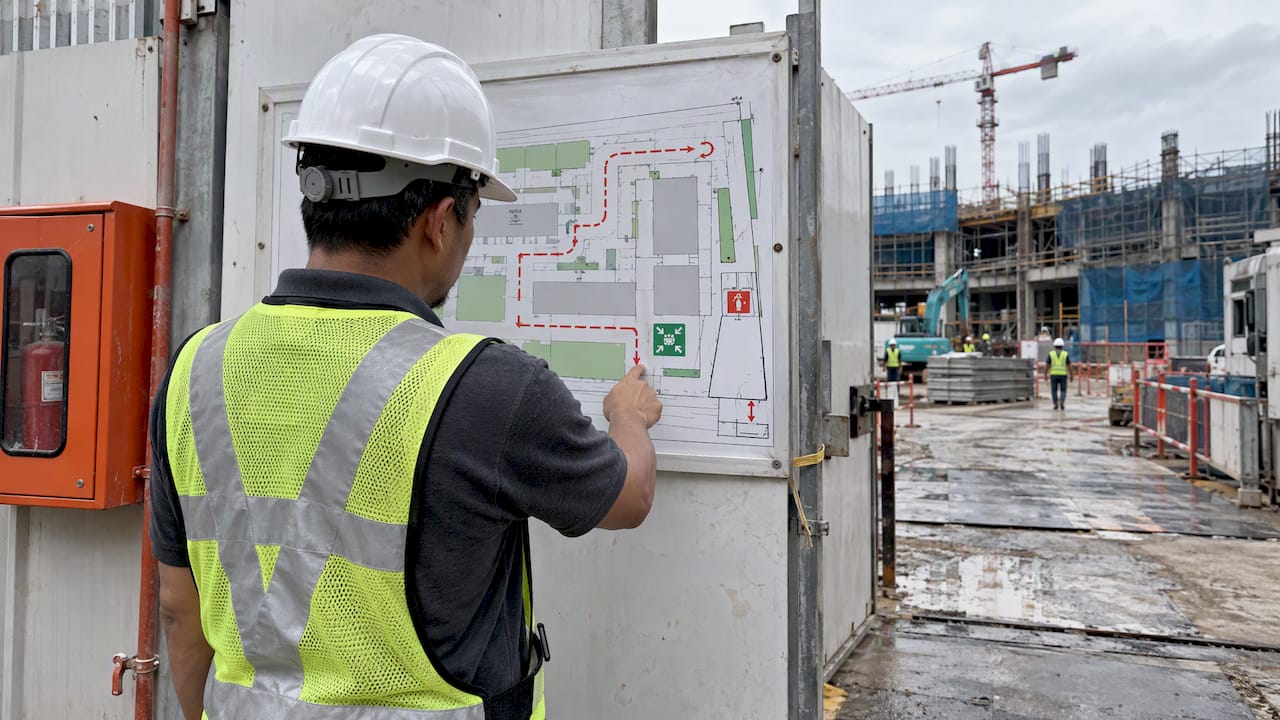
An emergency response plan (ERP) in Singapore is a written set of procedures that fixes who does what, who is warned, how people leave and who is told when a fire, medical incident, gas leak or chemical release occurs. The duty rests on the employer under the Workplace Safety and Health Act 2006, which requires procedures for dealing with emergencies at work and adequate instruction, information, training and supervision for workers. For construction sites, the Singapore Civil Defence Force (SCDF) evacuation guidelines and, on public infrastructure projects, Land Transport Authority (LTA) conditions give that duty its practical shape.
This guide sets out what the plan must contain, how roles are assigned, how evacuation and notification work, and how drills and reviews keep the document credible.
TL;DR
- The employer must have and implement emergency procedures and train workers in them; the plan is a statutory expectation, not optional paperwork.
- A sound plan assigns named roles, shows the assembly point on a site plan, lists contacts, and records drills and floor registers.
- On LTA projects, the plan is prepared with SCDF, accepted by the Engineer before work begins, updated at least quarterly, and must allow evacuation of all personnel within 10 minutes.
- Fire is only one scenario: chemical spills, pollution and infectious disease belong in the same plan and in the same risk management process.
- Risk assessments and safe work procedures are reviewed at least every three years, and immediately after an accident or a significant change in work processes.
Table of Contents
- What an emergency response plan is, and who is bound by it
- Fire first: the SCDF industrial premises framework
- A working structure for a construction site plan
- Identifying emergencies before assigning roles
- Warning, evacuating and accounting for people
- Who must be notified
- Drills, training and review
- Technology and the plan
- Common weaknesses we see in site plans
- Our perspective
- How MOSAIC supports your plan
- FAQ
- Sources
What an emergency response plan is, and who is bound by it
The plan converts a general legal duty into a sequence that a worker can follow under stress. It answers five questions in advance: how an emergency is detected, how people are warned, where they go, who takes charge, and which outside agencies are told and by whom.
Two layers of obligation apply in practice.
- The statutory layer. The WSH Act places the duty to deal with emergencies on the employer. The WSH (Risk Management) Regulations add that safe work procedures must include measures to safeguard persons in an emergency, and that these measures must be communicated to the worker.
- The premises and contract layer. The SCDF publishes emergency response plan and evacuation guidelines, including a version for industrial premises. For construction projects under the LTA, the LTA construction safety requirements require the contractor to work with SCDF to establish an emergency preparedness plan, submit it to the Engineer for acceptance before any construction activity commences, and update it at least quarterly.
The practical consequence is that a site can be compliant with the general duty yet still be rejected at tender or mobilization stage if its plan does not meet the project’s contractual form. Contractors should read the project’s safety specification before drafting anything.
Our own guide to an emergency preparedness plan for construction sites in Singapore covers the site-level view in more detail.
Fire first: the SCDF industrial premises framework
Fire remains the scenario around which most Singapore plans are built, because the SCDF guidelines for industrial premises supply a ready structure. Two features matter most.
The Fire Safety Committee and its roles
The SCDF industrial premises guideline describes a Fire Safety Committee made up of the Fire Safety Manager (FSM) or Assistant FSM, the Chief Security Officer, Fire Wardens or Assistant Fire Wardens, and the Company Emergency Response Team (CERT). The FSM prepares and enforces the plan, and wardens report the evacuation status of their areas.
On a construction site the titles may differ from those of a completed building, but the logic transfers: one accountable person for the plan, area-level wardens who know their zones, and a trained response group. The point is that every role has a named holder and a named alternate, so that a shift change or leave does not leave a gap.
What the written plan should hold
According to the same guideline, a written plan should:
- establish emergency responsibilities for the individuals who handle an incident;
- identify the assembly point on a site plan;
- list the Fire Safety Committee contacts;
- include evacuation-drill records and floor registers.
Personnel are also expected to know the escape routes and the location and use of firefighting equipment. A plan that lives in a folder in the site office, while workers have never seen the escape route drawing, satisfies none of these expectations.
A working structure for a construction site plan
The table below shows a structure that reflects the sources above. It is a working outline, not a prescribed form; project conditions and the Engineer’s requirements govern the final content.
| Section | What it contains | Basis |
|---|---|---|
| Scope and hazards | Site description, activities, foreseeable emergencies | WSH Risk Management Regulations |
| Organization | Plan owner, wardens, response team, alternates | SCDF industrial premises guideline |
| Alarm and warning | Alarm signals, who sounds them, how visitors are warned | SCDF industrial premises guideline |
| Evacuation | Routes, assembly points on a site plan, roll call method | SCDF; LTA 10-minute limit on LTA projects |
| Notification | SCDF and other agencies, internal escalation | SCDF; Fire Safety Act |
| Other emergencies | Medical, chemical, pollution, infectious disease | LTA requirements |
| Training and drills | Schedule, attendance, records | SCDF; LTA |
| Review | Triggers and intervals for revision | WSH Risk Management Regulations |
Identifying emergencies before assigning roles
Roles cannot be assigned sensibly until the site has said which emergencies it expects. The WSH framework treats this as part of risk management: risk management involves assessing, controlling and monitoring risks and communicating them. The emergency plan is therefore the last line of a chain that begins with the risk assessment, not a separate exercise.
For a typical building or civil project, the scenario list will include:
- fire in temporary structures, hot-work areas, fuel and material stores;
- serious injury, collapse or a person trapped, including in confined spaces and excavations;
- gas leak or release of a hazardous substance;
- chemical spill and environmental pollution;
- outbreak of infectious disease among the workforce.
The LTA requirements expect plans to account for site-specific hazards such as chemical spills, environmental pollution and infectious disease, in addition to fire safety, and to integrate these procedures into the overall risk management of the site and review them regularly. A plan that covers only fire is incomplete on an LTA project, and is thin on any other site with a different dominant hazard.
Warning, evacuating and accounting for people
Alarm and movement
Under the SCDF guideline, workers and visitors are warned by fire alarm signals, which sound as continuous ringing. On hearing the alarm, occupants evacuate by the nearest exit or designated stairs, do not use lifts, and proceed to the assembly area. Wardens then conduct floor-level roll calls so that everyone is accounted for.
On a construction site, three adaptations deserve attention:
- Audible coverage. A signal that cannot be heard over plant and machinery, or on a remote deck or basement level, is not a warning. Test coverage at the noisiest time of day.
- Temporary egress. Stairs, hoists and ramps change as the structure rises. The route drawing must be revised whenever the route changes, which is one reason the LTA requires quarterly updates.
- Visitors and subcontractors. Induction should show every person the alarm sound and the assembly point before they enter, and the register should capture them.
The 10-minute limit on LTA projects
The LTA requirement states that evacuation time for all workers and personnel from their work areas on a construction site must not exceed 10 minutes. That figure is a design and drill target. A site with a deep excavation, a high-rise core or a large workforce on night shift should time its drills against it and adjust routes, signals or warden numbers when it is exceeded.
Roll call and records
The floor register is the instrument that makes roll call reliable. A register that is updated daily, including subcontractor and visitor entries, allows the warden to report a count rather than a guess. The drill record then captures what the SCDF form requires, which is covered below.

Who must be notified
The SCDF guideline is explicit on the point that often fails in practice: the FSM must ensure that SCDF is notified of a fire, and where a Fire Command Centre (FCC) exists, the FCC operator must immediately notify SCDF of a fire alarm activation. The plan should therefore state who calls, from where, and what they say, rather than assume someone will.
The legal backdrop is the Fire Safety Act 1993, which empowers the SCDF Commissioner to enter and take control of premises in the event of a fire or suspected fire, including directing operations, shutting off utilities and closing nearby streets. The plan should therefore designate a person to meet the first SCDF responders, hand over the site plan and the register, and brief them on hazards such as fuel stores, gas cylinders and unprotected openings.
For non-fire incidents, internal escalation and external notification follow the type of event. The LTA projects add the Engineer and the project’s own reporting chain. Where a workplace safety and health violation or lapse is observed, MOM asks that it be reported. Keep a contact sheet that distinguishes each of these audiences, and test the numbers during drills.

Drills, training and review
Training and drills
Employers must train workers in emergency procedures and document the outcomes. The LTA requirements describe regular drills at intervals from quarterly to yearly depending on the governing regulation. SCDF also sets minimum annual numbers of evacuation drills, and of table-top exercises for premises that require an ERP; confirm the current minimums on the SCDF emergency response plan pages for your premises category.
Table-top exercises deserve more credit than they receive. They test decisions, such as who calls SCDF, who closes the gate, who speaks to the Engineer, without stopping work. They suit scenarios that are impractical to stage physically, such as a chemical release or a crane incident.
Drill records
The SCDF guideline requires the FSM to record each evacuation drill on the prescribed form and keep it for verification. The form records the date, drill time, participants and the time taken to evacuate. Keep these with the plan, because an auditor will ask for them first.
Review triggers
Risk assessments and the safe work procedures that flow from them must be reviewed at least once every three years, or immediately after an accident or a significant change in work processes, as the WSH Risk Management Regulations provide. On LTA projects the emergency preparedness plan itself is updated at least quarterly. In both cases, treat these as outer limits. A change in excavation stage, a new hot-work activity or a near miss is a reason to revisit the plan now.
Technology and the plan
Digital tools can make the register, the drill log and the contact list easier to keep current, particularly on multi-contractor sites. Some teams adopt workplace safety software for construction to centralize incident reporting, training records and compliance monitoring. Whatever the tool, it supports the plan; it does not replace the assigned roles, the drills or the accepted document.
MOM has urged the industry toward safety technologies and design for safety in its 2024 WSH Leadership Forum address, and has encouraged developers to use procurement to reward contractors with strong WSH performance. For contractors, a well-drilled, current emergency plan is visible evidence of that performance. Our article on video analytics and AI surveillance for worksite safety looks at this area further.
Common weaknesses we see in site plans
The following failings recur and are all avoidable.
- Generic text. A plan copied from another project, naming the wrong assembly point or a former project manager.
- No alternates. Roles held by one individual with no deputy.
- Fire only. No procedure for medical emergencies, spills or infectious disease.
- Stale drawings. Escape routes that no longer match the structure.
- Unrecorded drills. Drills held but no form, no timing, no attendance list.
- Unrehearsed notification. No one has practiced the call to SCDF or the hand-over to responders.
A periodic WSH audit and inspection usually surfaces these before an external inspector does. For the audit categories a site may face, see our overview of construction safety audit types.
Our perspective
We regard the emergency response plan as the point at which a safety management system is tested against reality. Risk assessments, safe work procedures and training all feed it, and a weakness anywhere upstream shows up here first. In our experience across more than 20 years of consultancy in the construction sector, the plans that perform are the ones whose owners treat them as operating documents: revised when the site changes, drilled with the people who will actually be present, and linked to the project’s risk register.
We also hold that the best protection is upstream. Design for Safety decisions on access, temporary works, material storage and egress reduce the number of emergencies the plan will ever be asked to handle, and make the remaining ones easier to manage. A contractor that engages the designer, the developer and the safety team early produces a plan that is shorter, more specific and more credible to the Engineer and to SCDF. Our Design for Safety in Singapore article explains how that integration works.
— Aman
How MOSAIC supports your plan
MOSAIC Eco-construction Solutions provides Quality, Environment and Safety consultancy and training for the construction sector. For emergency planning, the relevant work is drafting and documenting site procedures through EHS advisory and documentation, testing them through audit and inspection, and training the people who will carry them out. Our consultants can also support wider certification and compliance work, including BizSAFE and ISO, so that the emergency plan sits within a coherent management system. Service pricing is scoped to each engagement, so please contact us with your project details.

To discuss a plan for your site, a review of an existing one, or a drill programme, contact our consultancy team.
FAQ
Is an emergency response plan mandatory in Singapore?
The WSH Act requires employers to have procedures for dealing with emergencies at work and to train workers in them. Premises designated by SCDF have additional ERP requirements, and LTA construction contracts require an emergency preparedness plan. Check which of these apply to your project and premises category.
How often should a construction site update its plan?
On LTA projects, the emergency preparedness plan must be updated at least quarterly. Under the WSH Risk Management Regulations, risk assessments and safe work procedures are reviewed at least every three years, and immediately after an accident or a significant change in work processes. A change in site layout or activity is a sound reason to update sooner.
How long should an evacuation take?
The LTA requirement is that all workers and personnel on a construction site be able to leave their work areas within 10 minutes. Time your drills against this and record the result on the drill form, which captures the date, time, participants and time taken.
Who must call SCDF in a fire?
Under the SCDF industrial premises guideline, the Fire Safety Manager must ensure SCDF is notified, and an FCC operator, where one exists, must notify SCDF immediately on a fire-alarm activation. Your plan should name the person and the backup, and the call should be rehearsed.
Sources
- Workplace Safety and Health Act 2006, Singapore Statutes Online
- LTA Construction Safety requirements, GS Appendix A (June 2022)
- SCDF ERP Evacuation Guidelines, industrial premises
- MOM Guide to the WSH (Risk Management) Regulations
- Fire Safety Act 1993, Singapore Statutes Online
- MOM: WSH Act responsibilities of stakeholders
- MOM: Speech at the WSH Leadership Forum 2024
- Workplace safety software for construction teams