

Construction site ergonomics is defined as the deliberate design of tasks, tools, and work environments to match the physical and cognitive capabilities of construction workers, thereby preventing musculoskeletal disorders (MSDs) and improving overall site safety. Anchored to frameworks including OSHA General Duty Clause 5(a)(1) and ISO 11228, this discipline addresses workspace layout, tool selection, posture management, and environmental conditions. For site managers, understanding what is construction site ergonomics is not an academic exercise. It is a statutory and operational obligation that directly determines injury rates, productivity, and workforce retention. The construction site safety tips you implement today shape the physical health of your workforce for years.
What is construction site ergonomics and why does it matter?
Construction site ergonomics is the applied science of fitting the job to the worker, not forcing the worker to adapt to poorly designed conditions. This distinction is the foundation of every effective ergonomics program. When tasks, tools, and environments are designed around human physical limits, injury rates fall and output rises.
MSDs, including back injuries, tendinitis, and carpal tunnel syndrome, represent the most prevalent occupational health burden in construction. These conditions develop gradually through repeated physical stress, not from a single dramatic incident. The cumulative nature of MSD development means that by the time a worker reports pain, significant tissue damage has often already occurred.

Regulatory frameworks make ergonomic compliance non-negotiable. OSHA’s General Duty Clause requires employers to provide a workplace free from recognized hazards, which courts and enforcement agencies have consistently applied to ergonomic risks. ISO 11228 provides international standards for manual handling load limits and posture requirements. Site managers who treat ergonomics as optional expose their organizations to enforcement action, civil liability, and preventable workforce attrition.
The business case is equally direct. Reduced injury claims lower workers’ compensation premiums. Healthier workers sustain higher productivity across longer shifts. Experienced workers who are not sidelined by chronic pain remain on site, preserving institutional knowledge that cannot be quickly replaced.
What are the common ergonomic risks on construction sites?
Construction sites generate a dense concentration of ergonomic hazards across every trade and phase of work. Recognizing these risks is the prerequisite for controlling them.
The primary physical hazards include:
- Repetitive motions: Hammering, screwing, troweling, and similar cyclic tasks load the same muscle groups continuously, accelerating tissue fatigue and MSD onset.
- Awkward postures: Overhead work, kneeling on hard surfaces, and sustained trunk flexion place joints and soft tissues under loads far exceeding their design tolerance.
- Manual material handling: Lifting, carrying, and lowering heavy loads without mechanical assistance generates compressive forces on the lumbar spine that accumulate across a career.
- Vibration exposure: Hand-arm vibration from power tools and whole-body vibration from heavy plant equipment damage nerves, blood vessels, and joints over time.
- Environmental conditions: Uneven floors, inadequate lighting, and improperly stored materials force compensatory postures that are frequently misattributed to worker carelessness rather than site design failures.
The environmental category deserves particular attention. Hidden site hazards such as uneven walking surfaces and poorly positioned material stacks are root causes of ergonomic injuries that site managers routinely overlook. A worker who twists awkwardly to reach a tool stored at ground level is not being careless. The storage location is the hazard.
Pro Tip: Conduct a walkthrough specifically for environmental ergonomic hazards at the start of each project phase. Use a jobsite walkthrough checklist to identify uneven surfaces, obstructed pathways, and poorly positioned material storage before work begins.
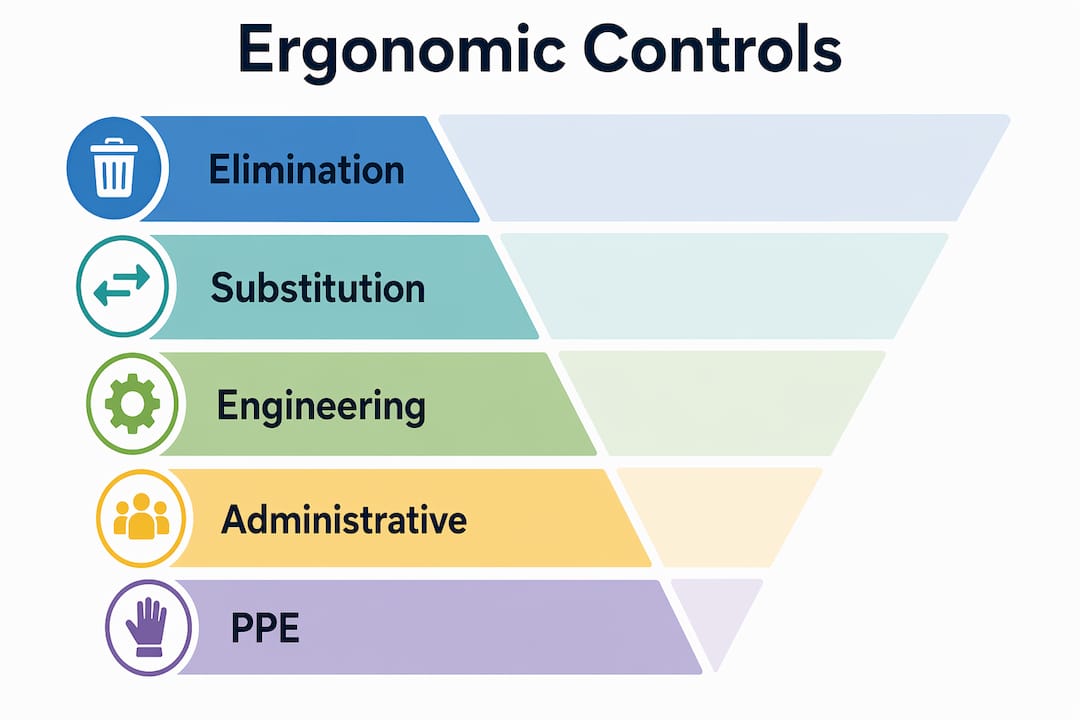
How does the hierarchy of ergonomic controls apply on construction sites?
The hierarchy of ergonomic controls provides a structured framework for reducing hazard exposure, ranked from most to least effective. Engineering controls deliver superior long-term injury reduction compared to administrative measures or personal protective equipment (PPE), and the hierarchy reflects this evidence.
The five levels applied to construction ergonomics are:
- Elimination: Remove the hazardous task entirely. Prefabricating components off-site eliminates repetitive overhead assembly on the job site.
- Engineering controls: Redesign the task or environment. Lift assists, adjustable scaffolding, and powered material handling equipment reduce manual load on workers without relying on behavioral change.
- Substitution: Replace a hazardous tool or process with a less harmful alternative. Lightweight composite tools substitute for heavier steel equivalents, reducing cumulative load on the upper extremities.
- Administrative controls: Modify work schedules and practices. Task rotation, micro-break scheduling every 30–60 minutes, and cross-training workers across different physical demands reduce localized muscle fatigue.
- PPE: Provide anti-vibration gloves, knee pads, and back support belts as a last resort. PPE does not eliminate the hazard. It only reduces exposure at the individual level.
| Control Level | Example in Construction | Effectiveness |
|---|---|---|
| Elimination | Off-site prefabrication of repetitive assemblies | Highest |
| Engineering | Powered lift assists, height-adjustable work platforms | High |
| Substitution | Lightweight composite tools replacing steel equivalents | High |
| Administrative | Task rotation, scheduled micro-breaks | Moderate |
| PPE | Anti-vibration gloves, knee pads, back belts | Lowest |
The critical error most sites make is defaulting to PPE and administrative controls because they are cheaper and faster to implement. This approach treats the symptom rather than the cause. Engineering controls require upfront investment but generate compounding returns through sustained injury reduction.
Pro Tip: When evaluating a new task or work sequence, apply the hazard identification process before selecting controls. Document your reasoning at each level of the hierarchy to demonstrate due diligence under OSHA and ISO standards.
What practical ergonomic strategies can site managers implement daily?
Daily ergonomic management does not require a dedicated ergonomist on every site. Site managers with structured protocols can implement high-impact improvements across four operational domains.
Workstation and task configuration:
- Adjust scaffold and work platform heights so primary tasks occur between hip and shoulder level, eliminating sustained trunk flexion and overhead reach.
- Position material storage at waist height wherever possible to reduce bending during retrieval.
- Select ergonomic tools for builders that incorporate pistol-grip handles, vibration dampening, and weight-balanced designs. These specifications reduce grip force requirements and upper extremity fatigue.
Lifting and body mechanics:
Proper lifting technique requires workers to use leg power, keep loads close to the body, and avoid combined trunk flexion and rotation. Training workers on body mechanics is a foundational daily safety practice, not a one-time induction item. Reinforce correct technique through toolbox talks and direct observation.
Environmental adjustments:
- Deploy anti-fatigue mats and improved lighting in areas where workers stand for extended periods on hard or uneven surfaces. These adjustments reduce lower limb fatigue and improve postural stability.
- Maintain clear, level walkways between material storage and work areas to prevent compensatory postures during transport.
Early symptom reporting and worker engagement:
Ergonomic injuries build gradually, and early triage prevents chronic disability. Establish a reporting culture where workers can flag discomfort without fear of being removed from work. Modified duty assignments allow symptomatic workers to remain productive while recovering. Sites that integrate daily ergonomic awareness into their culture consistently report higher productivity and lower turnover than those treating ergonomics as a periodic compliance exercise.
How to conduct ergonomic assessments and ensure compliance
Ergonomic assessments translate observable site conditions into quantitative risk data that supports both corrective action and regulatory defensibility. Validated tools including the NIOSH Lifting Equation, RULA, and REBA provide the structured methodology required for compliance under OSHA and ISO frameworks.
| Assessment Tool | Primary Application | Output |
|---|---|---|
| NIOSH Lifting Equation | Manual lifting tasks | Recommended Weight Limit and Lifting Index |
| RULA (Rapid Upper Limb Assessment) | Upper extremity posture analysis | Action level score (1–7) |
| REBA (Rapid Entire Body Assessment) | Whole-body posture for dynamic tasks | Risk level score (1–15) |
| Snook Tables | Push, pull, and carry task limits | Acceptable force limits by population percentile |
The assessment process follows four steps. First, observe and document all manual tasks, noting posture, load, frequency, and duration. Second, apply the appropriate validated tool to generate a quantitative risk score. Third, prioritize corrective actions based on risk level, applying the control hierarchy. Fourth, re-assess after implementing controls to verify risk reduction and document the improvement.
Compliance with the workplace safety management systems required under Singapore’s Workplace Safety and Health Act demands that ergonomic assessments be documented, dated, and linked to corrective action records. Regulators expect evidence of a systematic process, not anecdotal assurances. Posters and stretching programs alone do not constitute a defensible ergonomics program. An engineering-led program with quantitative assessment tools is the recognized standard.
Track injury metrics before and after interventions. MSD incident rates, lost-time injury frequency, and workers’ compensation costs are the primary indicators of program effectiveness. Quarterly reviews of these metrics allow site managers to identify deteriorating trends before they generate reportable incidents.
Key takeaways
Effective construction site ergonomics requires engineering-led controls, validated assessment tools, and a daily site culture that treats worker physical capacity as a managed resource, not an assumed constant.
| Point | Details |
|---|---|
| Define ergonomics correctly | Ergonomics fits the job to the worker, not the reverse, as anchored in OSHA and ISO 11228 standards. |
| Prioritize engineering controls | Lift assists and height-adjustable platforms deliver superior injury reduction compared to PPE or administrative measures. |
| Use validated assessment tools | Apply NIOSH Lifting Equation, RULA, and REBA to generate defensible, quantitative risk data for compliance. |
| Embed daily awareness | Sites with continuous ergonomic culture report higher productivity and lower turnover than those using one-off training. |
| Document everything | Regulatory defensibility under OSHA and Singapore’s WSH Act requires dated assessments linked to corrective action records. |
Why ergonomics culture outlasts any single training program
The most persistent mistake I observe across construction sites is treating ergonomics as an event rather than a system. A toolbox talk on lifting technique, delivered once at project mobilization, produces no measurable long-term change. Workers revert to habitual movement patterns within days, particularly under production pressure. The training happened. The culture did not.
What actually works is embedding ergonomic decision-making into the daily workflow at the supervisory level. When foremen conduct pre-task briefings that include a 90-second ergonomic scan, asking where the heavy lifts are, whether the work height is correct, and whether task rotation is scheduled, the practice becomes structural rather than aspirational. Workers begin to internalize the same questions.
The second underappreciated factor is worker involvement in hazard identification. Workers performing a task daily know its physical demands better than any consultant who observes it once. Sites that formally solicit worker input during ergonomic assessments consistently identify hazards that structured observation misses. This is not a soft management preference. It is a data quality issue. Better hazard data produces better controls.
The third factor is environmental vigilance. Uneven floors, obstructed pathways, and poorly positioned material storage are the ergonomic hazards most frequently attributed to worker error when they are, in fact, site management failures. A safety risk assessment workflow that includes environmental ergonomic checks at each phase transition catches these conditions before they generate injuries.
Ergonomics does not require a large budget. It requires disciplined attention applied consistently across every shift.
— Aman
How MOSAIC safety supports ergonomic compliance on your site

Com (MOSAIC Ecoconstruction Solutions) provides construction companies and site managers with the structured audit and compliance support needed to build defensible ergonomics programs aligned with Singapore’s Workplace Safety and Health Act, BizSAFE requirements, and ISO standards. Com’s safety audit services identify ergonomic risk exposures across manual handling, environmental conditions, and tool selection, then deliver prioritized corrective action plans grounded in validated assessment methodologies.
For site managers seeking to move beyond reactive injury management, Com’s safety audit services for Singapore construction provide the systematic, documented approach that regulators and insurers require. Ongoing consultancy support ensures that ergonomic controls remain effective as site conditions evolve across project phases.
FAQ
What is construction site ergonomics?
Construction site ergonomics is the science of designing tasks, tools, and work environments to match the physical and cognitive capabilities of construction workers. Its primary goal is preventing musculoskeletal disorders and improving safety, anchored to standards including OSHA General Duty Clause 5(a)(1) and ISO 11228.
What are the most common ergonomic injuries in construction?
Musculoskeletal disorders including back injuries, tendinitis, rotator cuff damage, and carpal tunnel syndrome are the most common ergonomic injuries in construction. These conditions develop gradually through repetitive motion, awkward postures, and manual material handling rather than from single traumatic events.
Which assessment tools are used for ergonomic risk evaluation?
The NIOSH Lifting Equation, RULA, REBA, and Snook Tables are the validated assessment tools used for quantitative ergonomic risk evaluation on construction sites. These tools generate defensible risk scores required for compliance under OSHA and ISO frameworks.
Why is PPE considered the least effective ergonomic control?
PPE reduces individual exposure to a hazard but does not eliminate the hazard itself, making it the least effective level in the control hierarchy. Engineering controls such as lift assists and adjustable work platforms address the source of the risk and deliver superior long-term injury reduction.
How often should ergonomic assessments be conducted on construction sites?
Ergonomic assessments should be conducted at project mobilization, at each major phase transition, and whenever a new task or significant change in work conditions is introduced. Quarterly reviews of MSD incident rates and lost-time injury data allow site managers to identify deteriorating trends before they generate reportable incidents.