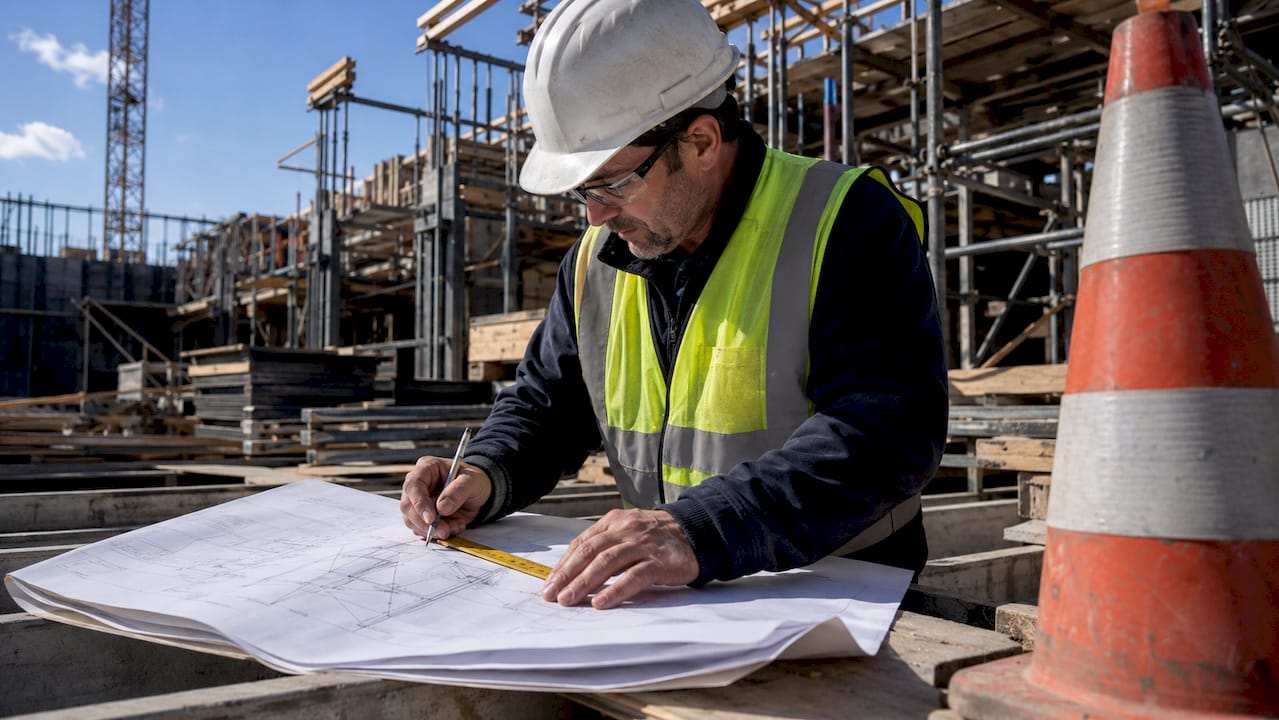
Temporary works safety refers to the engineered design, management, and operational controls implemented to keep temporary structures stable, compliant, and safe throughout every phase of a construction project. These controls protect workers, adjacent permanent structures, and the public from the catastrophic consequences of structural failure. Standards such as BS 5975:2024 and guidance from the Health and Safety Executive (HSE) define the statutory framework within which all temporary works must be designed, coordinated, and dismantled. Understanding this framework is not optional for construction professionals. It is a legal and professional obligation with direct consequences for project outcomes.
What are temporary works and why is their safety crucial?
Temporary works are engineered structures erected to support, protect, or provide access during construction, and removed once the permanent works are self-supporting. They are the enabling infrastructure of every major build, and their failure patterns are well-documented in HSE records. The category includes:
- Formwork and falsework: Molds and support systems for cast concrete, including props, frames, and decking
- Scaffolding: Access and working platforms for operatives at height
- Shoring and propping: Lateral support for excavations, existing walls, and partially demolished structures
- Cofferdams and sheet piling: Temporary earth and water retention for below-grade construction
- Temporary bridges and access roads: Load-bearing structures for plant movement across sites
Each category carries its own failure mode. Falsework collapses under premature or eccentric loading. Scaffolding fails when ties are removed without authorization. Shoring gives way when ground conditions change after installation. The interface between temporary and permanent structures is consistently identified as the most critical hazard zone, not the temporary structure in isolation.
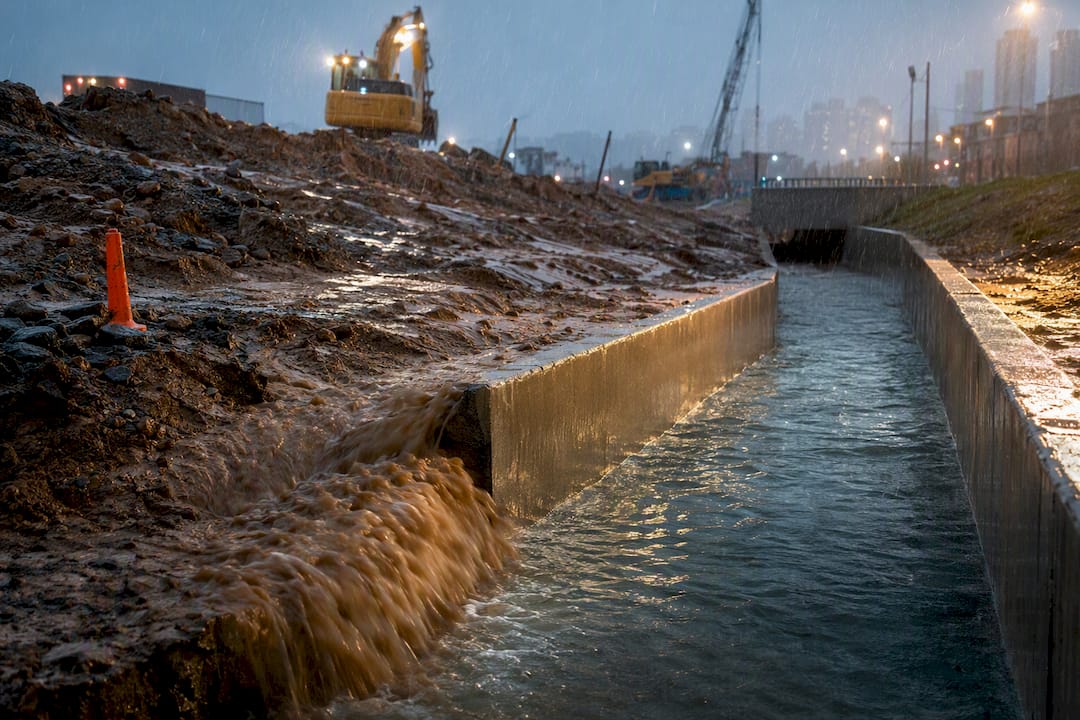
Environmental conditions compound every risk category. Wind loading, thermal movement, and soil saturation can destabilize a structure that met its design specification at the time of erection. Accident reports repeatedly highlight failures from unassessed environmental impacts after assembly, confirming that temporary works demand continuous monitoring, not a single sign-off at installation.
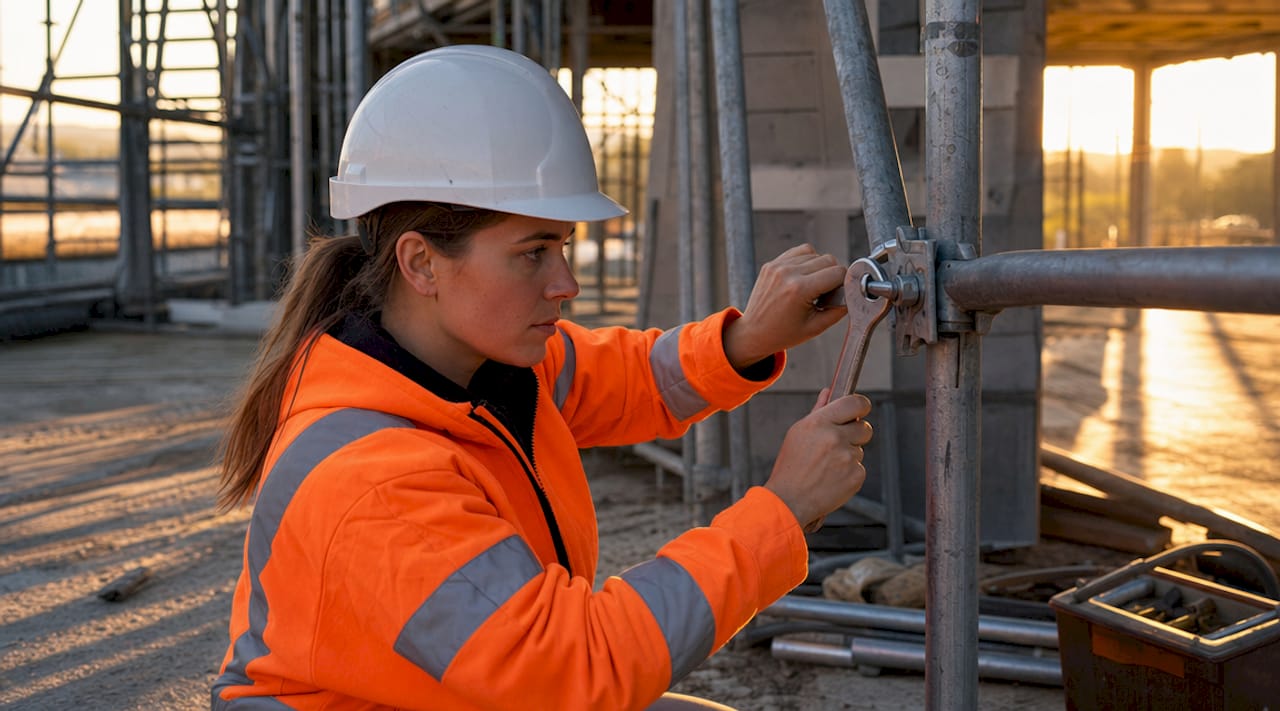
Pro Tip: Treat every temporary structure as a live engineering system. Assign a named responsible person to monitor it at defined intervals, particularly after significant weather events or adjacent excavation activity.
What regulatory frameworks and standards govern temporary works safety?
The primary regulatory instrument for temporary works in the UK and many Commonwealth jurisdictions is BS 5975:2024, which mandates a systematic management approach from design brief through to dismantling. The standard establishes four design check categories (0 through 3) based on complexity and consequence, and requires independent checking for Categories 2 and 3. It also mandates a live Temporary Works Register and formal permit-to-load and permit-to-dismantle processes before any critical phase proceeds.
The Temporary Works Coordinator (TWC) is the central accountability figure under BS 5975:2024. The TWC manages interfaces between contractors, coordinates design checks, maintains the register, and authorizes permits. Industry analyses credit TWCs with preventing costly errors and improving site safety culture. The role requires demonstrable competence, not merely appointment by title.
OSHA, in its May 2026 guidance, reinforces joint employer safety duties for host employers and staffing agencies, requiring site-specific training and PPE provision for all temporary workers regardless of contractual arrangement. This is directly relevant to temporary works, where agency-supplied labor is common on scaffolding, formwork, and groundworks crews.
The table below summarizes the key regulatory instruments and their primary requirements:
| Regulatory Instrument | Jurisdiction | Primary Requirement |
|---|---|---|
| BS 5975:2024 | UK / Commonwealth | TWC appointment, design categories, live register, formal permits |
| HSE Construction (Design and Management) Regulations | UK | Designer and principal contractor duties for temporary works |
| OSHA 29 CFR 1926 Subpart Q | USA | Concrete and masonry construction, formwork and shoring standards |
| OSHA Joint Employer Guidance (2026) | USA | Host employer training and PPE duties for temporary workers |
| MOM WSH Act (Singapore) | Singapore | Workplace safety obligations covering temporary structures on construction sites |
A company was fined £100,000 in April 2026 after a collapse caused by the absence of both a Temporary Works Coordinator and a formal design. This incident confirms that regulatory compliance is not a documentation exercise. It is the structural backbone of incident prevention.
What are the common hazards and risks in temporary works?
Catastrophic failures in temporary works rarely trace back to a single cause. Stacked failures are the norm: inadequate design briefs, unauthorized on-site modifications, missed inspection intervals, and adverse weather converging into a single collapse event. Each factor alone may be manageable. Combined, they overwhelm any residual safety margin.
The most frequently documented hazard categories include:
- Structural overload: Exceeding design loads through premature concrete pours, plant positioning, or material storage on falsework
- Unauthorized modification: Removing props, ties, or bracing without engineering authorization during construction or to accommodate other trades
- Ground movement: Settlement, heave, or softening beneath temporary structure foundations, particularly in excavation-adjacent zones
- Erection and dismantling errors: Incorrect assembly sequences, missing components, or out-of-plumb installation that compromises load paths
- Environmental destabilization: Wind, frost, thermal expansion, and flooding affecting structures designed for static conditions
“Dismantling temporary works is the most dangerous phase of the entire lifecycle. Schedule pressure drives operatives to remove supports before the permanent structure has achieved adequate strength, and the consequences are irreversible.” HSE accident data confirms that dismantling incidents frequently exceed those recorded during erection.
Communication breakdowns between trades represent an underappreciated hazard vector. When mechanical, electrical, and structural crews share a site without coordinated temporary works oversight, unauthorized alterations to scaffolding and propping systems occur routinely. The TWC’s role as a communication hub between contractors and permanent works designers is precisely what prevents these interactions from becoming incidents. Reviewing construction hazard examples from active sites reinforces how frequently these interface failures occur in practice.
What best practices and controls ensure effective temporary works safety?
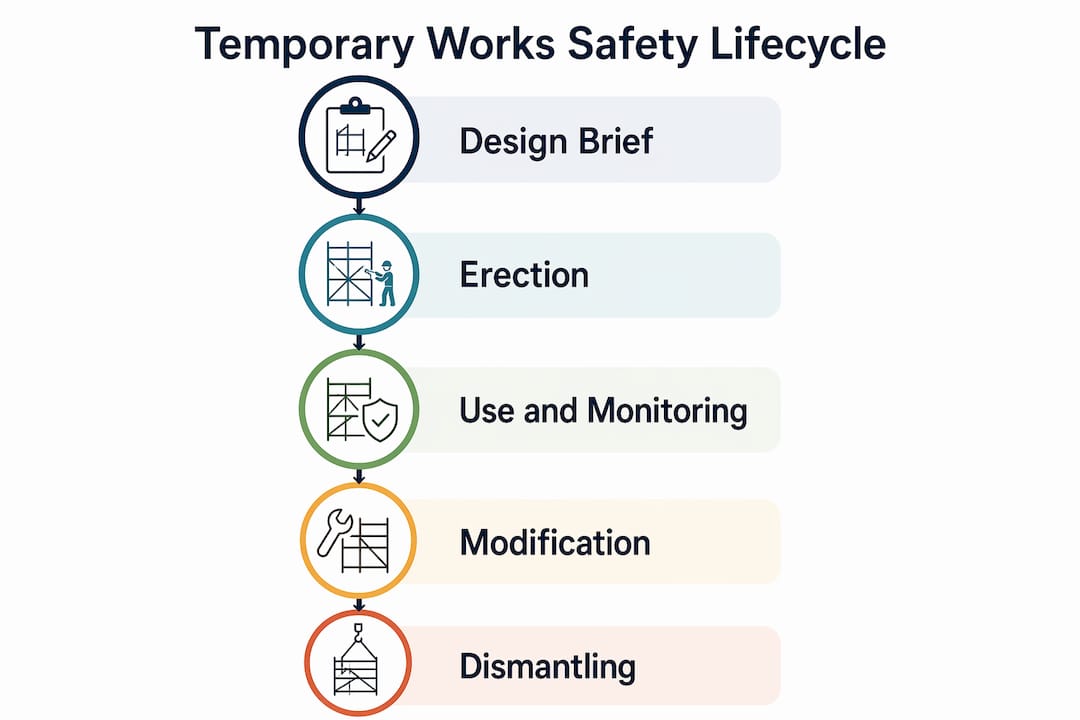
Effective temporary works safety management operates across the full lifecycle: design, erection, use, modification, and dismantling. Each phase requires distinct controls, and the failure to treat any phase as a formal engineering activity creates the conditions for incident.
The comparison below maps lifecycle phases against their minimum required controls:
| Lifecycle Phase | Minimum Required Control |
|---|---|
| Design brief | Written brief issued by TWC; scope, loads, and constraints defined |
| Design check | Independent check per BS 5975:2024 category (0 to 3) |
| Erection | Competent supervision; inspection against approved drawings |
| Permit to load | Formal TWC authorization before loading commences |
| In-use monitoring | Scheduled inspections; post-weather-event checks |
| Modification | Re-design and re-check before any change is implemented |
| Permit to dismantle | Formal TWC authorization; staged removal sequence specified |
The Temporary Works Register must function as a live control document, not a static filing system. Most control failures link back to register misuse or neglect, where entries are made at inception and never updated to reflect modifications, inspections, or changed site conditions. The register must track every design iteration, check certificate, permit, inspection record, and dismantling sign-off in real time.
Training is a non-negotiable control layer, particularly for temporary workers. Written agreements between host employers and staffing agencies on training scope, PPE provision, and incident reporting protocols are identified by safety authorities as the single most effective pre-start action for eliminating safety gaps in agency-supplied labor. Linking this to a structured training compliance program ensures that site-specific induction covers temporary works hazards explicitly, not just generic site rules.
Proper permit-to-work documentation formalizes the authorization chain for loading and dismantling, creating an auditable record that demonstrates due diligence and supports post-incident investigation when required.
Pro Tip: Treat dismantling as a separate engineered activity with its own design brief and permit. Never allow removal sequences to be determined informally on the day. The permanent structure must be verified as self-supporting before any temporary support is withdrawn.
Rigorous temporary works safety management also delivers measurable project efficiency gains. Project manager testimonials from 2026 consistently highlight that formal controls reduce delays caused by rework, structural remediation, and regulatory investigations. The upfront investment in coordination and design checking returns multiples in avoided incident costs and schedule recovery.
Key takeaways
Temporary works safety demands the same engineering rigor as permanent structures, governed by BS 5975:2024, HSE regulations, and OSHA guidance, with the Temporary Works Coordinator as the central accountability figure across every lifecycle phase.
| Point | Details |
|---|---|
| Define the TWC role formally | Appoint a competent Temporary Works Coordinator before design begins, not after erection starts. |
| Maintain a live register | Update the Temporary Works Register at every phase, from design brief through to dismantling sign-off. |
| Treat dismantling as high-risk | Issue a formal permit to dismantle and specify the removal sequence as an engineered activity. |
| Address joint employer duties | Establish written agreements with staffing agencies covering training, PPE, and reporting before work starts. |
| Audit environmental conditions | Conduct post-weather inspections and reassess design assumptions when site conditions change. |
Why the industry still underestimates temporary works risk
The April 2026 incident resulting in a £100,000 fine was not an anomaly. It was a predictable outcome of a pattern that repeats across construction sites where temporary works are treated as logistical tasks rather than engineering activities. Having worked with construction teams across multiple project types, the most consistent observation is that the TWC role is either absent, assigned to someone without adequate competence, or treated as a paperwork function rather than an active site management responsibility.
The cost argument against rigorous temporary works processes is also consistently overstated. The overhead of appointing a qualified TWC, maintaining a live register, and issuing formal permits is marginal relative to the cost of a single structural failure, regulatory investigation, or project shutdown. The efficiency gains from proper controls are real and documented. Teams that implement them report fewer delays, not more.
The dismantling phase deserves particular emphasis because it receives the least attention in pre-construction planning. Schedule pressure at project completion creates exactly the conditions where shortcuts are taken and permanent structure strength is assumed rather than verified. Treating removal as an afterthought is the single most preventable cause of late-stage temporary works incidents.
The path forward is straightforward: early TWC involvement, written joint employer agreements for agency labor, a genuinely live register, and a culture that treats every permit as a substantive engineering authorization rather than a bureaucratic formality. These are not aspirational standards. They are the minimum required by BS 5975:2024 and the baseline that separates compliant sites from those awaiting their next incident.
— Aman
Strengthen your temporary works safety program with expert support
Construction teams that recognize the complexity of temporary works safety compliance often benefit from structured external support to close competence gaps and formalize their management systems. Com provides specialist safety consultancy for construction that covers temporary works coordination frameworks, permit systems, and regulatory compliance aligned to current standards.

Com’s audit and certification support services help project teams assess their current temporary works processes against BS 5975:2024 and applicable local regulations, identify control gaps, and implement corrective measures before incidents occur. Whether your team needs a safety audit review to benchmark current practice or structured preparation for BizSAFE or ISO certification, Com delivers the technical depth and regulatory knowledge that construction professionals require. Contact Com to discuss a tailored temporary works safety assessment for your next project.
FAQ
What does temporary works safety mean in construction?
Temporary works safety refers to the engineered controls, management systems, and regulatory compliance measures applied to structures erected temporarily during construction to support, protect, or provide access for permanent works. It covers the full lifecycle from design brief through dismantling.
What is the role of a Temporary Works Coordinator?
The Temporary Works Coordinator (TWC) is the designated competent person responsible for managing all temporary works on a project, including overseeing design checks, maintaining the Temporary Works Register, and authorizing permits to load and dismantle under BS 5975:2024.
Why is dismantling the most dangerous phase of temporary works?
HSE records confirm that dismantling accidents frequently exceed erection-phase incidents because schedule pressure drives premature removal of supports before permanent structures achieve adequate load-bearing capacity. Formal, engineered dismantling permits are required to manage this risk.
What must a Temporary Works Register contain?
A Temporary Works Register must be a live document tracking design briefs, check certificates, permit-to-load authorizations, inspection records, modification approvals, and dismantling sign-offs. Register misuse or neglect is the most common root cause of control failures under BS 5975:2024.
Do host employers have safety duties for temporary workers on construction sites?
OSHA’s 2026 joint employer guidance confirms that host employers hold joint responsibility for temporary worker safety, including site-specific training and PPE provision, regardless of the contractual arrangement with the staffing agency.