Risk mitigation in construction is the deliberate process of reducing the likelihood and impact of identified hazards through structured planning, documented controls, and continuous monitoring. This guide to risk mitigation in construction delivers a standards-aligned framework that construction professionals and project managers can apply directly to live projects. Drawing on ISO 31000:2018, PMI PMBOK principles, and field-tested tools including risk registers, Construction Phase Plans, and structured hazard workshops, the following sections cover every stage of the process: from initial hazard identification through treatment, documentation, and ongoing review. The goal is a defensible, auditable mitigation program that satisfies regulatory requirements and protects workers.
What are the core risk mitigation strategies for construction projects?
Construction risk management recognizes five primary response strategies: avoidance, mitigation, transfer, acceptance, and exploitation. Understanding where each applies is the foundation of any credible mitigation program.
Avoidance eliminates the risk entirely by changing the project scope or method. Redesigning a foundation to avoid excavation near a live utility is avoidance. Mitigation reduces either the probability of occurrence or the severity of impact. Transfer shifts financial consequences to a third party through insurance or contractual clauses. Acceptance acknowledges a risk as tolerable within defined thresholds. Exploitation applies only to positive risks, such as accelerating a task to capture schedule float.
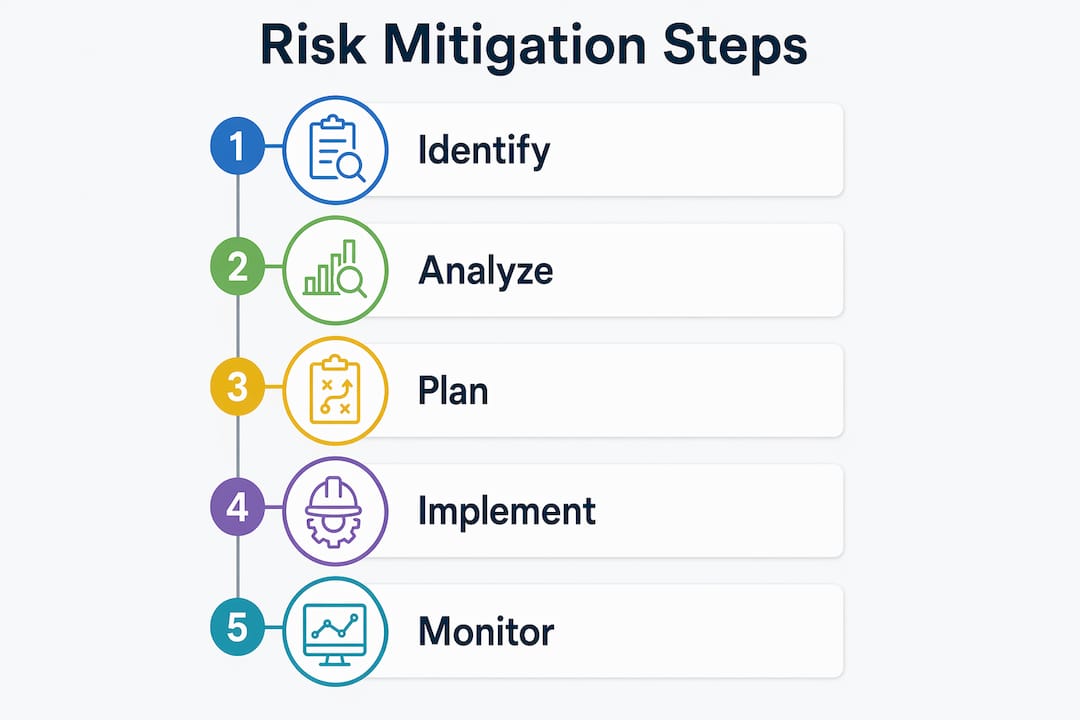
Mitigation is the most frequently applied strategy in construction because complete avoidance is often technically or commercially impractical, and pure acceptance is rarely defensible to regulators or clients. A practical risk-mitigation program follows an iterative cycle of identify, analyze, evaluate, treat, and review, adapting as construction progresses. This iterative model prevents the common failure of treating risk management as a one-time planning exercise.
Residual risk, the risk that remains after controls are applied, must be explicitly assessed and documented. If residual risk exceeds the project’s tolerance threshold, additional treatment is required before work proceeds.
| Strategy | Primary mechanism | Construction example | Key limitation |
|---|---|---|---|
| Avoidance | Eliminate the risk source | Redesign to remove confined space entry | May increase cost or scope |
| Mitigation | Reduce probability or impact | Install edge protection before work at height | Residual risk remains |
| Transfer | Shift financial consequence | Contractor all-risk insurance, AIA waiver clauses | Does not reduce physical hazard |
| acceptance | Tolerate within threshold | Minor weather delay contingency | Requires defined tolerance levels |
| Exploitation | Capture upside risk | Accelerate critical path task | Applies only to positive risks |
Pro Tip: When selecting a response strategy, document the rationale for rejecting higher-order controls. Auditors and regulators expect evidence that avoidance and engineering controls were genuinely evaluated before acceptance was chosen.
How to identify and analyze construction risks using modern assessment techniques
Structured hazard identification is the prerequisite for any effective mitigation plan. Without a systematic process, high-consequence risks remain invisible until they materialize as incidents.
The most widely used identification methods in construction are:
- HAZID (Hazard Identification): A structured workshop technique applied at the design or pre-construction stage to identify hazards by discipline or work package. Participants include designers, project managers, and safety advisors.
- HAZOP (Hazard and Operability Study): Applied to process-intensive construction activities such as temporary works or mechanical installations, examining deviations from design intent.
- Job Safety Analysis (JSA): A task-level technique that breaks each activity into steps, identifies hazards at each step, and assigns controls. JSA is the standard workface tool for method statement preparation.
- Bowtie Analysis: Reserved for critical or high-consequence hazards, bowtie diagrams map both prevention barriers (left of the event) and mitigation barriers (right of the event), providing a defensible control structure.
Stacking assessment methods by risk criticality ensures thorough coverage from design to workface, supporting defensible control claims. This means applying HAZID at the design stage, JSA at the task level, and bowtie analysis only where consequence severity justifies the additional rigor.
Qualitative risk analysis assigns likelihood and impact ratings, typically on a 3×3 or 5×5 matrix, to produce a risk score that drives prioritization. The output feeds directly into the risk register, which must record the hazard description, current controls, risk rating, risk owner, and review date. A risk register that lacks ownership and review cadence becomes an administrative artifact rather than a decision tool.
The hazard identification process should begin at the design stage, not at the pre-construction briefing. Early identification allows designers to eliminate or reduce hazards before they are locked into the construction method, which is the core principle of Design for Safety.
Pro Tip: Run HAZID workshops with a multidisciplinary team that includes the principal contractor, structural engineer, and a safety advisor. Single-discipline reviews consistently miss interface hazards, which are among the highest-consequence risks on complex projects.
What are the essential steps to develop and implement a risk mitigation plan?
A mitigation plan that specifies only vague intentions fails at the point of execution. Effective mitigation plans must specify actions, owners, timelines, and residual risk assessments to enable consistent decision-making and escalation. The following sequence translates risk analysis outputs into operational controls.
-
Select the control level. Apply the hierarchy of controls: elimination first, then substitution, engineering controls, administrative controls, and personal protective equipment (PPE) as the last resort. For fall protection, guardrails are an engineering control and are preferred over a fall arrest harness, which is PPE. Start with elimination and move down the hierarchy only when infeasibility is demonstrated, not assumed.
-
Assign ownership and timelines. Each mitigation action requires a named individual accountable for implementation and a completion date tied to the construction program. Unowned actions are never completed.
-
Estimate cost and resource requirements. Mitigation actions that lack budget allocation are routinely deferred under commercial pressure. Embedding control costs in the project budget at the planning stage prevents this.
-
Document in the Construction Phase Plan (CPP). The CPP must cover significant risks, site rules, welfare arrangements, and emergency procedures with named responsible individuals. In Great Britain, the CPP is a statutory requirement under CDM 2015 before work commences. In Singapore, equivalent documentation is required under the Workplace Safety and Health Act and BizSAFE frameworks.
-
Prepare method statements. Method statements translate CPP-level controls into task-specific instructions. They must reference the risk register entry, specify the control measures, and be communicated to workers before the task begins.
-
Address contractual risk transfer. AIA contracts and Singapore SIA conditions both include provisions for mutual waivers of consequential damages and insurance alignment to mitigate contractual risk. Project managers should review these clauses with legal counsel before contract execution, not after a dispute arises.
-
Deliver training and toolbox talks. Controls documented in plans but not communicated to workers provide no protection. Training records and toolbox talk attendance sheets are the evidence auditors examine first.
Pro Tip: Treat the Construction Phase Plan as a living document from day one. Version-control every update, record the date and reason for each revision, and confirm in writing that affected workers received the briefing. Auditors expect documented updates and briefings as construction progresses.
How to monitor, review, and adjust risk mitigation measures during construction
Monitoring is where most construction risk programs fail. Plans are prepared, controls are installed, and then the risk register is filed until the next audit. Effective construction risk management requires continuous monitoring through both leading and lagging indicators.
Key Risk Indicators (KRIs) differ from Key Performance Indicators (KPIs) in a critical way: KRIs signal that a risk is trending toward its threshold before an incident occurs, while KPIs measure outcomes after the fact. Relying exclusively on lagging indicators such as lost-time injury frequency rates means the data arrives too late to prevent harm.
Leading indicators such as normalized safety observations can trigger intervention approximately two weeks before peak risk periods. This lead time is operationally significant. A project manager who tracks observation trends by work package can deploy targeted supervision and additional controls before the risk window opens, rather than investigating after an incident.
The following monitoring framework applies to most construction projects:
- Weekly safety observation reviews: Track observation volume, near-miss reports, and unsafe condition closures by work package and subcontractor.
- Fortnightly risk register reviews: Update risk ratings based on current site conditions, close completed actions, and add newly identified risks.
- Monthly CPP review meetings: Assess whether documented controls remain adequate as scope, sequence, or site conditions change.
- Trigger-based escalation: Define threshold conditions that automatically escalate a risk to senior management, such as two consecutive weeks of declining observation rates in a high-risk work package.
| Monitoring activity | Frequency | Owner | Output |
|---|---|---|---|
| Safety observation trend analysis | Weekly | Safety advisor | Intervention report |
| Risk register update | Fortnightly | Project manager | Revised risk register |
| CPP review meeting | Monthly | Principal contractor | Updated CPP version |
| Risk escalation review | Trigger-based | Senior management | Escalation decision record |
Pro Tip: Integrate risk register reviews into the standard project progress meeting agenda. When risk review is a standalone meeting, attendance drops and decisions are deferred. When it is embedded in the program review, risk ownership becomes a project management norm rather than a safety department function.
What are the common mistakes in construction risk mitigation and how can they be avoided?
The most persistent failure in construction risk mitigation is not technical. It is organizational. A 2026 Delphi study published in MDPI identified that top barriers to risk management adoption include lack of structured frameworks, insufficient top management support, and inadequate practitioner skills. These governance and capability gaps consistently outrank tool limitations as the primary cause of program failure.
The most damaging operational mistakes include:
- Vague mitigation actions. Entries such as “monitor closely” or “follow safe work procedures” provide no actionable guidance and cannot be audited for compliance.
- Inactive risk registers. A risk register last updated at the pre-construction stage reflects the project as it was planned, not as it is being built. Risk profiles change weekly on active sites.
- Treating the CPP as a compliance checkbox. A CPP prepared to satisfy a regulatory submission and then filed is a liability, not a control. It creates a documented gap between stated controls and actual site practice.
- Excluding subcontractors from the mitigation process. On most construction projects, subcontractors execute the highest-risk work. A mitigation program that operates only at the principal contractor level misses the majority of workface hazards.
- Skipping residual risk assessment. Documenting a control without assessing the residual risk leaves the project team without a basis for deciding whether additional treatment is required.
“Risk management is not a bureaucratic exercise. It is the mechanism by which project teams make defensible decisions under uncertainty. When it is reduced to paperwork, the paperwork becomes the risk.” — Construction safety governance principle aligned with ISO 31000:2018 guidance
The cultural shift required to avoid these failures is straightforward in principle: risk mitigation must be a line management responsibility, not a safety department function. When project managers own the risk register and subcontractor supervisors participate in hazard workshops, the program becomes operationally embedded rather than administratively maintained.
Key takeaways
Effective construction risk mitigation requires a structured, standards-aligned program with clear ownership, documented controls, and continuous monitoring integrated into project management rather than delegated to a safety function.
| Point | Details |
|---|---|
| Apply the hierarchy of controls | Start with elimination and substitution before accepting administrative controls or PPE as primary mitigations. |
| Maintain a living risk register | Update risk ratings, ownership, and control status fortnightly to reflect actual site conditions. |
| Document controls in the CPP | The Construction Phase Plan must be version-controlled, communicated to workers, and updated as scope changes. |
| Use leading indicators for monitoring | Track safety observation trends and near-miss rates to intervene before peak risk periods, not after incidents. |
| Address governance gaps first | Top management support and practitioner capability are the primary determinants of program effectiveness, not tool selection. |
Why risk mitigation is a project management discipline, not a safety function
In my experience working with construction project teams across multiple regulatory environments, the single most reliable predictor of a functional risk mitigation program is whether the project manager treats the risk register as a decision tool or as a document to be filed. When project managers use the risk register to allocate supervision resources, sequence work packages, and brief subcontractors, the program works. When it is delegated entirely to the safety advisor, it becomes a compliance artifact that satisfies auditors but does not protect workers.
The Construction Phase Plan deserves the same treatment. I have reviewed CPPs that were technically compliant on the day of submission and operationally irrelevant by the end of week two, because no one updated them as the project evolved. A living CPP, with version control and documented worker briefings, is one of the most cost-effective risk controls available to a principal contractor. It costs nothing beyond discipline and process.
Early hazard assessment at the design stage consistently delivers the highest return on mitigation investment. Eliminating a confined space entry from the design costs a fraction of the controls required to manage it safely during construction. Project managers who engage designers in risk workshops before the construction method is fixed routinely reduce their high-consequence risk inventory by a material margin.
Leadership buy-in is not optional. When senior management treats safety metrics as lagging indicators reviewed quarterly, the project team receives a clear signal about organizational priorities. When senior management participates in risk escalation decisions and holds project managers accountable for risk register quality, the entire program operates at a higher level of rigor.
— Aman
How MOSAIC supports your construction risk mitigation program

MOSAIC’s safety consultancy services are purpose-built for construction companies and project managers operating under Singapore’s Workplace Safety and Health Act, BizSAFE frameworks, and ISO management system requirements. MOSAIC’s team of qualified safety advisors conducts structured hazard workshops, prepares and reviews Construction Phase Plans, and delivers risk register audits that identify governance gaps before they become regulatory findings. For organizations seeking to formalize their risk management program, MOSAIC’s construction safety consultancy services provide the structured framework, documentation support, and training delivery that project teams need to operate with confidence. MOSAIC also offers safety audit services that benchmark current practice against regulatory requirements and identify specific improvement actions.
FAQ
What is risk mitigation in construction?
Risk mitigation in construction is the process of reducing the likelihood or impact of identified hazards through documented controls, ownership assignment, and continuous monitoring. It operates within the broader construction risk management cycle defined by ISO 31000:2018.
What is the hierarchy of controls in construction safety?
The hierarchy of controls prioritizes elimination, substitution, engineering controls, administrative controls, and PPE in descending order of effectiveness. Guardrails as an engineering control for fall protection are preferred over fall arrest harnesses, which are PPE.
How often should a construction risk register be updated?
A risk register should be updated at minimum fortnightly during active construction phases, with additional updates triggered by scope changes, incidents, near misses, or significant changes in site conditions.
What must a Construction Phase Plan include?
A Construction Phase Plan must cover significant risks, site rules, welfare arrangements, coordination arrangements, emergency procedures, and named responsible individuals. It must be updated as the project progresses and communicated to relevant workers.
What are the biggest barriers to effective risk mitigation in construction?
A 2026 MDPI Delphi study identifies lack of structured frameworks, insufficient top management support, and inadequate practitioner skills as the primary barriers, ranking governance and capability gaps above tool limitations as the dominant causes of program failure.
Recommended
- Managing Risk During the Design Stage: A Proactive Approach to Safer, More Efficient Construction – MOSAIC Eco-construction Solutions Pte Ltd
- Construction Compliance Management Guide – MOSAIC Eco-construction Solutions Pte Ltd
- Risk assessment in construction: essential guide for Singapore managers
- Construction site risk assessment how to: Singapore managers’ guide