

Environmental risk classification is defined as the systematic process of identifying, evaluating, and categorizing environmental hazards based on their likelihood of occurrence and potential impact on human health, ecosystems, and regulatory compliance. For construction and industrial professionals, this classification process is the operational backbone of any credible environmental risk assessment. The EPA’s four-stage framework, the FEMA National Risk Index scoring scale, and the BOWTIE methodology each represent established tools that translate raw site data into defensible risk categories. Without a structured classification system, project teams cannot prioritize controls, allocate resources, or satisfy statutory frameworks with any consistency.
What are the main types of environmental risks in construction?
Environmental risk factors include chemical, physical, biological, and habitat-related hazards, each requiring a distinct assessment approach. Understanding these categories is the first step in any credible environmental classification system.
Chemical hazards are the most frequently encountered on construction and industrial sites. These include soil contamination from petroleum hydrocarbons, heavy metals such as lead and arsenic, and airborne volatile organic compounds released during demolition or excavation. The exposure pathway determines actual risk level. A highly toxic substance in a sealed, controlled environment may carry negligible risk, while the same substance near a water table or sensitive receptor becomes a critical concern.

Physical hazards cover noise, vibration, radiation, and thermal extremes. On construction sites, sustained ground vibration from pile driving can destabilize adjacent structures and disturb ecological habitats. Dust particulates from concrete cutting or earthworks represent a physical hazard with both human health and ecological dimensions.
Biological hazards include legionella in stagnant water systems, mold in enclosed spaces, and vector-borne pathogens in areas with standing water. These risks are often underestimated during the planning phase and become compliance liabilities during project execution.
Habitat-related risks involve land clearing, soil erosion, and disruption of protected species corridors. Regulatory bodies in most jurisdictions require formal habitat impact assessments before ground-breaking on greenfield sites.
The severity of each risk type depends on three intersecting variables:
- Hazard magnitude: The inherent toxicity, energy, or destructive potential of the agent
- Exposure pathway: Whether a viable route exists for the hazard to reach a human or ecological receptor
- Receptor sensitivity: The vulnerability of the population or ecosystem at risk
Classifying risks by these variables, rather than by hazard type alone, produces a more accurate and legally defensible risk profile for any site. Professionals seeking a deeper breakdown of site-specific hazards can reference construction environmental hazards as a practical starting point.
How does the EPA’s four-stage risk assessment framework work?
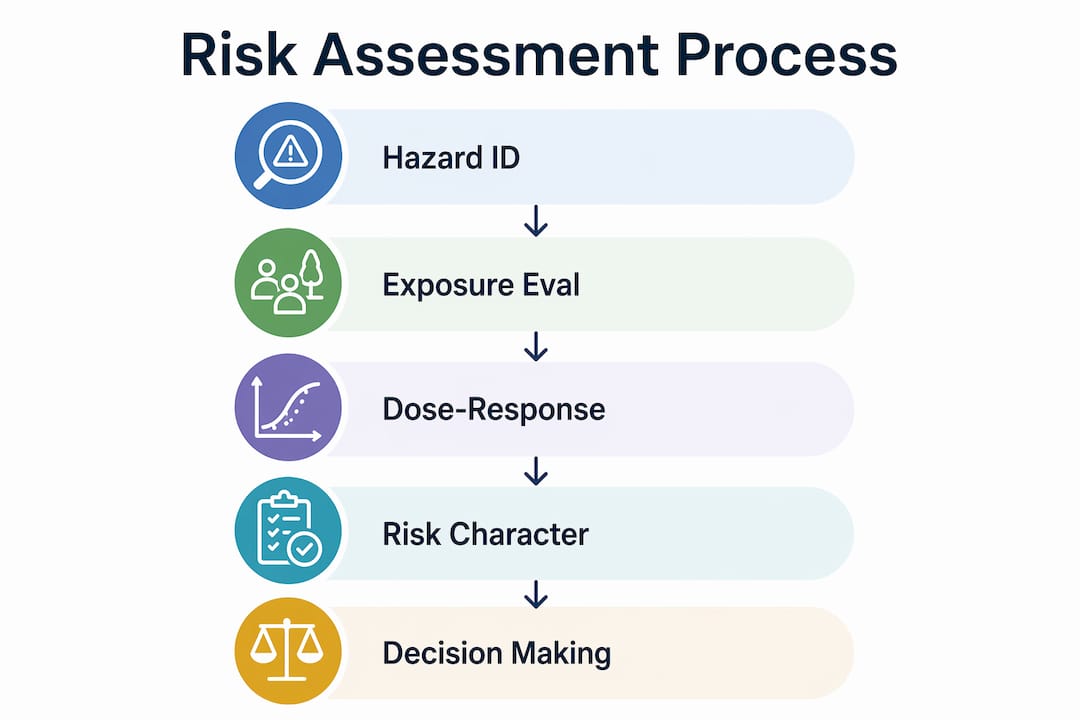
The EPA’s risk assessment framework consists of four standardized stages: hazard identification, exposure assessment, dose-response assessment, and risk characterization. Each stage builds on the previous one, producing a classification output that is both scientifically grounded and regulatorily defensible.
-
Hazard identification determines whether a substance or condition has the potential to cause harm. At this stage, site investigators compile chemical inventories, review historical land use records, and conduct preliminary soil and groundwater sampling. The output is a list of chemicals or conditions of potential concern, not yet a risk level.
-
Exposure assessment maps the pathways through which identified hazards could reach human or ecological receptors. Exposure pathways determine whether a hazardous substance can actually reach a receptor. Demonstrating that no viable pathway exists can reduce the effective risk classification to low or negligible, which has direct implications for remediation cost and project scheduling.
-
Dose-response assessment quantifies the relationship between the level of exposure and the severity of the health or ecological effect. This stage draws on toxicological databases and epidemiological studies to establish reference doses and cancer slope factors. The output informs the numerical thresholds used in the final classification.
-
Risk characterization integrates findings from all three prior stages into a final risk estimate. This estimate is expressed as a risk level, typically ranging from negligible to unacceptable, and forms the basis for regulatory reporting and remediation planning.
Pro Tip: When conducting exposure assessments on brownfield sites, document every assumed exposure pathway in writing. Regulators increasingly require explicit justification for pathways that are ruled out, not just those that are retained.
The EPA framework applies equally to ecological risk assessment, where receptors include soil invertebrates, aquatic organisms, and terrestrial wildlife. Construction teams working near protected wetlands or biodiversity corridors should run parallel human health and ecological risk characterizations to avoid compliance gaps.
A critical nuance: environmental risk results from both hazard presence and exposure. A highly toxic substance in a controlled industrial setting may carry a lower classification than a moderately hazardous material adjacent to a school or water supply. This context-dependence is why the four-stage framework cannot be replaced by a simple hazard inventory.
What are common environmental risk classification systems and scoring methods?
Classification systems translate raw risk data into standardized bands that guide decision-making. The most widely referenced scoring model in the United States is the FEMA National Risk Index, which uses a scale from 0 to 100 based on Expected Annual Loss and social vulnerability metrics.
| Risk Score | Classification | Recommended Action |
|---|---|---|
| 0–19.9 | Very Low | Standard monitoring; no immediate intervention required |
| 20–39.9 | Relatively Low | Periodic review; document exposure pathways |
| 40–59.9 | Relatively Moderate | Active controls required; update risk register quarterly |
| 60–79.9 | Relatively High | Immediate mitigation measures; notify relevant regulators |
| 80–100 | Very High | Halt affected operations; initiate formal remediation plan |
Two broad methodological approaches exist within environmental classification systems: qualitative and quantitative.
Qualitative methods assign descriptive categories such as low, medium, or high based on professional judgment and site observation. These are faster and less data-intensive, making them suitable for preliminary assessments or sites with limited historical data. Their limitation is subjectivity, which can produce inconsistent results across different assessors.
Quantitative methods assign numerical scores based on measured concentrations, modeled exposure estimates, and toxicological benchmarks. These methods are more defensible in regulatory proceedings but require more time, data, and technical expertise. Probabilistic tools such as Monte Carlo simulations and Bayesian networks help quantify classification uncertainty, which is particularly valuable on complex industrial sites where data gaps are common.
Context also shapes which system applies. A real estate transaction requires a different classification methodology than a recurring industrial compliance audit or an ecological impact assessment for a new infrastructure corridor. A tailored approach to classification is necessary because different scenarios require distinct risk methods. Professionals working across multiple project types should maintain familiarity with at least two classification frameworks to match the method to the regulatory context.
How can professionals apply environmental risk classification to enhance site safety?
Applying classification outputs to actual site operations requires deliberate integration into project management workflows. Classification is not a one-time document. Environmental risk assessment is a dynamic, iterative process, and single-site assessments frequently identify data gaps that require further investigation before a final classification can be confirmed.
Effective integration follows several established practices:
- Embed classification outputs into the risk register. Every identified risk category should map to a specific control measure, a responsible party, and a review date. Generic risk registers that list hazards without classification levels provide no operational guidance.
- Use the BOWTIE methodology to delineate responsibilities. Clear delineation of responsibilities between internal preventive measures and regulatory compliance obligations is critical to successful risk classification. BOWTIE diagrams separate causes from consequences and assign ownership at each barrier, which prevents the common failure mode of assuming regulatory compliance covers internal operational risk. Construction teams can also reference how BOWTIE supports risk management during early project stages.
- Schedule iterative reassessment. Site conditions change as excavation progresses, as weather events alter drainage patterns, or as adjacent land use changes. A classification assigned at project inception may be materially inaccurate six months into construction.
- Document uncertainty explicitly. Advanced statistical methods such as Monte Carlo simulations help manage classification uncertainty on data-limited sites. Where uncertainty is high, the precautionary principle requires classifying upward until additional data supports a lower band.
- Align classification outputs with regulatory reporting cycles. Many jurisdictions require periodic environmental compliance submissions. Classification data should be formatted to match the reporting templates of the relevant authority, reducing the administrative burden and the risk of non-conformance findings.
Pro Tip: Build a site-specific exposure pathway diagram before finalizing any risk classification. Demonstrating that no feasible pathway exists between a hazard and a receptor is often the most cost-effective way to reduce a classification band without physical remediation.
Professionals seeking to apply these principles to live projects can find practical guidance on environmental risk mitigation specific to construction site conditions.
Key Takeaways
Environmental risk classification is only as reliable as the exposure pathway analysis and iterative reassessment process that supports it.
| Point | Details |
|---|---|
| Classification requires context | Hazard presence alone does not determine risk level; exposure pathway and receptor sensitivity are equally decisive. |
| EPA four-stage framework | Hazard identification, exposure assessment, dose-response assessment, and risk characterization form the standard classification sequence. |
| Scoring systems guide action | FEMA National Risk Index bands from Very Low (0–19.9) to Very High (80–100) directly inform the urgency of mitigation measures. |
| Iterative reassessment is mandatory | Site conditions evolve; classifications assigned at project start must be reviewed as excavation, drainage, and land use change. |
| Uncertainty must be documented | Probabilistic methods like Monte Carlo simulations quantify data gaps and support defensible, precautionary classification decisions. |
Why classification is harder than most project teams expect
My experience working across construction and industrial projects has made one pattern unmistakable: project teams consistently underestimate how much the exposure pathway analysis changes the final classification. Teams invest significant effort in hazard identification, producing detailed chemical inventories and sampling reports. Then they assign a risk level based almost entirely on the hazard concentration, without rigorously mapping whether a viable pathway to a receptor actually exists.
The result is systematic overclassification on some sites and dangerous underclassification on others. A site with elevated arsenic in deep bedrock, with no groundwater connection to surface receptors, may carry a lower effective risk than a site with moderate diesel contamination adjacent to a stormwater drain feeding a protected estuary. The numbers in the soil report do not tell that story. The pathway analysis does.
The second pattern I see repeatedly is treating classification as a project milestone rather than a living process. Teams complete an environmental risk assessment, file the report, and move on. Six months later, a contractor opens a new excavation face, intersects a previously unknown contamination plume, and the project team has no protocol for reclassifying in real time. The regulatory exposure from that gap is substantial.
The fix is not more complex software or larger sampling programs. It is disciplined process design: a clear trigger for reassessment, a named responsible party, and a classification update procedure that takes hours, not weeks. Regulators in 2026 are increasingly auditing the process, not just the output. Teams that can demonstrate iterative, documented classification management are far better positioned than those presenting a single polished report from the project start date.
— Aman
How Com supports environmental risk compliance on your projects
Com, operating as MOSAIC Eco-construction Solutions, provides Quality, Environment, and Safety consultancy services specifically designed for construction and industrial project teams navigating complex regulatory requirements. From safety audits and BizSAFE certification support to Design for Safety consultancy and EHS manpower outsourcing, Com delivers the technical depth that classification-driven compliance demands.

For project teams that need to validate their environmental risk classification processes against regulatory benchmarks, Com’s safety audit examples demonstrate how structured audits translate classification outputs into compliant, documented site management. Teams managing ongoing EHS obligations can also explore how outsourcing EHS manpower maintains classification rigor without overextending internal resources.
FAQ
What is environmental risk classification?
Environmental risk classification is the process of categorizing identified environmental hazards by their likelihood and potential impact, using standardized frameworks such as the EPA four-stage model to guide risk management and regulatory compliance decisions.
What are the four stages of the EPA environmental risk assessment?
The EPA framework covers hazard identification, exposure assessment, dose-response assessment, and risk characterization. Each stage builds sequentially to produce a defensible risk level for regulatory and operational use.
How does the FEMA National Risk Index scoring system work?
The FEMA National Risk Index assigns scores from 0 to 100 based on Expected Annual Loss and social vulnerability, with bands ranging from Very Low (0–19.9) to Very High (80–100), each corresponding to a defined level of required action.
Why does exposure pathway analysis matter in risk classification?
Exposure pathways determine whether a hazard can actually reach a human or ecological receptor. Demonstrating no viable pathway exists can reduce a site’s effective risk classification to low or negligible, directly affecting remediation scope and project cost.
How often should environmental risk classifications be updated on a construction site?
Classifications should be reviewed whenever site conditions change materially, including new excavation, altered drainage, or adjacent land use changes. Treating classification as a static document rather than a living process is a common compliance failure.
Recommended
- Construction Environmental Hazards Explained for Pros
- Environmental Risk Mitigation Tips for Construction Sites
- Managing Risk During the Design Stage: A Proactive Approach to Safer, More Efficient Construction – MOSAIC Eco-construction Solutions Pte Ltd
- Quality environment safety explained: A guide for construction pros


