A confined space program for a Singapore construction site is a written, enforced system that decides whether entry is needed, controls the atmosphere and isolation, names who may authorize and monitor entry, and proves that rescue is ready before anyone goes in. The Workplace Safety and Health (Confined Spaces) Regulations 2009 set the legal minimum. A program that only repeats the regulations, without site-specific procedures, trained people and records, fails at the moment an auditor or the Ministry of Manpower (MOM) asks to see it working. This guide sets out what the program contains and how to make it auditable, and where our consultancy takes the documentation, audit and training workload off your safety team.
TL;DR
- A confined space is defined by hazard, not by size: dangerous atmosphere, inadequate air, or risk of engulfment. Entry begins when the head passes through the opening.
- Since 1 June 2024, specified confined-space offences carry fines of up to S$50,000, imprisonment of up to 2 years, or both.
- The program rests on a permit-to-work, gas testing by a competent assessor, a named attendant, trained personnel and a rehearsed rescue plan.
- Records are the proof: permits, test results, daily reviews, drill logs and training certificates.
- BizSAFE, ISO and Design for Safety (DfS) are where the program is anchored and audited, not separate paperwork.
Table of Contents
- What counts as a confined space on a construction site
- The legal frame and what non-compliance costs
- Who does what: the roles the program must name
- What the program should contain
- Permit-to-work: the four stages
- Training that stands up to an audit
- Rescue planning: the part that gets tested in a real emergency
- Records that prove the program works
- How BizSAFE, ISO and Design for Safety connect to the program
- Where we take the workload off your team
- Our perspective
- FAQ
- Sources
What counts as a confined space on a construction site
The WSH (Confined Spaces) Regulations 2009 define a confined space as a chamber, tank, manhole, vat, silo, pit, pipe, flue or other enclosed space where one of three conditions applies. Dangerous gases, vapors or fumes create a risk of fire, explosion or people being overcome. The air supply is, or is likely to become, inadequate to sustain life. Or there is a risk of engulfment by material. A person is considered to enter once their head passes through an opening into the space.
On a construction site, that definition catches more than the obvious tank. Common examples include:
- Manholes, sewers and drainage pits during utility works.
- Bored pile shafts and excavated pits where gases can collect.
- Tanks, ducts, risers and plant rooms before commissioning.
- Basement voids and sumps where ventilation is poor.
- Barge tanks and ISO tanks on marine or logistics-related works.
The Workplace Safety and Health Council (WSHC) Confined Space Safety Guidebook lists the atmospheric hazards behind these spaces. Oxygen deficiency below 19.5% by volume can come from rotting organic matter, rusting, bacterial growth, welding and cutting, gas displacement or poor ventilation. Oxygen enrichment, fire and explosion, and toxic atmospheres are the other three. Non-atmospheric hazards include heat, noise, poor lighting, mechanical and electrical hazards, and skin contact with chemicals.
The guidebook also explains why these spaces are more dangerous than open work areas. Entrances may not allow evacuation during flooding or collapse of free-flowing material, self-rescue is difficult, interior layout restricts rescue, natural ventilation is often insufficient, and conditions change quickly. The work itself, such as welding, coating or using petrol-driven equipment, can introduce new hazards. This is why the program must treat the activity and the space together, not the space alone.
The legal frame and what non-compliance costs
The Confined Spaces Regulations came into operation on 1 November 2009 and were amended by the Amendment of Penalties Regulations 2024 on 1 June 2024, as shown on the Singapore Statutes Online entry. Construction employers also work under the WSH (Construction) Regulations 2007, which require adequate safety and health training for anyone carrying out manual work and for anyone overseeing it, as stated in the consolidated regulations.
The penalty changes matter for how seriously a board or project director treats the program. Under the WSH (Amendment of Penalties) Regulations 2024:
- Breaching core duties, including regulations 5, 6, 7, 8(1), 9, 10(1), 12, 13(3), 15(1), 16(1), 17(1), 18(1), 19, 21 or 22(1), carries a fine of up to S$50,000, imprisonment of up to 2 years, or both.
- Lesser breaches, such as regulations 4, 11, 14 and parts of 13, 15 and 16, carry up to S$20,000 or 2 years, rising to S$50,000 for a repeat offender with a relevant offence within 5 years.
The wider consequences of a WSH Act breach, including stop-work orders and director liability, are covered in our guide to WSH Act penalties in Singapore. For the regulation-by-regulation view that safety officers need when preparing for inspection, see our note on making confined space rules auditable.
Who does what: the roles the program must name
The regulations are built around named, competent people. Before any entry, the responsible person (the employer or principal) must appoint a competent authorized manager and a competent confined space safety assessor (CSSA), and ensure an entry permit is issued. The permit must state the description and location of the space, the purpose of entry, gas-testing results and the period of validity, according to regulation 9.
The WSHC guidebook breaks the day-to-day duties down as follows:
| Role | Core duties |
|---|---|
| Authorized manager | Satisfies the permit conditions, issues the permit, reviews and re-endorses it daily |
| CSSA | Inspects the site, sets the sampling strategy, tests with calibrated instruments, records results and flags deviations |
| Supervisor | Briefs entrants and attendants, applies for the permit, authorizes entry, ensures procedures and rescue arrangements are in place, terminates the permit |
| Entrant | Follows procedures, carries a portable gas instrument for continuous monitoring, reports unsafe conditions or alarms |
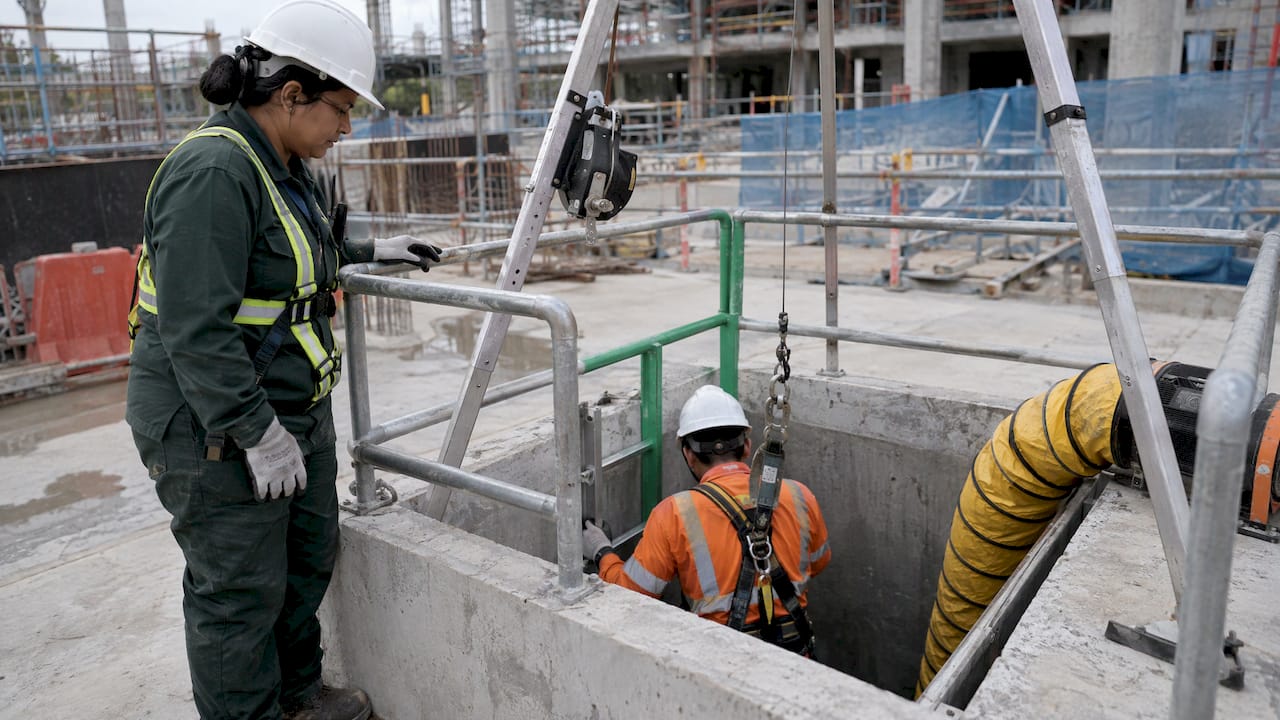
| Attendant | Stays outside, keeps visual or verbal contact, orders evacuation, alerts rescue personnel |
These duties are drawn from the Confined Space Safety Guidebook. The WSHC technical advisory adds that an attendant must be appointed wherever any person enters or works in a confined space, and must remain outside, as set out in Working Safely in Confined Spaces.
Under regulation 15, the responsible person and the authorized manager must both ensure all measures necessary for the worker’s safety and health are in place throughout entry, and the responsible person must inform the authorized manager once the worker has left the space after completing the work. In practice, the program needs a close-out step, not only an opening one.
What the program should contain
WSHC’s guidance on working safely in confined spaces sets out what employers should do. Turned into program sections, it reads as follows.
- Entry evaluation. Decide whether entry is necessary at all. If the task can be done from outside, by redesigning the work or using remote tools, the hazard is removed, which is the top of the hazard control hierarchy.
- Access and egress. Safe opening practices, a safe way in and out, and sufficient lighting.
- Information. Make confined-space information available: location, hazards, previous contents, drawings and isolation points.
- Entry procedures and controls. Isolation, ventilation, gas testing, and the permit-to-work.
- Training. For every supervisor, entrant and attendant, before appointment.
- Emergency rescue plan and equipment. Written, rehearsed and resourced before entry begins.
- Attendant appointment. A named person for every entry.
The program should also reference Singapore Standard SS 568, which positions itself as the interpretive bridge between industry practice and the Confined Spaces Regulations. Its 2011 edition clarifies the definitions and qualifications of appointed personnel: the authorized manager, the CSSA and the attendant. Writing your appointment criteria to match that vocabulary removes ambiguity when an auditor reads your procedure.
Permit-to-work: the four stages
The permit is the control point of the program. WSHC describes it as a formal check that all elements of a safe system of work are in place before entry. Its technical advisory sets out four stages:
- Application. The supervisor completes a joint risk assessment with the authorized manager, inspects the space, prepares the pre-entry requirements and applies for the permit.
- Testing. The CSSA inspects the site, establishes the sampling strategy and tests with calibrated instruments, recording results and flagging any deviation.
- Issue. The authorized manager issues the permit only when every condition is met.
- Display and review. The supervisor posts the permit at the entrance until it expires, is revoked or work is complete, and the authorized manager reviews and re-endorses it daily.
Where programs most often go wrong is the gap between stages one and three. A permit signed before testing is finished, or a risk assessment copied from a previous job, defeats the purpose. Each stage needs a named person, a signature and a time.
Isolation before entry
Isolation controls in the technical advisory include lockout-tagout de-energization, blanking or bleeding of pipes, and removal of mechanical linkages. Add the isolation points to the permit itself so the attendant can verify them without hunting for a separate document.

Gas testing limits and sequence
The authorized manager may issue an entry permit only when the conditions below are met, as restated in the LTA Construction Safety Handbook, citing regulation 13:
| Parameter | Condition for permit issue |
|---|---|
| Oxygen | 19.5% to 23.5% by volume |
| Flammable gas or vapor | Below 10% of the lower explosive limit |
| Toxic substances | Not above the permissible exposure levels in the First Schedule of the WSH (General Provisions) Regulations |
| Ventilation | Adequate |
| Ingress | Dangerous substances prevented from entering |
The same handbook states that gas monitoring must be done by a competent confined space assessor, first to certify the space safe for entry and then at every four-hour interval, in this order: oxygen, flammable gas or vapor, then toxic gas. Oxygen goes first because the reading on flammable gas sensors can be unreliable in an oxygen-deficient atmosphere. Build the four-hour re-test into the permit form as a timed field, so a missed test is visible.
Training that stands up to an audit
The guidebook requires supervisors, entrants and attendants to be trained before appointment, and again when procedures or duties change, when a new type of space or hazard arises, or when a worker shows a lack of understanding. It identifies the Safety Instruction Course (manhole) for supervisors and the Safety Orientation Course (manhole) for workers.
Two practical points follow. First, keep a competency matrix that maps each named role on each project to a certificate and an expiry. Second, treat toolbox briefings as supplementary: they refresh the job-specific hazards but do not replace accredited training. Our training and EHS manpower outsourcing offering exists for contractors who need either their own staff trained or additional safety personnel on a project.
Rescue planning: the part that gets tested in a real emergency
The WSHC guidebook says workers must be trained on the rescue plan before confined-space work starts. The plan should name the available rescue personnel, specify rescue methods and equipment, and provide an effective recall method. Equipment must be suitable, maintained and readily available. Drills should be held at least every 12 months, and untrained workers should not attempt rescue.
The guidebook’s recommended rescue equipment includes:
- Self-contained breathing apparatus (SCBA)
- Full-body harness with retrieval line
- Hand-cranked mechanical winch and tripod, required when the entrant is five feet or more below the entrance
- Ladder and explosion-proof lighting
- Stretcher, approved head protection, reviving apparatus and first aid equipment
A rescue plan is also a scheduling problem: trained rescuers, the attendant and the supervisor must be on site and available for every shift in which entry occurs. Good planning of site work crews makes sure that a drill-trained team is rostered on the days a permit is active, rather than discovered to be off site when the alarm sounds. For a worked scenario of how a rescue plays out and what it exposes, read our confined space rescue example.
Records that prove the program works
An auditor will not take the program on trust. The entry permit is the core record, and per the technical advisory it captures:
- Identification and location of the space, purpose, entry date and time, and validity
- Atmospheric and non-atmospheric hazards
- Control measures: isolation, PPE, barricades, emergency response and responder contacts
- Attendant’s name, ventilation and lighting arrangements
- Test results for oxygen, flammable gas and toxic gas
- Names and signatures of the supervisor, CSSA and authorized manager
Around the permit sit the CSSA’s recorded test results, the authorized manager’s daily review signatures, the permit copy posted at the entrance, the 12-monthly rescue drill record and the training certificates, including those from accredited courses. Reviewing a sample of closed permits every month, checking for blank fields, missing re-tests and late sign-offs, turns the records into a management tool instead of an archive.
How BizSAFE, ISO and Design for Safety connect to the program
A confined space program is not a stand-alone document. It lives inside your WSH management system, and that system is what BizSAFE and ISO certification audit. A contractor pursuing BizSAFE Level 3, Level 4 or Star needs its risk management and procedures to show that high-risk activities such as confined space entry are controlled and documented. Our BizSAFE Level 3, 4 and Star and ISO certification services guide clients through those certification processes.
Design for Safety works upstream. If the design avoids a confined space, or provides permanent access, ventilation points and anchor points, the construction program becomes simpler and the hazard is reduced at the source. Our Design for Safety Professional service and the guide on appointing a DfS professional explain how that appointment works under the WSH (DfS) Regulations. For the wider obligations on a project, the WSH construction sector regulation guide and the note on statutory safety requirements give the context.
Where we take the workload off your team
Writing the procedure is the smaller part. Keeping permits, test logs, training matrices and drill records consistent across several live projects is where programs decay. We provide EHS advisory and documentation, WSH audit and inspection, risk management plan development, training and EHS manpower outsourcing for construction firms, backed by more than 20 years of experience and a consultant team that works across industries.
If you want the program reviewed against the regulations and your actual site practice, our WSH Audit and Inspection service is the starting point. For procedures and records written to be auditable, our EHS Advisory and Documentation service covers that work. Contact us through the MOSAIC website.

Our perspective
Confined space incidents are rarely caused by an unknown hazard. They happen where a known hazard met a permit that was signed early, a test that was skipped, or a rescue plan nobody had rehearsed. The regulations name the roles clearly; the failure is almost always in the gap between the name on the form and the competence on the site.
Our experience of more than 20 years in quality, environment and safety consulting leads us to a consistent view: the program should be designed backwards from the audit. If a permit, a gas-test record, a daily re-endorsement and a drill log can be pulled in minutes, the site is controlling the work. If they cannot, the paperwork is not the problem; the system is.
That is why we treat the confined space program as part of the whole management system: Design for Safety to remove the hazard where possible, BizSAFE and ISO to make the controls routine, audits to verify them, and training and manpower support to keep competent people in the named roles. Continuous support after the engagement is part of how we work, because the program only matters on the day it is used.
Aman
FAQ
What is the difference between a confined space and a restricted work area?
The regulations define a confined space by its hazards: a dangerous atmosphere, an inadequate air supply or a risk of engulfment. A space can be small and open and not qualify, or large and enclosed and qualify. Assess every enclosed space against those three conditions before work starts.
Who can issue a confined space entry permit?
Only the authorized manager, appointed by the responsible person, and only when the atmospheric and ventilation conditions are met. The CSSA tests the atmosphere and records the results, and the supervisor applies for the permit and posts it at the entrance.
How often must the atmosphere be re-tested?
The LTA Construction Safety Handbook states testing by a competent assessor before entry and then at every four-hour interval, in the order oxygen, flammable gas or vapor, then toxic gas. Your permit form should record each test with a time and signature.
How often should rescue drills be held?
WSHC guidance says at least every 12 months, and workers must be trained on the rescue plan before confined-space work begins. Keep a drill record with participants, scenario and findings for audit.
What are the penalties for breaching the Confined Spaces Regulations?
From 1 June 2024, breaches of core duties carry fines of up to S$50,000, imprisonment of up to 2 years, or both. Lesser breaches carry up to S$20,000 or 2 years, rising to S$50,000 for repeat offenders within 5 years.
Sources
- WSH (Confined Spaces) Regulations 2009, Singapore Statutes Online
- WSH (Confined Spaces) Regulations 2009, regulation 9
- WSH (Amendment of Penalties) Regulations 2024
- WSH (Construction) Regulations 2007
- Regulation 15, Confined Spaces Regulations 2009, laws.sg
- WSHC Confined Space Safety Guidebook
- WSHC Confined Space Safety Guidebook, rescue equipment edition
- WSHC, Working Safely in Confined Spaces
- WSHC Technical Advisory, Working Safely in Confined Spaces (permit-to-work)
- WSHC Technical Advisory, attendant duties
- LTA Construction Safety Handbook
- Singapore Standard SS 568:2011 preview
- Planning site work crews