
bizSAFE Level 3 vs bizSAFE STAR: Which Certification Does Your Business Need in 2026?
Introduction to Singapore Workplace Safety in 2026
Workplace safety is an absolute business imperative in Singapore today. Organizations must secure proper certifications to remain commercially viable. The choice between bizSAFE Level 3 and bizSAFE STAR is critical. This decision impacts legal compliance and government tender eligibility directly. Furthermore, it determines your organization’s overall risk management maturity. The Workplace Safety and Health (WSH) Council updated its guidelines. These new 2026 guidelines enforce stricter compliance measures universally. Consequently, Singapore businesses must evaluate their safety certification needs carefully.
BizSAFE Level 3 provides a robust regulatory baseline for companies. It focuses heavily on structured risk management processes. Conversely, bizSAFE STAR represents the pinnacle of global safety excellence. It demands comprehensive integration with international safety standards. Specifically, it requires mandatory ISO 45001 certification prerequisites. Businesses must understand these crucial differences immediately to succeed. This comprehensive report analyzes both certification tiers exhaustively. It provides detailed insights into the 2026 WSH Council requirements. Moreover, it examines audit processes and tender eligibility criteria thoroughly. This analysis guides executives in strategic safety investments.
The State of Workplace Safety and Health in 2026
Singapore achieved remarkable workplace safety milestones in recent years. The nation recorded a historic low fatality rate in 2025. Specifically, the workplace fatal injury rate hit 0.96 per 100,000 workers.1 This stellar performance places Singapore among elite global safety leaders. It rivals leading countries like the Netherlands and Germany.1 The United Kingdom and Sweden share this exceptional safety tier.1 Furthermore, the major injury rate fell to an all-time low. It reached exactly 15.7 per 100,000 workers recently.2 These statistics exclude platform workers from the initial calculation dataset.2 However, the Platform Workers Act changed this starting January 2025.3 This progress reflects sustained collective efforts from tripartite partners.3
Despite these gains, persistent injury patterns demand continued regulatory vigilance. Non-fatal injuries still affect thousands of workers annually in Singapore.4 Slips, trips, and falls remain highly prevalent across multiple industries. They constitute 32% of all non-fatal workplace injuries reported.4 Contact with moving machinery accounts for another 18% of incidents.4 Additionally, manual handling injuries represent 15% of recorded cases.4 In 2025, Singapore recorded a total of 36 workplace fatalities.2 Six of these were categorized as Work-related Traffic Accidents (WRTAs).2 A WRTA involves bodily injury to a vocational driver.3 These statistics highlight critical systemic gaps in basic safety management. Organizations without structured systems report significantly higher injury rates. Their injury rates are 2.3 times higher than certified counterparts.4 Inadequate risk assessment practices cause 73% of serious workplace incidents.4 Therefore, the Ministry of Manpower enforces stricter compliance protocols continuously.
Anatomy of the Comprehensive bizSAFE Programme
The bizSAFE programme is a progressive capability development system. It features five distinct structural levels for capability building.5 The Ministry of Manpower (MOM) supports this essential program actively.7 It helps enterprises build systematic workplace safety capabilities incrementally.6 Every Singapore-registered company can participate in this structured journey easily.6 Organizations progress from basic leadership awareness to world-class excellence.5 Understanding the preliminary levels provides vital context for higher tiers. The programme also incorporates SGSecure elements to manage terror threats.7 This includes specific protective security and contingency planning measures.7
The Foundational Tier: bizSAFE Level 1
bizSAFE Level 1 establishes the essential foundation of executive commitment. It targets top management, including CEOs and Managing Directors specifically.9 A designated top executive must attend a specialized workshop.5 This is known as the Top Executive WSH Program (TEWP).5 The WSH Council conducts this mandatory three-hour training session online.6 The curriculum covers legal duties and risk management fundamentals comprehensively.6 Top management must sign a formal safety commitment letter subsequently.5 This action demonstrates informed commitment from organizational leadership visibly.9 Section 48(1) of the WSH Act mandates this executive responsibility.9 Effective safety culture cannot be driven purely from the bottom up.9 Top management changes necessitate immediate workshop attendance by new leaders.7 This maintains the organization’s active bizSAFE status seamlessly without interruption.9 The Level 1 certification validity lasts for exactly six months.6
Building the Core: bizSAFE Level 2
bizSAFE Level 2 focuses on building practical risk management foundations. The company must officially appoint a Risk Management (RM) Champion.6 This champion attends a recognized two-day Risk Management Course.6 The training covers comprehensive hazard identification and assessment methodologies thoroughly.10 Participants learn how to develop a Risk Management Implementation Plan.6 They establish fundamental risk control measures for their specific operations.10 Completing this level ensures internal competency for identifying workplace hazards.10 The organization gains a dedicated leader for driving safety initiatives.10 Course fees typically range between S600 currently.6 The Level 2 status is non-renewable and valid for six months.6 If the RM Champion leaves, the new appointee must train.7 They must attend the course immediately to maintain company status.7
Comprehensive Deep Dive: bizSAFE Level 3
bizSAFE Level 3 represents a critical commercial milestone for enterprises. It proves an organization has implemented effective risk management systems.7 The certification demonstrates strict compliance with WSH (Risk Management) Regulations.7 It acts as the standard baseline for commercial B2B contracts.10 Most government tenders require this certification as a minimum prerequisite.10 Therefore, achieving Level 3 unlocks significant business expansion opportunities rapidly.
Core Requirements and Risk Management Focus
The primary focus of Level 3 is a comprehensive documentation audit.10 Companies must conduct thorough risk assessments for all workplace activities.12 This includes both routine and non-routine work processes entirely.10 The RM Champion leads this extensive internal hazard evaluation process.6 They must utilize the standard risk matrix of likelihood versus severity.10 Consequently, the company develops a tailored Risk Management Plan.13 This plan details specific control measures using the hierarchy of controls.10 These controls include elimination, substitution, engineering, and administrative measures.10 The company must engage employees actively in these safety practices.13 Proper documentation of all processes and incident records is absolutely mandatory.13 The law requires reviewing these risk assessments every three years.7 Furthermore, reviews must happen whenever work activities change significantly.7
The 2026 Speed Limiter Verification Mandate
The WSH Council introduced a highly critical requirement for 2026. This update affects logistics, construction, and transportation sectors profoundly. From January 1, 2026, RM implementation audits face new verification protocols.7 Auditors must verify the installation of speed limiters in lorries.7 This mandate addresses the high risk of serious commuting injuries.7 Speed limiters are recognized as reasonably practicable hazard control measures.7 Companies lacking these devices in any lorry face immediate consequences.7 They will inevitably fail the RM implementation audit entirely.7 Consequently, their bizSAFE application or renewal will be rejected immediately.7 Unsuccessful verification inspections force companies to conduct completely new audits.8 This causes severe application processing delays exceeding ten working days.8 Therefore, companies must equip their fleets before seeking 2026 certification.7
Implementation Process, Timelines, and Auditing
Achieving Level 3 requires following a precise, structured operational pathway. The company first completes the Level 1 and Level 2 prerequisites.13 Next, the team conducts comprehensive risk assessments across all departments.13 Management reviews these assessments and implements the identified control measures.13 The company then engages a MOM-approved Auditing Organization (AO).6 This AO conducts an independent, external Risk Management Implementation Audit.6 The external audit features extensive document reviews and site inspections.6 Furthermore, the auditor conducts direct interviews with various staff members.6 For overseas companies, registered AO auditors must visit overseas sites.8
The entire Level 3 certification process spans four to eight weeks.6 Companies utilizing professional safety consultants can accelerate this timeline significantly. Assisted implementations frequently conclude within just two to three weeks.6 The financial investment for Level 3 remains highly accessible for SMEs. The Risk Management Audit typically costs between S2,000.6 This cost varies based on enterprise size and operational complexity.6 Renewal audits generally cost between S1,200 currently.6 Consequently, Level 3 offers the highest Trust-to-Cost ratio locally.15 The certification remains valid for three years after official approval.6
The Transitional Tier: bizSAFE Level 4
bizSAFE Level 4 bridges the gap between assessments and full systems. It builds directly upon Level 3 risk assessment foundations securely.10 Companies must implement a Workplace Safety and Health Management System (WSHMS).16 The company appoints a dedicated WSHMS Programme Lead or Champion.6 This lead attends a comprehensive four-day implementation course actively.6 They develop a full WSHMS Implementation Plan for the organization.6
This framework integrates safety objectives and emergency response protocols completely.6 It covers organizational roles, incident investigation, and extensive staff training.10 Developing this system typically requires three to six months totally.10 A MOM-approved auditing body must audit this newly implemented framework.10 The Level 4 course costs between S900.6 Level 4 certification remains valid for exactly three years.6 This tier signals a highly mature, systematic safety management approach.17
Comprehensive Deep Dive: bizSAFE STAR
bizSAFE STAR is the absolute pinnacle of workplace safety excellence.6 It represents the gold standard within the Singapore certification framework.10 This tier transitions organizations from basic compliance to global leadership. High-risk industries specifically target this elite certification for operational validation.10 Marine, construction, and large-scale manufacturing sectors consider it a necessity.10 Attaining STAR status confers immense industry credibility and global recognition.17
Integration with ISO 45001 and SS651 Standards
bizSAFE STAR is fundamentally an operational and systemic management audit.10 It completely eclipses the documentation focus of the Level 3 tier.10 The core requirement is implementing a full WSH Management System.13 Furthermore, this system must achieve formal ISO 45001 or SS651 certification.6 ISO 45001 represents the definitive global language of occupational safety.15 It mandates a rigorous continuous improvement cycle called PDCA.15 The standard demands profound leadership commitment and active worker participation.15 It requires analyzing the complex context of the entire organization deeply.15
Previously, the WSH Council accepted the older OHSAS 18001 standard. However, strict regulatory updates eliminated this allowance in recent years. The Council completely rejects OHSAS 18001 certifications approved after March 2021.18 They also reject non-accredited ISO 45001 certifications outright in 2026.18 Companies must obtain their ISO 45001 certification from heavily scrutinized bodies. These certification bodies must hold formal Singapore Accreditation Council (SAC) accreditation.10 Alternatively, mutual recognition arrangement bodies are also strictly required currently.18
The Comprehensive Auditing and Application Protocol
The auditing process for bizSAFE STAR is exceptionally rigorous indeed. It requires massive, organization-wide participation across all departments and hierarchies.10 The company must first complete bizSAFE Level 3 certification successfully.13 They subsequently develop and implement the extensive WSH Management System.13 Employees undergo rigorous training on all complex WSHMS requirements thoroughly.13 Internal teams conduct extensive preliminary gap analyses and internal audits.13 This verifies absolute certification readiness before the final external audit.13
The company then engages an independent, SAC-accredited third-party auditing body.10 This external auditor evaluates the entire management system against ISO 45001.10 This deep-dive evaluation scrutinizes daily operations, safety culture, and improvements. In addition to the ISO certificate, applicants must submit an RM Audit Report.16 The WSH Council demands this specific RM Implementation Audit Report.19 This report verifies compliance with the localized Code of Practice.19 It addresses unique local risks like terrorism, diseases, and mental health.15
The timeline for achieving bizSAFE STAR is understandably highly extensive. Preparing the full management system requires six to twelve months.10 The financial investment is substantially higher than lower certification tiers. ISO 45001 certification and auditing easily exceed S$6,000 in total costs.15 The STAR status validity mirrors the underlying ISO 45001 certificate exactly.6 It remains valid for three years under normal operational circumstances.6 However, if the ISO certification lapses, the STAR status invalidates immediately.6
Comparative Analysis: Level 3 versus STAR
Understanding the precise differences between these tiers ensures optimal allocation. Companies must align their certification strategy with commercial objectives directly. The following table provides a comprehensive structural comparison of both certifications.
| Feature / Criteria | bizSAFE Level 3 | bizSAFE STAR |
| Core Focus Area | Risk Assessment and Control Implementation | Comprehensive WSH Management System Integration |
| Primary Standard | WSH (Risk Management) Regulations Compliance 7 | ISO 45001 or SS651 Standards 6 |
| Type of Audit | Documentation and basic operational verification 10 | Full systemic operational management system audit 10 |
| Auditor Type | MOM-approved Auditing Organization (AO) 7 | SAC-accredited Independent Certification Body 13 |
| Required Reports | RM Implementation Audit Report Only 6 | ISO 45001 Certificate + RM Audit Report 18 |
| Typical Timeline | 4 to 8 weeks for completion 10 | 6 to 12 months for full certification 10 |
| Estimated Cost | S2,000 for standard companies 6 | S$6,000+ (includes ISO 45001 certification costs) 15 |
| Target Audience | SMEs and general commercial service contractors 15 | MNCs and high-risk industrial sector leaders 10 |
| Tender Usage | Minimum baseline for most government contracts 10 | Highly preferred for massive infrastructure mega-projects 10 |
| Validity Status | 3 Years (Requires renewal audit) 6 | 3 Years (Tied directly to ISO validity) 6 |
| Corporate Scope | Primarily departmental to mid-level organizational 6 | Requires absolute full organization-wide active participation 10 |
The Specialized Local Dialect versus Global Language
A critical conceptual difference separates bizSAFE from generic international standards. ISO 45001 operates as the universal global language of occupational safety.15 It applies broadly across international borders and diverse regulatory jurisdictions. Conversely, bizSAFE acts as the highly specialized local dialect of Singapore.15 It addresses hyper-specific local legislations like Risk Management Regulations strictly.15 Furthermore, bizSAFE incorporates unique national security initiatives seamlessly into frameworks.
For instance, bizSAFE Level 3 integrates SGSecure elements deeply within requirements.7 It prepares companies to manage potential terror threats within their premises.7 It includes specialized guidance on protective security and contingency planning measures.7 A generic ISO 45001 audit frequently overlooks these localized security protocols.15 Therefore, multinational corporations exporting goods globally require ISO 45001 inherently. However, they still need bizSAFE STAR to operate locally within Singapore.15 STAR bridges the global framework with mandatory local compliance seamlessly.
Government Tenders and Commercial Procurement Strategies
Procurement policies in Singapore heavily favor organizations demonstrating certified safety cultures. Workplace safety is an absolute business imperative for lucrative contract eligibility.6 Government agencies and Government-Linked Companies enforce strict procurement prerequisites universally.6 Understanding how certification levels impact tender success is vital for growth.
The Level 3 Commercial Baseline
bizSAFE Level 3 acts as the minimum commercial passport for SMEs. The vast majority of government tenders demand this tier explicitly.10 It proves the contractor possesses fundamental hazard management capabilities reliably. Private sector corporations also adopt this standard for their supply chains.20 They require subcontractors to hold Level 3 before granting site access.6 This creates a massive market-wide cascade effect driving national safety adoption.17 Companies lacking Level 3 face immediate disqualification from active commercial tenders.6 Furthermore, losing this status forces removal from the official bizSAFE Marketplace.6 Consequently, maintaining Level 3 is synonymous with maintaining basic business viability. Large procurers demand these standards to mitigate their massive liabilities.17
The STAR Competitive Advantage for Major Projects
bizSAFE STAR provides a formidable competitive advantage in high-stakes procurement battles. High-risk industries specify STAR routinely during massive contractor selection processes.10 For example, the Land Transport Authority (LTA) manages colossal infrastructure projects continually. Projects involving rail maintenance and engineering demand extraordinary safety expertise strictly.21 Tenderers for such LTA contracts face rigorous capability and safety scrutiny.21
The LTA utilizes the GeBIZ platform for managing these massive tenders.21 Tenderers must sign a specific Non-Disclosure Agreement (NDA) beforehand.21 They submit this NDA to the physical LTA Office directly.21 This office resides at 1 Hampshire Road, Block 2A, Level 1.21 Subsequently, tenderers email lta_contracts@lta.gov.sg to request required system passwords.21 The NDA must feature an authorized signature on every single page.21 Additionally, every page requires an official company stamp for absolute validity.21 Holding bizSAFE STAR signals a highly mature, externally validated safety system.17 The Housing & Development Board (HDB) and Public Utilities Board prioritize this. Large procurers recognize the immense reduction in liability with STAR-certified vendors.
Regulatory Shifts and 2026 Compliance Mandates
The legal framework surrounding workplace safety in Singapore tightened significantly recently. The Ministry of Manpower intensified enforcement protocols dramatically throughout recent years.22 Regulatory coverage expanded, bringing tighter scrutiny to all operational commercial sectors.22 Employers face substantially higher financial penalties for safety lapses in 2026.22 Random audits explicitly targeting under-reporting of minor workplace incidents increased sharply.22 Failure to report incidents is prosecuted as a severe criminal offense.22
Code of Practice on Chief Executives’ and Directors’ Duties
The most transformative regulatory development is the newly gazetted Code of Practice.23 The Code of Practice on Chief Executives’ and Board of Directors’ WSH Duties applies universally.24 This Code provides absolute clarity on executive safety roles and legal duties.24 The Ministry of Manpower oversees the strict enforcement of this Code.25 It applies universally to all Company Directors and equivalent upper management.25 Industry type and organization size provide no exemption from these rules.25
Under the WSH Act, directors hold massive responsibilities to their workforce. They must demonstrate a reasonable degree of due diligence proactively.26 Their paramount duty is preventing WSH lapses within their entire organization.26 The Code outlines exactly how directors must execute this critical mandate.27 It establishes seventeen specific measures categorized under four core guiding principles.25
Analysis of the Seventeen Executive Measures
The Code’s seventeen measures force profound changes in corporate governance structures.25
The first principle demands integrating safety into core business decisions completely.25 Measures 1 and 2 clarify the specific roles of individual board members.26 Safety considerations must be classified as highly important, non-negotiable strategic decisions.26
The second principle focuses on building a phenomenally strong safety culture.25 It spans Measures 3 through 9, demanding visible executive leadership constantly.25 Measure 3 requires publishing organizational commitments and tracking performance metrics regularly.26 Measure 4 forces WSH onto the regular agenda of all board meetings.26 Measure 5 is critically important; it ensures sufficient resource allocation universally.25 Measure 6 facilitates direct safety reporting channels straight to company directors.26 Measure 7 requires directors to actively acquire relevant WSH knowledge continually.26 Measure 8 mandates direct engagements to understand precise worker safety concerns.26 Measure 9 demands effective safety standards from all external vendors seamlessly.26
The third principle evaluates the effectiveness of established WSH management systems.25 It encompasses Measures 10 through 13 regarding systematic oversight mechanisms.25 Executives must ensure suitable, adequate, and highly timely risk assessments continuously.27 They must maintain absolute oversight of compliance with established safe work procedures.27
The fourth principle empowers workers to engage in safety initiatives actively.25 Spanning Measures 14 to 17, it fosters a collaborative safety environment.25 Measure 11 specifically addresses industries reliant heavily on multiple complex parties.25 Construction projects involving numerous subcontractors require highly hands-on management approaches.25 Executives must seek direct feedback from independent workers regarding safety improvements.25 Furthermore, directors must recognize and appropriately reward excellent worker safety performance.27 Conversely, they must endorse immediate disciplinary actions for repeated procedure non-compliance.27
Legal Ramifications and Aggravated Sentences
The legal implications of ignoring this Code are tremendously severe currently. Courts analyze compliance with these seventeen measures during corporate criminal sentencing.25 This occurs when companies commit any offense under the strict WSH Act.25 Proactive attempts to comply with the Code serve as powerful mitigating factors.25 Courts may reduce financial penalties if directors prove strong compliance efforts.25
Conversely, blatant failure to comply results directly in harshly aggravated sentences.25 For instance, consider a failure to repair heavy construction machinery adequately. This directly violates Measure 5 regarding sufficient resource allocation to safety.25 This breach of the Code entails massively increased liability for the employers.25 It guarantees harsher punitive sanctions from the presiding judicial authorities inevitably.25 Consequently, acquiring bizSAFE Level 3 or STAR is no longer discretionary. It is a vital legal shield protecting executives from immense personal liability. Certifications provide documented proof of compliance with these strict Code measures.
Occupational Diseases and Health Surveillance Strategies
A comprehensive safety strategy must address long-term occupational health hazards aggressively. The Ministry of Manpower prioritizes the prevention of insidious occupational diseases heavily. They utilize the critical Medical Surveillance Programme to monitor worker exposure.3 This program identifies early, reversible health changes before overt diseases develop.3
bizSAFE Level 3 requires identifying health hazards during the risk assessment phase.7 Companies evaluate chemical exposure, excessive noise, and ergonomic strains across tasks. However, bizSAFE STAR provides a vastly superior framework for managing risks. The ISO 45001 standard demands structured, ongoing health monitoring and systemic interventions.15
By December 1, 2025, specific occupational diseases required aligned regulatory reporting.28 A unified list of 38 diseases became legally reportable and compensable.28 This aligns the WSH Act (WSHA) with the Work Injury Compensation Act (WICA).28 Noise-induced deafness (NID) remains the most dominant threat facing workers. NID comprised an astonishing 60% of all occupational disease cases recently.28 Work-related musculoskeletal disorders (WRMD) closely followed, representing 26% of recorded illnesses.28 Occupational skin diseases accounted for another 10% of total reported cases.28 STAR-certified companies deploy ergonomic specialists and noise-dampening engineering controls systematically. They integrate health surveillance seamlessly into their expansive continuous improvement cycles. Consequently, they protect workers better and reduce massive compensation liabilities simultaneously. The ILO actively supports establishing global risk observatories for these hazards.29
WSH Campaigns and MOM Initiatives for 2026
The government launched several aggressive safety campaigns throughout 2025 and 2026. The WSH Council introduced the highly visible “I Choose Safety” campaign.30 This initiative targets everyday safety choices and proactive hazard reporting deeply.30 It reinforces the crucial “Pause. Check. Make it Safe” methodology actively.30 Silas Sng, Commissioner for WSH, stressed the importance of these initiatives.31 The national goal targets sustaining a workplace fatal injury rate below 1.0.30
The Ministry of Manpower actively engages workers through innovative interactive platforms. A new interactive game booth titled “Spot the Hazard” launched recently.32 This booth roves across six different SMRT bus interchanges in 2026.32 Players must identify specific workplace hazards within a strict 60-second limit.32 Participants stand a chance to win attractive prizes while learning safety.32 The campaign launch occurred at the Woodlands Integrated Transport Hub officially.30 Minister of State Dinesh Vasu Dash officiated this critical safety event.30
Furthermore, the MOM issues continuous WSH circulars to update safety protocols. Circular 2026-02 addressed safety concerns regarding vertical lifters in conveyor systems.33 It was officially released to the public on March 16, 2026.33 Circular 2026-01 addressed vital safety considerations in gate design and operations.33 The Ministry released this specific guidance on January 23, 2026.33 These continuous updates prove that WSH is an endlessly evolving discipline.
Digital Marketing & Search Trends for Certification Services
Safety consultancies must understand digital marketing to reach companies requiring bizSAFE. Search Engine Optimization (SEO) strategies reveal fascinating trends in corporate safety demands. Keyword search volume indicates how often people search for bizSAFE terms.34 This metric helps SEO strategists understand exactly what safety services businesses need.35 High search volume means more potential traffic, but also higher competition.36
Digital marketers utilize tools like Google Keyword Planner to analyze demand.35 Ahrefs and Semrush provide deeper insights into specific safety keyword competitiveness.35 Successful marketing balances search volume, relevance, and manageability of keyword competition.36 If someone searches for “red running shoes,” they do not want boots.36 Similarly, companies searching for “bizSAFE Level 3” require specific compliance auditing.
In Singapore, SEO requires mastering unique local terminology and Singlish variations.38 Technical SEO fundamentals remain absolutely critical for reaching these corporate clients.38 Singapore boasts incredibly fast average internet speeds globally.38 Consequently, users exhibit exceptionally low tolerance for slow-loading service websites.38 Bounce rates increase by 32% when page load times exceed two seconds.38 Marketers must target government-related modifier terms to capture relevant corporate traffic.38 Phrases like “MOM requirements for bizSAFE” demonstrate extremely high commercial intent.38 Understanding these trends helps safety providers connect with companies needing certification.
The Role of Advanced Technology in Safety Management
As safety regulations intensify, organizations increasingly leverage advanced technologies for compliance. The Ministry of Manpower actively encourages adopting innovative WSH technologies nationally.1 The Tripartite Jobs Council (TJC) supports enterprises in becoming highly AI-ready.39 Technology integrates perfectly with robust bizSAFE STAR management systems to drive results.
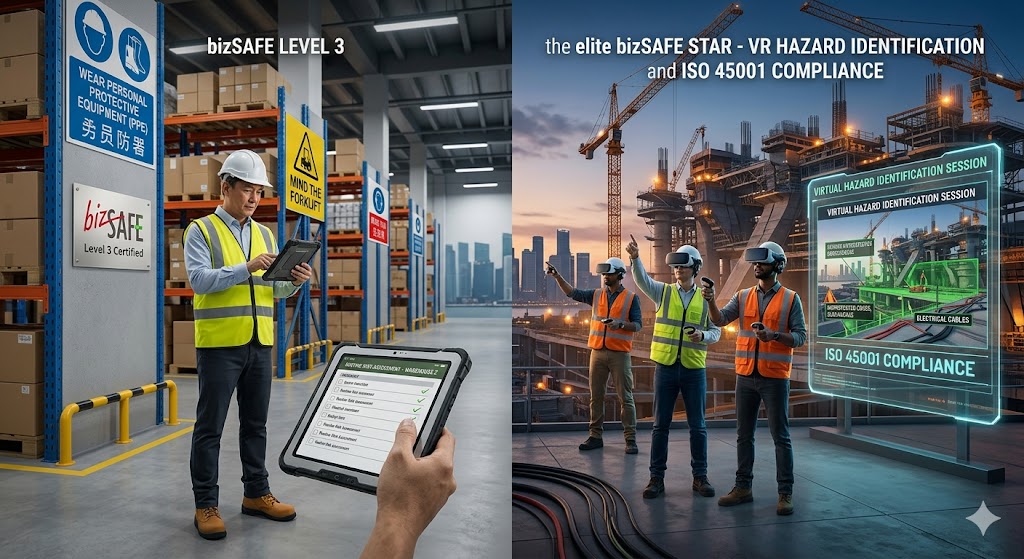
Virtual Reality (VR) transforms workplace safety training standards across Singapore entirely.40 SCAL Academy integrated VR into its essential JTC Safety Induction Course.40 Workers immerse themselves in highly realistic, simulated high-risk construction scenarios safely.40 They practice crucial hazard identification skills without facing actual physical dangers.40 This interactive methodology enhances compliance understanding far beyond traditional classroom lectures.40
Furthermore, Natural Language Processing (NLP) revolutionizes how companies analyze safety data.40 NLP algorithms process massive volumes of unstructured worker feedback and reports rapidly.40 This technology identifies hidden safety trends and emerging hazards with pinpoint accuracy.40 Additionally, interactive real-time dashboards utilizing tools like Power BI visualize metrics.40 Tableau serves a similar function for displaying highly complex data visually.40 They display injury rates and equipment downtime for immediate executive review.40
Machine Learning (ML) models represent the absolute frontier of predictive safety.40 These sophisticated algorithms adapt continually over time, improving their predictive accuracy dramatically.40 They forecast potential incident hotspots before tragic accidents can physically occur.40 Organizations deploying bizSAFE STAR utilize these ML models to fulfill continuous improvement. The integration of Artificial Intelligence presents tremendous opportunities for modern businesses.39 It ensures Singaporeans thrive in an AI-enabled economy without leaving safety behind.39 Advanced technology acts as the ultimate multiplier for any implemented WSH system.
Strategic Renewal and Maintenance Protocols
Achieving certification is merely the beginning of the safety compliance lifecycle. Both bizSAFE Level 3 and STAR statuses demand rigorous ongoing maintenance efforts. Certifications expire exactly three years from their official date of issue.6 Letting a certification lapse triggers catastrophic commercial consequences for the enterprise.6 The company loses its listing on the official WSH Council directory immediately.6 Consequently, ongoing government tenders disqualify the company from bidding automatically.6
Managing the Renewal Process Effectively
Companies must initiate the renewal process aggressively two months before expiry.6 They submit applications online directly via the bizSAFE Enterprise Application Form.16 For Level 3 renewals, a completely fresh Risk Management Implementation Audit is required.6 Companies cannot simply reuse outdated documentation from their previous successful certification.10 They must update hazard identification worksheets across all evolving work processes thoroughly.10
The renewal audit evaluates the active implementation of the Risk Management Plan.10 Auditors inspect current training records, emergency procedures, and recent incident reports.10 They conduct workplace walkthroughs to verify the physical presence of control measures.10 Furthermore, all risk assessments must reflect new 2026 Ministry of Manpower guidelines.10 For instance, the aforementioned lorry speed limiter rule must be explicitly addressed.7
Renewing bizSAFE STAR involves maintaining the underlying ISO 45001 certification rigorously. The company faces rigorous surveillance audits annually from their accredited certification body. Every three years, a full comprehensive re-certification audit occurs without exception.10 Maintaining STAR is significantly more resource-intensive than maintaining the Level 3 tier. However, the operational benefits and tender advantages justify the continuous corporate investment.
Navigating E-Services and the BUS Programme
The WSH Council provides comprehensive e-services to manage these crucial certifications. Companies utilize the bizSAFE Self-Help Excel tool to verify their active status.6 This tool requires the company’s official Unique Entity Number (UEN) specifically.6 Alternatively, users can input the company name exactly as registered under ACRA.6 The portal allows companies to request the official bizSAFE trademarked logo.6 However, this logo remains strictly reserved for Level 3 companies and above.6 Users can also request their specific e-certificate or bizSAFE certificate number.6
The Ministry of Manpower operates the strict Business Under Surveillance (BUS) Programme.6 Companies suffering severe safety lapses or fatalities enter this punitive program forcefully.6 Entering the BUS program suspends a company’s bizSAFE status absolutely immediately.6 Reinstating the bizSAFE status requires successfully exiting the rigorous BUS program first.19 The MOM monitors these companies exhaustively until profound systemic improvements are proven. This underscores the reality that bizSAFE is not merely a static certificate. It requires a living, breathing safety culture embedded in daily corporate operations.
Conclusion and Final Strategic Recommendations
The evolution of Singapore’s Workplace Safety and Health landscape is remarkably relentless. The nation achieved spectacular fatality reductions, dropping below 1.0 per 100,000 workers.1 However, maintaining this global leadership demands uncompromising dedication from every corporate entity. The bizSAFE framework remains the cornerstone of this magnificent national safety strategy.
In 2026, bizSAFE Level 3 stands as the absolute non-negotiable commercial baseline. It provides SMEs with robust risk management frameworks and critical tender eligibility.10 It enforces vital localized rules, including the new mandate for lorry speed limiters.7 Conversely, bizSAFE STAR represents the ultimate zenith of systemic occupational health management.10 By integrating ISO 45001, it empowers MNCs and high-risk industries to dominate globally.6
Executives face unprecedented legal accountability under the rigorous Code of Practice currently.25 Ignorance of workplace safety regulations courts devastating legal and financial ruin inevitably. Choosing the correct bizSAFE tier mitigates these immense risks powerfully and effectively. Ultimately, true safety excellence transcends mere regulatory compliance and documentation audits completely. It demands conscious, everyday choices echoing the “I Choose Safety” campaign deeply.30 Embracing these safety certifications builds resilient enterprises capable of thriving safely through 2026.
Works cited
- 0325 WSH Report 2025 – Singapore – MOM, accessed June 1, 2026, https://www.mom.gov.sg/newsroom/press-releases/2026/0325-wsh-report-2025
- WSH Advisory for Fatal Accidents in Second Half of 2025, accessed June 1, 2026, https://www.tal.sg/wshc/media/announcements/2026/wsh-advisory-for-fatal-accidents-in-second-half-of-2025
- Workplace Safety and Health Report 2025 – Singapore – MOM, accessed June 1, 2026, https://www.mom.gov.sg/-/media/mom/documents/safety-health/reports-stats/wsh-national-statistics/wsh-national-stats-2025.pdf
- ISO 45001 Singapore Workplace Safety: Closing the Gap in Injury Prevention, accessed June 1, 2026, https://sageshield.com/iso-45001-singapore-workplace-safety-gap-injury-prevention/
- bizSAFE Certification Levels Guide (Level 1 to Star) – Greensafe International, accessed June 1, 2026, https://www.greensafe.com.sg/bizsafe-certification-levels-guide/
- BizSAFE Singapore: All Levels, Requirements & Certification (2026) – AnjouHealth, accessed June 1, 2026, https://www.anjouhealth.com/bizsafe-singapore-complete-guide/
- About bizSAFE, accessed June 1, 2026, https://www.tal.sg/wshc/programmes/bizsafe/about-bizsafe
- Apply for bizSAFE, accessed June 1, 2026, https://www.tal.sg/wshc/programmes/bizsafe/apply-for-bizsafe
- BizSAFE Level 1 Singapore: CEO WSH Programme Guide (2026) – AnjouHealth, accessed June 1, 2026, https://www.anjouhealth.com/bizsafe-level-1-singapore-guide/
- bizSAFE Singapore 2026 | Complete Guide to Levels 1-4 & Star |, accessed June 1, 2026, https://sageshield.com/bizsafe-guide/
- bizSAFE Level 3 Risk Management Audit Checklist, accessed June 1, 2026, https://www.tal.sg/wshc/resources/publications/checklists-and-articles/bizsafe-level-3-risk-management-audit-checklist
- bizSAFE Level 3 Risk Management System – Absolute Kinetics Consultancy, accessed June 1, 2026, https://www.sg-akc.com/bizsafe-level-3-risk-management-system/
- bizSAFE STAR Certification in singapore: Enhancing MICE Sustainability, accessed June 1, 2026, https://isoconsultants.sg/service/bizsafe-star-certification-in-singapore/
- accessed June 1, 2026, https://sageshield.com/bizsafe-3-certification-guide-singapore/#:~:text=What%20is%20the%20difference%20between,OHSAS%2018001%2FISO%2045001%20standards.
- BizSafe Level 3 requirements Building Strategies – MOSAIC Eco-construction Solutions Pte Ltd, accessed June 1, 2026, https://mosaicsafety.com.sg/bizsafe-level-3-requirements-building-strategies/
- What is bizSAFE: Certifications, Processes, Benefits and Requirements – SCAL Academy, accessed June 1, 2026, https://scal-academy.com.sg/courses/course_detail/What-is-bizSAFE-Certifications-Processes-Benefits-and-Requirements
- bizSAFE Certification Singapore 2025 Guide for SMEs, accessed June 1, 2026, https://mosaicsafety.com.sg/bizsafe-certification-singapore-2025-guide-for-smes/
- New Requirements for bizSAFE Level 3, 4 and STAR, accessed June 1, 2026, https://www.tal.sg/wshc/media/announcements/2020/new-requirements-for-bizsafe-level-3-4-and-star
- bizSAFE Frequently Asked Questions, accessed June 1, 2026, https://www.tal.sg/wshc/programmes/bizsafe/frequently-asked-questions
- WSH Awards 2026, accessed June 1, 2026, https://www.tal.sg/wshc/wsh-awards
- Tender Information – Singapore – Land Transport Authority (LTA), accessed June 1, 2026, https://www.lta.gov.sg/apps/tender/
- Singapore Workplace Safety Regulations 2026: What Every Business Must Know, accessed June 1, 2026, https://sageshield.com/singapore-workplace-safety-regulations-2026/
- Code of practice on WSH duties of chief executives and board of directors gazetted as Approved Code of Practice – Allen & Gledhill, accessed June 1, 2026, https://www.allenandgledhill.com/sg/publication/articles/22614/code-of-practice-on-wsh-duties-of-chief-executives-and-board-of-directors-gazetted-as-approved-code-of-practice
- Code of Practice on Chief Executives’ and Board of Directors’ WSH Duties, accessed June 1, 2026, https://www.tal.sg/wshc/resources/publications/codes-of-practice/code-of-practice-on-chief-executives-and-board-of-directors-wsh-duties
- Code of Practice on Chief Executives’ and Board of Directors’ WSH Duties: What Employers Should Know – SingaporeLegalAdvice.com, accessed June 1, 2026, https://singaporelegaladvice.com/law-articles/code-of-practice-workplace-safety-health-employers/
- Code of Practice – Singapore Institute of Directors, accessed June 1, 2026, https://www.sid.org.sg/common/Uploaded%20files/Resources/2022_10_25CodeofPractice.pdf
- Code of Practice – Chief Executives’ and Board of Directors’ Workplace Safety and Health Duties – Year of Issue: 2022 – Eversafe Academy, accessed June 1, 2026, https://eversafe.edu.sg/code-of-practice-chief-executives-and-board-of-directors-workplace-safety-and-health-duties-year-of-issue-2022/
- Singapore saw workplace safety improve in H1 2025 – Staffing Industry Analysts, accessed June 1, 2026, https://www.staffingindustry.com/news/global-daily-news/singapore-saw-workplace-safety-improve-in-h1-2025
- a national strategy for workplace safety and health in singapore – International Labour Organization, accessed June 1, 2026, https://www.ilo.org/media/271506/download
- WSH Council Launches New Campaign to Encourage Everyday Choices That Prevent Workplace Incidents, accessed June 1, 2026, https://www.tal.sg/wshc/media/press-releases/2026/wsh-council-launches-new-campaign-to-encourage-everyday-choices-that-prevent-workplace-incidents
- Let’s Talk: Ask the Commissioner for WSH – 2025 in Review, 2026 in Focus https://www.youtube.com/watch?v=WeCgoXIcs0Y
- National WSH Campaign, accessed June 1, 2026, https://www.tal.sg/wshc/campaigns
- WSH circulars – Singapore – MOM, accessed June 1, 2026, https://www.mom.gov.sg/workplace-safety-and-health/wsh-circulars
- Search Volume | Digital Marketing Singapore, accessed June 1, 2026, https://digitalm.sg/seo-terms/search-volume/
- Importance Of Keyword Search Volume For SEO – OOm Singapore, accessed June 1, 2026, https://www.oom.com.sg/the-importance-of-keyword-search-volume-for-seo/
- Keyword research by SEO agencies in Singapore, accessed June 1, 2026, https://www.papercutsg.com/post/keyword-research-by-seo-agencies-in-singapore
- Top 13 Keyword Research Tools SEO Should Use in 2025 – Web Design Singapore, accessed June 1, 2026, https://mediaplus.com.sg/find-seo-keywords-for-free/
- Singapore SEO Secrets Revealed: The All-In-One Blueprint | Hashmeta, accessed June 1, 2026, https://hashmeta.com/blog/singapore-seo-secrets-revealed-the-all-in-one-blueprint/
- 0501 May Day Message 2026 – MOM, accessed June 1, 2026, https://www.mom.gov.sg/newsroom/press-releases/2026/0501-may-day-message-2026
WSH Technology & Innovation | Top Tech Advancements in Workplace Safety, accessed June 1, 2026, https://scal-academy.com.sg/courses/course_detail/WSH-Technology-and-Innovation