Introduction
Achieving bizSAFE Star certification in manufacturing precision engineering facilities demands a fully implemented Workplace Safety and Health Management System (WSHMS) that meets SS ISO 45001:2018 or SS 651:2019 standards, combined with a successful Risk Management Implementation Audit conducted by a MOM approved WSH auditor. It builds on the earlier milestone of Achieving bizSAFE Certification before organizations mature their systems to Star level. For precision engineering manufacturers-whether operating CNC machining centers, tool and die workshops, semiconductor fabrication lines, or medical device clean rooms-this represents the highest level of recognition under Singapore’s national bizSAFE programme and signals a mature, shop-floor-integrated safety culture.
This guide covers the complete bizSAFE journey within bizSAFE Singapore, from current safety status through to bizSAFE Star certification for precision engineering manufacturers. It addresses the specific hazards of high-speed rotating machinery, hazardous chemical handling, clean room operations, and tight-tolerance production environments. Topics outside the scope of precision manufacturing-such as construction-specific safety or marine industry regulations-are not covered here. The target audience includes precision engineering facility managers, safety officers, quality managers, and top management, as well as readers in adjacent operational areas such as facilities management, seeking to enhance workplace safety standards while maintaining manufacturing precision and productivity.
Direct answer: Manufacturing precision engineering facilities can achieve bizSAFE Star by progressing through bizSAFE Levels 1–4, implementing an ISO 45001-compliant WSH management system tailored to their specific operational hazards, obtaining third-party certification from SAC accredited certification bodies, and passing a Risk Management Implementation Audit using MOM’s prescribed checklist.
By reading this guide, you will:
-
Understand the specific bizSAFE Star requirements that apply to precision engineering manufacturing operations
-
Learn how to integrate high-level WSHMS documentation with daily shop-floor operations through visual management systems
-
Follow a phased implementation timeline with practical milestones for CNC, clean room, and chemical-intensive facilities
-
Identify common certification challenges unique to precision manufacturing and their proven solutions
-
Gain clarity on costs involved, renewal process requirements, and how to track and maintain bizSAFE status over time while realizing business benefits
Understanding bizSAFE Star Requirements for Manufacturing Precision Engineering
bizSAFE Star is the highest level of recognition under Singapore’s national workplace safety certification programme. bizSAFE is a five-level workplace safety certification program administered within Singapore’s workplace safety ecosystem by the Workplace Safety and Health Council, and bizSAFE Star sits at the apex, requiring organizations to demonstrate a comprehensive workplace safety and health management system that goes well beyond basic compliance. bizSAFE STAR requires ISO 45001 or SS 651 certification from an accredited body, plus a Risk Management Audit Report submitted to the WSH Council. The bizSAFE program was launched in Singapore in 2007 and has since grown to encompass approximately 43,000 bizSAFE certified companies across various industries.
For manufacturing precision engineering facilities, achieving bizSAFE Star means addressing multi-dimensional hazards: high-speed rotating machinery (lathes, CNC mills, grinders), reactive and hazardous chemicals (coolants, etchants, solvents), particulate-sensitive clean room environments, and ergonomic challenges associated with microscopic tolerance work. Manufacturing companies must tailor risk assessments to their specific operational hazards rather than relying on generic templates, and these advanced requirements are especially relevant in higher risk sectors such as precision engineering operations involving machinery, chemicals, and clean rooms-a principle that distinguishes successful bizSAFE Star implementations from superficial ones.
Critical Workplace Safety and Health Standards for Precision Engineering
SS ISO 45001:2018 forms the backbone of bizSAFE Star certification. It requires documented leadership commitment, structured worker participation, systematic hazard identification, legal compliance registers, operational controls, performance evaluation, and continual improvement. For precision engineering manufacturers, the standard’s clauses on operational planning and control translate directly into machine-specific safe work procedures, chemical handling protocols, and clean room safety instructions.
SS 651:2019 applies specifically to safety and health management in chemical-intensive operations. For precision engineering facilities that use semiconductor etchants, reactive coating materials, or toxic solvents, SS 651:2019 adapts ISO 45001 to include process safety requirements covering chemical reactions, storage, handling of toxic, flammable, and corrosive substances. Organizations certified under SS 651 are considered to meet ISO 45001 requirements as well, making it a strategic choice for chemical-heavy precision engineering operations.
The connection between these international safety and health standards and Singapore’s bizSAFE framework is direct: bizSAFE Star certification requires one of these recognized certifications, ensuring that bizSAFE certified companies operate management systems that meet both global and local regulatory benchmarks.
Regulatory Framework, Risk Management, and Compliance Requirements
The Ministry of Manpower (MOM) enforces WSH Risk Management Regulations that require all workplaces to conduct risk assessments, implement risk control measures, and monitor their effectiveness. The WSH Act, as the governing health act behind these duties, imposes specific obligations on occupiers regarding machinery safety, chemical handling, and worker protection-all central concerns in precision engineering environments.
A significant regulatory development affects precision engineering directly: as of 1 January 2025, the WSH Act’s Fifth Schedule expanded the classes of higher-risk machinery to explicitly include lathes, milling machines, sheet benders, rollers, and cutting machines. This means stricter duties for manufacturers, suppliers, and occupiers around guarding, safe operation information, and maintenance-requirements that directly feed into the risk management implementation plan for any precision engineering facility pursuing bizSAFE Star.
Risk Management is essential for compliance with WSH regulations, and the RM Implementation Audit uses MOM’s prescribed checklist (updated as of 1 January 2021) to verify that a facility’s risk management plan is not just documented but actively implemented on the shop floor. This regulatory foundation sets the stage for the practical implementation work required to achieve bizSAFE Star status, while maintaining the company’s bizSAFE status depends on continuing compliance and timely renewal after certification.
Precision Engineering Facility-Specific Implementation Requirements
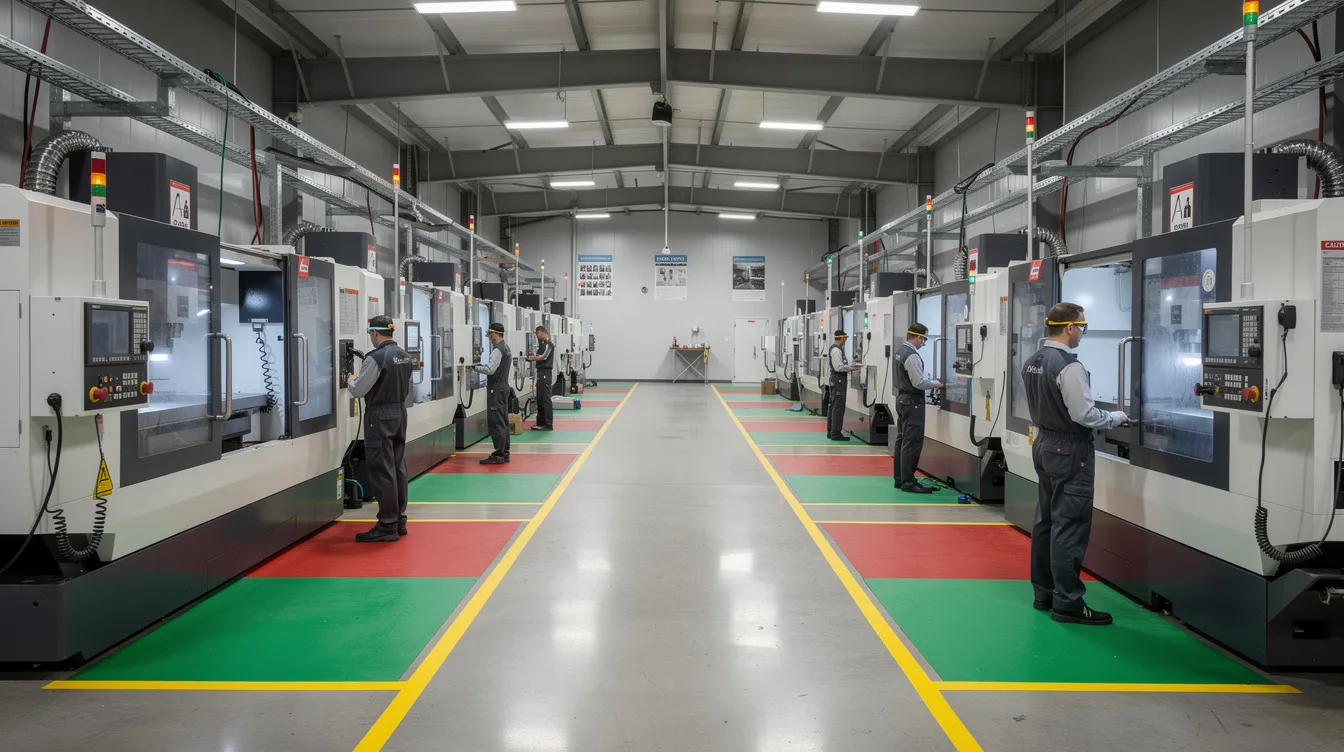
Building on the regulatory framework, precision engineering facilities must translate broad safety requirements into specific, actionable protocols that address the unique hazards of their operations. Unlike general manufacturing, precision engineering combines high-energy machinery, microscopic tolerances, chemically sensitive processes, and often clean room environments-each demanding tailored safety approaches within the WSHMS.
Machinery and Equipment Safety Integration
Implementation of Lock Out Tag Out (LOTO) systems is mandatory under Regulation 16 of the WSH General Provisions Regulations before any maintenance, lubrication, or adjustment work on CNC machines, lathes, milling machines, and automated production lines. LOTO procedures must specify every energy source-electrical, pneumatic, hydraulic, mechanical-and ensure trained personnel apply individual locks before work begins. bizSAFE Star helps mitigate risks in environments involving heavy machinery and automated assembly by requiring these procedures to be documented, trained, and verified through internal audits.
Machine guarding requirements under the WSH General Provisions mandate that dangerous parts-flywheels, moving parts in motors, belts, spindles-be securely fenced or otherwise safeguarded. For precision manufacturing equipment, this means selecting guards that provide adequate protection without compromising operator access to workpieces or measurement instruments. Safety interlocks on machine enclosures should be wired to prevent operation when guards are open, and emergency stop mechanisms must be tested during pre-shift inspections.
Calibration and maintenance safety extends to overhead lifting equipment commonly used to handle heavy workpieces, dies, and molds. Lifting gear and appliances require thorough examination by an authorized examiner every six months, with mandatory record keeping. Workplace risk assessments must cover the specific hazards of each piece of equipment, including chip ejection trajectories from CNC operations, coolant splash zones, and pinch points on automated tool changers.
Chemical and Material Handling Protocols
Safety Data Sheet (SDS) management forms the foundation of chemical safety in precision engineering. Facilities must maintain a current chemical inventory with SDSs for every cutting fluid, solvent, cleaning agent, etchant, and coating material on site. These documents must be accessible at point of use-best practice involves QR codes on chemical storage cabinets linking to digital SDS repositories.
Personal protective equipment (PPE) selection must match specific chemical exposure scenarios. Semiconductor etching operations require chemical-resistant gloves and face shields rated for the specific acids in use, while coolant mist exposure in CNC operations may demand respiratory protection. The Tax Incentives Scheme for Chemical Hazards Control allows companies to claim accelerated depreciation on ventilation and scrubber systems that reduce toxic substance concentrations below 50% of the permissible exposure level (PEL)-or below 10% PEL if already under the 50% threshold.
Ventilation and exposure control systems are critical for precision engineering work environments. Local exhaust ventilation at grinding stations, mist collectors on CNC machines, and fume hoods in chemical preparation areas must be designed, installed, and regularly verified to maintain airborne concentrations within safe limits.
Clean Room and Controlled Environment Safety
Emergency response procedures for semiconductor and medical device manufacturing clean rooms require specialized protocols that account for both personnel safety and contamination control, and teams should be ready to demonstrate emergency preparedness during bizSAFE audits, including evacuation, lockdown, and first aid readiness where relevant to the facility. Chemical spills in clean rooms demand validated recovery procedures that ensure equipment and air handling systems are free from contaminants, with post-incident particle count testing to confirm environmental integrity.
Integration of safety protocols with contamination control in precision manufacturing creates unique challenges. Gowning procedures, airlock entry systems, and material transfer protocols must satisfy both ISO 14644 clean room standards and WSH requirements simultaneously. Safety equipment-fire extinguishers, emergency showers, spill kits-must be clean room compatible to avoid introducing particulates.
Key facility-specific implementation requirements:
-
Machine-specific LOTO procedures for every piece of equipment, documented and trained
-
Chemical inventory with point-of-use SDS access and PPE matrices
-
Validated clean room emergency response procedures that preserve environmental integrity
-
Lifting equipment inspection records maintained on a six-monthly cycle
These facility-specific requirements form the operational backbone of the WSHMS. The next section explains how to systematically integrate them into daily shop-floor operations through a phased implementation process.

Step-by-Step Implementation Process with Shop-Floor Integration
The critical success factor for achieving bizSAFE Star in precision engineering facilities is bridging the gap between high-level WSHMS documentation and daily manufacturing operations. Paper systems that exist only in binders fail audits and-more importantly-fail to protect workers. Visual management tools, worker participation mechanisms, and systematic evidence collection create the living system that auditors expect and that genuinely reduces incidents.
Phase 1: Foundation Building and Management System Development
This phase establishes leadership commitment and the initial system framework, typically spanning months 1–3 of the bizSAFE journey.
Complete bizSAFE Levels 1–4 certification requirements:
-
Level 1 requires top management to attend a half-day bizSAFE workshop to demonstrate management commitment. This is non-negotiable-leadership commitment is crucial in establishing a strong workplace safety culture.
-
bizSAFE Level 2 requires a Risk Management Champion to complete an approved risk management course and attend the approved bizSAFE course for Level 2. The course covers hazard identification, risk assessment methodology, and control measures before this individual develops the RM Implementation Plan as the formal output for progressing through this stage.
-
Level 3 requires implementing a comprehensive risk assessment covering all operational hazards. Risk Management Plans must be implemented for bizSAFE Level 3, and Level 3 certification typically takes 4 to 8 weeks to complete.
-
Level 4 requires developing a Workplace Safety and Health Management System supported by a WSH implementation plan for structured roll-out, covering hazard identification, risk control measures, training, emergency response, and performance monitoring, with the appointed WSHMS Programme Lead typically required to attend the relevant course before enterprise progression to this stage.
Note that bizSAFE Levels 1 and 2 certificates are non-renewable after six months, so facilities should plan their progression timeline carefully to avoid certification lapses.
Develop ISO 45001-compliant WSHMS documentation including policies, procedures, and work instructions tailored to precision engineering operations. A gap analysis against current practices is essential-facilities already certified to ISO 9001 or ISO 14001 will find significant overlap in document control, management review, and internal audit structures.
Establish safety committees with representation from production, engineering, quality, and maintenance departments. Worker participation is an ISO 45001 requirement and a critical audit focus area. Operators who perform daily machining, chemical handling, and clean room work must have a formal voice in the safety and health management system.
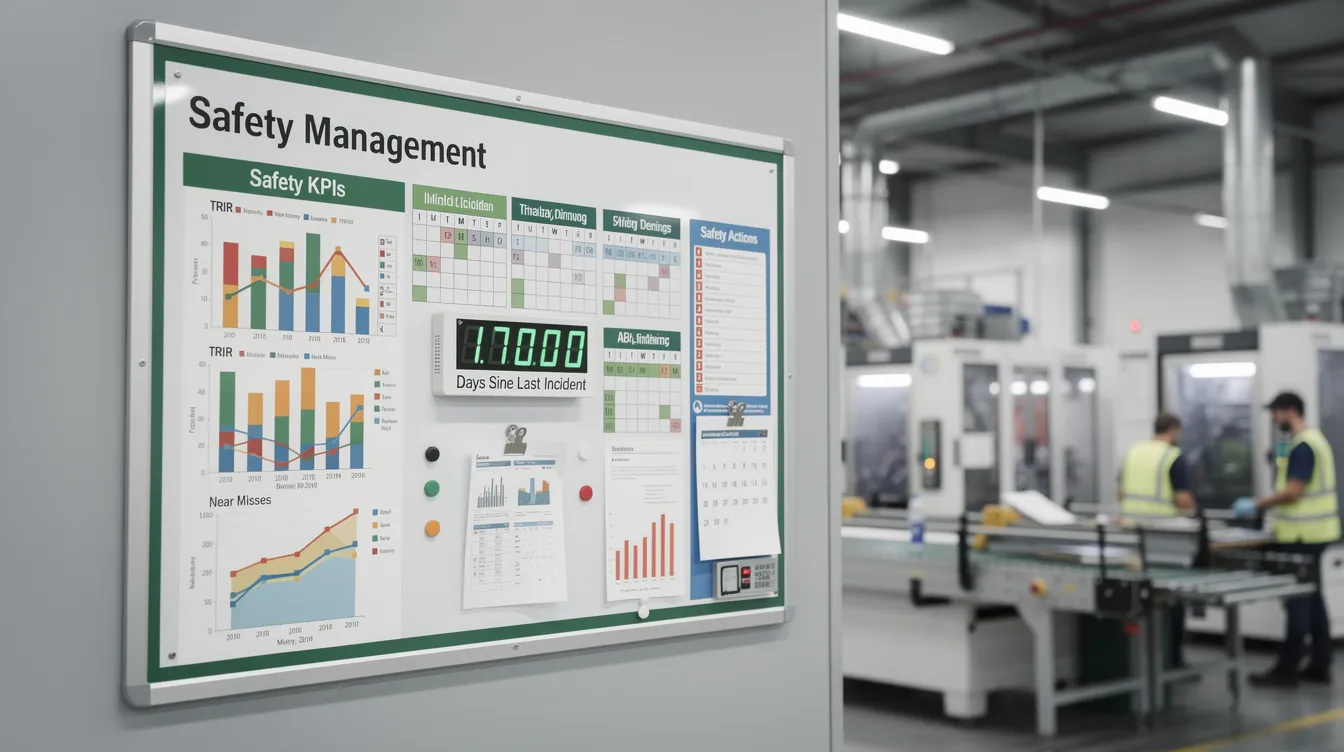
Create visual safety management boards displaying Key Performance Indicators (KPIs), incident reports, near-miss logs, and improvement initiatives at each manufacturing work cell. These boards become the physical connection point between the formal WSHMS and every worker’s daily routine.
Phase 2: Shop-Floor Integration with Visual Management Systems
This phase transforms documented procedures into visible, daily practices across the production floor. The table below compares different visual management approaches specifically suited to manufacturing precision engineering facilities:
|
Visual Tool |
Shop-Floor Application |
WSHMS Integration |
|---|---|---|
|
Safety Work Instructions |
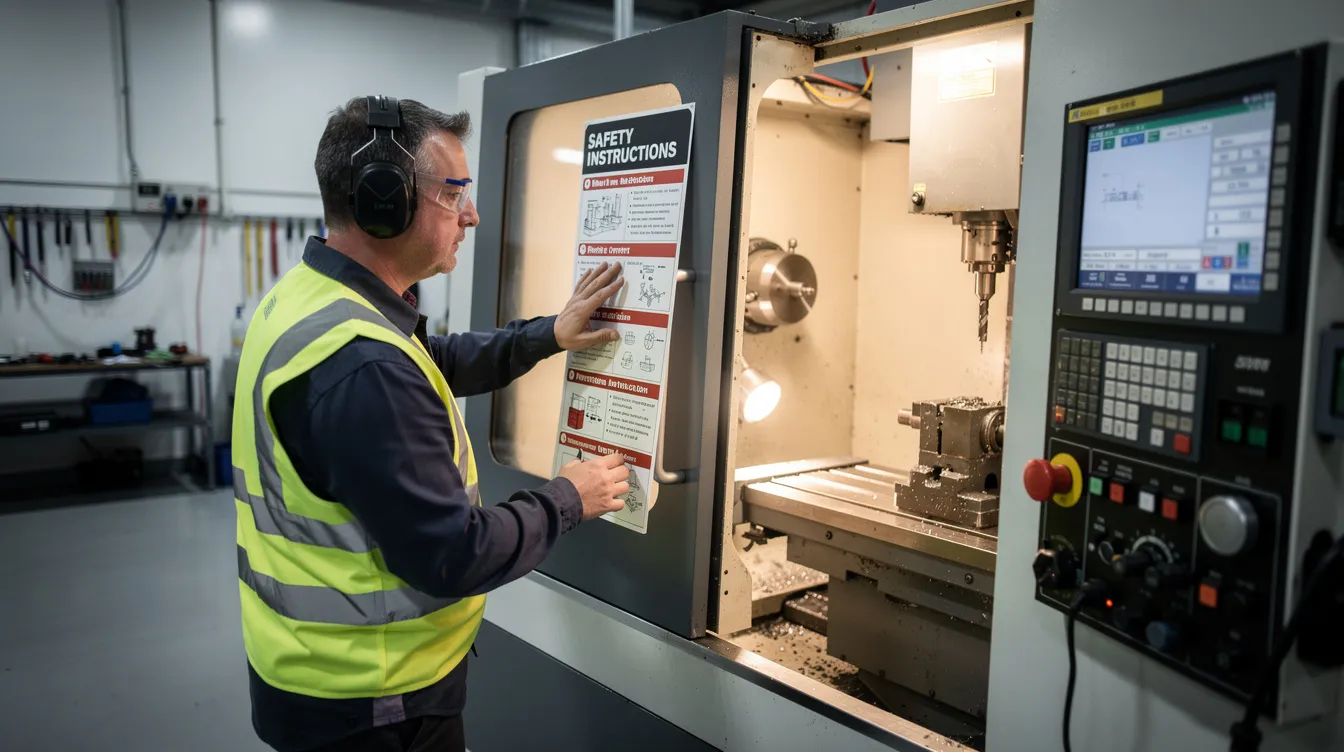
Laminated cards at each CNC machine and work station showing machine-specific hazards, required PPE, and emergency procedures |
Links directly to documented procedures and risk assessments in the formal system; provides auditable evidence of communication |
|
Hazard Identification Boards |
Color-coded displays at each work area showing machine-specific risks (chip ejection, coolant splash, pinch points) and corresponding control measures |
Connected to formal hazard registers and control matrices; updated when risk assessments are revised |
|
Daily Safety Checklists |
Pre-shift inspections covering equipment guard integrity, emergency stop function, coolant levels, ventilation operation, and clean room conditions |
Feeds into management review data, performance monitoring KPIs, and trend analysis for continual improvement |
|
Chemical Hazard Signage |
GHS-compliant labels and exposure limit displays at chemical storage and use points with QR codes linking to digital SDSs |
Satisfies SDS accessibility requirements and documents chemical risk communication |
|
Safety Suggestion Boards |
Dedicated boards where operators post improvement ideas, near-miss observations, and safety initiative proposals |
Provides documented evidence of worker participation required by ISO 45001 and examined during RM implementation audit |
These visual tools create a seamless connection between what workers do every day and what the formal management system documents. When a MOM approved WSH auditor walks the shop floor during the RM implementation audit, they observe these tools as evidence that the WSHMS is implemented-not just written. The risk assessment methodology becomes visible through hazard boards; the risk management implementation plan becomes tangible through daily checklists and safety work instructions.
Effective documentation is key to achieving and maintaining bizSAFE Star certification, and visual management systems serve dual purposes: they communicate safety requirements to workers in real time and simultaneously generate the records that demonstrate system implementation during audits.
Phase 3: Third-Party Certification and Audit Preparation
Achieving bizSAFE Star certification requires completion of foundational levels and obtaining ISO 45001 certification, followed by the RM Implementation Audit. This phase typically spans months 9–12.
Engage Singapore Accreditation Council (SAC) accredited certification bodies for ISO 45001:2018 or SS 651:2019 assessment. The bizSAFE STAR audit must be conducted by an accredited body-non-accredited certifications are no longer accepted for bizSAFE Star applications. Only companies certified at the relevant level may use the bizSAFE logo under programme rules. The certification process involves Stage 1 (documentation review) and Stage 2 (site audit with shop-floor verification). Safety consultants recommend coordinating the ISO certification audit and bizSAFE RM audit within the same timeline to reduce disruption, cost, and redundancy.
Schedule the MOM-approved Risk Management Implementation Audit to address Singapore-specific requirements. Many facilities aim to reach at least bizSAFE Level 3 before tendering for larger public or commercial projects. The RM implementation audit report must use MOM’s prescribed checklist and covers hazard identification, risk control measures, legal compliance, emergency response preparedness, and increasingly, areas such as infectious disease preparedness and mental health considerations. A Risk Management Audit Report is mandatory for bizSAFE STAR, and Companies must submit their bizSAFE STAR application through WSH Council along with this report. Where relevant, SMEs can also review support schemes from the Singapore government to help manage certification and audit costs.
Conduct internal audits and management reviews with photographic evidence of shop-floor implementation and worker participation. Organizations must conduct regular internal audits to comply with bizSAFE requirements-these should be scheduled quarterly during the implementation phase. Collect evidence including:
-
Photographs of machine guards, safety signage, and visual management boards in active use
-
Completed pre-shift checklists and toolbox talk attendance records
-
Minutes from safety committee meetings showing worker-raised issues and management responses
-
Training hours records demonstrating competency development across all shifts
-
Incident and near-miss reports with documented follow-up actions
Companies must pass an independent audit to maintain bizSAFE Star certification. A successful audit depends on demonstrable shop-floor integration-auditors specifically look for alignment between what the documentation says and what actually happens at each work cell.
Common Implementation Challenges and Practical Solutions
Precision engineering manufacturers face distinct obstacles during the bizSAFE certification process. These challenges stem from the fundamental tension between production demands-tight tolerances, delivery schedules, clean room integrity-and comprehensive safety system implementation. Below are the most common challenges with proven solutions drawn from industry experience.
Integrating Safety with Production Efficiency
Production pressure in precision engineering frequently leads to shortcuts: bypassing safety interlocks to speed up machine setup, delaying preventive maintenance to meet delivery deadlines, or skipping pre-shift safety checks during overtime periods. This directly undermines the WSHMS and creates identified risks that auditors will flag.
Solution: Implement lean safety principles that treat safety activities as value-added rather than overhead. Schedule preventive maintenance during planned downtimes and integrate safety checks into existing machine setup procedures rather than adding separate steps. Involve operators in selecting safety guards and interlocks that provide protection with minimal interference to production operations. When operators participate in designing safety solutions, compliance improves because the controls reflect actual workflow realities.
Managing Complex Documentation Requirements
Precision engineering facilities often struggle with the volume of SOPs, work instructions, training records, risk assessments, chemical inventories, clean room validation records, and environmental monitoring logs required for a comprehensive workplace safety system. Document management becomes a barrier rather than a tool.
Solution: Utilize digital management systems with mobile access for shop-floor workers. Implement QR codes on machines and chemical storage linking physical equipment to digital work instructions, risk assessments, and SDSs. Automated document control workflows ensure version currency and eliminate the risk of outdated procedures remaining on the shop floor. Cloud-based WSHMS software consolidates all documentation into a single, auditable platform.
Ensuring Worker Participation and Buy-In
Operators in precision manufacturing often perceive safety activities as administrative overhead that competes with their core machining or assembly work. Without genuine worker engagement, the WSHMS becomes a paper system.
Solution: Establish safety suggestion programs with recognition systems that reward safety initiatives proposed by operators. Assign experienced operators as “machine safety champions” responsible for specific equipment zones. Involve operators directly in risk assessment activities for their own work areas-this builds ownership and captures hazard knowledge that desk-based assessments miss. Regular safety training specific to precision engineering hazards, including incident case studies from the sector, demonstrates real consequences and reinforces the value of safe practices. Enhanced training support should go beyond compliance requirements to develop genuine health capabilities across the workforce.
Maintaining Certification During Production Changes
Precision engineering facilities frequently introduce new machine tools, change chemical formulations, add product lines, or modify clean room configurations. Each change potentially introduces new hazards that the existing WSHMS may not address.
Solution: Develop formal change management procedures embedded within the WSHMS that automatically trigger safety reviews when introducing new products, processes, chemicals, or equipment. Every change request form should include a safety impact assessment section reviewed by the Risk Management Champion before implementation. This is particularly critical for chemical processes-introducing a new etchant or coating material requires updated risk assessments, SDS integration, PPE review, and potentially modified ventilation requirements. Regular WSH risk management reviews ensure the system remains current as operations evolve.
These challenges are manageable when addressed systematically within the WSHMS framework. The key is building safety into operational processes rather than layering it on top.
Conclusion and Implementation Roadmap
Achieving bizSAFE Star certification for manufacturing precision engineering facilities requires systematic integration of an ISO 45001-compliant management system with daily shop-floor operations through visual management, worker participation, and rigorous documentation. bizSAFE Star is the highest level of recognition under Singapore’s national bizSAFE programme and represents a genuine commitment to occupational health and safety excellence-not merely a compliance exercise. bizSAFE Star certification is valid for three years, and companies must renew certification before it expires, with renewal applications submitted two months before expiry and a recertification audit required for renewal.
The tangible benefits justify the investment: bizSAFE certification enhances company reputation and credibility within the precision engineering supply chain. Obtaining bizSAFE certification qualifies companies for government tenders, and bizSAFE Star status provides enhanced tender scores for public sector bids. bizSAFE-certified companies can reduce insurance premiums significantly, and companies with bizSAFE certification enjoy free advertising of services through the bizSAFE marketplace. Most importantly, bizSAFE certification helps reduce workplace incidents and accidents-protecting the people who make precision manufacturing possible.
Immediate next steps:
-
Conduct a gap analysis of current safety practices against ISO 45001:2018 requirements and MOM’s RM audit checklist, focusing on machinery safety, chemical handling, and clean room operations specific to your facility
-
Engage experienced HSE consultants familiar with precision engineering hazards to develop a tailored implementation roadmap-facilities already holding ISO 9001 or ISO 14001 can leverage existing management system structures
-
Develop a progressive timeline for bizSAFE level achievement, budgeting 9–12 months for medium-sized facilities (longer for complex semiconductor or medical device operations with extensive clean room and chemical processes)
-
Begin top management commitment activities immediately-the managing director or equivalent must attend the Level 1 bizSAFE workshop to set the foundation for the entire programme
Related topics worth exploring include integrating ISO 14001 environmental management with your ISO 45001 system for combined efficiency, Design for Safety principles applied to precision engineering facility layout, and ongoing monitoring of regulatory changes from government agencies including expanded machinery safety requirements under the WSH Act.
Additional Resources
-
MOSAIC Safety bizSAFE Star consultation services – implementation support specifically designed for manufacturing and precision engineering facilities seeking bizSAFE Star certification
-
MOM-approved auditor directory – available through the WSH Council for locating qualified auditors to conduct Risk Management Implementation Audits
-
WSH Council bizSAFE programme resources – including application forms, audit checklists, and industry-specific guidance documents for manufacturing safety management
-
Singapore Standards e-shop – for obtaining SS ISO 45001:2018 and SS 651:2019 standard documents required during implementation
-
bizSAFE certification ROI analysis – understanding the financial returns including insurance costs reduction and tender eligibility for Singapore businesses pursuing certification