
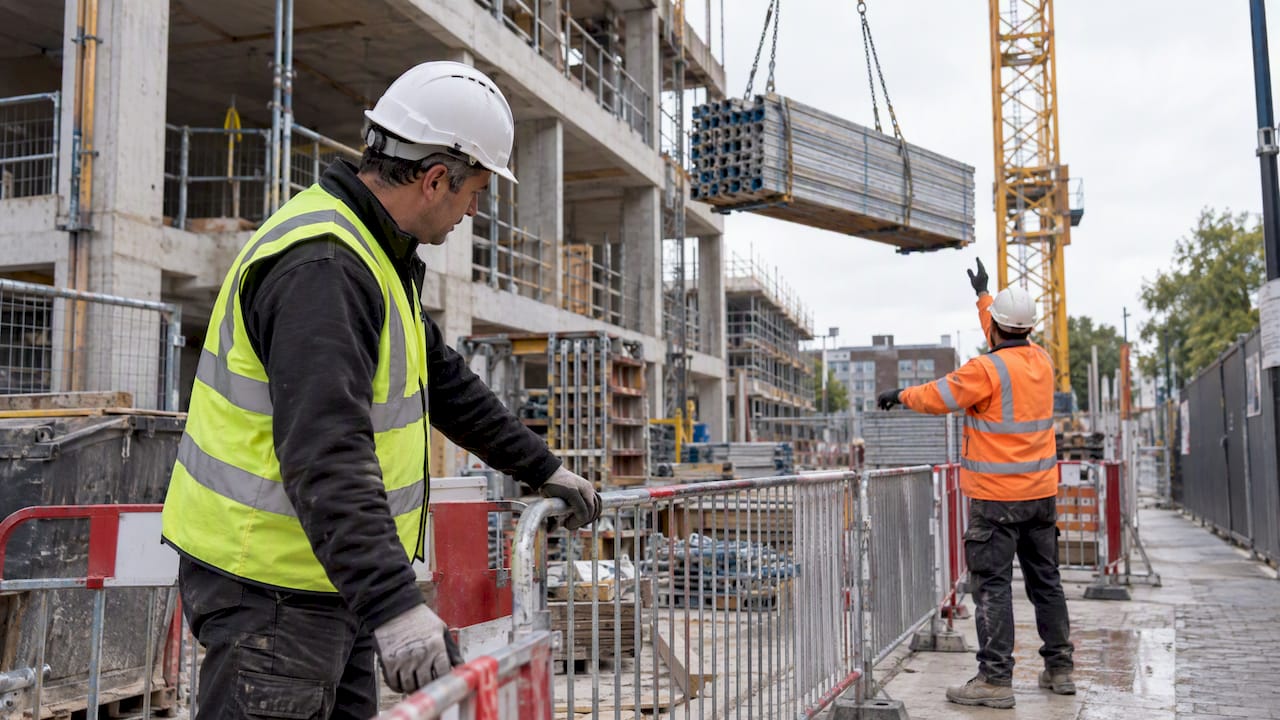
ISO 45001 is structured into 10 clauses, and Clauses 4 through 10 contain the auditable occupational health and safety requirements, as the ISO/TC 283 FAQ confirms. Those seven clauses cover context, leadership, planning, support, operation, performance evaluation and improvement, and they follow the Plan-Do-Check-Act cycle that ISO 45001 is built on.
TL;DR:
- Every requirement clause carries equal weight, and Annex A offers interpretation guidance only; auditors do not assess conformity against the annex.
- On a construction site, a permit to work is Do, weekly inspection tallies are Check, and revised methods after near misses are Act.
- Clause 8 requires contractor coordination, procurement controls, and periodic emergency drills for credible site hazards; teams must review findings and revise plans afterward.
- Define the documented scope by naming sites, activities, legal entities, and contractor interfaces, then record why any process or activity falls outside it.
- Certification is voluntary and does not transfer legal responsibility; before commissioning an audit, verify that the certification body holds appropriate accreditation.
Table of Contents
- 1. Which clauses make up ISO 45001?
- 2. How do the clauses map to Plan, Do, Check, Act?
- 3. Clause 4: context, interested parties and scope
- 4. Clause 5: leadership and worker participation
- 5. Clause 6: planning for hazards, risks, legal requirements and objectives
- 6. Clause 7: support, competence and documented information
- 7. Clause 8: operational planning, outsourcing and emergency preparedness
- 8. Clause 9: performance evaluation
- 9. Clause 10: improvement and corrective action
- 10. Which documented information do auditors expect to see?
- 11. How do you implement the clauses and get certified?
- 12. How does each clause look on a real construction project?
- 13. How do the clauses support compliance with regional construction safety rules?
- 14. What do construction stakeholders owe under each clause?
- 15. What challenges do teams face, and how can they solve them?
- 16. What practical lessons stand out from applying clause-based systems?
- 17. How we help you turn the clauses into a working system
- FAQ
- Sources
1. Which clauses make up ISO 45001?
The ten clauses fall into two groups. The first three frame the standard, and the remaining seven carry the requirements an auditor tests. Standards Australia’s preview of the adopted text confirms that Clauses 1 to 3 set scope, references and definitions, while Clauses 4 to 10 contain the requirements used to assess conformity.
- Clause 1, Scope: states what the standard is for and which organizations can use it.
- Clause 2, Normative references: lists documents the standard depends on. For this standard, it is effectively a placeholder.
- Clause 3, Terms and definitions: fixes the vocabulary, such as hazard, risk, worker and incident.
- Clause 4, Context of the organization: internal and external issues, interested parties and system scope.
- Clause 5, Leadership and worker participation: top management commitment, policy, roles and consultation.
- Clause 6, Planning: hazard identification, risk assessment, legal requirements and objectives.
- Clause 7, Support: resources, competence, awareness, communication and documented information.
- Clause 8, Operation: operational controls, outsourcing, procurement and emergency preparedness.
- Clause 9, Performance evaluation: monitoring, internal audit and management review.
- Clause 10, Improvement: incidents, corrective action and continual improvement.
Annex A is guidance only. It helps you interpret the requirements, but nobody audits against it.
2. How do the clauses map to Plan, Do, Check, Act?
The PDCA cycle is the engine behind the standard. Reading the clauses through it turns a list of headings into a working sequence you can schedule and assign.
- Plan (Clauses 4 to 6): define your context and scope, secure leadership commitment and policy, then plan through hazard identification, risk assessment and objectives. The practical outputs are a documented scope, a risk methodology and a register of legal requirements.
- Do (Clauses 7 and 8): provide the people, skills, communication and records, then run operations under control. The outputs are competence records, operational procedures, contractor controls and tested emergency plans.
- Check (Clause 9): measure what happens, investigate it, audit it and review it at management level. The outputs are indicators, audit reports and management review minutes.
- Act (Clause 10): fix what failed and improve what worked. The outputs are corrective action records and updated risk assessments.
On a construction site, the mapping shows up in familiar routines. A permit-to-work procedure is Do. A weekly inspection tally is Check. A revised method statement after a near miss is Act. Contractor control at the point of work cuts across all four, because a subcontractor’s crew is covered by the same cycle as your own.
The ISO/TC 283 Q&A adds a useful caution: the grouping of requirements does not indicate a hierarchy. Every clause must be met.
3. Clause 4: context, interested parties and scope
Clause 4 decides how large your system is and what it must account for, so every later clause inherits its decisions.
Clause 4.1 asks you to determine the internal and external issues that affect your ability to achieve the intended outcomes of your OH&S system. Internal issues include your workforce mix, equipment age, subcontracting model and safety culture. External issues include client requirements, the regulatory climate, weather exposure, the density of the surrounding site and the local labor market.
Clause 4.2 requires you to identify interested parties and their relevant needs and expectations. Workers come first, but the list also includes regulators, clients, insurers, neighbors, principal contractors and suppliers. You then decide which of those needs become legal or other requirements you must follow. That judgment feeds directly into Clause 6.1.3.
Clause 4.3 sets the scope of the system. It must consider the issues and requirements above, as well as planned or performed work-related activities, and it must be available as documented information. A vague scope is a common audit finding. A good one names the sites, activities, legal entities and contractor interfaces that are in or out.
Clause 4.4 requires you to establish, implement, maintain and continually improve the system, including the processes needed and their interactions. In plain terms, the system is a living arrangement, not a binder.
Context also shapes risk prioritization. A contractor working at height on a congested urban site faces different priorities than one running a remote earthworks project, even if both hold the same certificate. Record the reasoning behind your scope. When an auditor asks why a process is excluded, a rationale tied to your context analysis ends the discussion quickly.

4. Clause 5: leadership and worker participation
Clause 5 puts accountability on top management and gives workers a formal voice. The HSE’s guidance describes ISO 45001 as a systemic management tool rather than a compliance checkbox, and Clause 5 is where that idea becomes concrete.
Clause 5.1 requires top management to demonstrate leadership and commitment. That means taking overall responsibility, ensuring the policy and objectives fit the strategy, integrating the system into business processes, providing resources, and protecting workers from reprisal when they report hazards.
Clause 5.2 requires an OH&S policy that is appropriate to your organization and includes commitments to:
- provide safe and healthy working conditions
- eliminate hazards and reduce risks
- fulfill legal and other requirements
- continually improve the system
- consult with and enable the participation of workers
Clause 5.3 assigns roles, responsibilities and authorities, and communicates them within the organization. In construction, that includes who can stop work, who approves a permit and who signs off a temporary works design.
Clause 5.4 requires consultation and participation of workers, including non-managerial workers, at every level. You must provide mechanisms, time and training, remove barriers to participation, and emphasize involvement in hazard identification, incident investigation and objective setting.
Pro Tip: Minute your toolbox talks and safety committee meetings so they show which worker suggestions were adopted. An auditor looking for participation wants evidence that input changed something.
5. Clause 6: planning for hazards, risks, legal requirements and objectives
Clause 6 is the technical core of the standard. It converts your context and policy into specific, prioritized actions.
Clause 6.1.1 requires you to consider the issues from Clause 4 and determine the risks and opportunities that need addressing. Clause 6.1.2 then splits into four parts. Hazard identification (6.1.2.1) must be ongoing and proactive, and it covers routine and non-routine activities, human factors, emergencies, past incidents, and people at or near your work, including visitors and contractors. OH&S risk assessment (6.1.2.2) evaluates risks from identified hazards while taking existing controls into account, and you must keep your methodology and criteria as documented information. Assessment of other risks (6.1.2.3) covers opportunities to improve OH&S performance, such as adapting work to workers or eliminating hazards through design.
Clause 6.1.3 requires you to determine and keep access to applicable legal and other requirements and to know how they apply. Clause 6.1.4 requires you to plan actions to address those risks, opportunities and requirements, and to prepare for emergencies. Clause 6.2 covers objectives. They must be measurable where practicable, consistent with the policy, monitored and updated. You also plan who does what, with which resources, by when and how results are evaluated.
A practical sequence for carrying out Clause 6:
- Fix your risk method first: scales, criteria and who may approve acceptance of a risk.
- Walk the work and list hazards for each activity, including non-routine tasks and contractor interfaces.
- Assess each risk using the method, then apply the hierarchy of controls from elimination downward.
- Record the legal and other requirements that apply and link each to the process it governs.
- Set objectives from the highest risks and gaps, with owners, resources and dates.
- Plan how objectives and controls will be integrated into operations and how results will be evaluated.
Pro Tip: Change your risk assessment whenever the work changes. A new crane lift, a new subcontractor or a revised sequence of works all trigger a fresh look.
6. Clause 7: support, competence and documented information
Clause 7 supplies what the system needs to function. It is rarely dramatic, but weak support is where many systems quietly fail.
The requirements break down as follows:
- Resources (7.1): people, infrastructure, equipment and funding sufficient to run the system.
- Competence (7.2): determine the competence workers need, ensure it through education, training or experience, and keep evidence.
- Awareness (7.3): workers must know the policy, their contribution, the consequences of nonconformity, relevant hazards and their right to remove themselves from danger.
- Communication (7.4): decide what to communicate, when, to whom and how, internally and externally.
- Documented information (7.5): create, update and control the information the standard requires plus what your system needs to be effective.
Typical documented information includes the scope, OH&S policy, roles and responsibilities, risk methodology, legal requirements register, training and competence records and emergency plans. A self-assessment checklist published by the Uganda National Bureau of Standards lists a similar non-exhaustive set of records.
Proportionality matters. A small fit-out firm does not need the same document tree as a national contractor. Guidance such as BSI’s little book of health and safety notes that organizations can scale implementation to their size and complexity.
Good communication evidence looks ordinary: a shift briefing sheet, a noticeboard of site rules in the workers’ languages, a log of a stop-work call and its follow-up. Good competence evidence is a matrix showing each worker’s tickets, expiry dates and refresher dates.
7. Clause 8: operational planning, outsourcing and emergency preparedness
Clause 8 is where the plan meets the site. It is also where construction organizations face the most scrutiny, because work is performed by many hands.
Clause 8.1.1 requires you to plan, implement and control the processes needed to meet system requirements, applying the hierarchy of controls and adapting work to workers. Clause 8.1.2 asks you to eliminate hazards and reduce risks through that hierarchy. Clause 8.1.3 covers management of change, such as new equipment, methods, materials or staffing. Clause 8.1.4 governs procurement, contractors and outsourcing. You must coordinate procurement with contractors, identify hazards created by their activities, and ensure that outsourced functions and processes are controlled.
In practice, this clause is about concrete routines:
- a prequalification check of subcontractors’ safety record and competence before award
- a contractor induction before anyone enters the site
- permit-to-work for hot work, confined spaces and lifting
- verification checks on rented plant before it arrives
- a change log that triggers risk review when scope or sequence shifts
Clause 8.2 requires emergency preparedness and response. You must plan for credible emergencies such as falls, fires, collapses and medical events, provide first aid, test and exercise the plans periodically, evaluate the results, communicate with workers and interested parties, and revise the plans afterward. A drill that nobody reviews does not satisfy the clause. Record what went wrong in the drill and what you changed.
8. Clause 9: performance evaluation
Clause 9 asks whether the system works and what the evidence says. It combines measurement, compliance checks, audit and review into one evaluation loop.
- Monitoring and measurement (9.1.1): decide what to monitor, the methods, the criteria and when to analyze results. Calibrate measuring equipment.
- Compliance evaluation (9.1.2): check periodically that you meet legal and other requirements, and keep records.
- Internal audit (9.2): plan an audit programme at defined intervals, define criteria and scope, use objective and impartial auditors, and report results to relevant managers and workers.
- Management review (9.3): top management reviews the system at planned intervals, considering audit results, incident trends, consultation outcomes, risks and opportunities, and the chance for improvement.
Useful construction indicators mix leading and lagging measures: near-miss reporting, percentage of planned inspections completed, closure time for corrective actions, and lost-time injury frequency. Contractor performance belongs in the same dashboard, since Clause 8.1.4 makes their activity your concern.
The key point: ISO describes auditing and review as core elements of the standard, alongside leadership commitment, worker participation and continual improvement. The standard sets no fixed review date, so you define a cadence that fits your risk profile and keep it.
9. Clause 10: improvement and corrective action
Clause 10 closes the loop. Everything you learn in Clause 9 comes back here to change the system.
Clause 10.1 sets the general expectation that you determine opportunities for improvement and implement actions to achieve the intended outcomes. Clause 10.2 covers incidents, nonconformities and corrective action. When an incident or nonconformity occurs, you react promptly, control and correct it, deal with consequences, evaluate the need for action to remove root causes, review risk assessments, implement the action and review its effectiveness. Workers must take part in the investigation, and you retain documented evidence of what happened and what you did.
Clause 10.3 requires continual improvement of the suitability, adequacy and effectiveness of the system, and it asks you to promote a culture that supports it, involve workers, and share the results of improvement with them.
The thread running through the clause is feedback into Clause 6. A fall from a mobile scaffold should end with an updated risk assessment, a revised method statement and a refreshed briefing, not just a signed incident form.
Signs of real improvement include falling injury rates, faster corrective action closure, rising near-miss reporting, higher worker participation in inspections and fewer repeat audit findings.
10. Which documented information do auditors expect to see?
The standard names some records explicitly and leaves others to your judgment. A practical set, grouped by clause, looks like this:
- Clause 4: the scope of the system, with a record of the context and interested party analysis behind it
- Clause 5: the OH&S policy and the assigned roles, responsibilities and authorities
- Clause 6: risk and opportunity methodology, hazard registers, risk assessments, the legal requirements register, objectives and plans to achieve them
- Clause 7: competence evidence, training records and communication records
- Clause 8: operational procedures, contractor controls, emergency plans and drill records
- Clause 9: monitoring results, compliance evaluations, internal audit programme and reports, management review outputs
- Clause 10: incident and nonconformity records and corrective action results
Some items are effectively mandatory because the clause text demands them, such as the scope, policy, risk method and audit records. Others, such as detailed work instructions, are good practice that you add where their absence would raise risk.
Documented information exists to prove the system operates and to feed improvement. If a record never informs a decision, question whether you need it. Our guide on building EHS documentation that works covers this trade-off in more detail.
11. How do you implement the clauses and get certified?
Work through the clauses in the order the standard sets out:
- Context: map your issues, interested parties and scope.
- Leadership: secure management commitment, issue the policy and assign roles.
- Planning: build the risk method, assess hazards and set objectives.
- Support: close competence gaps and set up communication and document control.
- Operation: implement controls, contractor management and emergency plans.
- Evaluate: run monitoring, an internal audit and a management review.
- Improve: close findings and feed the lessons back into planning.
Certification is voluntary, as both ISO’s standard page and the HSE make clear. Clients sometimes require it, but the HSE also notes that certification does not transfer legal responsibility: your organization remains responsible for controlling risk every day. Credibility rests on the accreditation of the certification body and the competence of its auditors, so check accreditation before you commission an audit.
National audit protocols can also align with the standard. In Singapore, for example, the Ministry of Manpower states that ISO 45001 certification can satisfy regulatory audit requirements when an SAC-accredited certification body that is also an accredited auditing organisation performs the audit. Its ConSASS scoring system is a construction audit tool aligned to the same management-system logic.
Implementers should also know about Amendment 1:2024, which adds climate action changes to the 2018 text.
12. How does each clause look on a real construction project?
Examples make the abstract clauses concrete. Take a mid-rise residential build with a main contractor and subcontractors.
Clause 4: the contractor’s context review flags a tight urban site, a public walkway beside the works and a client who demands certified systems. The scope names the site, the lifting operations and every subcontractor working under the contractor’s control.
Clause 5: the project director signs the policy, appoints a site safety lead with stop-work authority, and chairs a monthly worker safety forum where trade foremen raise issues directly.
Clause 6: the team assesses crane lifts over the public walkway as high risk. Controls include exclusion zones, banksmen and lifts only outside peak foot traffic. The legal register links each control to the relevant regulation.
Clause 7: a competence matrix shows every rigger’s ticket and expiry. Briefings are delivered in the languages the workforce speaks.
Clause 8: subcontractors are prequalified, inducted and monitored. A permit-to-work governs hot work, and a fire drill on the upper floors is run and reviewed.
Clause 9: weekly inspections feed a dashboard, an internal audit samples contractor files, and the management review looks at trends.
Clause 10: a dropped-object near miss triggers a revised toe-board specification across every floor.
13. How do the clauses support compliance with regional construction safety rules?
ISO 45001 is not a law, and it does not replace regulations. What it does is give you a disciplined way to find, track and meet them. Clause 6.1.3 requires you to determine the legal and other requirements that apply, Clause 9.1.2 requires you to evaluate compliance periodically, and Clause 10 requires corrective action when you fall short.
The standard’s high-level structure also helps. As the ISO/TC 283 Q&A explains, the structure is shared with other management standards, which supports integration. A contractor can link its ISO 45001 system to quality and environmental systems rather than running three parallel sets of paperwork. Our comparison of ISO 9001 and ISO 45001 for construction shows what to share and what to keep separate.
Regional regimes differ widely. Some require formal safety and health management systems and audits, and some treat certification as one route to meeting that obligation. The HSE is explicit that using the standard can support legal compliance, but that regulators and certifiers should apply requirements proportionately.
When you work across jurisdictions, build your legal register by site and keep one owner for updating it. That single habit prevents most regulatory surprises.
14. What do construction stakeholders owe under each clause?
Responsibility on a project is shared, and each clause lands on different people.
- Clients and developers: under Clauses 4 and 8, they are interested parties whose requirements shape scope, and they influence risk through design, program and procurement decisions. Early safety input at design stage reduces downstream hazards.
- Principal contractors: accountable for the system. They hold Clause 5 leadership duties, run Clause 6 planning, and control subcontractors under Clause 8.1.4.
- Designers and engineers: feed Clause 6 by eliminating hazards through design and Clause 8.1.3 by managing design changes.
- Subcontractors: follow site controls, supply competence evidence under Clause 7, report incidents and take part in consultation.
- Supervisors and foremen: carry out Clause 8 controls daily, lead briefings and escalate hazards.
- Workers and their representatives: participate under Clause 5.4, report hazards and have the right to remove themselves from danger.
- Suppliers and plant hirers: meet procurement requirements and supply equipment that is safe and properly maintained.
Write these responsibilities into role descriptions, subcontract terms and induction materials. A duty that exists only in a manual does not hold up on a busy site.
15. What challenges do teams face, and how can they solve them?
Common obstacles recur across construction projects, and each has a practical remedy.
Vague scope. Teams write a scope that hides gaps. State the sites, activities and contractor interfaces explicitly and record why anything is excluded.
Paper participation. Worker consultation becomes a signature sheet. Run short, regular sessions at the work face, and track which suggestions led to changes.
Generic risk assessments. Copied templates miss the actual task. Assess by activity and revisit when methods, sequence or crews change.
Weak contractor control. Prequalification happens once and then fades. Add scheduled verification, performance scoring and a clear route to remove a contractor who falls short.
Document overload. Teams build manuals nobody reads. Keep what the standard requires plus what reduces risk, and retire the rest.
Untested emergency plans. A plan on a shelf proves nothing. Drill the credible scenarios, record the findings and close them.
Treating certification as the goal. The HSE’s view is that success needs genuine worker engagement beyond documentation. Treat the certificate as a by-product of a system that works.
16. What practical lessons stand out from applying clause-based systems?
A few patterns hold across projects I have seen. First, worker participation decides whether the rest of the system is real. Where foremen help write the controls, compliance follows with far less policing. Where they do not, even a tidy manual goes unread.
Second, proportionate documentation beats exhaustive documentation. Teams that record only what informs decisions keep their systems alive through staff changes.
Third, put your effort into Clause 8. Controls at the point of work prevent injuries; everything else supports them. And treat each clause as a workstream with an owner, a deadline and a set of records. That framing makes audit preparation routine and turns continual improvement from a slogan into a calendar entry.
If you need hands-on help, bring in an adviser early rather than after a failed audit.
— Aman
17. How we help you turn the clauses into a working system
We help construction firms turn Clauses 4 to 10 into a system that holds up on site and in an audit. Our ISO Certification support takes you from gap analysis to certification readiness. Our EHS Advisory and Documentation team drafts the policy, risk methodology and procedures your clauses require, sized to your organization. We also carry out WSH Audit and Inspection work and support ConSASS assessments, which helps you understand where your system stands before a certification body arrives.

Contact us for a tailored gap analysis or a certification readiness plan, and tell us which clause is giving your team the most trouble.
FAQ
What are the 10 clauses of ISO 45001?
ISO 45001 has ten clauses: scope, normative references, terms and definitions, context of the organization, leadership and worker participation, planning, support, operation, performance evaluation and improvement. Clauses 4 through 10 hold the auditable requirements, as the ISO/TC 283 FAQ states.
How many clauses does ISO 45001 consist of?
ISO 45001 consists of 10 clauses. The first three introduce scope, references and definitions, and the remaining seven carry the requirements against which an organization is assessed.
What are the 7 elements of ISO 45001?
The seven requirement clauses, 4 to 10, are context, leadership and worker participation, planning, support, operation, performance evaluation and improvement. ISO’s explainer highlights leadership commitment, worker participation, hazard identification, legal compliance, emergency planning, incident investigation and continual improvement as key elements within them.
What are the key clauses shared by ISO 14001 and ISO 45001?
Both standards follow the same high-level structure, so their clauses 4 through 10 carry the same headings: context, leadership, planning, support, operation, performance evaluation and improvement. The ISO/TC 283 Q&A notes this shared structure supports integration with other management standards.
Sources
- Welcome to our ISO 45001 FAQ’s
- Requirements for a safety and health management system
- Health and safety management systems – HSE
- ISO 45001:2018 – Occupational health and safety management systems