
Introduction
The MOM WSH Technology Scheme channels government funding toward safety technology adoption across Singapore’s high-risk industries. For CFOs, Finance Managers, and WSH Directors evaluating capital allocation for workplace safety upgrades, this scheme offsets 50–70% of qualifying costs on technologies such as AI-powered cameras, smart wearables, electronic permit-to-work systems, and fleet safety platforms. This article is a practical guide to structuring a co-funded WSH tech project from risk diagnosis through grant application to Board-level ROI reporting.
The focus here is on Singapore-based companies, particularly small and medium enterprises and medium sized enterprises in construction, marine, and logistics. Other government grants like the Productivity Solutions Grant (PSG) and Enterprise Development Grant (EDG) are covered only where they interact with or complement the WSH Technology Scheme’s safety-specific funding criteria.
To answer the core question directly: you can use the MOM WSH Technology Scheme to co-fund safety upgrades by identifying your top workplace hazards from incident data, matching them to MOM-approved WSH technology categories (video analytics, wearables, ePTW, vehicular safety), and submitting a costed proposal through the Business Grants Portal. The Ministry of Manpower promotes several co-funding schemes related to workplace safety technology, with grants covering up to 50% of qualifying costs for pre-approved safety technology solutions.
By the end of this guide, you will:
-
Understand what the MOM WSH Technology Scheme funds and how it differs from generic productivity grants
-
Know which safety technologies qualify for co-funding in 2025–2026
-
Follow a step-by-step process to plan, justify, and apply for funding
-
Have worked examples and ROI logic ready for Board presentation
Understanding the MOM Workplace Safety and Health Technology Scheme
The MOM WSH Technology Scheme is a targeted funding programme operated through the Ministry of Manpower and the WSH Council to accelerate adoption of technologies that remove workers from hazardous tasks, monitor risks in real time, deter unsafe acts, and improve emergency response. Unlike generic innovation or digitalisation grants, every project funded under this scheme must demonstrate a direct, measurable reduction in workplace safety and health risks.
The scheme sits within Singapore’s WSH 2028 Strategy, which targets a workplace fatality rate below 1.0 per 100,000 workers. It is designed for high-risk sectors where upfront capital expenditure on safety technology is a barrier, particularly for small and medium enterprises that lack the cash flow to fund AI video analytics, wearable technology, or digital safety management systems from operating budgets alone.
Key Objectives and Policy Context
The scheme’s primary objective is to shift companies from manual, reactive safety controls to data-driven, technology-enabled prevention. This objective responds to concrete enforcement data: in 2024, workplace fatalities rose by 19% to 43 deaths, pushing the fatal injury rate to 1.2 per 100,000 workers. The construction sector accounted for 20 out of those 43 workplace deaths, with a fatal injury rate of 3.7 per 100,000 workers. MOM conducted over 17,000 inspections in 2024, targeting falls from height, vehicular incidents, and machinery safety lapses.
The 2025 WSH report brought some improvement. Singapore recorded its lowest-ever fatal injury rate of 0.96 per 100,000 workers, and the construction sector’s combined fatal and major injury rate dropped from 31.0 to 26.3 per 100,000. Yet small-scale construction works (renovations, additions, and alterations) still accounted for over 60% of all fatal and major injuries in Singapore’s construction sector, indicating that technology adoption remains uneven.
The WSH Technology Scheme sits alongside initiatives such as bizSAFE Certification, which is a five-level framework for workplace safety compliance in Singapore, and the mandatory deployment of AI-enabled Video Surveillance Systems (VSS) on construction projects over S$5 million from June 2024. Organizations looking to upgrade safety standards can tap into these national co-funding frameworks to address top causes of workplace incidents: fall hazards, vehicular risks, and exposure to heat stress and confined spaces.
Basic Features and Eligibility
Eligibility typically requires the applicant to be a Singapore-registered entity operating in one of MOM’s priority sectors. Projects must implement approved WSH technology solutions at operational worksites.
Common funding parameters include:
-
Co-funding ratio: Up to 50% of qualifying costs for pre-approved solutions via the Productivity Solutions Grant PSG; some WSH-specific technology solutions have reached 70% support for SMEs, as reported in MOM’s 2022 parliamentary response
-
Grant caps: Approximately S$30,000 per solution under PSG for pre-scoped items; larger integrated projects under EDG or sector-specific grants can receive higher amounts
-
Qualifying costs: Hardware (cameras, sensors, wearables), software licenses, system integration, training, and first-year subscription or support
Eligible projects must meet specific application criteria and timing as defined by the grant schemes. A project that simply installs basic CCTV without analytics or hazard detection capability will not meet the threshold. The technology must go beyond compliance; it needs to include features such as real time alerts, behaviour detection, or integration with incident reporting workflows.
To benefit from the scheme, firms need to align their specific safety upgrades with the priority technology categories that MOM has identified as high-impact.
Aligning Safety Upgrades with Scheme-Supported Technologies
The transition from understanding the scheme to selecting the right technology is where finance leaders and WSH Directors need to evaluate both risk reduction and cost effectiveness. MOM’s WSH Technology Scheme prioritises innovative solutions that address Singapore’s top incident categories: falls from height, vehicular collisions, slips and trips, machinery contact, and exposure to hazardous environmental conditions.
AI-Enabled Video Analytics and Site Surveillance
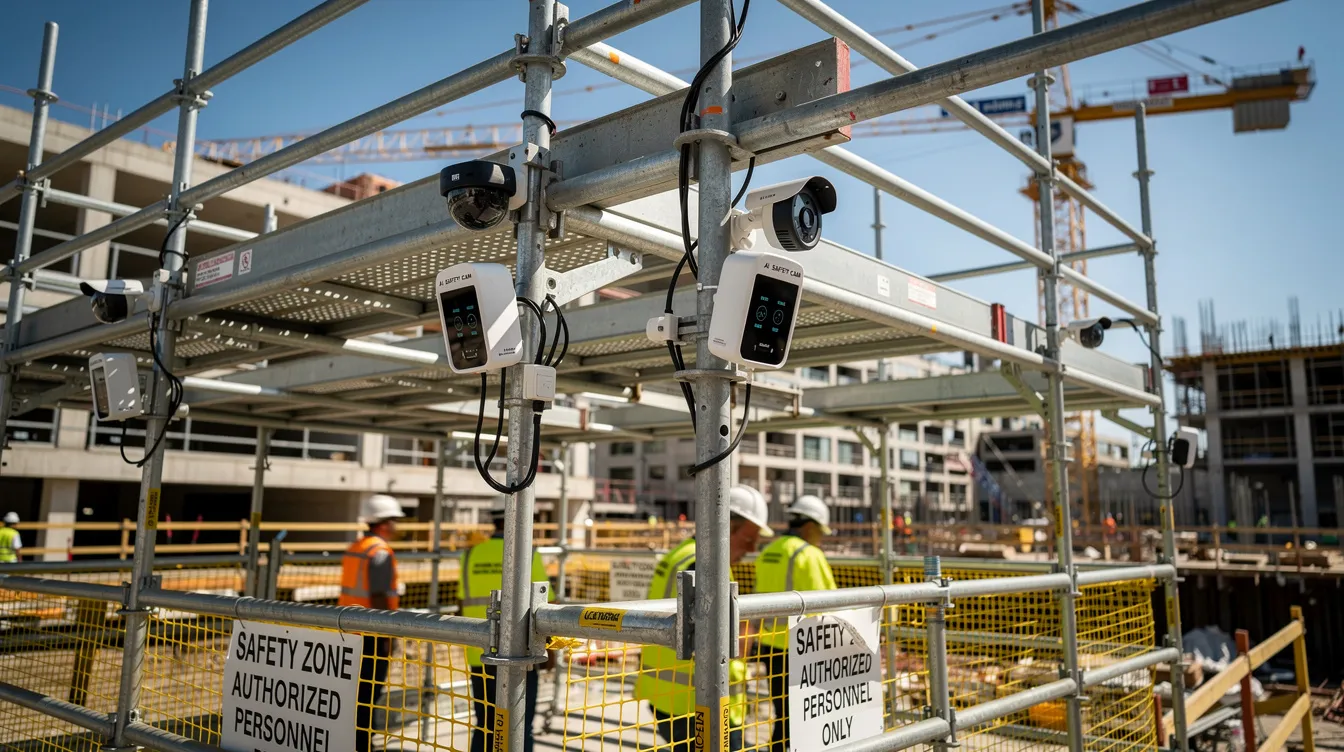
AI-powered video surveillance systems detect hazards in real-time, including workers operating at height without harnesses, unsafe proximity to moving vehicles, and unauthorised entry into restricted zones. AI video analytics will be mandatory for construction projects over S$5 million from June 2024, but the WSH Technology Scheme helps companies go beyond minimum compliance by funding higher-specification systems with machine learning capabilities.
AI can identify near-misses to prevent future incidents. In advanced site supervision, artificial intelligence can also predict future risks using historical and real-time data. AI-driven analytics improve safety management workflows by feeding detection data directly into incident reporting and risk management platforms, replacing manual observation logs.
For a fundable application, proposals should specify camera count, coverage zones (tower cranes, loading bays, scaffold access points), and how the system integrates with the site’s existing safety processes. The expected outcomes to quantify: reduction in near miss events, fewer stop-work orders, and lower enforcement penalty exposure. A detailed guide to mandatory VSS compliance requirements can help frame the baseline that the scheme funds you to exceed.

Wearable Technologies and Worker Health Monitoring
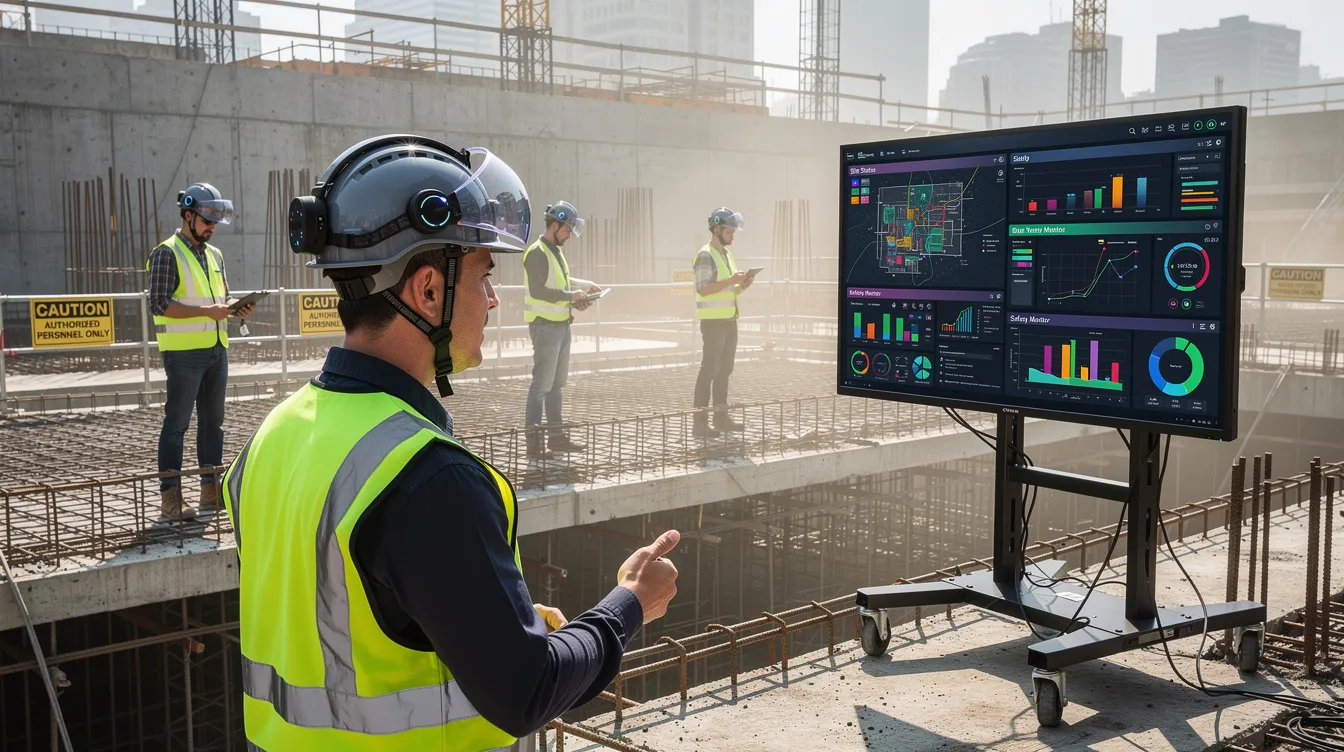
Wearable technology monitors workers’ health and environment in real-time. Smart wearables such as helmets with impact sensors, vests with vital signs tracking, and smartwatches with fall detection provide continuous data on worker fatigue, heat stress exposure, and entry into confined spaces or restricted zones. In Singapore, wearable tech is integrated with AI for enhanced safety, combining smartwatch alerts with video analytics to create layered hazard detection.
Smartwatches can detect near-misses and alert supervisors instantly. Wearable devices can identify unsafe conditions before incidents occur, shifting safety culture from reactive to proactive. For outdoor workers in Singapore’s tropical climate, environmental monitoring wearables track air quality, noise levels, and heat index to flag when conditions require rest breaks or rotation.
Concrete use cases include: confined space entry where wearables monitor air quality and vital signs simultaneously; hot outdoor works where heat stress alerts prevent exertional injuries; and lone workers in remote site areas where fall detection triggers immediate response. An application should quantify the targeted headcount to be equipped, the expected reduction in heat-related incidents or fall injuries, and how alerts feed into supervisors’ response workflows. For more on how these technologies integrate into broader WSH tech ecosystems, including drones and AI, the practical interplay matters for scoping a complete project.
Drones also fall within the scheme’s scope. Drones enhance situational awareness on construction sites and can remove human workers from dangerous environments during inspections. JTC used drones to inspect a 31-storey building in Singapore, capturing visual, thermal, and spatial data for safety management from a safe distance. Drones provide critical data that feeds directly into digital safety management systems and information modeling platforms.
Digital Permit-to-Work (ePTW), Risk Management and Safety Platforms
An electronic permit-to-work system replaces paper-based permits and manual checklists with a digital platform that enforces approval workflows, tracks active permits in real time, and prevents conflicting high-risk works (for example, hot works scheduled near flammable storage). Technologies like electronic Permit-to-Work systems and vehicular safety systems help reduce workplace hazards by ensuring only properly authorised work proceeds.
Safety technology needs to be integrated into existing workplace safety management systems. The strongest applications show how ePTW connects to AI cameras (auto-flagging work without valid permits), to the Hubble Safety Management System or equivalent integrated platforms, and to ISO 45001 or bizSAFE processes. ISO 45001 is the international standard for occupational health and safety, adopted by over 100 countries since its release in 2018. ISO 45001 certification can reduce workplace incidents and improve compliance. Employers unifying safety management platforms can facilitate better training integration, linking permit data with toolbox talk records and risk assessment outcomes.
MOM’s parliamentary response in 2022 confirmed that several SMEs adopted ePTW systems through PSG funding. The WSH Technology Scheme support extends this by enabling richer, WSH-focused platforms with features such as automated escalation when permits expire and integration with real-time site monitoring dashboards.
Vehicular and Mobile Plant Safety Technology
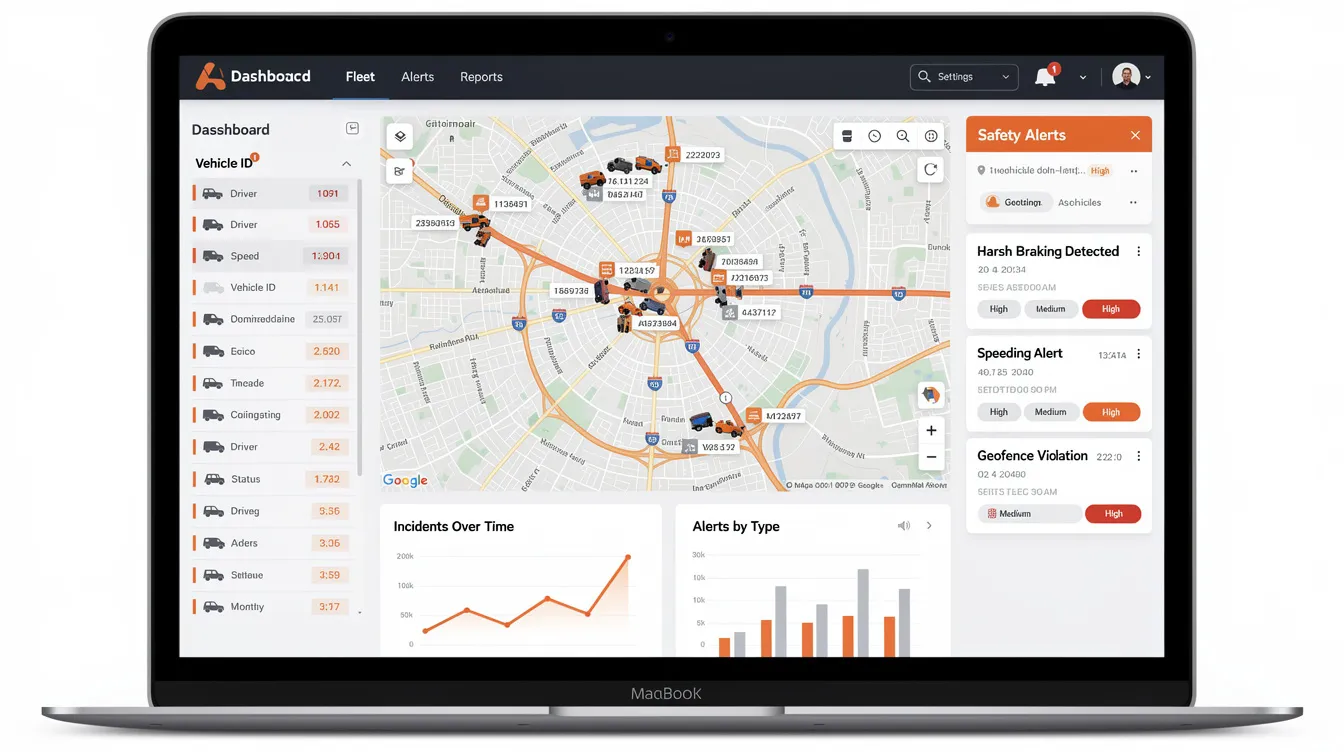
Vehicular safety remains a priority because vehicular incidents are among the leading causes of workplace fatalities in Singapore. Fleet safety management systems, Advanced Driver Assistance Systems (ADAS), blind-spot cameras, and stability control systems for lorry cranes directly address these risks.
One documented result: a company that adopted fleet safety management technology recorded 93% fewer driver fatigue episodes and 58% fewer potential collisions. Kiat & Kiat Contractor installed Vehicle Safety Systems on approximately 90% of their fleet in mid-2022, enabling live video feeds that detected unsafe driving behaviour and improved management reaction time.
MOM has run dedicated support schemes for this category, including the Lorry Crane Stability Control System Grant. The WSH Technology Scheme co-funding can be combined with vendor volume discounts and internal driver training to create a vehicular safety programme that tracks driver status, harsh braking events, fatigue alerts, and near miss collisions at worksite entries. Geofencing for heavy equipment adds another layer, restricting crane or forklift operation to designated zones and triggering alerts when boundaries are breached.
Safety metrics to track include: frequency of fatigue alerts per 1,000 km, reduction in harsh braking events, and near miss rates at site access points. These figures translate directly into insurance premium negotiations and avoided downtime costs, while also giving the main contractor objective data to assess subcontractor compliance, enforce project safety requirements, and inform contractor selection decisions.
Designing a Fundable WSH Tech Upgrade Plan
A successful application requires more than selecting technology from a catalogue. MOM evaluates whether the applicant has diagnosed specific risks, planned implementation with measurable milestones, and committed resources to sustain adoption after the grant period ends. Companies should start with identifying specific safety risks before selecting technology solutions.
Step-by-Step Planning and Application Workflow
-
Diagnose WSH risks and gaps. Review 24–36 months of incident data, near miss logs, and findings from StartSAFE, bizSAFE, or internal audits. Completing impact assessments before technology implementation is essential for demonstrating ROI. A structured workplace risk assessment identifies which hazards carry the highest frequency and severity.
-
Map priority risks to supported technologies. Connect your top risks (falls from height, vehicular strikes, confined space hazards, heat stress) to specific WSH tech categories: AI-powered cameras for fall hazards, wearables for worker health monitoring, ePTW for permit control, fleet systems for vehicular risks. Proposals are strongest when they show how the selected solution addresses specific WSH challenges identified from incident data or site audits.
-
Build a costed implementation plan. Cover hardware, software, integration, training, and change management for each site. Get vendor quotations that itemise each cost category separately; this is critical for grant claims.
-
Quantify safety and financial outcomes. Model expected reduction in incident frequency and severity. Use MOM/WSH Institute incident cost tools to calculate direct costs (medical, compensation, work stoppages) and indirect costs (project delays, insurance premium increases, regulatory penalties). Present a payback period or NPV calculation.
-
Prepare application documents. Assemble ACRA profile, financial statements, project proposal, vendor quotations, and implementation timeline. Businesses can improve workforce training while implementing new workplace safety technologies; include training budgets as eligible line items.
-
Submit via the Business Grants Portal. Ensure no payments have been made to vendors before submission, as this disqualifies the claim. Assign an internal owner to manage clarifications and follow-up requests from the grant administrator.
-
Implement, monitor, and report. Roll out in phases, track safety KPIs against baseline data, and document results for both MOM reporting and internal ROI reviews. Using technology can enhance productivity while improving safety outcomes, so track both safety and enhanced productivity metrics.
MOSAIC Ecoconstruction Solutions can support this process as a WSH consultancy partner, from initial risk diagnosis through solution scoping and application drafting.
Integrating MOM WSH Technology Scheme with Other Grants
Funding programs include the Productivity Solutions Grant and the Enterprise Development Grant. Understanding which scheme to anchor each project component on prevents double-claiming and maximises total co-funding. Substantial cost savings can be achieved through grants and co-funding for safety technology when the cost allocation is structured correctly.
|
Criterion |
MOM WSH Technology Scheme |
PSG |
EDG |
|---|---|---|---|
|
Primary Objective |
Safety hazard reduction |
SME productivity (pre-scoped solutions) |
Business transformation and capability upgrading |
|
Typical Co-Funding |
50–70% for qualifying WSH tech |
Up to 50% for SMEs |
Varies by project scale and enterprise size |
|
Typical Project Size |
Varies; innovation challenges up to S$1M |
Capped at ~S$30,000 per solution |
Larger, customised projects |
|
Best for AI VSS |
Full system with analytics and integration |
Pre-approved camera packages |
Custom multi-site AI platform builds |
|
Best for ePTW |
WSH-focused platforms with audit integration |
Pre-scoped ePTW software |
Enterprise-wide digital safety management systems |
|
Best for Fleet Safety |
Vehicle Safety Systems, ADAS, geofencing |
Pre-approved fleet monitoring solutions |
Fleet-wide integrated telematics + training systems |
The Productivity Solutions Grant offers financial support for pre-scoped IT solutions that improve safety, while EDG suits larger customised projects. Double-funding for the same cost item is not permitted. If PSG covers the hardware cost for AI cameras, EDG cannot cover the same line item but could cover the integration software connecting those cameras to a centralised safety management system.
Organizations can use Enterprise Singapore resources to verify which solutions are pre-approved under PSG. Note that PSG, EDG, and MRA will cease on 29 September 2026, replaced by the new EDGE Grant. Companies planning applications should submit before that transition.
Prioritising Sites and Phasing Roll-Out
For firms operating across multiple worksites, phasing deployment maximises safety impact while managing cash flow and documentation requirements. Rank sites based on: incident history over the past three years, manpower exposure (headcount in high-risk activities), contract requirements (public sector or Tier-1 clients increasingly require advanced WSH tech), and readiness of site supervision teams to adopt new digital solutions.
Start with one or two high-risk flagship sites as pilots. This approach validates the technology in your operating environment, surfaces integration issues before company-wide deployment, and generates before/after data that strengthens subsequent grant applications for additional sites. Staggered roll-out also simplifies grant reporting, since each phase produces a discrete set of invoices, training records, and performance metrics.
For construction firms managing both large projects and small-scale renovation works, the pilot site should ideally be one where the WSH Institute or WSH Council has flagged emerging risks, since grant reviewers prioritise applications targeting known hazard concentrations.
Common Challenges and Practical Solutions in Using the WSH Technology Scheme
Many medium enterprises and even larger contractors encounter friction at the intersection of grant administration, technology selection, and worksite adoption. The following challenges surface repeatedly in applications and post-approval implementation.
Challenge 1: Unclear Fit Between Technology and Scheme Criteria
Companies often select technology based on vendor demonstrations rather than MOM’s stated safety priorities. A sensor system that tracks productivity metrics but does not improve hazard detection or reduce risks tied to MOM’s top incident categories will score poorly on a grant application.
Start from your risk profile, not from vendor catalogues. Cross-reference your incident data with MOM’s published WSH resources on priority hazards. If your top risk is falls from height, the technology must detect fall hazards, enforce permit controls for working at height, or monitor guardrail integrity. Consultancies such as MOSAIC can pre-screen technologies against scheme criteria before you invest time in a full application.
Challenge 2: Underestimating Change Management and Site Adoption
Funded systems that go unused on site undermine both safety outcomes and grant KPIs. A wearable programme that local workers refuse to wear because the devices are uncomfortable, or an ePTW system that supervisors bypass because the user friendly interfaces were not tested with actual site teams, produces no return on the co-funded investment.
Build structured training, toolbox sessions, and supervisory WSH ownership into the project plan from the start. Include budget lines for training and on-site coaching as eligible costs. Achieving bizSAFE Certification can improve a company’s safety culture, and the certification process includes training and audits that complement technology adoption programmes. Wearables help shift safety culture from reactive to proactive only when frontline workers understand the alerts and supervisors act on the data.
Challenge 3: Weak ROI Models for Finance Review
Applications sometimes stall internally because finance teams cannot see the payback, even with 50% co-funding. Implementing safety technology can reduce the likelihood of severe workplace incidents, but that statement alone does not satisfy a CFO reviewing competing capital requests.
Use the WSH Institute’s incident cost calculator to attach dollar values to your company’s historical workplace incidents and workplace accidents. Model a conservative 20–30% reduction in incident frequency after technology deployment and calculate: avoided medical and compensation costs, avoided work stoppages (hours × billing rate), avoided penalties from enforcement actions, and insurance premium reductions. Present the result as a simple payback period. For fleet safety, the documented 93% reduction in driver fatigue episodes and 58% fewer potential collisions provide a concrete benchmark for modelling savings in overtime, vehicle repair, and liability exposure.
Challenge 4: Documentation and Compliance Burden
Collecting invoices, training attendance records, and performance reports for grant claims and audits is time-consuming. Companies that treat documentation as an afterthought risk delayed reimbursement or partial claim rejection.
Assign a project controller at the outset. Use a digital platform or document repository aligned with your ISO 45001 or bizSAFE record-keeping requirements, so safety and finance teams share a single source of truth. ISO certification helps organizations improve workplace safety and health standards while simultaneously creating the documentation infrastructure that grant administrators require. When the same records serve both WSH compliance and grant reporting, the administrative load drops and audit readiness improves.
Conclusion and Immediate Next Steps
The MOM WSH Technology Scheme provides a targeted path for Singapore firms to offset 50–70% of the capital cost of proven safety technologies, from AI video analytics and smart wearables to digital permit-to-work and fleet safety systems. WSH technology can mitigate workplace incident risks while generating measurable financial returns through reduced incidents, lower insurance costs, and fewer enforcement penalties. With PSG and EDG ending in September 2026, the window to apply under current funding structures is narrowing.
Concrete next steps for CFOs and WSH Directors:
-
Pull 24–36 months of incident and near miss data and identify your top two or three risk categories
-
Select one or two priority technologies (AI cameras, ePTW, fleet safety, wearables) that directly target those risks
-
Convene Operations, Safety, and Finance stakeholders to agree on scope, pilot sites, and budget envelope
-
Consult MOM/WSH Council materials or a specialist consultancy such as MOSAIC Ecoconstruction Solutions to map the project to the WSH Technology Scheme and prepare application documents
-
Submit a first application for a pilot site within the next 60–90 days to secure funding before the grant transition
Related areas to explore: bizSAFE certification and its ROI, ISO 45001 integration with digital safety systems, and planning for the post-September 2026 EDGE Grant that will replace current Enterprise Singapore support schemes. Addressing mental health and well being alongside physical safety through integrated platforms is an emerging area that future WSH tech funding is likely to cover.
Additional Resources
Official WSH resources for grant planning:
-
MOM Workplace Safety and Health Technology page: lists all supported WSH technology categories, definitions, and links to relevant support schemes
-
MOM Resource Guide: Grants and Innovation Challenges for WSH Tech (PDF): overview of available funding channels, eligibility, and application steps
-
Enterprise Singapore Productivity Solutions Grant: current PSG details, pre-approved solutions list, and application portal
-
MOM WSH National Statistics Report 2024 (PDF): incident data for benchmarking your risk profile
-
WSH 2028 Strategy Report (PDF): policy context and national targets for technology adoption
Recommended visuals for internal Board presentations:
-
Incident cost comparison chart: Bar chart showing annual incident costs (medical, compensation, downtime, penalties) versus the net cost of WSH tech investment after grant co-funding
-
Application process flow diagram: From risk identification through grant submission to post-implementation reporting, showing key milestones and responsible parties
-
Integrated site technology layout: Mock-up or site photo showing how AI cameras, wearables, ePTW kiosks, and a fleet safety dashboard operate together across a worksite
-
Funding scheme comparison table: Visual version of the PSG vs EDG vs WSH Technology Scheme comparison, sized for a single presentation slide
MOSAIC Ecoconstruction Solutions provides tailored slide decks and visuals for Board approval presentations using these elements, along with end-to-end support for WSH compliance and technology grant applications.