Introduction
bizSAFE Level 3 certification is mandatory for public sector procurement by major agencies in Singapore, and most government tenders now require it as a minimum qualification. If your company supplies services to GeBIZ-listed agencies, statutory boards, or MNC procurement panels, lacking Level 3 means disqualification before your price is even opened. This article explains why bizSAFE Level 3 has shifted from a differentiator to a baseline requirement for Singapore corporate tenders, and what B2B vendors, sub-contractors, logistics firms, and facilities companies need to do about it.
The scope here is Level 3 as a commercial tender prerequisite. For a step-by-step technical walkthrough of the full bizSAFE programme, refer to our bizSAFE certification guide for SMEs. This article is written for vendors, subcontractors, fleet operators, and industrial service providers trying to qualify for tenders from HDB, LTA, JTC, PUB, NEA, Town Councils, and MNC procurement panels.
Buyers use bizSAFE Level 3 as a quick screening tool to filter out vendors without proven risk management. The Ministry of Manpower (MOM) and the Workplace Safety and Health Council have structured the bizSAFE programme as the screening framework behind this requirement, so that Level 3 is the first tier where risk management implementation is verified by an independent audit, giving procurement teams a standardised, checkable credential.
By reading this article, you will understand:
-
How government agencies and MNC buyers screen suppliers using bizSAFE Level 3 in their tender workflows
-
Which sectors now treat Level 3 as non-negotiable, with concrete examples from construction, cleaning, logistics, and facilities management
-
The commercial risks of operating without Level 3, including lost contracts and supply chain exclusion
-
Practical steps to close certification gaps before your next tender deadline, including the core bizSAFE certification requirements
Understanding bizSAFE Level 3 in the Tender Context
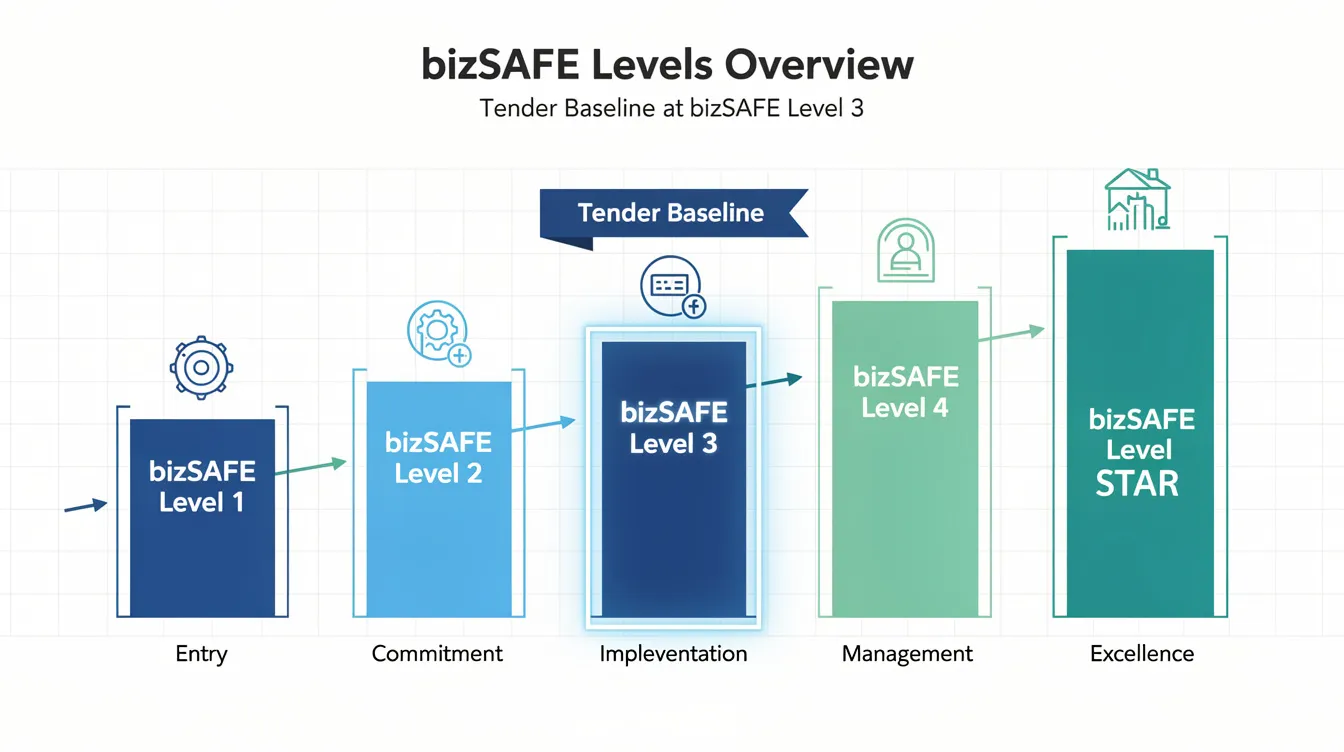
bizSAFE Level 3 is a nationally recognized standard in Singapore for risk management compliance. In tender settings, it is best understood as part of the wider bizSAFE recognition framework that buyers use to screen supplier readiness. Unlike Levels 1 and 2, which involve attending a top executive WSH programme and completing a risk management course respectively, Level 3 requires a company to implement a risk management plan across its operations and pass a risk management implementation audit conducted by a Singapore Accreditation Council (SAC)-accredited Auditing Organisation. This external audit is what makes Level 3 the commercial threshold: it provides buyers with third-party verification that workplace safety protocols exist beyond internal claims.
The bizsafe certification process for Level 3 also reflects broader regulatory changes. Speed limiter checks for commercial fleets, mental health and fatigue considerations in risk assessments, and SGSecure threat awareness are now part of the audit landscape in 2026, making Level 3 a holistic risk marker rather than a narrow checklist.
Key Elements of bizSAFE Level 3
To achieve bizSAFE Level 3, companies must meet core bizSAFE certification requirements by conducting comprehensive risk assessments covering all work activities, including both routine and non-routine tasks. These assessments feed into a documented risk management implementation plan that specifies control measures, assigns responsibilities, and establishes review schedules. Workers must be briefed on the identified workplace hazards and the corresponding safety protocols.
The defining feature of Level 3 is the RM implementation audit by a SAC-accredited Auditing Organisation. This independent audit differentiates Level 3 from self-declared safety systems. Tender evaluation teams can verify a company’s bizSAFE status through the WSH Council’s bizSAFE portal, checking both the bizSAFE certificate number and expiry date. Only certified firms should publicly represent that status in procurement materials or use the bizSAFE logo in line with the applicable approval conditions. Level 3 certification is valid for three years from the approval date, after which a fresh risk management implementation audit is required for renewal.
How bizSAFE Fits into Singapore’s Workplace Safety Strategy
The bizSAFE programme sits within Singapore’s national workplace safety framework, WSH 2028. One of WSH 2028’s core strategies is using procurement as a lever to push safety management down through supply chains. The results are measurable: Singapore’s fatal injury rate dropped to 0.96 per 100,000 workers in 2025, down from 1.20 in 2024. The construction sector’s combined fatal and major injury rate fell from 31.0 to 26.3 per 100,000 over the same period.
The WSH Council encourages companies to achieve bizSAFE Level 3 to standardize safety measures across industries. bizSAFE complements, rather than replaces, legal duties under the WSH Act and the Code of Practice on Chief Executives’ and Board of Directors’ WSH Duties, launched in October 2022. That Code requires every CEO or board director to exercise due diligence in workplace safety, including contractor selection. Because regulators and clients rely on bizSAFE to signal basic compliance, procurement teams have started hard-coding Level 3 into tender documents as a mandatory criterion.
How Government and MNC Buyers Use bizSAFE Level 3 to Screen Suppliers
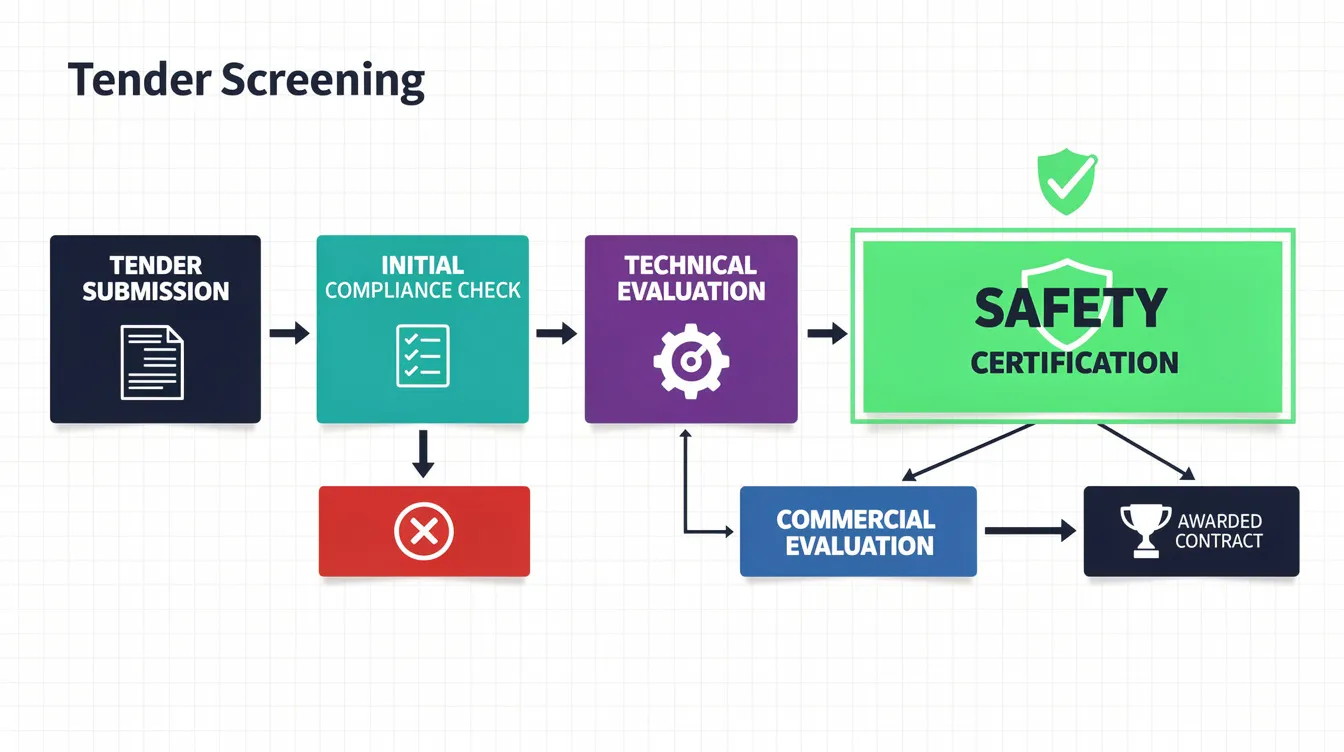
With Level 3 defined, the practical question is how it functions inside actual procurement workflows. Government agencies use it as a pass/fail filter. MNCs mirror the same approach in their vendor onboarding. The requirement reflects a shift in corporate procurement towards prioritizing safety as an operational issue, not just a compliance formality.
Consider a scaffolding subcontractor bidding for an HDB estate upgrading term contract. Without a valid bizSAFE Level 3 certificate, the bid is rejected at the compliance check stage; the evaluator never reaches the pricing page. A logistics SME bidding for a 3PL contract with an MNC distribution centre faces the same gate.
The GeBIZ and Statutory Board “Gatekeeper” Effect
GeBIZ and Vendor@Gov profiles store certifications including bizSAFE level and expiry dates. Agencies pre-filter vendors using these fields before opening price proposals. The bid evaluation process increasingly considers safety performance as a key metric, and Level 3 serves as a threshold for evaluating supply-chain governance and safety capability in bids.
Concrete examples of agencies that commonly require Level 3 as a minimum include HDB (estate upgrading and building maintenance), LTA (road works and traffic management), PUB (pipeline and drainage maintenance), JTC (estate services), and the National Environment Agency for cleaning and waste contracts, with public-sector eligibility in construction-related procurement often tied to Building and Construction Authority (BCA) expectations. Even non-facilities tenders list it: the Singapore Chinese Cultural Centre’s IT infrastructure RFQ included “BizSafe Level 3 and above” as a mandatory criterion. An April 2026 NParks RFQ on GeBIZ specifically required WSH consultancy services for bizSAFE Level 3 implementation.
For many categories, bids without Level 3 are rejected at the compliance check stage. Companies without Level 3 certification face disqualification from tenders, regardless of pricing competitiveness.
How GLCs and MNCs Mirror Government Requirements
Large private contractors require bizSAFE Level 3 from their suppliers to mitigate liability risks. Singapore-based groups such as CapitaLand, Mapletree, Keppel, and PSA adopt requirements mirroring the Singapore government’s tender templates. The mechanism is straightforward: private sector procurement teams often base their RFQs and master service agreements on government templates, so bizSAFE Level 3 appears in MNC vendor qualification forms for contractors, cleaners, technicians, and transporters, and private-sector qualification forms often favour bizSAFE certified companies because the status simplifies internal risk review.
Main contractors bidding for government mega-projects (LTA MRT lines, major HDB developments) pass Level 3 and bizsafe star requirements down to every subcontractor, including SMEs providing niche works or ad-hoc manpower. This creates a procurement cascade where Level 3 functions as a de facto licence to operate for high-risk and support trades. In some higher-value contractor ecosystems, shortlisting also expects visibility through the bizSAFE Marketplace.
The Supply Chain Cascade: From Principal to Sub-contractor
Under the WSH Act, principals and occupiers remain responsible for safety lapses caused by their contractors and sub-contractors. A main contractor holding bizsafe star certification or ISO 45001 cannot afford a subcontractor’s safety failure triggering a Stop Work Order that halts the entire project.
This drives a practical requirement: main contractors and facilities managers require their entire vendor list to hold at least Level 3. A scaffolding specialist needs it to enter HDB blocks. A waste collection vendor needs it for JTC industrial estates. A lorry transport provider needs it for construction materials delivery to live sites. An M&E maintenance vendor needs it for data centre access.
The result is a closed supply chain where non-certified vendors are shut out of mainstream B2B work. Losing bizSAFE Level 3 status removes access to government contracts and, through the cascade effect, to the private-sector contracts that flow from them.
Why bizSAFE Level 3 Has Become the Baseline: The Business Logic
The previous sections describe what buyers do. The question is why they do it. Four forces drive the shift: legal compliance pressure on directors, risk transfer through procurement, operational continuity concerns, and reputation protection.
Legal and Regulatory Pressures on Buyers
On 1 April 2024, Singapore strengthened WSH requirements for public sector construction tenders by extending the Safety Disqualification (SDQ) framework to all public construction and construction-related tenders, including subcontractors and contracts above S$90,000. Under SDQ, firms accumulating 25 or more demerit points within 18 months face temporary disqualification from government tenders.
MOM’s enforcement has intensified in parallel. In 2024, MOM issued over 16,000 enforcement actions, including 58 Stop Work Orders and more than S$3.1 million in fines for WSH breaches. The Code of Practice on Chief Executives’ and Directors’ Duties, which took effect in late 2022, requires directors to demonstrate due diligence in contractor selection under Section 48(1) of the WSH Act. Using bizSAFE Level 3 as a minimum tender requirement gives boards and public agencies a defensible benchmark: they engaged only vendors with externally audited risk management.
Risk, Continuity, and Cost Control
Workplace injuries impose substantial costs on the economy, including lost productivity and legal liabilities. For buyers, the costs are project-specific: a single workplace incident can trigger a Stop Work Order (averaging days to weeks of downtime), liquidated damages for schedule delays, MOM investigations consuming management time, and potential debarment under SDQ that blocks future government tenders.
bizSAFE certification reduces workplace accidents through structured risk management, and buyers increasingly associate certified vendors with stronger internal safety initiatives that support continuity and cost control. In the first half of 2025, Singapore’s major injury rate reached an all-time low of 15.5 per 100,000 workers, providing evidence that structured safety frameworks produce measurable reductions. Certified companies may receive lower insurance premiums from providers, as some Work Injury Compensation insurers factor safety certifications into their risk assessments. For a buyer managing 50 to 200 vendors across a facilities portfolio, requiring Level 3 is the lowest-cost way to reduce incident probability across the entire supply chain.
bizSAFE Level 3 vs “No bizSAFE”: How Buyers Compare Vendors
From a buyer’s perspective, the comparison between vendors with and without Level 3 is stark:
|
Criteria |
Vendor with bizSAFE Level 3 |
Vendor without bizSAFE |
|---|---|---|
|
Regulatory comfort |
Audited proof of risk management compliance |
Buyer accepts reputational and regulatory risk |
|
Audit trail for board |
External audit records available for due diligence |
Only internal claims; no third-party verification |
|
Perceived risk of delays |
Lower probability of workplace incidents and Stop Work Orders |
Higher exposure to schedule-disrupting safety events |
|
Insurance attractiveness |
May qualify for better WIC premiums |
Standard or higher premiums |
|
Ease of internal approval |
Documented proof satisfies compliance checklists |
Procurement, Legal, and Risk teams require justification |
bizSAFE Level 3 acts as a common benchmark for workplace safety across contractors and suppliers. For procurement teams evaluating hundreds of vendors, it provides a standardised, low-cost screening mechanism that reduces uncertainty without requiring bespoke safety audits of every applicant.
Sector-Specific Patterns: Where Level 3 Is Now Non-Negotiable
While bizSAFE is not legally required to register a business, specific sectors have reached a point where competing without Level 3 is commercially impractical. The patterns differ by industry.
Construction, Engineering, and Sub-Contractors
BCA’s Contractors Registration System (CRS) requires firms tendering for public sector construction projects to register under appropriate workheads. For grades L4 to L6, management certifications including bizSAFE Level 3 are mandatory. The SDQ framework means construction subcontractors must maintain clean WSH records; past safety failures eliminate them regardless of pricing.
bizSAFE Level 3 is the minimum requirement for many contractors bidding for structural steel, formwork, rebar, painting at height, and renovation work in occupied buildings. Even small, specialised sub-contractors (façade cleaning, rope access, testing and commissioning) are now asked for Level 3 in 2025-2026 tender documents. Higher-risk packages may require Level 4 or bizSAFE STAR, but Level 3 is the entry point.
Logistics, Fleet Operators, and Last-Mile Providers
Transport-related tenders have tightened as 2026 audits now incorporate speed limiter verification for commercial vehicles and driver fatigue assessments. Distribution contracts for supermarket chains, e-commerce 3PL operations, and construction materials delivery increasingly list Level 3 as a requirement.
Large shippers and developers face reputational exposure when branded vehicles are involved in road accidents. A fatal crash involving a supplier’s lorry triggers MOM investigation, media coverage, and potential Business Under Surveillance placement. For these buyers, bizSAFE Level 3 proves fundamental hazard management capabilities for fleet operations, vehicle movements, and loading/unloading procedures.
Facilities Management, Cleaning, and Technical Services
Under NEA’s Enhanced Cleaning Business Licensing Framework, effective 1 January 2024, cleaning businesses serving government procurement entities with contracts up to S$1 million must hold at least a Class 2 licence, which requires bizSAFE Level 3 certification. Contracts above S$1 million require Class 1.
Integrated facilities management contracts for malls, offices, data centres, hospitals, and government buildings now almost universally require Level 3. The risk profile justifies it: façade cleaning involves working at height, chemical cleaning creates exposure hazards, and mechanical maintenance of lifts and chillers involves confined spaces and energised equipment. Large FM vendors push their sub-vendors in pest control, waste collection, and ad-hoc maintenance to hold Level 3 so they can deploy on sensitive sites.
Lower-Risk Sectors: When Level 3 Is Still Optional
Pure consulting, design, and software firms may not face mandatory Level 3 requirements for desk-based work. However, if such firms need physical site access for IT cabling, site surveys, or interior design installations, clients often still require Level 3. The SCCC IT infrastructure tender is a concrete example of this crossover. Even if Level 3 is not strictly required for your current tenders, obtaining it can future-proof tender eligibility as the Singapore government continues tightening procurement safety requirements.
Common Challenges for SMEs and How to Overcome Them
Many SMEs and subcontractors view Level 3 as a paperwork burden. The actual risk is quantifiable: losing access to tenders and preferred vendor lists. bizSAFE Level 3 is required for most government tenders, and a single missed contract can cost more than the entire certification process.
“We’re Too Small; It’s Only for Big Contractors”
Risk is tied to activity, not headcount. A five-person team doing rope access cleaning faces the same fall hazards as a 500-person contractor. Clients care about exposure: working at height, driving commercial vehicles, handling chemicals. Main contractors’ vendor lists now routinely require Level 3 from micro-SMEs with 5 to 20 staff.
A practical starting point: conduct existing risk assessments for your top three to five high-risk activities. This builds internal understanding and generates documentation that feeds directly into your risk management plan.
Lack of In-House Safety Expertise
Small vendors often have no Workplace Safety and Health Officer. The owner doubles as HR, operations, and safety management. Two realistic options exist: nominate a supervisor as the risk management champion and send them for the Level 2 risk management course, or engage a consultancy like MOSAIC Ecoconstruction Solutions to design a practical, right-sized Workplace Safety and Health management system.
While auditors from SAC-accredited organisations cannot consult, independent consultants can prepare documentation, train staff, run mock audits, and coach the company’s senior management representative through submission. The guide to workplace risk assessments provides a foundation for structuring this work.
Perception of High Cost and Limited ROI
The certification process takes four to eight weeks to complete, with costs covering RM training, audit fees, and optional consultancy. A typical SME spend falls in the S$5,000 to S$10,000 range. Compare that against a single HDB term contract worth S$200,000 or two to three years of steady FM work. bizSAFE certification opens access to government grants for safety improvements, and training portions may qualify for SkillsFuture or Enterprise Singapore support through the enterprise development grant.
bizSAFE recognition can improve commercial credibility among clients and stakeholders. The bizSAFE certification ROI analysis breaks down the financial case in detail.
Practical Steps to Secure bizSAFE Level 3 for Tender Readiness
For companies targeting 2026 government tenders, the path from zero to Level 3 follows a defined sequence. Start the process six to twelve months before your target tender window if you have no existing safety framework, or two to three months if you have conducted risk assessments and need only the external audit.
Step-by-Step Path from Zero to Level 3
-
Audit your tender pipeline. Review tender specifications from key agencies and customers for the next 12 to 24 months. Identify which contracts list bizSAFE Level 3 as mandatory. This establishes the commercial case for top management commitment.
-
Secure senior management commitment. The CEO or board director (or their company’s senior management representative) management attends the top executive WSH programme as the Level 1 requirement. Align workplace safety and health goals with your sales and tender strategy.
-
Appoint and train a risk management champion. Select someone with real operational authority (operations supervisor, fleet manager) and send them for the Level 2 risk management course. This person will own the risk management plan development.
-
Develop and implement risk assessments. Cover core activities: working at height, confined spaces, lifting operations, vehicle movements, chemical handling. Include 2026 requirements such as mental health, fatigue management, and occupational health considerations. Document control measures and communicate them to all workers.
-
Run a pre-audit check. Conduct an internal review or engage MOSAIC Ecoconstruction Solutions to perform a gap analysis against bizSAFE Level 3 requirements and applicable bizsafe certification requirements before booking the audit. Fix gaps, then book a SAC-accredited risk management implementation audit.
-
Submit and integrate. After passing the external audit, submit the audit report via the WSH Council portal. Processing takes about 10 working days. Integrate the renewed bizSAFE certificate into all tender documentation, GeBIZ profiles, and vendor registration packs.
DIY vs Engaging a Specialist Consultancy
|
Factor |
DIY Approach |
With Consultancy Support |
|---|---|---|
|
Timeline |
3 to 6 months (learning curve for risk assessments and documentation) |
4 to 8 weeks (compressed through templates and coaching) |
|
Internal effort |
High; safety champion builds everything from scratch |
Moderate; consultant drafts, staff reviews and implements |
|
Error risk |
Higher; first-time applicants often face audit findings requiring rectification |
Lower; mock audits catch gaps before the formal RM implementation audit |
|
Audit pass rate (first attempt) |
Variable |
Higher, based on pre-audit preparation |
MOSAIC Ecoconstruction Solutions provides end-to-end support: from risk assessments and safety and health management documentation to mock audits, staff training, and advisory for companies building more comprehensive workplace safety systems as they scale beyond Level 3. Consultants cannot submit the bizSAFE application on behalf of clients (per WSH Council guidance), but they prepare everything up to that point and coach the client through submission. For SMEs needing Level 3 before a specific tender deadline, this compressed approach reduces the risk of missing the window.
Conclusion and Strategic Next Steps
bizSAFE Level 3 has moved from a differentiator to a baseline entry ticket for government and corporate tenders in Singapore. Regulatory pressure on buyers through the SDQ framework and Directors’ Code of Practice, supply chain liability under the WSH Act, and commercial preference for vendors with audited safety systems have collectively made Level 3 the standard screening criterion. Level 3 is the minimum requirement for most government tenders, and the trend is toward broader coverage across more sectors and lower contract values.
To act on this:
-
Audit your current safety certifications against target tenders. Check your company’s bizSAFE status and expiry date on the WSH Council portal.
-
Map which business lines depend most on Level 3. Prioritise the bizsafe journey for revenue-critical divisions.
-
Plan top executive WSH programme attendance and risk management champion training within the next quarter.
-
Schedule a risk management gap analysis with MOSAIC Ecoconstruction Solutions to benchmark your current state.
-
Set an internal deadline to obtain or renew Level 3 at least three months before major tender windows. Start the renewal process two months before expiry for existing certificates.
After achieving bizsafe certification at Level 3, companies that want to achieve bizSAFE STAR should put ISO 45001 in place together with a certified WSH management framework. bizSAFE STAR status is the highest tier and is backed by a full safety and health management system, which helps position your company for EPC and large FM contracts. Integrating a full WSH management system with ISO 9001 quality management strengthens both safety culture and tender competitiveness.
Additional Resources and FAQs on bizSAFE Level 3 for Tenders
This section addresses specific tender-related questions rather than general bizSAFE programme FAQs.
FAQ: Is bizSAFE Level 3 legally mandatory to run my business?
bizSAFE Level 3 is not a legal requirement to operate a business in Singapore. However, the WSH risk management regulations are legally binding, and in practice, Level 3 is commercially mandatory if you want to bid for most government and large corporate contracts in higher-risk sectors. Safety audits are essential for validating the effectiveness of a company’s risk management strategies, and Level 3 is the mechanism buyers use to verify this.
FAQ: Which government tenders require bizSAFE Level 3?
Most government tenders require at least bizSAFE Level 3 certification. Typical examples include HDB building maintenance and estate upgrading, Town Council cleaning and landscaping, LTA traffic management and road works, JTC estate maintenance, PUB pipeline and drainage works, NEA cleaning and waste contracts, and MOE/MOH/FM tenders involving site works. Check the bizSAFE tender eligibility guide for sector-specific details.
FAQ: How early should I get Level 3 before a tender closes?
Agencies require a valid bizSAFE Level 3 at the point of tender submission. The certification process takes four to eight weeks. Allow two to three months total to account for training, risk assessment development, auditing, rectification of findings, and WSH Council processing (about 10 working days after audit submission). Companies must update hazard identification worksheets for renewal and ensure all updating risk assessments are current.
FAQ: What happens if my Level 3 expires during an ongoing contract?
Many contracts require continuous validity. Expiry may trigger non-compliance notices, removal from preferred vendor lists, or bar you from bidding for contract renewals. Certification is valid for three years from the approval date. Renewal requires a fresh risk management implementation audit. Companies moving beyond Level 3 should also maintain their bizSAFE recognition, including bizSAFE STAR where applicable, through periodic audits and system reviews. The renewal audit evaluates current training records and incident reports. Diarise expiry dates and initiate the renewal process at least two months before expiry.
FAQ: How can MOSAIC Ecoconstruction Solutions help my company?
MOSAIC provides end-to-end QES advisory services, including bizSAFE and ISO certification support, risk assessments, audit preparation, outsourced safety personnel, and Design for Safety services. The firm works with construction, logistics, and facilities companies to build practical safety systems that meet tender requirements. An initial consultation reviews your current safety status against target tenders and proposes a roadmap to achieve or maintain bizSAFE Level 3 ahead of specific procurement opportunities, while also supporting firms that want to strengthen their Workplace Safety and Health health management system toward bizSAFE STAR and the external certification pathway. Visit the safety consultancy overview for more detail on service scope.