Introduction
Multilingual large language models (LLMs) automate the translation, classification, and routing of worker incident reports across language barriers, then map each report to ISO 45001 corrective action workflows. For construction firms and manufacturers operating in Singapore, where the workforce speaks English, Mandarin, Malay, Tamil, Bengali, Burmese, Hindi, Thai, Tagalog, and other languages, these models solve a specific problem: workers can report incidents in their preferred language, enhancing feedback quality, while safety officers receive standardized English documentation ready for investigation and audit.
This article covers how multilingual LLMs process incident reports, how they integrate with ISO 45001 Clause 10.2 corrective action processes, and what deployment looks like for organizations managing multiple sites in Singapore’s construction and manufacturing sectors. It does not cover general AI strategy or enterprise IT architecture outside of safety management systems.
Multilingual large language models improve worker incident reporting accuracy for workplace incidents. They translate unstructured safety reports in real time, classify incidents by severity and type, extract root causes, and generate corrective action plans aligned with ISO 45001 requirements. The result is faster immediate response after reports are submitted, higher worker participation rates among non-English speakers, and audit-ready documented information.
After reading this article, you will understand:
-
How multilingual LLMs process incident details across languages and map them to ISO 45001 documentation requirements
-
The corrective action tracking workflow from incident classification through effectiveness verification
-
Deployment steps, platform trade-offs, and technology comparison for on-premise vs. cloud solutions
-
Practical solutions for worker resistance, terminology gaps, and legacy system integration
-
Metrics to measure reporting accuracy, corrective action closure rates, and audit readiness to protect workers
Understanding Multilingual LLMs in Safety Management
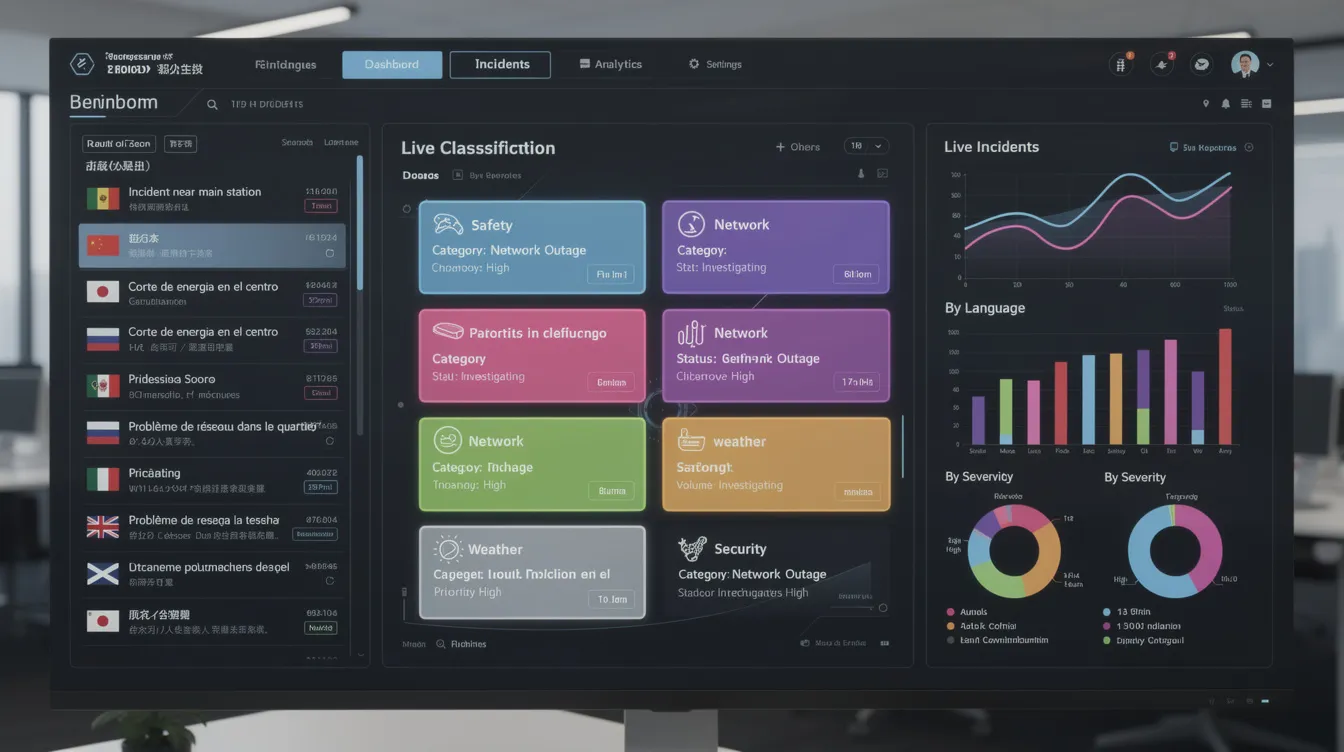
A large language model is an AI system trained on massive multilingual text datasets. It performs natural language processing (understanding text) and natural language generation (producing translations, summaries, and classifications). For occupational health and safety, the relevant capabilities are: translating free-text or voice-based incident reports, helping teams identify hazards from those reports, classifying incident types and severity, extracting contributing factors through root cause analysis, and generating corrective action templates.
Singapore’s workforce composition makes these capabilities necessary rather than optional. The Ministry of Manpower’s Safety Orientation Courses are offered in English plus seven other languages: Bengali, Burmese, Hindi, Malay, Mandarin, Tamil, and Thai. If safety training already happens in eight languages, incident reporting should follow the same principle. ISO 45001 emphasizes worker participation in incident investigations; multilingual reporting also supports proactive risk based thinking by surfacing issues earlier across languages, rather than after translation gaps delay action.
Multilingual interfaces in incident reporting systems increase worker participation. A positive safety culture encourages reporting without fear of blame, and ISO 45001 emphasizes leadership accountability and worker participation. When workers trust that their reports will be accurately understood, employee engagement in safety processes improves incident reporting.
Core Language Processing Capabilities
Real-time translation allows unstructured safety reports to be standardized quickly. A worker submits an incident report in Bengali via a mobile app; the LLM detects the source language, translates the text to English, and preserves technical safety terminology using a domain-specific glossary. Research on the LLM-BT back-translation framework achieved over 90% term consistency when translating and back-translating safety-relevant content, a threshold that makes automated translation viable for routine incident reporting.
Automatic classification follows translation. LLMs analyze incident descriptions and assign severity levels, incident types, and required corrective actions. In clinical settings, a proprietary LLM achieved 85.7% sensitivity and 97.9% specificity when labeling incident types against clinician annotations. Construction and manufacturing incidents differ in vocabulary, but the classification architecture is the same: labeled training data, fine-tuned models, and human verification for edge cases.
ISO 45001 Clause 5.4 requires organizations to ensure worker consultation and participation in the OH&S management system. LLMs address this requirement directly: workers report incidents in their preferred language, the system extracts key safety data from unstructured text, and safety teams receive structured, actionable reports. ISO 45001 defines an incident as any work-related occurrence, including near miss events and cases of ill health. Capturing these across all languages spoken on site moves organizations from reactive incident reporting to proactive safety management.
Integration with ISO 45001 Management Systems
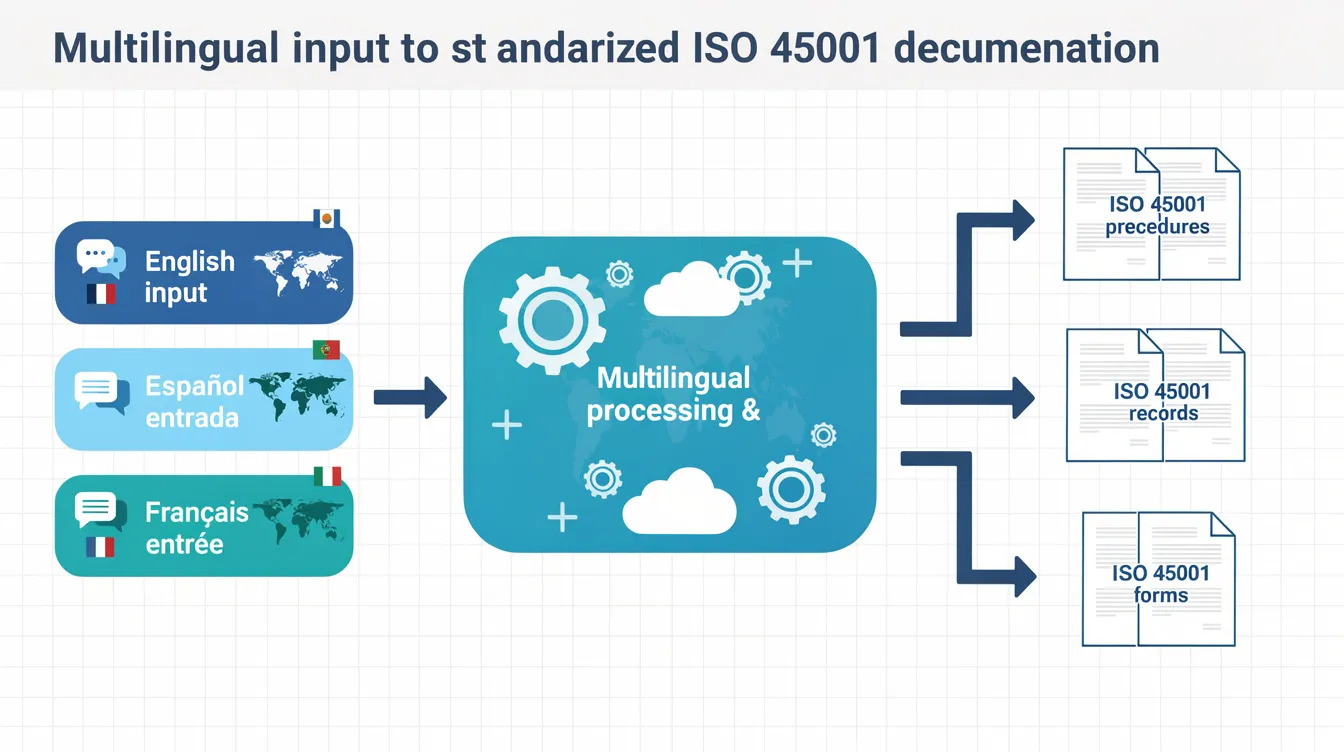
Clause 10.2 of ISO 45001 covers incident investigation and corrective actions. It requires organizations to react in a timely manner, investigate incidents, identify root causes, implement corrective actions according to the hierarchy of controls, verify effectiveness, and retain documented information. Multilingual LLMs automate the first steps of this chain: they receive the incident report, translate and classify it, generate investigation templates, and route the case to the appropriate safety officer.
Standardized documentation generation is where LLMs close the gap between incident occurrence and audit readiness. Each processed report includes: the nature of the incident or nonconformity, actions taken, evidence collection, verification requirements, results, and communications to relevant workers and other relevant interested parties. Maintaining dual-language records enhances audit readiness for ISO 45001 compliance, because auditors can trace the original worker report alongside the standardized English documentation.
Standardizing hazard classifications ensures compliance with ISO 45001 risk categories and supports consistent handling of each ISO 45001 incident record across languages. When incident data flows in eight languages, manual classification creates inconsistencies. LLMs apply the same taxonomy across all inputs, mapping each report to the organization’s structured safety management system categories.
Practical Applications in ISO 45001 Corrective Action Tracking
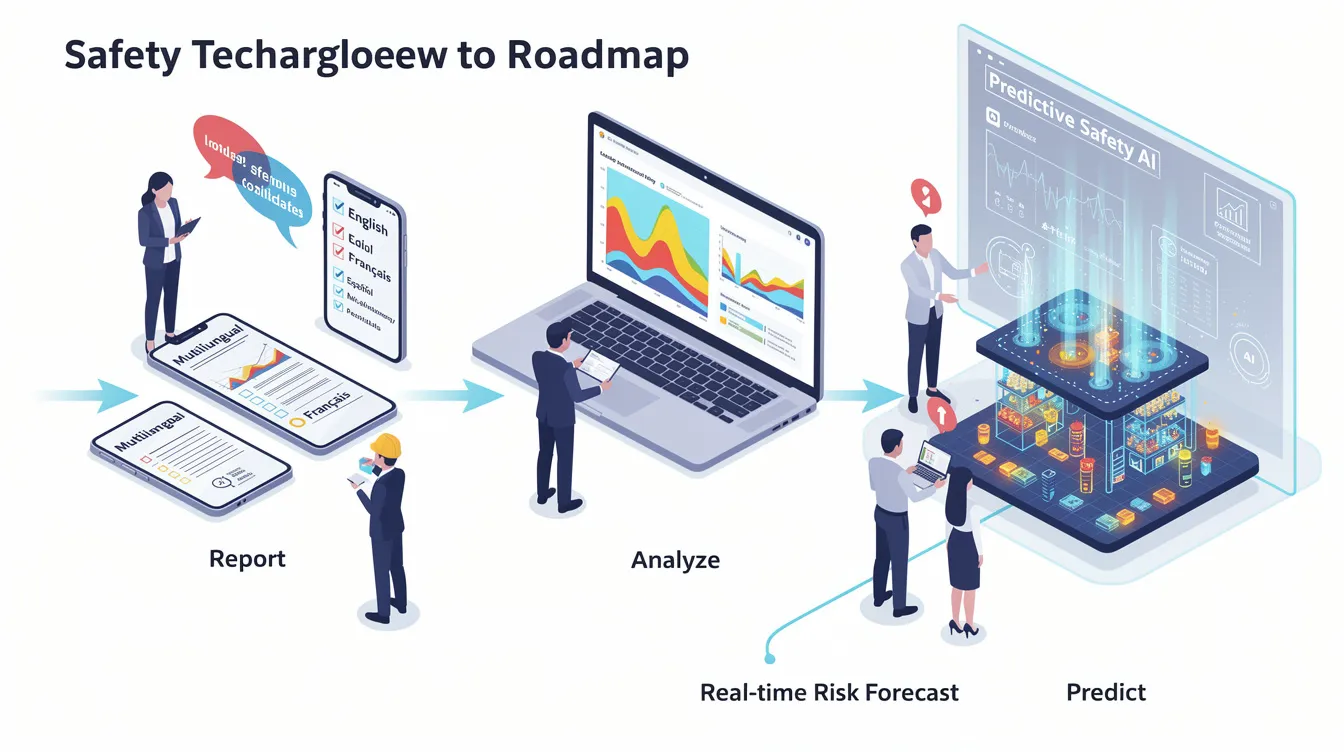
The language processing foundation described above enables a specific workflow: a worker reports an incident in any supported language, the LLM translates and classifies it, an investigation is triggered, corrective actions are assigned, and closure is tracked until effectiveness verification is complete. Each step maps to an ISO 45001 requirement.
Automated Incident Reporting, Classification, and Routing
LLMs analyze incident descriptions across languages and assign severity classifications within seconds. A fall-from-height report submitted in Burmese receives the same severity tag as an identical report submitted in English. The system routes the classified report to the appropriate safety officer, supervisor, or management level based on incident type and severity.
Real-time generation of investigation templates follows routing. The LLM pre-populates the template with extracted incident details: date, time, location, personnel involved, hazard identified, and preliminary contributing factors. Safety teams receive a structured starting point rather than a blank form. ISO 45001 requires timely incident reporting and investigation processes; automated classification and routing reduce the gap between when an incident occurs and when investigation begins from hours or days to minutes.
Singapore’s construction sector recorded a fatal and major injury rate of 26.3 per 100,000 workers in 2025, down from 31.0 in 2024, according to the WSH Report 2025. Every hour of delay between incident and investigation is a period where similar incidents could potentially occur at other locations. Automated routing eliminates that delay for the classification and assignment steps.
Corrective Action Plan Generation
ISO 45001 requires root cause analysis for corrective actions. LLMs automate root cause analysis and suggest corrective actions aligned with ISO standards. The model analyzes the current incident against historical incident data, identifies patterns, and proposes corrective actions that address underlying problems, not just symptoms.
Corrective actions must address systemic weaknesses. If three incidents across two languages describe equipment failure on the same crane model, the LLM flags the pattern and recommends engineering controls rather than administrative workarounds. Automatic assignment of responsibilities, deadlines, and verification requirements follows. Each corrective action entry includes: the responsible person, the target completion date, the verification method, and the link back to the originating incident.
Corrective actions should be verified for effectiveness after implementation. The LLM tracks each action through to closure and prompts safety officers when verification deadlines approach. LLMs create a feedback loop that supports continual improvement in safety management: closed actions feed back into the model’s training data, improving future recommendations.
Identifying recurring hazards through multilingual data aids in preventive measures. When the system processes reports across languages and sites, it detects patterns that a single-language, single-site system would miss. A near miss reported in Tamil at one site and a similar incident reported in Mandarin at another site may share the same root causes; the LLM surfaces this connection for preventive action.
Compliance Documentation Automation
ISO 45001 requires documentation of corrective actions taken. Organizations must document incident investigation findings under ISO 45001. The LLM generates standardized reports for internal audits and external audit readiness with full traceability from incident to closure.
Capturing safety trends across languages supports systematic improvements and compliance. The system produces dashboards showing open corrective actions, overdue verifications, recurring hazards, and participation rates by language group. Safety leaders use these dashboards during management review to assess risks, identify system deficiencies, and plan operational controls.
Corrective actions are communicated back to affected workers and relevant workers in their preferred languages. If a corrective action changes a work procedure, the LLM generates the instruction in Bengali, Burmese, or whichever language the work team uses. This closes the communication loop required by ISO 45001 and reduces the risk of unsafe behaviors caused by misunderstood instructions.

Implementation Framework for Construction and Industrial Organizations
Deploying multilingual LLMs for incident management requires a structured methodology. The steps below apply to Singapore construction firms and manufacturing companies pursuing bizSAFE certification or ISO 45001 certification, and to multinational organizations operating across multiple sites.
Deployment Methodology
Organizations ready to implement multilingual LLM solutions should follow this sequence:
-
Language assessment and workforce communication preference mapping. Survey all sites to determine which languages workers speak, read, and prefer for reporting. Include literacy assessment; some workers may prefer voice interfaces over text. Singapore’s SOC training in eight languages provides a baseline, but individual sites vary.
-
Integration with existing incident management systems. Most firms use spreadsheets, paper forms, or basic digital tools. API-based integration overlays LLM translation and classification functionality onto existing workflows without replacing them. Map each step to ISO 45001 Clause 10.2 documentation requirements using your current workplace safety checklist as a starting point.
-
Staff training on multilingual reporting interfaces. Safety officers learn to review LLM-generated classifications and corrective action suggestions. Workers learn to submit reports via mobile app in their preferred language. Hands-on demonstration is more effective than written instructions for workers with limited literacy.
-
Pilot testing with selected high-risk work areas. Deploy at one construction site or manufacturing line with a known multilingual workforce. Collect bilingual incidents, test classification accuracy per language, and gather feedback from both workers and safety officers. A pilot by Niyati for a global building/manufacturing client in Singapore took less than three months to implement.
-
Performance monitoring and continuous improvement. Track classification accuracy, reporting lag reduction, corrective action closure rates, and worker participation rates. Feed corrections back into the model. ISO 45001 emphasizes continual improvement through corrective actions; the same principle applies to the reporting system itself.
Technology Platform Comparison
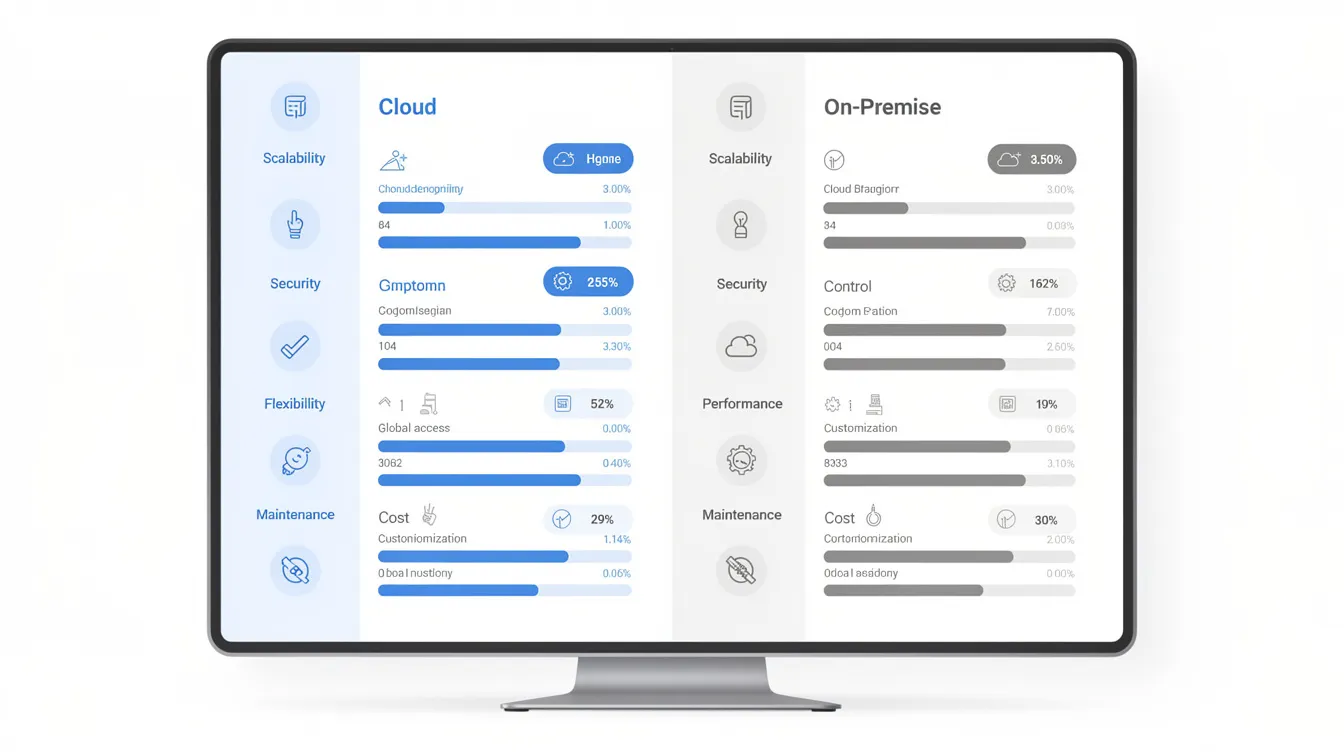
|
Platform Feature |
Cloud-Based Solutions |
On-Premise Deployment |
|---|---|---|
|
Language Support |
50+ languages with regular model updates |
Customizable to specific organizational language needs |
|
ISO 45001 Integration |
Pre-built templates and corrective action workflows |
Fully customizable compliance frameworks mapped to organizational procedures |
|
Data Security |
Shared infrastructure with encryption; requires PDPA compliance review |
Complete organizational control over incident data and worker information |
|
Implementation Time |
2-4 weeks with standard configuration |
8-12 weeks with custom development and integration |
|
Model Updates |
Continuous, managed by provider |
Manual; requires internal ML expertise |
|
Cost Structure |
Subscription-based; lower upfront cost |
Higher setup cost; lower ongoing per-incident cost at scale |
The choice depends on three factors. Data security requirements: organizations handling sensitive worker health data or operating under strict contractual nondisclosure may need on-premise deployment to comply with Singapore’s PDPA and MOM regulations. Customization needs: firms with unusual hazard taxonomies or non-standard investigation workflows benefit from on-premise flexibility. Scale: cloud solutions suit organizations with fewer than 500 workers across sites, while on-premise becomes cost-effective for larger deployments.
BESIX, a global construction firm with 11,000 employees across 26 countries, implemented a centralized EHS platform supporting multiple languages (English, French, Portuguese, Dutch) and standardized incident reporting and corrective action management across over 580 projects. Their experience illustrates that multilingual safety platforms scale across diverse workforces when backed by consistent terminology databases.
Common Implementation Challenges and Solutions
Three barriers recur in deployments of AI-powered incident reporting systems. Each has a tested mitigation strategy.
Worker Resistance to AI-Powered Reporting
Workers may distrust AI reporting tools, fearing surveillance or disciplinary consequences. Trust in management leads to lower turnover and higher engagement; the reverse is also true. The solution is participatory rollout. Involve workers in the pilot phase. Demonstrate that reports are anonymized before reaching management dashboards. Show workers how the system translates their reports accurately and routes them to safety officers who act on the findings. A strong reporting culture signals safety as a priority at all levels.
Gradual introduction works better than a sudden switch. Start with voluntary use alongside existing paper forms. As workers see that the system produces faster incident response and that their safety concerns are addressed, adoption increases organically. Effective incident reporting transitions organizations to proactive safety management rather than leaving them dependent on reactive incident reporting.
Accuracy Concerns with Technical Safety Terminology
LLMs struggle with rare or sector-specific terms. Research on LLM safety output consistency across languages shows that even high-performing models exhibit error rate variations across languages and safety categories. A study comparing AI translation against human interpreters found that while AI preserved terminology accuracy and adequacy of meaning within a non-inferiority margin, it did not match human interpreters on clarity or fluency.
The mitigation has two parts. First, develop organization-specific terminology databases in all relevant languages, built with bilingual safety experts. The LLM-BT framework’s 90% term consistency depends on exactly this kind of glossary-backed translation. Second, establish human-in-the-loop verification for all incidents classified as major or fatal severity. Automated outputs flag uncertainty levels; anything above threshold triggers human review before the corrective action plan is finalized. Risk assessments involving new or changed hazards require this human verification step regardless of the model’s confidence score.
Integration with Legacy Safety Management Systems
Most construction firms in Singapore manage incidents through spreadsheets, email chains, or basic database tools. Replacing these systems entirely creates disruption during the transition period, a period when hazard identification and incident response cannot afford gaps.
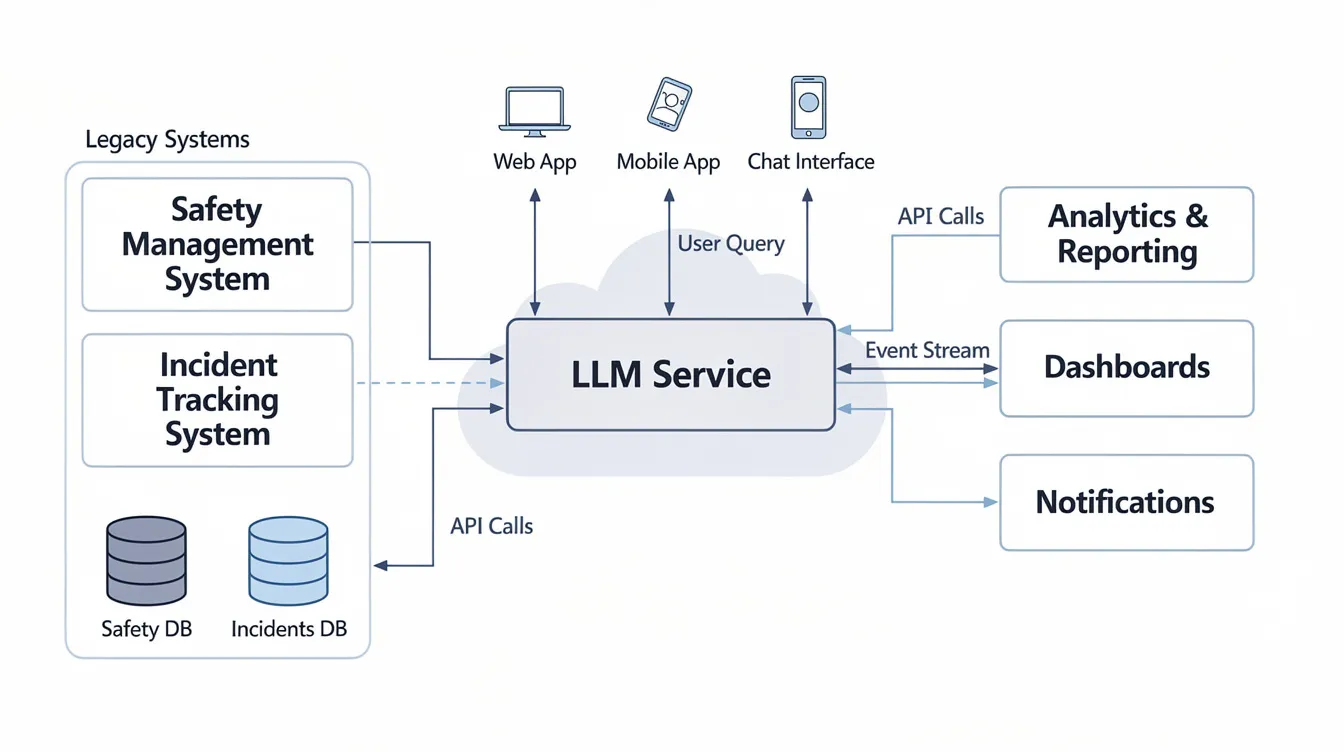
API-based integration preserves existing workflows. The LLM layer sits between the worker’s mobile interface and the existing management system, handling translation, classification, and corrective action suggestion. Investigation workflows remain familiar to safety officers. The existing system continues to store documented information and serve as the system of record for construction safety audits.
Phase implementation across sites. Start with the pilot site, resolve integration issues, then extend to additional sites one at a time. Each phase includes mapping to existing controls and verifying that the system handles all incident types present at that site, including near miss reports, occupational illnesses, and mental health-related incidents.
Digital tools can enhance compliance with ISO 45001 standards. AI-powered platforms improve incident management efficiency. Wearable technology monitors workers’ health in real-time, and smart helmets with gas detectors enhance hazard identification. These technologies complement multilingual LLMs; the LLM processes the reports generated by both human observation and sensor data.
Conclusion and Next Steps
Multilingual LLMs solve a measurable problem in occupational safety: language barriers that prevent workers from reporting incidents completely and accurately. When workers can report incidents in their preferred language, safety teams receive classified, translated, investigation-ready reports within minutes. Corrective action processes run from assignment through effectiveness verification on a single platform. Incident management connects investigation with continual improvement in safety, producing the documented information that ISO 45001 auditors require.
AI analyzes data to predict potential workplace hazards. As the system accumulates incident data across languages and sites, it shifts organizations from managing incidents after they occur to identifying patterns that prevent recurrence.
For Singapore organizations operating in construction and manufacturing:
-
Conduct a language assessment of workforce communication preferences across all operational sites. Map spoken, written, and preferred reporting languages for each team.
-
Evaluate current incident reporting workflows against ISO 45001 requirements to identify automation opportunities and documentation gaps.
-
Pilot a multilingual LLM solution at one high-risk site; measure classification accuracy, reporting lag, and worker participation rates before and after deployment.
-
Develop an integration plan connecting the LLM system to your existing safety management system and bizSAFE certification requirements.
Related topics that build on this foundation include AI-powered construction site inspection programs, automated compliance reporting for workplace risk assessment, and predictive risk analytics for construction safety, which extend the same multilingual data infrastructure to risk management and continuous improvement in safety.
Additional Resources
-
ISO 45001:2018 Clause 10.2 guidance on incident investigation and corrective action requirements
-
Singapore Ministry of Manpower WSH Report 2025 with workplace safety statistics and multilingual communication guidelines
-
MOSAIC safety management systems guide for Singapore construction organizations implementing structured methodologies
-
Research on scaling LLMs for critical error detection in translation, covering instruction-tuned models for under-represented languages