Passing an audit does not make a worksite safe. That distinction matters more than most contractors realize, particularly in Singapore’s construction sector, where regulatory requirements have grown more demanding, tender eligibility increasingly depends on certification status, and the consequences of inadequate safety systems extend well beyond financial penalties. Singapore’s fatal injury rate in construction remains a closely tracked metric precisely because the sector continues to present elevated risk despite significant national progress. This guide clarifies the legal frameworks, practical compliance tools, and risk management strategies that construction companies need to build genuinely safer worksites.
Table of Contents
- Defining workplace safety in Singapore
- Frameworks for compliance: BizSAFE, ISO 45001, and ConSASS
- Risk management: Assessment, controls, and edge cases
- Measuring impact: Safety performance and continual improvement
- Why compliance isn’t enough: Our view on workplace safety
- Take your next steps: Support for achieving workplace safety
- Frequently asked questions
Key Takeaways
| Point | Details |
|---|---|
| Legal foundations matter | Workplace safety in Singapore starts with the WSH Act and sector regulations for construction. |
| Frameworks drive compliance | bizSAFE and ISO 45001 provide structured pathways for meeting tender and certification requirements. |
| Risk management is essential | Effective hazard review and controls are required for every construction activity, not just high-risk tasks. |
| Continuous improvements pay off | Tracking performance via audits and industry benchmarks leads to safer worksites and lower injury rates. |
| Leadership sets the tone | Top management commitment and proactive culture turn compliance into real safety outcomes. |
Defining workplace safety in Singapore
Workplace safety in Singapore is not a discretionary management concern. It is a statutory obligation with direct legal consequences for employers, site supervisors, and principal contractors alike. The foundational instrument is the WSH Act, which establishes duties for every party in the supply chain, from developers and main contractors to subcontractors and individual workers.
The WSH Act’s scope is notably broad. It covers:
- Employer duties: Providing safe work systems, adequate training, and appropriate supervision
- Employee duties: Complying with safety instructions and not endangering others
- Principal contractor duties: Coordinating safety across all contractors on a shared worksite
- Designer duties: Eliminating or reducing hazards at the design stage before construction begins
Construction is explicitly recognized as a high-risk sector under the Act, triggering additional regulatory instruments including the WSH (Construction) Regulations, the WSH (Scaffold) Regulations, and the WSH (Work at Heights) Regulations. These subsidiary instruments impose specific technical standards for scaffolding, formwork, excavation, and lifting operations, all activities that generate disproportionate injury and fatality risk.
“Safety is not a bureaucratic checkbox. It is the architecture of every decision made on a construction site, from procurement to handover.”
Understanding construction safety standards in Singapore requires recognizing that the regulatory framework is layered. The WSH Act provides the overarching duty of care, subsidiary regulations specify technical requirements, and approved codes of practice (ACOPs) offer detailed implementation guidance. Compliance with an ACOP is not legally mandatory, but it provides a strong defense against prosecution by demonstrating that industry best practice was followed.
For construction companies, the practical implication is that legal compliance requires more than passing an audit. It requires establishing workplace safety management systems that are genuinely operational, not merely documented. Auditors assess whether systems exist; incident investigators examine whether those systems actually functioned when conditions deteriorated.
Frameworks for compliance: BizSAFE, ISO 45001, and ConSASS
Having established the legal baseline, the next question is which structured framework best supports a construction company’s compliance journey and strategic positioning. Three frameworks dominate Singapore’s construction safety landscape.
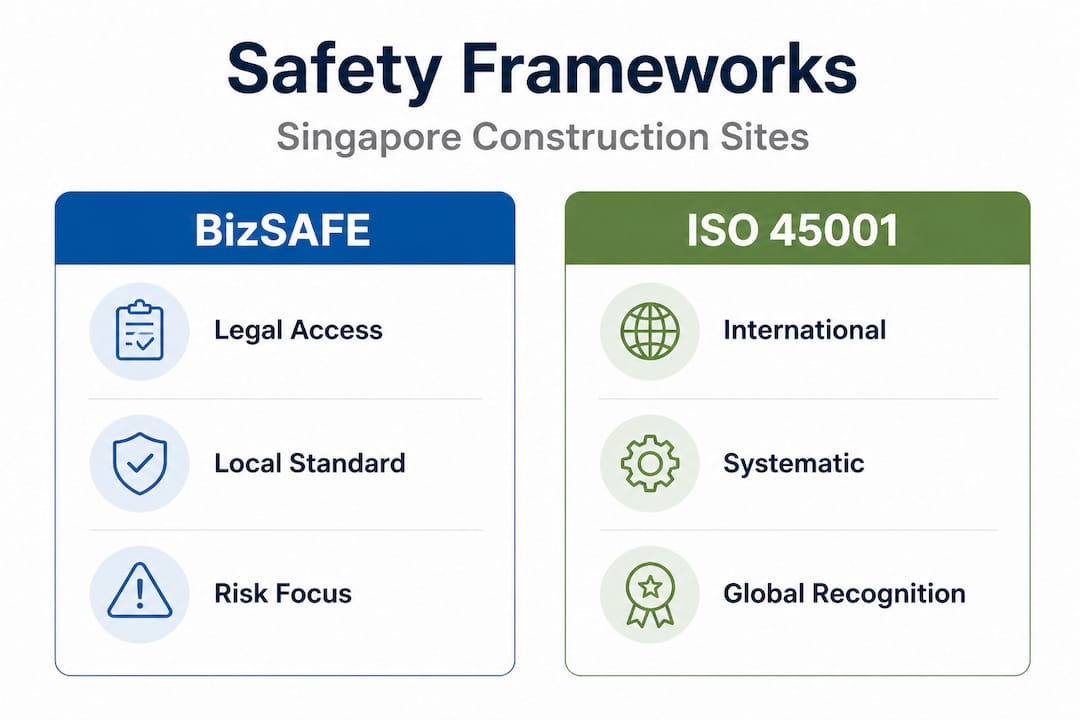
BizSAFE is a national capability-building program administered by the Workplace Safety and Health Council (WSHC). It provides a progressive five-level certification pathway designed to help companies build robust WSH management systems incrementally. Each level has specific requirements:
- BizSAFE Level 1: Senior management attends a WSH risk management workshop
- BizSAFE Level 2: Company develops a risk management implementation plan
- BizSAFE Level 3: Risk management plan is audited and approved by a MOM-approved Auditing Organization (AO)
- BizSAFE Level 4: Company develops a WSH management system
- BizSAFE Star: WSH management system is independently audited and certified
For most construction contractors, BizSAFE Level 3 is the minimum threshold for government tender eligibility and BCA (Building and Construction Authority) contractor registration. The bizSAFE certification guide provides detailed preparation steps for companies approaching this level for the first time.
ISO 45001 is the international standard for occupational health and safety management systems. Unlike BizSAFE, which is Singapore-specific, ISO 45001 certification is recognized globally and signals to international clients, joint venture partners, and multinational developers that a company’s safety management system meets world-class standards. ISO 45001 uses a Plan-Do-Check-Act (PDCA) methodology and emphasizes proactive hazard identification, worker participation, and top management leadership as core system requirements.
ConSASS (Construction Site Audit Scoring System) is a MOM-administered audit tool used specifically on large construction sites. It evaluates safety management implementation through scored audits, with results directly influencing MOM’s regulatory oversight intensity. Companies with consistently high ConSASS scores demonstrate operational safety maturity beyond basic certification.
| Framework | Scope | Primary benefit | Mandatory? |
|---|---|---|---|
| BizSAFE Level 3 | Singapore companies | Tender eligibility, legal compliance | Effectively yes for govt contracts |
| BizSAFE Star | Singapore companies | Advanced WSH system recognition | No, but competitive advantage |
| ISO 45001 | Global standard | International credibility, PDCA system | No, but preferred by MNCs |
| ConSASS | Large construction sites | MOM audit performance | Applies to qualifying sites |
The safety management systems guide outlines how these frameworks can be integrated rather than treated as competing alternatives. In practice, a BizSAFE Star-certified company has already fulfilled many of the structural requirements for ISO 45001 certification, making dual certification a cost-efficient strategy for companies pursuing international work.
Pro Tip: If your company is preparing for BizSAFE Level 3, treat the risk assessment documentation process as the foundation for ISO 45001 compliance. The two frameworks share significant structural overlap, and building your documentation to the higher standard from the outset avoids costly rework later.
Risk management: Assessment, controls, and edge cases
With frameworks understood, the operational core of workplace safety is risk management, specifically the systematic identification, assessment, and control of hazards before they cause harm. Risk assessments under the WSH (Risk Management) Regulations are mandatory for all work activities, not merely high-risk ones. This is a common misconception: many contractors conduct thorough risk assessments for confined space entry or working at heights while neglecting seemingly routine tasks like manual material handling or housekeeping, which collectively account for a significant proportion of injuries.
The standard risk assessment process for construction activities involves five steps:
- Identify hazards: Systematically examine each work activity, equipment, material, and environment
- Assess risk: Evaluate the likelihood and severity of harm for each identified hazard
- Implement controls: Apply the hierarchy of controls to reduce risk to as low as reasonably practicable (ALARP)
- Document findings: Record the assessment, controls, and responsible persons in a formal Risk Assessment (RA) document
- Review and update: Reassess when work conditions change, after incidents, or on a scheduled periodic basis
The hierarchy of controls, applied in descending order of effectiveness, is:
- Elimination: Remove the hazard entirely (e.g., redesign to avoid working at height)
- Substitution: Replace a hazardous material or process with a less dangerous alternative
- Engineering controls: Physical barriers, guardrails, machine guarding, ventilation systems
- Administrative controls: Safe work procedures, permit-to-work systems, training, supervision
- Personal Protective Equipment (PPE): Last resort, not a substitute for higher-order controls
BizSAFE Level 3 requires that a company’s risk assessment documentation be audited and approved by a MOM-approved AO. This means the RA must be technically sound, not merely formatted correctly. Auditors examine whether identified hazards are realistic, whether controls are specific and implementable, and whether residual risk has been genuinely reduced.
| High-risk activity | Primary hazard | Recommended control level |
|---|---|---|
| Working at heights (>2m) | Falls from height | Engineering: full scaffolding, edge protection |
| Excavation and trenching | Collapse, engulfment | Engineering: shoring, benching |
| Confined space entry | Asphyxiation, toxic gas | Administrative: permit-to-work, gas testing |
| Crane and lifting operations | Struck-by, overloading | Engineering: rated equipment, exclusion zones |
| Hot works (welding, cutting) | Fire, explosion | Administrative: hot work permit, fire watch |
The risk assessment process for construction sites must also account for edge cases: scenarios that fall outside routine activity but occur with enough frequency to require pre-planned controls. These include simultaneous operations (SIMOPS) where multiple trades work in proximity, temporary works failures, and unexpected ground conditions during excavation. The common workplace hazards encountered on Singapore construction sites consistently include falls, machinery entanglement, and electrical contact, each requiring specific pre-task controls rather than generic RA language.
Design for Safety (DfS) represents the upstream application of risk management principles, requiring designers and engineers to consider construction-phase and maintenance-phase hazards during the design process itself. DfS is mandatory for projects above specified contract value thresholds under Singapore’s WSH (Design for Safety) Regulations, and it represents the most cost-effective point at which hazards can be eliminated or reduced.
Pro Tip: Permit-to-work (PTW) systems are frequently cited as an administrative control, but their effectiveness depends entirely on implementation quality. A PTW that is completed as a formality, without genuine pre-task hazard review, provides no real protection and may actually increase liability by creating a paper trail that demonstrates awareness of risk without corresponding action.
Measuring impact: Safety performance and continual improvement
Frameworks and risk assessments create the structural conditions for safety. Measuring outcomes determines whether those structures are actually working. Construction companies that treat safety performance data as a management tool, rather than a compliance obligation, consistently outperform those that track metrics only for reporting purposes.
Singapore’s fatal injury rate in construction dropped from 31.0 to 26.3 per 100,000 workers in a single year, a meaningful improvement that reflects the cumulative effect of regulatory enforcement, industry capability building, and improved safety management systems. However, the absolute number of fatalities remains unacceptable, and the data consistently shows that smaller contractors and minor works projects account for a disproportionate share of incidents.
“What gets measured gets managed. Safety performance data is not a retrospective report card; it is a forward-looking diagnostic tool for identifying where management systems need strengthening.”
Key performance indicators that construction safety managers should track include:
- Lost Time Injury Frequency Rate (LTIFR): Number of lost-time injuries per million hours worked
- Total Recordable Incident Rate (TRIR): All recordable injuries per 200,000 hours worked
- Near-miss reporting rate: Volume of near-miss reports relative to workforce size (higher is better, indicating a reporting culture)
- Safety observation rate: Number of proactive safety observations per supervisor per month
- Corrective action closure rate: Percentage of identified hazards resolved within target timeframes
The PDCA (Plan-Do-Check-Act) cycle embedded in both BizSAFE and ISO 45001 provides the structural mechanism for continual improvement. The “Check” phase requires that performance data be systematically reviewed against targets, and the “Act” phase requires that management decisions be made in response to that data. Companies that implement management systems with genuine PDCA discipline show measurable improvement in safety outcomes over successive audit cycles.
Staying current with new safety measures introduced by MOM and WSHC is also a continual improvement obligation. Regulatory requirements evolve in response to incident patterns, and companies that monitor these changes proactively avoid the compliance gaps that typically emerge when standards are updated but internal procedures are not.
Why compliance isn’t enough: Our view on workplace safety
The construction industry has a persistent tendency to conflate certification with safety. A company that holds BizSAFE Star certification and a clean audit record is not necessarily a safe company. It is a company that has demonstrated, at a point in time, that its documented systems met the auditor’s criteria. The gap between documented systems and operational reality is where most incidents occur.
From our experience working with construction companies across Singapore’s regulatory landscape, the single most reliable predictor of genuine safety performance is not certification level but leadership behavior. When senior management treats safety as a non-negotiable operational value rather than a compliance function, the entire organization responds accordingly. Safety briefings become substantive rather than perfunctory. Near-miss reports are welcomed rather than suppressed. Risk assessments are written by the people doing the work, not by a safety officer filling in a template.
The hierarchy of controls and PDCA cycle are not paperwork frameworks. They are decision-making tools that, when genuinely applied, force systematic thinking about hazard elimination before workers are exposed. Proactive risk management at the design stage, for example, can eliminate entire categories of construction-phase risk at a fraction of the cost of engineering controls implemented after construction begins.
Small-scale contractors face a particular challenge: they often lack the dedicated safety resources of larger firms, yet they operate in the same high-risk environments and face the same legal obligations. The answer is not to scale down safety ambition but to prioritize upstream planning, leverage BizSAFE’s structured capability-building pathway, and invest in competent safety consultancy that delivers practical, site-specific solutions rather than generic documentation.
Compliance is the floor, not the ceiling. The companies that lead Singapore’s construction safety performance treat regulatory requirements as the minimum acceptable standard and build from there.
Take your next steps: Support for achieving workplace safety
Navigating Singapore’s layered safety regulatory environment requires more than good intentions. It requires structured expertise, current regulatory knowledge, and the ability to translate framework requirements into operational site practice.

MOSAIC Ecoconstruction Solutions provides construction companies with end-to-end support for achieving and maintaining safety compliance, from ISO 45001 certification consulting that aligns your management system with international standards, to targeted preparation for ConSASS and BizSAFE audits. Whether your company is building its first formal safety management system or strengthening an existing one ahead of a major tender, our consultancy team delivers practical, site-specific guidance grounded in deep regulatory expertise. Learn how to approach preparing for a safety audit with confidence, and position your organization for both compliance and genuine safety excellence.
Frequently asked questions
What is the WSH Act and how does it affect construction companies?
The WSH Act covers all workplaces including construction sites, imposing legal duties on employers, principal contractors, and employees to manage risk and maintain safe work environments. Non-compliance can result in prosecution, fines, and project suspension.
What’s the difference between BizSAFE and ISO 45001?
BizSAFE is a Singapore-specific national program for WSH capability building, while ISO 45001 is a globally recognized standard using PDCA methodology for proactive occupational health and safety management. Companies pursuing international work often benefit from holding both.
Is BizSAFE Level 3 required for all construction contracts in Singapore?
BizSAFE Level 3 is effectively mandatory for government construction tenders and BCA contractor registration, making it a practical prerequisite for most commercial construction work in Singapore rather than a voluntary enhancement.
What are the leading causes of construction injuries in Singapore?
Falls from height are the leading cause of construction fatalities, with machinery entanglement and struck-by hazards also contributing significantly to the sector’s injury profile.
How can small-scale contractors improve workplace safety with limited resources?
Small-scale works account for over 60% of incidents, making upstream risk review and BizSAFE’s structured capability-building pathway the most cost-effective starting points for contractors with limited dedicated safety resources.
Recommended
- Essential Guide: Singapore Construction Safety Standards
- Safety management systems: A complete guide for Singapore construction
- Workplace risk assessment in Singapore construction: A practical guide
- The Ultimate Guide to Top 10 Workplace Hazards in Singapore: Manufacturing & Construction Focus (2025) – MOSAIC Eco-construction Solutions Pte Ltd
- Health and Safety Compliance for Surveyors
- Fixings in building safety: essential guide for secure structures – Aussie Nails and Fasteners Warehouse