Risk assessment in Singapore’s construction sector is frequently mischaracterized as administrative overhead, a regulatory formality that project managers complete once and file away. That perception is costly. Fatal and major injury rates in Singapore’s construction industry have trended downward in recent years, a trajectory that safety experts attribute directly to improvements in structured, site-specific risk assessment practice. This guide examines the regulatory foundation, the five-step process mandated under the Workplace Safety and Health framework, advanced assessment methodologies, and the strategic connection between rigorous risk assessment and competitive tender success.
Table of Contents
- Understanding risk assessment in Singapore construction
- The five-step risk assessment process explained
- Dynamic and quantitative risk assessment: advanced approaches
- Integrating risk assessment with ConSASS, DfS, and tender success
- What most guides miss about risk assessment in construction
- Workplace safety solutions to elevate your next project
- Frequently asked questions
Key Takeaways
| Point | Details |
|---|---|
| Regulatory foundation | Risk assessment is a legal requirement in Singapore construction, protecting workers and projects. |
| Step-by-step clarity | The five-step process turns compliance from confusion into actionable routines for safer sites. |
| Advanced methods | Dynamic and quantitative risk assessments prepare managers for complex or high-risk scenarios. |
| Tender advantage | Effective risk assessment and ConSASS scores give companies a head start in Singapore tenders. |
| Practical wisdom | Frequent reviews and multidisciplinary teams prevent common pitfalls and raise safety standards. |
Understanding risk assessment in Singapore construction
Risk assessment in Singapore’s construction sector is not an optional best practice. It is a statutory obligation with enforceable consequences and measurable operational benefits. Before examining the process itself, it is essential to understand why the framework exists and who bears legal responsibility for executing it correctly.
The risk assessment process is formally defined under the Workplace Safety and Health Act (Cap. 354A) and the accompanying WSH (Risk Management) Regulations 2006. Risk assessment in Singapore is a systematic process mandated by the WSH Act, requiring employers to identify hazards, evaluate associated risks, implement controls, and maintain documentation of findings for inspection by the Ministry of Manpower (MOM). Non-compliance carries financial penalties and, in severe cases, criminal liability for responsible officers.
The scope of legal obligation is deliberately broad. Three categories of duty holders must conduct risk assessments:
- Employers, who must assess all work activities performed by their employees on any site.
- Principals, meaning main contractors and subcontractors who engage or supervise the work of others, including independent contractors.
- Self-employed persons, who must assess hazards arising from their own work activities, even when operating without direct employees.
This tripartite obligation is significant in the Singapore construction context because site operations routinely involve layered contractual arrangements. A main contractor cannot simply delegate risk assessment responsibility entirely to a nominated subcontractor and consider the obligation discharged.
“Effective risk assessment is not a document you produce for inspectors. It is a living protocol that governs every decision made on site, from scaffolding erection to confined space entry.”
Beyond statutory compliance, the strategic value of rigorous risk assessment extends to business performance. Singapore’s Construction Safety Audit Scoring System (ConSASS) evaluates safety management on active construction sites, and the resulting scores feed directly into the Public Quality Mark (PQM) and other tender qualification frameworks. Organizations that treat risk assessment as a genuine operational discipline rather than paperwork consistently achieve higher ConSASS scores, which translates into measurable tender advantage. The five-step compliance process is the starting point for building that advantage systematically.
The five-step risk assessment process explained
Every construction project manager in Singapore must have command of the five-step risk assessment process. It is the foundational methodology from which more advanced techniques are derived, and it is the structure that MOM inspectors reference during enforcement activities.
Step 1: Hazard identification
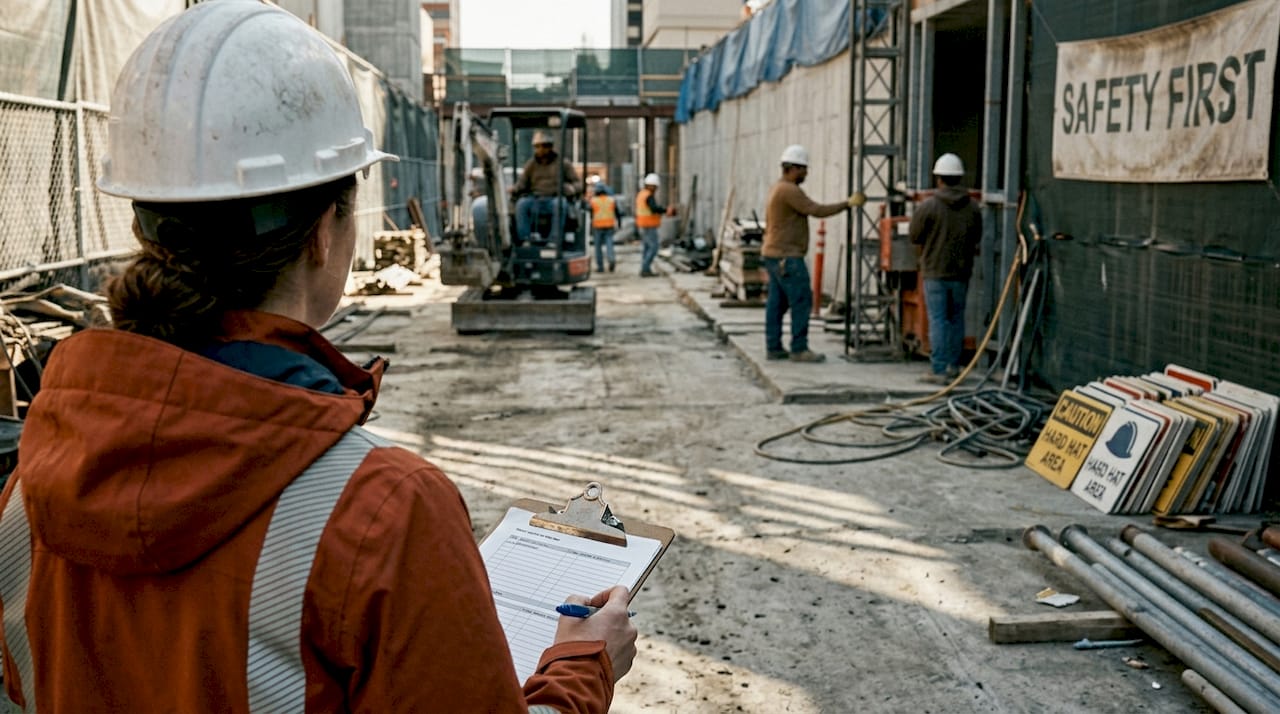
The first step requires a systematic survey of all work activities, plant, equipment, and environmental conditions on the site. Common construction hazards include falls from height, struck-by incidents involving mobile plant, electrical contacts, manual handling injuries, noise-induced hearing loss, and exposure to hazardous substances such as silica dust and solvents. Small-scale works, renovation activities, and confined space operations require particular attention because these environments generate a disproportionate share of Singapore’s construction incidents.
Step 2: Risk evaluation using a risk matrix
Each identified hazard is scored using a likelihood-severity matrix, typically scaled 1 to 5 on each axis. Likelihood scores assess the probability of an incident occurring under existing conditions, ranging from remote (1) to almost certain (5). Severity scores assess the potential consequence, from negligible (1) to catastrophic fatality (5). The product of these two scores produces a risk rating that determines the urgency and nature of required controls.
Step 3: Implementing the hierarchy of controls
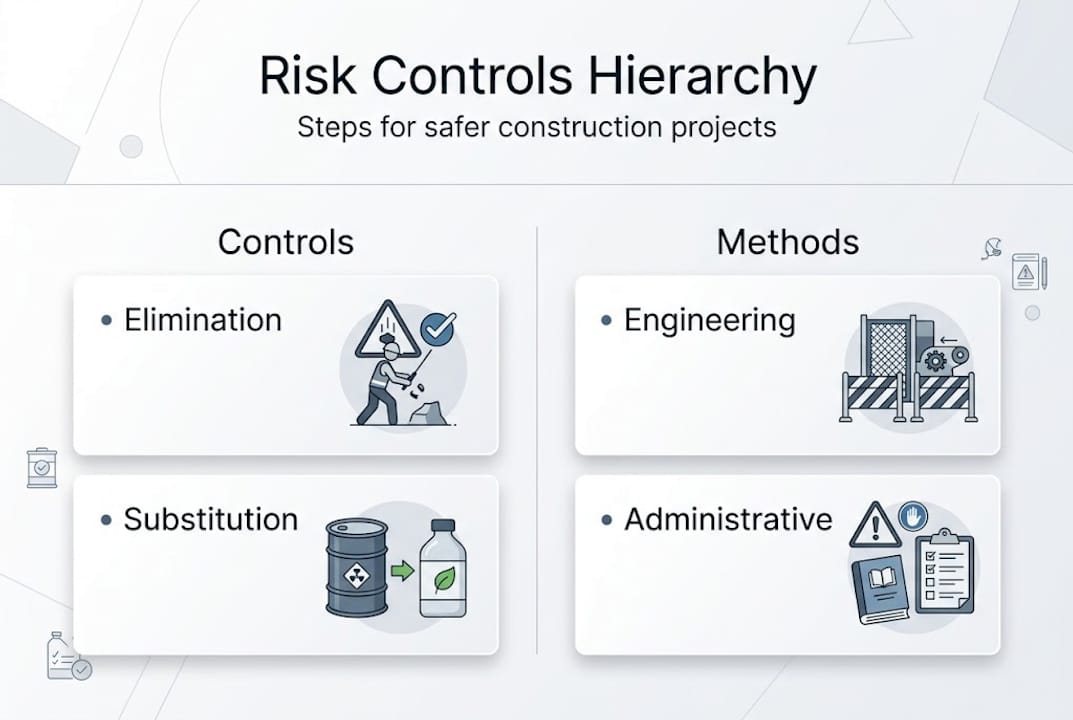
The standard five-step process specifies that hazard controls must follow a defined hierarchy. Elimination of the hazard is the most effective control and must be considered first. Where elimination is not practicable, substitution, engineering controls, administrative controls, and personal protective equipment (PPE) follow in descending order of effectiveness. A critical error seen on many Singapore sites is defaulting directly to PPE without genuinely evaluating whether engineering or administrative controls could achieve superior risk reduction.
Step 4: Documentation of findings
The risk assessment document must record the hazard, the existing controls in place, the residual risk rating after controls, and the additional controls required. MOM accepts both paper-based and digital records, provided the documentation is accessible to workers and supervisors on site.
Step 5: Monitoring and review
Risk assessments must be reviewed and updated periodically. The minimum statutory review interval is three years, but this threshold is frequently misapplied as a default schedule rather than a minimum floor.
Pro Tip: Review your risk assessment immediately after any near-miss event, any change in work method, introduction of new equipment, or modification to site layout. Waiting for the three-year mandatory interval on a dynamic construction site is operationally inadequate and regulatorily risky.
The table below summarizes the hierarchy of controls with practical construction examples.
| Control level | Description | Construction example |
|---|---|---|
| Elimination | Remove the hazard entirely | Prefabricate roof sections off-site to eliminate height work |
| Substitution | Replace with a safer alternative | Use water-based paint instead of solvent-based |
| Engineering controls | Physical barriers and safety devices | Install edge protection and guardrails at floor openings |
| Administrative controls | Safe work procedures and training | Implement permit-to-work system for confined spaces |
| PPE | Last line of defense | Safety harnesses and helmets for residual fall risks |
For a more granular breakdown of each step and how to structure supporting documentation, the ultimate guide to RA provides detailed worked examples applicable to Singapore project conditions.
Dynamic and quantitative risk assessment: advanced approaches
While most projects start with the five-step process, advanced sites or high-risk operations require more sophisticated risk assessments. Understanding when and how to apply these advanced methodologies is a mark of mature safety leadership.
Static versus dynamic risk assessment
The conventional five-step risk assessment is inherently static. It is conducted before work commences, based on anticipated conditions, and updated on a scheduled basis. This model works well for routine, repetitive tasks where site conditions are predictable. However, Singapore’s construction environment includes numerous project types where conditions shift rapidly: tunnel excavations, demolition works, complex structural alterations, and large-scale M&E installation sequences where multiple trades operate in close proximity simultaneously.
Dynamic risk assessment (DRA) supplements the formal static assessment by equipping workers and supervisors to evaluate hazards in real time as site conditions change. DRA is not a replacement for the statutory risk assessment. Rather, it functions as a continuous hazard recognition protocol that is embedded in worker training and site supervision. Workers trained in DRA can identify and respond to unexpected hazards, such as an uncovered excavation, a sudden equipment malfunction, or a deteriorating weather condition, without waiting for a formal assessment cycle.
Digital Workplace Safety and Health Management Systems
Digital safety management platforms have transformed how leading Singapore contractors maintain and deploy risk assessment records. Cloud-based Workplace Safety and Health Management Systems (WSHMS) enable real-time updating of risk registers, automated notification when review dates approach, and instant accessibility of risk assessment documentation by workers via mobile devices. Integrating digital WSHMS with WSH management systems creates a compliance infrastructure that is both auditable and operationally functional.
Quantitative risk assessment for major hazard installations
For projects involving major hazard installations (MHIs), Singapore law mandates a quantitative risk assessment (QRA). QRA uses probabilistic modeling to calculate numerical estimates of risk, typically expressed as individual risk contours and societal risk F-N curves. This methodology is applied where catastrophic accident scenarios, such as toxic gas releases or large-scale explosions, could affect populations beyond the site boundary. QRA requires specialized competence and is typically conducted by licensed safety consultants with specific MHI experience.
| Assessment type | Applicability | Key characteristics |
|---|---|---|
| Static RA | All construction projects (mandatory) | Scheduled, document-based, pre-work |
| Dynamic RA | High-change environments, complex sites | Real-time, supervisor-led, continuous |
| Digital WSHMS | Progressive contractors, multi-site operations | Cloud-based, auditable, real-time updates |
| Quantitative RA | Major hazard installations | Probabilistic modeling, numerical risk outputs |
Choosing the appropriate assessment methodology is a function of the project’s hazard profile, regulatory classification, and operational complexity. A single residential project and a petrochemical facility expansion each demand a fundamentally different assessment architecture, even though both must satisfy Singapore’s core WSH Act obligations.
Integrating risk assessment with ConSASS, DfS, and tender success
To maximize compliance and business value, risk assessment must connect with broader frameworks like ConSASS and Design for Safety. This integration is where safety management transitions from a cost center to a competitive asset.
ConSASS, administered by MOM and the Building and Construction Authority (BCA), evaluates the safety management system of active construction sites against a structured scoring rubric. High ConSASS scores contribute to a contractor’s standing within Singapore’s PQM tender qualification framework, providing demonstrable advantage when bidding for government and semi-government projects. The connection between rigorous, well-documented risk assessment and high ConSASS performance is direct: assessors look for evidence that risk assessments are site-specific, regularly reviewed, worker-accessible, and genuinely linked to on-site controls.
Understanding the critical importance of ConSASS as a scoring system reveals several strategic priorities:
- Risk assessments must be specific to the work activities actually being performed on the scored site, not generic templates.
- Workers must be able to demonstrate familiarity with the risk assessments relevant to their tasks.
- Documentation trails must show that identified controls have been physically implemented, not merely listed.
- Near-miss incidents must be reflected in updated assessments, demonstrating an active review culture.
Design for Safety (DfS), mandated under the WSH (Design for Safety) Regulations 2011, requires designers and developers to systematically identify and eliminate or reduce construction and maintenance hazards at the design stage. Integrating DfS principles early in the project lifecycle means that risk assessment findings from previous similar projects can directly inform design decisions, reducing inherent hazards before a single worker sets foot on site. Organizations applying DfS principles at the concept and schematic design stages consistently report fewer high-severity hazards appearing in their construction-phase risk assessments.
The data from Singapore’s WSH 2025 report is instructive. Falls from height remain the leading cause of fatal and major injuries in construction, and small-scale works sites account for a disproportionate share of the sector’s incident burden. Small-scale sites contribute over 60% of construction incidents by site category, a statistic that underscores why risk assessment rigor on minor works contracts is just as critical as on large-scale developments. Understanding the benefits of regular ConSASS audits helps organizations build the audit-readiness culture that sustains both safety performance and tender competitiveness over time.
Pro Tip: Structure your risk assessment program to triangulate across three domains: statutory WSH compliance, ConSASS audit readiness, and DfS integration at the design stage. Organizations that coordinate these three frameworks as a unified system, rather than treating each as a separate compliance obligation, achieve materially better safety outcomes and score higher across all tender qualification criteria.
What most guides miss about risk assessment in construction
The majority of risk assessment guidance published for Singapore’s construction sector focuses on process compliance: complete the five steps, use the correct matrix, retain the documentation. This is necessary but insufficient.
From direct engagement with Singapore construction projects across residential, commercial, and infrastructure sectors, the most consequential factor in risk assessment quality is not the format of the document but the composition and discipline of the team producing it. Multidisciplinary assessment teams, drawing from site supervisors, safety officers, trade specialists, and occasionally equipment suppliers, consistently identify hazard categories that solo-authored assessments miss. A site supervisor who understands sequencing may not recognize electrical isolation hazards. An electrical specialist may not anticipate ergonomic risks in confined routing. Combining perspectives is not procedural courtesy; it is a technical necessity.
The “copy-paste” risk assessment is one of Singapore construction safety’s most persistent failure modes. Generic templates applied without site-specific adaptation create a false sense of compliance while leaving genuine hazards unaddressed. Site-specific risk assessments avoiding copy-paste culture, along with frequent reviews beyond the three-year minimum, distinguish the organizations that genuinely reduce incidents from those that merely pass inspections. Integrating DfS from the earliest design briefing, rather than retrofitting safety considerations onto completed designs, is the highest-leverage intervention available to project managers who want both safer sites and stronger ConSASS positions. Explore advanced RA insights to see how leading Singapore contractors operationalize these principles systematically.
Workplace safety solutions to elevate your next project
Understanding risk assessment at the theoretical level is the first step. Translating that knowledge into compliant, auditable, and operationally effective systems on live projects is where expert consultancy delivers measurable value.

MOSAIC Ecoconstruction Solutions supports construction project managers and safety officers across Singapore with customized risk assessment frameworks, ConSASS audit preparation, and Design for Safety integration services. Whether you need a structured inspection checklist consulting engagement, specialist guidance through the DFSP process, or a fully managed WSH management system for your organization, the team brings deep regulatory knowledge and proven site-level experience to every engagement. Contact MOSAIC to build compliance that wins tenders and protects your people.
Frequently asked questions
Who is required to conduct risk assessment for construction projects in Singapore?
Employers, principals, and self-employed persons must conduct risk assessments for all work activities under Singapore’s WSH Act regulations, regardless of project scale.
How often should risk assessments be reviewed on site?
Risk assessments must be reviewed at least every three years and must also be updated promptly after any workplace incident, near-miss event, or material change in work activity or site conditions.
What hazards are most commonly addressed in construction risk assessments?
Falls from height and struck-by incidents are the leading hazard categories in Singapore construction, with small-scale sites accounting for more than 60% of incidents by site type.
How does effective risk assessment help project tenders?
Strong, well-documented risk assessment practice directly supports high ConSASS scores, which improve a contractor’s qualification standing within Singapore’s PQM tender evaluation framework.
What is the difference between static and dynamic risk assessment?
Static risk assessment establishes the formal compliance baseline through pre-work documentation, while dynamic risk assessment equips supervisors and workers to identify and respond to emerging hazards in real time as site conditions evolve.
Recommended
- Risk assessment process: mastering construction safety in Singapore
- Master construction risk assessment: 5 steps to compliance
- The Ultimate Guide to Risk Assessment in Singapore: Mastering WSH Compliance to Protect Your People and Your Business – MOSAIC Eco-construction Solutions Pte Ltd
- The Comprehensive Guide to Design for Safety Professionals (DFSP) in Singapore Construction Projects – MOSAIC Eco-construction Solutions Pte Ltd