

Construction executives in Singapore frequently treat ISO certification as an administrative obligation rather than a strategic asset, and that misalignment carries measurable costs. Firms that approach ISO 45001, ISO 9001, and ISO 14001 as mere paperwork exercises routinely forfeit competitive advantages in tendering, operational efficiency, and long-term profitability. The empirical record is clear: structured adoption of these standards reshapes safety culture, accelerates regulatory compliance, and generates returns that extend well beyond the certification audit cycle.
Table of Contents
- What are ISO standards in construction?
- Key benefits: Compliance, safety, and operational efficiency
- How ISO standards drive profitability and long-term gains
- Applying ISO standards: Practical steps for Singapore companies
- Fresh perspective: Why ISO adoption in construction pays off in Singapore
- Get expert ISO support for your Singapore construction projects
- Frequently asked questions
Key Takeaways
| Point | Details |
|---|---|
| ISO standards boost performance | Adopting ISO standards directly leads to improved safety, compliance, and efficiency for Singapore construction firms. |
| ISO 45001 equals long-term gains | ISO 45001 adoption results in strong productivity and profitability versus older OHSAS systems. |
| Compliance is strategic, not just legal | Meeting ISO requirements strengthens reputation, ensures access to tenders, and reduces operational risks. |
| Execution matters | Successful ISO implementation hinges on leadership, employee engagement, and continuous improvement. |
What are ISO standards in construction?
ISO standards are internationally recognized frameworks developed by the International Organization for Standardization to establish consistent requirements for management systems, processes, and performance outcomes across industries. In the construction sector, they function as the structural backbone of quality, safety, and environmental governance, providing organizations with systematic methods to identify hazards, control risks, manage quality, and reduce environmental impact.
Three standards are paramount for Singapore construction companies:
- ISO 45001 governs occupational health and safety management systems, requiring firms to identify workplace hazards, assess risks, and implement controls through a defined hierarchy. It replaced the earlier OHSAS 18001 framework and introduced a stronger emphasis on worker participation and organizational context.
- ISO 9001 addresses quality management systems, covering processes from procurement and subcontractor management through to project delivery and client satisfaction measurement.
- ISO 14001 establishes requirements for environmental management systems, covering waste reduction, resource consumption, emissions control, and regulatory environmental compliance.
| Standard | Focus area | Primary benefit for construction |
|---|---|---|
| ISO 45001 | Occupational health and safety | Accident reduction, regulatory compliance |
| ISO 9001 | Quality management | Defect reduction, project delivery consistency |
| ISO 14001 | Environmental management | Waste control, sustainability compliance |
In Singapore’s construction sector, these standards intersect directly with the Workplace Safety and Health Act, the Building and Construction Authority’s regulatory frameworks, and the Ministry of Manpower’s enforcement priorities. Firms pursuing major public sector contracts increasingly encounter ISO certification as a prerequisite or scoring criterion in tender evaluations, making adoption not merely aspirational but commercially necessary.
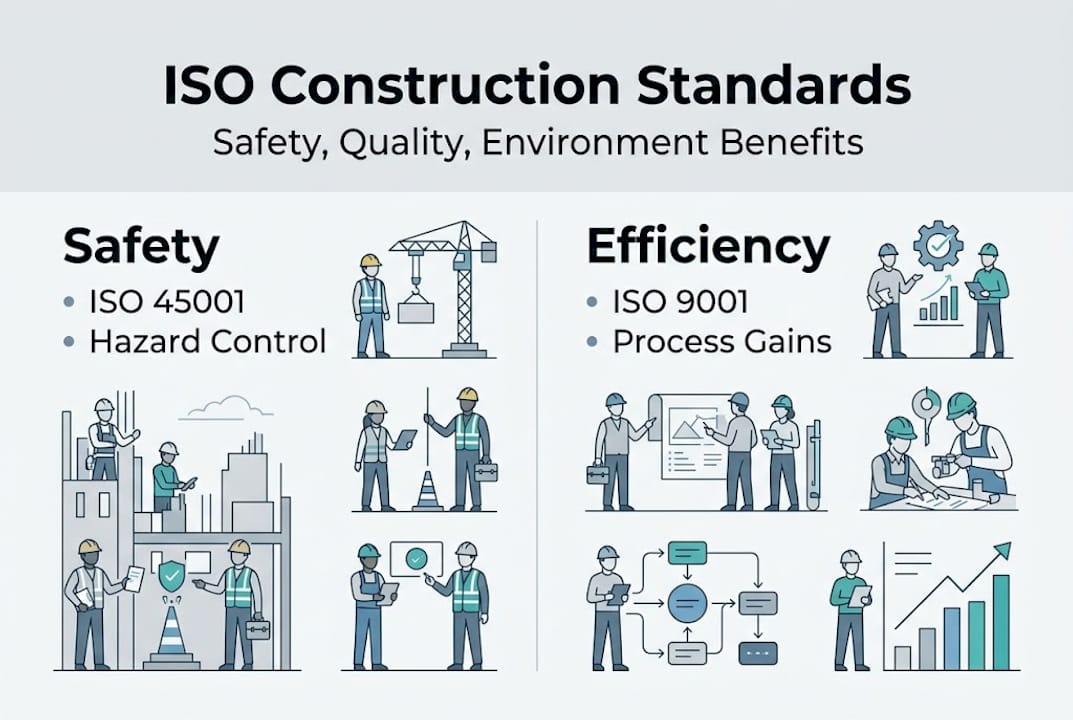
The operational significance of these standards extends beyond documentation. Properly implemented ISO 45001 consulting engagements restructure how firms conduct site inspections, manage subcontractor safety obligations, and respond to incidents. Research confirms that ISO 45001 adopters demonstrate long-term productivity and profitability gains, with firms transitioning directly to ISO 45001 without prior OHSAS 18001 certification showing stronger performance improvements than those carrying legacy OHSAS systems.
Effective site safety also depends on physical controls that complement management systems. Referencing construction signage best practices alongside ISO 45001 implementation reinforces the hazard control hierarchy at the operational level, ensuring that procedural requirements translate into visible, enforceable site conditions.
The ISO 45001 implementation guide available for Singapore firms provides a structured pathway through gap analysis, system design, staff training, and certification audit preparation, which we will examine in detail in later sections.
Key benefits: Compliance, safety, and operational efficiency
Understanding what ISO standards are gives way to examining what they actually deliver. For Singapore construction firms, the benefits cluster across three domains: regulatory compliance, safety performance, and operational efficiency, each reinforcing the others in ways that compound over time.
Regulatory compliance is the most immediate driver. Singapore’s Workplace Safety and Health Act imposes significant penalties for non-compliance, and ISO 45001 provides a systematic architecture for meeting those obligations. Firms with certified management systems demonstrate to the Ministry of Manpower and the Building and Construction Authority that their safety governance is structured, auditable, and continuously improving rather than reactive.
Safety performance improvements are well documented. ISO 45001 requires organizations to conduct systematic hazard identification, implement risk controls, establish emergency response procedures, and monitor leading and lagging safety indicators. This structured approach reduces reliance on individual supervisor judgment and creates consistent safety practices across all project sites. Firms implementing boosting construction safety strategies through ISO 45001 report measurable reductions in lost-time injury rates and improved worker confidence in reporting near-misses without fear of reprisal.

Operational efficiency gains are perhaps the least anticipated but most commercially significant. ISO 9001 implementation drives process standardization across procurement, subcontractor management, and project handover. ISO 14001 reduces waste disposal costs and streamlines environmental permit management. Together, these systems eliminate duplicated effort, reduce rework, and accelerate project delivery timelines.
Pro Tip: Firms that integrate ISO 45001, ISO 9001, and ISO 14001 into a unified integrated management system reduce documentation overhead by approximately 30 to 40 percent compared to maintaining three separate systems, while also simplifying the internal audit cycle.
| Benefit category | ISO standard | Measurable outcome |
|---|---|---|
| Regulatory compliance | ISO 45001 | Reduced MOM enforcement actions |
| Safety performance | ISO 45001 | Lower lost-time injury frequency rates |
| Quality consistency | ISO 9001 | Reduced defect and rework rates |
| Environmental management | ISO 14001 | Lower waste disposal costs |
| Tender competitiveness | All three | Improved scoring in public sector bids |
The research base supporting these claims is substantial. Long-term productivity gains are consistently associated with ISO 45001 adoption, particularly for firms that implement the standard without the constraints of a legacy OHSAS 18001 system. Firms that undergo ISO 45001 audit compliance processes also benefit from the discipline of external scrutiny, which identifies systemic gaps that internal reviews frequently overlook.
Physical site safety controls, including those covered in signage safety tips, remain a critical complement to management system certification. ISO 45001 establishes the procedural framework; physical controls and trained worker behavior translate that framework into daily site reality.
How ISO standards drive profitability and long-term gains
Beyond compliance and safety, the business case for ISO standards rests on empirical evidence linking certification to sustained financial performance. This is where many Singapore construction executives underestimate the strategic value of structured adoption.
“Certifications boost performance, but effects are moderated by industry sensitivity, prior certifications, and organizational context; long-term gains are consistently stronger than short-term returns.”
This finding carries significant implications for how firms should approach certification strategy. The profitability impact is not immediate, and organizations that treat certification as a one-time event rather than a continuous improvement platform will capture only a fraction of the available returns.
The mechanisms through which ISO standards generate profitability are identifiable and practical:
- Reduced incident costs. Workplace accidents generate direct costs through medical treatment, compensation claims, regulatory fines, and project delays, as well as indirect costs through reputational damage and workforce morale deterioration. ISO 45001’s systematic risk controls reduce incident frequency, compressing both cost categories.
- Improved tender success rates. Singapore’s public sector procurement increasingly weights safety management system certification in bid evaluations. Firms holding ISO 45001 certification access a broader pool of high-value contracts, improving revenue mix and margin quality.
- Lower insurance premiums. Insurers recognize ISO 45001 certification as evidence of structured risk management, and many offer premium reductions to certified firms. Over a multi-year period, these savings contribute meaningfully to operating margin.
- Operational waste reduction. ISO 9001 and ISO 14001 implementation drives systematic elimination of process inefficiencies, reducing material waste, rework costs, and regulatory compliance expenditure.
| Profitability driver | Mechanism | Timeframe for impact |
|---|---|---|
| Incident cost reduction | Fewer accidents, lower compensation claims | 12 to 24 months |
| Tender access | Certification as prerequisite or scoring criterion | 6 to 18 months |
| Insurance premium reduction | Demonstrated risk management maturity | 12 to 36 months |
| Operational efficiency | Process standardization, waste reduction | 18 to 36 months |
The nuance in the research matters for strategic planning. Firms transitioning from OHSAS 18001 to ISO 45001 show smaller performance gains than those implementing ISO 45001 as their first formal occupational health and safety management system. This suggests that the structural and cultural changes required by ISO 45001 deliver the greatest value when they are genuinely transformative rather than incremental updates to an existing certification framework.
Pro Tip: Firms seeking to maximize risk management gains should treat ISO 45001 implementation as an organizational redesign exercise, not a documentation project. The firms that capture the strongest long-term returns are those that restructure their safety governance from the ground up rather than mapping existing OHSAS processes onto the new standard’s requirements.
Applying ISO standards: Practical steps for Singapore companies
Translating the strategic case for ISO standards into operational reality requires a structured, phased approach. Singapore construction firms encounter specific implementation challenges related to project-based work structures, high subcontractor dependency, multilingual workforces, and the concurrent demands of regulatory compliance across multiple statutory frameworks.
The following implementation sequence reflects best practice for firms approaching ISO 45001 adoption, with parallel considerations for ISO 9001 and ISO 14001:
- Conduct a gap analysis. Assess current safety, quality, and environmental management practices against the requirements of the target standard. Identify documented gaps in policy, procedure, training records, and performance monitoring systems. This baseline establishes the scope and resource requirements for implementation.
- Secure leadership commitment. ISO 45001 explicitly requires top management to demonstrate visible, active leadership of the occupational health and safety management system. Without genuine executive engagement, implementation stalls at the documentation layer and fails to produce cultural change.
- Design and document the management system. Develop the policy framework, risk assessment methodology, operational controls, emergency response procedures, and performance monitoring systems required by the standard. Documentation should be proportionate to organizational complexity, not exhaustive for its own sake.
- Train all relevant personnel. Workers, supervisors, and managers must understand their roles within the management system. For Singapore’s multilingual construction workforce, training materials require translation and culturally appropriate delivery methods.
- Implement, monitor, and correct. Run the system through a full operational cycle before the certification audit, using internal audits and management reviews to identify and correct non-conformities. This phase is where many firms discover the gap between documented procedures and actual site practice.
- Engage a certification body for the external audit. Select an accredited certification body recognized by the Singapore Accreditation Council and prepare for Stage 1 (documentation review) and Stage 2 (implementation audit) assessments.
Common obstacles for Singapore firms include insufficient leadership time allocation, underestimation of subcontractor integration requirements, and inadequate documentation control systems. Firms that have worked through overcoming ISO 45001 challenges consistently identify subcontractor management as the most resource-intensive element of implementation, given the construction sector’s reliance on tiered subcontracting arrangements.
- Establish clear contractual safety obligations for all subcontractors before implementation begins
- Integrate subcontractor safety performance into the main contractor’s monitoring and review cycle
- Use ISO 17020 BIM processes to align inspection and verification workflows with digital project management systems
- Build ongoing improvement cycles into the management review calendar, not just the pre-audit period
Pro Tip: ISO 45001 adopters that establish robust internal audit programs before their certification audit consistently achieve certification on the first attempt and sustain stronger performance gains in the years following certification.
Fresh perspective: Why ISO adoption in construction pays off in Singapore
The construction industry’s instinct is to evaluate ISO certification through a compliance lens, asking whether it satisfies a regulatory or contractual requirement. That framing systematically undervalues the strategic return. The firms that extract the greatest long-term benefit from ISO standards are those that treat certification as the formalization of a safety and quality culture that was already being built, not as the culture itself.
There is an uncomfortable truth embedded in the research: firms that adopt ISO 45001 primarily to win tenders tend to achieve certification but not transformation. The documentation exists; the culture does not follow. Those firms capture short-term commercial benefits but miss the compounding returns that accrue to organizations where safety governance is genuinely embedded in leadership behavior, operational decision-making, and workforce expectations.
Integrating ISO with DfMA and emerging construction methodologies represents the next frontier for Singapore firms seeking to move beyond compliance into genuine competitive differentiation. The delay cost of waiting for regulatory pressure to force adoption is real and growing.
Get expert ISO support for your Singapore construction projects
Singapore construction firms navigating ISO implementation face a complex intersection of regulatory requirements, operational constraints, and certification timelines that demand structured, experienced support. The gap between understanding ISO standards conceptually and embedding them effectively into project operations is where most implementation efforts encounter their greatest friction.

MOSAIC Ecoconstruction Solutions provides specialized ISO 45001 consulting services designed specifically for Singapore’s construction sector, covering gap analysis, system design, staff training, and audit preparation through a single integrated engagement model. Whether your firm requires safety audit preparation support ahead of a certification assessment or sustained outsourced safety manpower to maintain system integrity across active project sites, the consultancy’s proven track record in Singapore construction provides a reliable foundation for achieving and sustaining certification.
Frequently asked questions
What are the most important ISO standards for construction companies in Singapore?
ISO 45001 for occupational health and safety, ISO 9001 for quality management, and ISO 14001 for environmental management are the three standards most critical for Singapore construction firms seeking compliance, tender eligibility, and operational efficiency. Research confirms that ISO 45001 adopters achieve measurable long-term productivity and profitability gains.
How do ISO standards improve safety on construction sites?
ISO standards require systematic hazard identification, risk assessment, and tiered control implementation, replacing ad hoc safety responses with structured, auditable processes that reduce accident frequency and severity. Certified management systems also establish continuous monitoring and corrective action cycles that sustain safety performance between audit periods.
Is ISO 45001 certification mandatory for Singapore construction companies?
ISO 45001 is not a statutory requirement under Singapore law, but it is increasingly specified as a mandatory or heavily weighted criterion in major public sector tenders and private developer procurement frameworks. Certification effects on business performance are moderated by industry context, making early adoption strategically advantageous before competitors establish certification as a market baseline.
How long does it take to implement ISO standards in construction?
Implementation typically requires 3 to 12 months, depending on company size, the maturity of existing safety and quality management practices, and the scope of subcontractor integration required. Firms with no prior formal management system certification generally require the upper end of that range to achieve a certification-ready state.
Recommended
- ConSASS 2026 Guide: Integrating Safety with DfMA, ISO 45001 & AI in Singapore Construction – MOSAIC Eco-construction Solutions Pte Ltd
- BizSafe 2025: The Ultimate Guide to Certification & ROI – MOSAIC Eco-construction Solutions Pte Ltd
- Protecting Your People, Securing Your Projects: The Critical Importance of ConSASS – MOSAIC Eco-construction Solutions Pte Ltd
- DfS Consultant Streamlines Construction – MOSAIC Eco-construction Solutions Pte Ltd