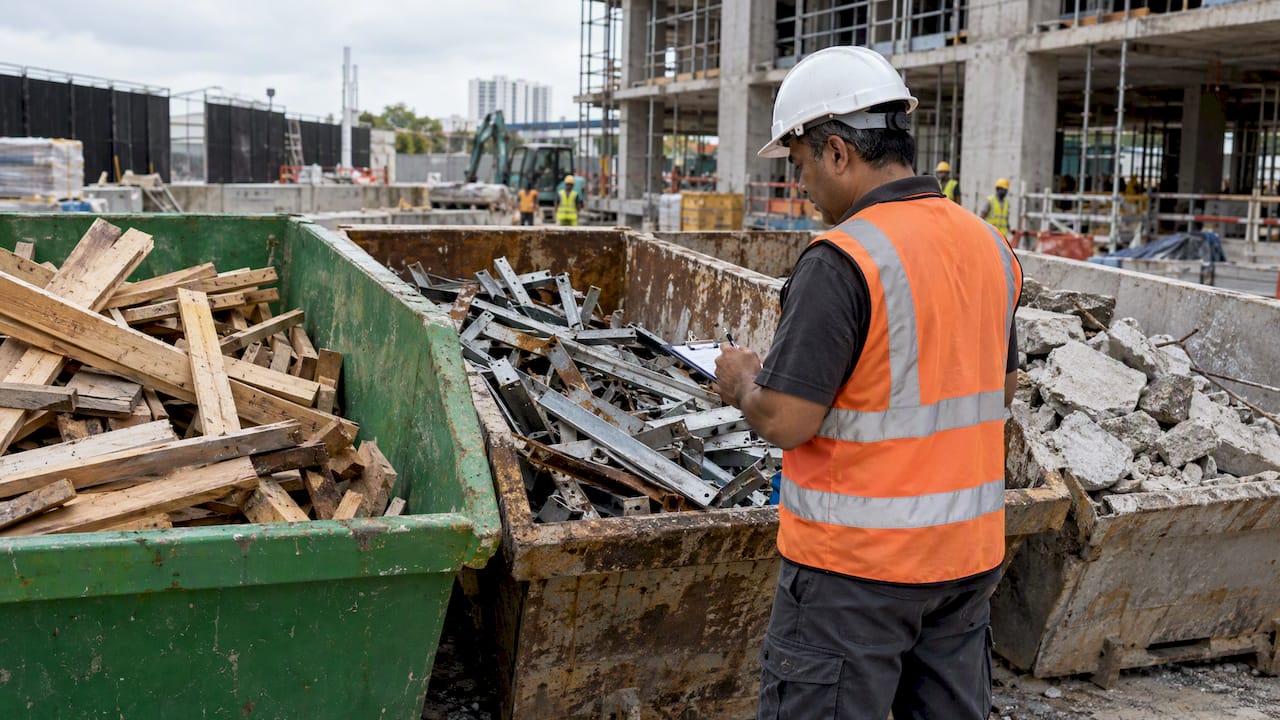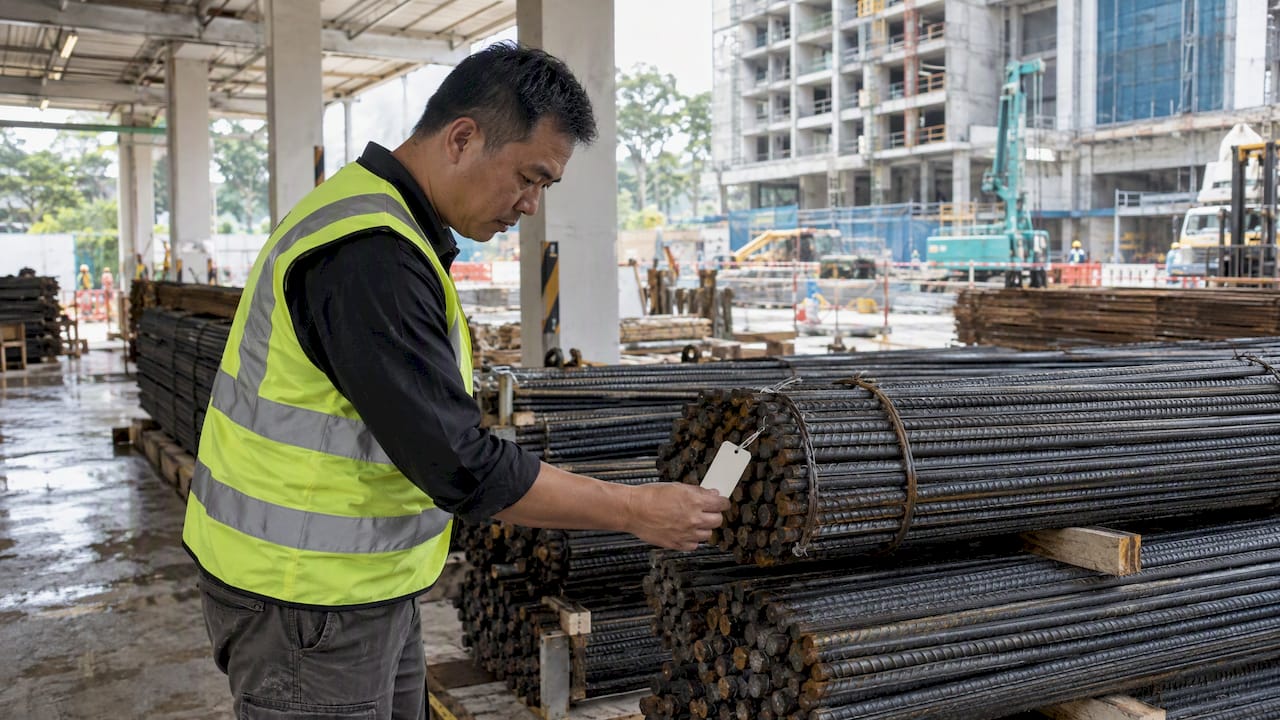
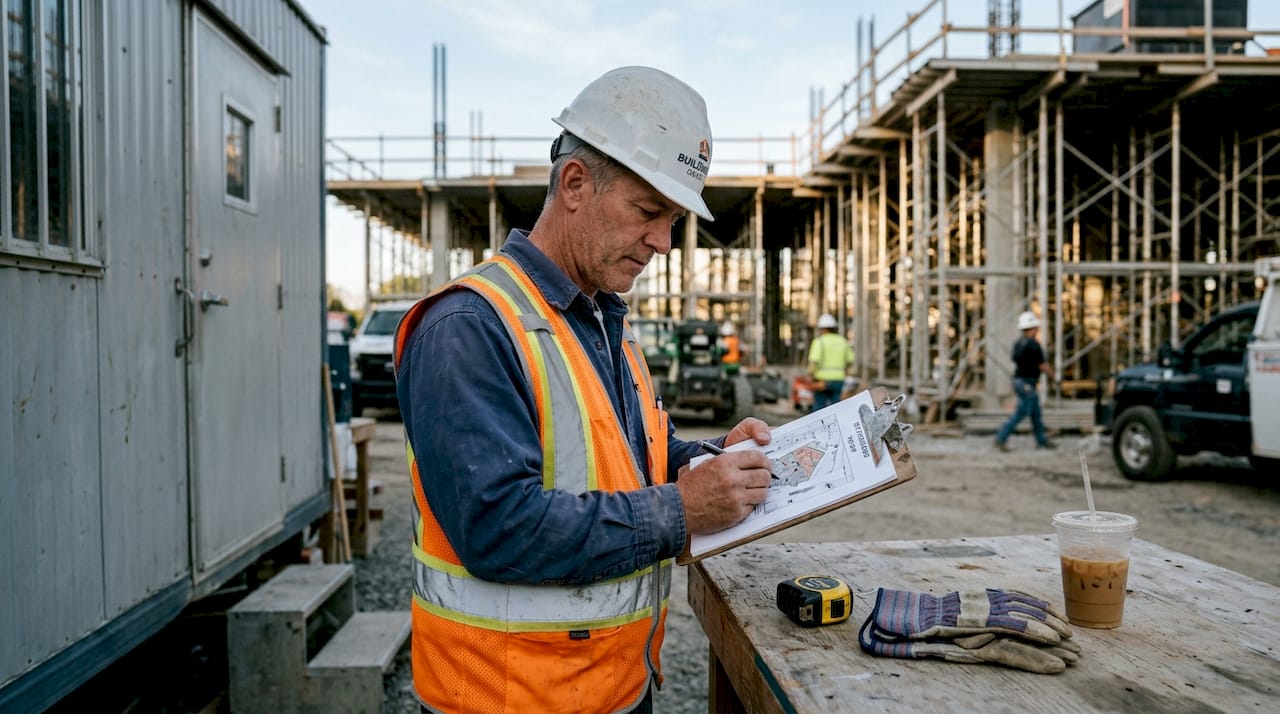
Singapore’s construction sector recorded a fatal/major injury rate of 26.3 per 100,000 workers in 2025, a figure that underscores an enduring reality: construction remains one of the highest-risk industries in the country despite decades of regulatory evolution. For project managers and safety officers, the consequences of an incomplete or poorly executed risk assessment extend well beyond regulatory censure. They include project shutdowns, civil liability, reputational damage, and, most critically, preventable fatalities. This guide delivers a structured, regulation-aligned walkthrough of construction risk assessment in Singapore, from statutory obligations through the five-step HIRAC process, verification protocols, and the cultural shifts that separate truly safe sites from merely compliant ones.
Table of Contents
- Regulatory basics: Why risk assessment matters
- Preparing for a risk assessment: Tools, roles, and requirements
- Step-by-step: Singapore’s 5-step HIRAC process
- Verification, review, and common pitfalls
- Expert perspective: Moving beyond compliance to true site safety
- How to take the next step in safety management
- Frequently asked questions
Key Takeaways
| Point | Details |
|---|---|
| Legal & safety duty | Risk assessment is a mandatory, enforceable step in every Singapore construction project. |
| 5-step HIRAC process | Following the structured HIRAC method ensures compliance and genuine risk reduction. |
| Integrate DRA | Dynamic risk assessment (DRA) empowers teams to adapt instantly to on-site changes. |
| Review and improve | Continuous monitoring, audit readiness, and staff involvement keep your safety system effective. |
Regulatory basics: Why risk assessment matters
Risk assessment in Singapore construction is not a procedural formality. It is a statutory obligation with serious legal consequences for principals and employers who fall short. The WSH Act and regulations mandate that risk assessments be conducted before any work with foreseeable risk commences, with non-compliance exposing organizations to fines of up to S$500,000 and potential custodial sentences for responsible officers.
The regulatory architecture governing construction risk assessment draws from several interlocking frameworks:
- WSH (Risk Management) Regulations: Require all employers and principals to identify hazards, assess risks, and implement controls before work begins.
- SS 506: Singapore’s national standard for occupational safety and health management systems, providing the structural benchmark for WSHMS implementation.
- BizSAFE: A five-level certification program administered by the Workplace Safety and Health Council, with risk assessment capability embedded at Level 2 and above.
- ConSASS (Construction Site Audit Scoring System): A site-level audit framework applied to projects valued above S$30 million, directly assessing the quality and currency of risk assessments across high-risk activities.
Critical terminology that every project manager and safety officer must internalize includes:
HIRAC (Hazard Identification, Risk Assessment, and Control): The overarching methodology. RA (Risk Assessment): The formal document produced. DRA (Dynamic Risk Assessment): A real-time assessment conducted when site conditions change unexpectedly. ConSASS: The audit scoring system that evaluates whether formal risk controls are actually being practiced on-site.
Understanding common workplace hazards specific to construction, including falls from height, struck-by incidents, and vehicular movement, is foundational to producing a risk assessment that reflects actual site conditions rather than generic templates. The financial and human cost of inadequate assessment is not theoretical. Fatalities and major injuries trigger mandatory MOM investigations, project suspensions, and in serious cases, prosecution. Robust risk assessment is, therefore, the first and most consequential line of defense for any construction organization operating in Singapore.
Preparing for a risk assessment: Tools, roles, and requirements
A risk assessment that will withstand regulatory scrutiny and genuinely protect workers requires deliberate preparation before a single hazard is recorded. The composition of the risk assessment team is the first critical variable. Effective teams integrate the project manager, the workplace safety and health officer (WSHO), site supervisors, frontline workers, and, for projects requiring Design for Safety compliance, a Design for Safety professional. Subcontractors must also be represented, as they execute the highest-risk work packages on most sites.
Documentation to gather before the assessment begins includes:
- Project drawings and method statements
- Past incident and near-miss reports from similar projects
- MOM guidelines and industry codes of practice
- Site layout plans, including access routes, laydown areas, and proximity to public spaces
- Existing hazard registers from previous phases
The tools required span both physical and digital formats. Hazard registers, structured checklists aligned to MOM guidelines, ConSASS audit forms for higher-value projects, and increasingly, digital safety management platforms that allow real-time hazard logging and team communication. As noted in a practical ConSASS guide, audits require triangulation, gathering evidence from documents, interviews, and physical inspection, which means your preparation must produce evidence across all three categories.

| Role | Primary tool | When engaged |
|---|---|---|
| Project manager | Method statements, RA register | Pre-mobilization, change events |
| WSHO | Hazard checklists, ConSASS forms | Ongoing, pre-audit |
| Site supervisor | Site walk-through checklists | Daily, before high-risk tasks |
| Frontline worker | DRA cards, verbal reporting | Real-time, task-specific |
| DfS professional | Design risk register | Design and pre-construction phases |
A comprehensive risk assessment guide will specify the documentation thresholds required at each project phase, ensuring nothing is omitted before formal assessment begins.
Pro Tip: Schedule a structured pre-assessment walk-through with subcontractors present. Workers who perform the tasks daily identify hazards that desk-based assessors routinely miss, and their inclusion strengthens both the quality and the legal defensibility of the final document.
Step-by-step: Singapore’s 5-step HIRAC process
Singapore’s regulatory framework prescribes a five-step risk assessment process that moves from hazard identification through to communication and training. Each step has distinct deliverables and compliance implications.
- Identify hazards: Conduct systematic site walk-throughs, review method statements, and consult workers to catalog all foreseeable hazards across all work activities, including temporary works, interfaces, and logistics.
- Evaluate risks: For each hazard, assess the likelihood of an incident occurring and the severity of potential consequences. Use a risk matrix to produce a risk rating (low, medium, high, or very high) that prioritizes control effort.
- Implement controls: Apply the hierarchy of controls in strict order: elimination (remove the hazard entirely), substitution (replace with a less hazardous method), engineering controls (physical barriers, guarding, mechanical aids), administrative controls (permits to work, training, scheduling), and personal protective equipment (PPE) as the last resort.
- Monitor and review: Establish a schedule for reviewing the RA, triggered by incidents, near-misses, changes in scope, or the introduction of new plant and equipment. Document all reviews formally.
- Communicate and train: Disseminate findings to all affected workers through toolbox talks, site briefings, and posted hazard notices. Retain training records as evidence of compliance.
A critical distinction that many project teams underutilize is the difference between static and dynamic risk assessment:
| Feature | Static RA | Dynamic RA (DRA) |
|---|---|---|
| Timing | Pre-task, planned in advance | Real-time, triggered by change |
| Format | Formal written document | Structured verbal or card-based |
| Compliance role | Primary WSH obligation | Supplementary, fills planning gaps |
| Best used for | Routine, predictable tasks | Unplanned events, rapidly changing conditions |
Pro Tip: Train supervisors to recognize the specific triggers for a DRA, including sudden weather changes, unexpected ground conditions, or the arrival of unplanned plant. A risk register that documents both static and dynamic assessments provides the most defensible compliance record.
Verification, review, and common pitfalls
Completing the five-step HIRAC process does not close the compliance loop. Verification and continuous review are where many construction organizations fall short, treating risk assessment as a one-time exercise rather than a living system.
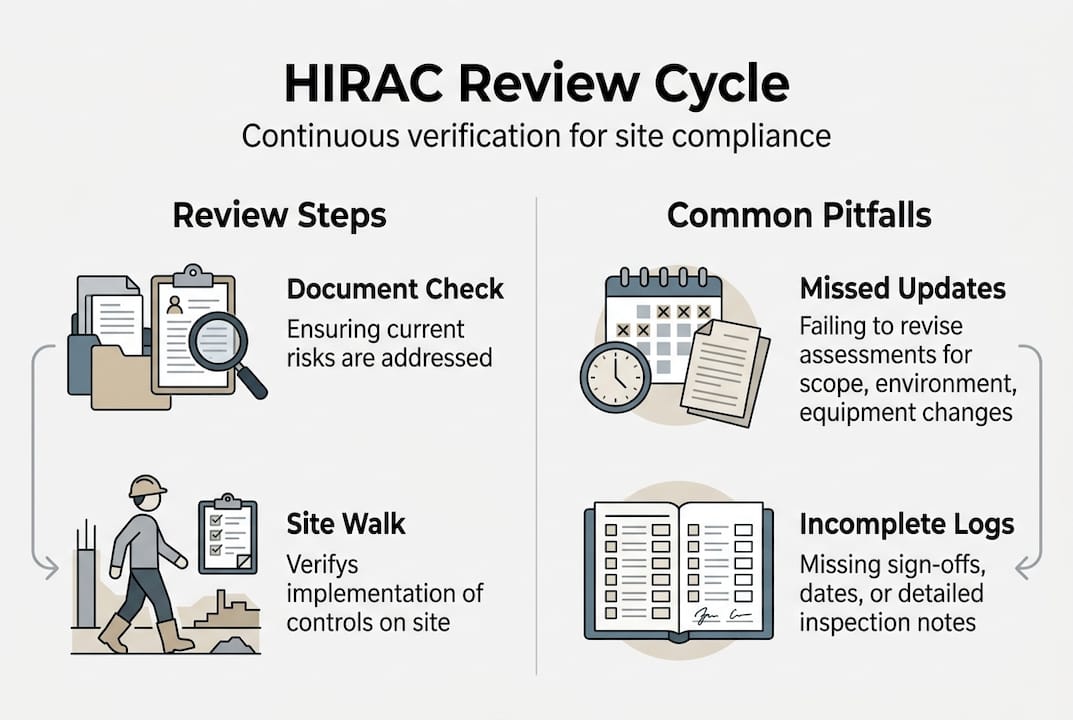
For projects subject to ConSASS audits, the stakes are particularly high. ConSASS Band III requires continual improvement and regular review of leading indicators, supplemented by dynamic risk assessments for high-paced project environments. Auditors will check not only that risk assessments exist but that they are current, communicated, and demonstrably influencing site behavior. High-risk activities, including scaffold erection, lifting operations, and vehicular movement, require particularly rigorous periodic verification.
Dynamic Risk Assessments close the gap between formal risk planning and rapidly changing site conditions, making them an indispensable tool for sites where scope, sequencing, or workforce composition shifts frequently.
Common pitfalls that undermine otherwise compliant risk assessment programs include:
- Treating the RA as a one-off document produced at project start and never revisited
- Failing to communicate findings to workers in a language and format they understand
- Omitting subcontractor activities from the hazard register
- Not updating the RA after incidents, near-misses, or scope changes
- Ignoring DRA opportunities during fast-moving or unplanned work sequences
- Producing generic, template-based RAs that do not reflect actual site conditions
“Act on reported hazards promptly. The interval between hazard identification and corrective action is the single most reliable leading indicator of a site’s true safety culture.”
Integrating ConSASS requirements into your review schedule ensures that verification activities align with audit cycles, reducing last-minute remediation efforts. For projects with significant design risk, managing risk at the design stage upstream of construction is the most cost-effective intervention available.
Expert perspective: Moving beyond compliance to true site safety
The organizations that consistently achieve the best safety outcomes in Singapore construction are not simply those with the most detailed risk assessment documents. They are the ones where leadership treats the RA process as a diagnostic tool rather than a regulatory obligation. Minimum compliance, producing a document that satisfies an auditor while failing to change site behavior, is a well-documented pathway to preventable incidents.
Empirical benchmarks suggest that site leaders should target continuous improvement against the 26.3 per 100,000 fatal/major injury rate, not simply audit score optimization. The sites that achieve this embed both static and dynamic RA into daily operational rhythms, treating every worker as a safety sensor with the authority and expectation to identify and escalate hazards in real time.
The transition from continuous WSH improvement as a concept to a lived site practice requires leadership commitment that goes beyond safety briefings. It requires systems that close the loop between hazard identification and corrective action, visibly and consistently.
Pro Tip: Give frontline workers formal ownership of specific hazard zones, assigning them responsibility for both identifying and escalating issues. This structural accountability reduces the lag between detection and resolution more effectively than any audit cycle alone.
How to take the next step in safety management
For construction project managers and safety officers ready to move from foundational compliance to genuine safety leadership, specialized support accelerates the journey significantly.

MOSAIC Ecoconstruction Solutions provides expert consultancy across ConSASS solutions, Design for Safety guidance, and WSH management systems, delivering structured frameworks tailored to Singapore’s regulatory environment. Whether your organization requires a full WSHMS implementation, ConSASS audit preparation, or DfS integration, our team of certified professionals provides the technical depth and regulatory fluency to raise your safety performance to the next tier. Contact MOSAIC today to schedule an initial consultation and benchmark your current risk assessment program against best-practice standards.
Frequently asked questions
Is risk assessment legally required for all construction projects in Singapore?
Yes. The WSH Act regulations require risk assessments for all employers and principals before any work with foreseeable risk commences on construction sites, regardless of project size or value.
What are the most common hazards found during construction risk assessments?
The leading construction hazards identified in Singapore are falls from height, struck-by-object incidents, machinery accidents, and vehicular movement, all of which require specific control measures within the HIRAC framework.
How often must risk assessments be reviewed?
Risk assessments must be reviewed after incidents, near-misses, or changes in site conditions, and ConSASS Band III mandates continual improvement with regular review cycles aligned to audit schedules.
What is the role of dynamic risk assessment (DRA)?
Dynamic Risk Assessment supplements planned risk assessments by enabling workers and supervisors to identify and control hazards in real time when site conditions change unexpectedly between formal review cycles.
Are small-scale works less risky than larger projects?
No. Over 60% of incidents in Singapore construction occur during small-scale works and renovations, making rigorous risk assessment equally critical for minor projects as for major construction contracts.
Recommended
- Managing Risk During the Design Stage: A Proactive Approach to Safer, More Efficient Construction – MOSAIC Eco-construction Solutions Pte Ltd
- Protecting Your People, Securing Your Projects: The Critical Importance of ConSASS – MOSAIC Eco-construction Solutions Pte Ltd
- The Ultimate Guide to Risk Assessment in Singapore: Mastering WSH Compliance to Protect Your People and Your Business – MOSAIC Eco-construction Solutions Pte Ltd
- ConSASS 2026 Guide: Integrating Safety with DfMA, ISO 45001 & AI in Singapore Construction – MOSAIC Eco-construction Solutions Pte Ltd