Is Your Office a Hidden Hazard Zone? The Surprising Risks a WSH Consultant Can Uncover
1. The Misconception of the Safe Office
The modern office is often perceived as a remarkably safe environment. Most people associate severe workplace danger with heavy industrial worksites. Construction zones naturally dominate global occupational safety discussions and media.
Consequently, the standard climate-controlled administrative office escapes rigorous safety scrutiny. However, this widespread public perception is fundamentally and dangerously flawed. Subtle hazards continuously lurk within these seemingly pristine corporate spaces.
These hidden risks quietly undermine worker health and daily operations. They also severely impact organizational productivity and long-term financial stability. Therefore, an expert WSH consultant must regularly intervene and investigate.
A comprehensive safety audit reveals highly surprising and dangerous vulnerabilities. Subtle issues quickly accumulate into severe legal and financial consequences. This exhaustive research report details these hidden workplace hazards meticulously. Furthermore, it provides actionable insights for achieving stringent regulatory compliance.
2. The WSH Regulatory Landscape in Singapore
Singapore maintains a highly rigorous and evolving occupational safety framework. The Ministry of Manpower (MOM) governs these strict national standards. The primary legislation is the Workplace Safety and Health Act.
2.1 The Workplace Safety and Health Act
The WSH Act is the central pillar of workplace safety. This critical legislation shifted management from reactive to proactive strategies. Furthermore, the WSH Act covers absolutely all workplaces in Singapore.
Administrative offices are certainly not exempt from these legal obligations. The Act emphasizes reducing risks directly at their original source.1 It also encourages strong industry ownership of safety and health outcomes.1
2.2 Duty Holders and Stakeholder Obligations
Employers hold the primary legal duty for daily workplace safety. They must ensure a thoroughly safe working environment for everyone.2 Risk management is a strictly mandatory legal requirement for businesses. The WSH Risk Management Regulations demand systematic hazard evaluations constantly. Employers must properly conduct risk assessments for all operational activities.3
Consequently, they must implement appropriate control measures to minimize risks.4 Employers must review these assessments at least every three years.5 Operational changes also trigger mandatory immediate reviews of these documents.
Stakeholder responsibilities extend far beyond the direct corporate employer. Occupiers of premises share significant legal safety duties and liabilities. They must ensure safe access and egress for all personnel.6 Manufacturers and suppliers must also provide inherently safe operational equipment.7
2.3 Escalating Penalties and Composition Fines
The legal and financial stakes have never been higher today. Enforcement actions intensified significantly as Singapore approached the year 2026.3
MOM utilises a tiered penalty system for corporate non-compliance. Composition fines address straightforward, observable safety breaches during routine inspections.8 Since 2022, minimum composition fines doubled to $2,000 per lapse.9
A WSH consultant helps companies avoid these costly financial penalties. The penalties for specific administrative failures are surprisingly severe.
| Offence Category | Fine Range (SGD) | Regulatory Authority |
| Failure to conduct risk assessments | $1,000 to $5,000 | MOM 8 |
| Failure to report workplace accidents | $1,000 to $5,000 | MOM 8 |
| Inadequate PPE provision | $1,000 to $3,000 | MOM 8 |
| Missing required safety signage | $500 to $2,000 | MOM 8 |
| Unsafe scaffolding or fall protection | $2,000 to $5,000 | MOM 8 |
2.4 Legal Implications of Court Prosecutions
Court prosecutions occur for severe or repeated workplace safety offences. The maximum fines imposed by courts are exceptionally punitive today.
| Severe Offence Category | Maximum Fine | Imprisonment Term | Conditions |
| Failure to comply with Remedial Order | $50,000 (+ $5,000 daily) | Up to 12 months | Either or both 10 |
| Failure to comply with Stop Work Order | $500,000 (+ $20,000 daily) | Up to 12 months | Either or both 10 |
| General Breach (Individual, First Offence) | $200,000 | Up to 2 years | Either or both 10 |
| General Breach (Corporate, First Offence) | $500,000 | N/A | N/A 10 |
| General Breach (Corporate, Repeat Offence) | $1,000,000 | N/A | N/A 10 |
Additionally, fatal incidents trigger doubled maximum fines for subsequent offences.10 Therefore, engaging a competent WSH consultant is a strategic necessity. A consultant navigates this complex regulatory landscape efficiently and safely.11
3. The Economic Burden of Office Hazards
Workplace injuries extract a massive financial toll on global economies. Singapore faces proportional economic impacts from unchecked occupational office hazards.
3.1 Macroeconomic Impact on Singapore’s GDP
The macroeconomic statistics regarding workplace injuries are truly staggering. Work-related injuries cost Singapore an estimated $10.45 billion historically.12 This massive financial burden equated to 3.2% of the national GDP.12
Employers bore approximately 22.1% of these massive economic costs.12 In 2024, the workplace fatal injury rate persisted as a concern. It stood at 1.2 per 100,000 workers across the nation.13 The major injury rate was 15.8 per 100,000 workers simultaneously.13 While construction leads in fatalities, office injuries remain stubbornly high.
3.2 The Hidden Costs of Absenteeism
Direct injury costs represent only a small fraction of losses. Absenteeism and presenteeism generate devastating financial losses for modern businesses. Absenteeism refers to scheduled working days missed by unwell employees. In Singapore, mental health issues drive massive economic absenteeism losses. Absenteeism costs an estimated $2.3 billion annually for local businesses.14
3.3 The Presenteeism Crisis
Presenteeism occurs when employees work while physically or mentally unwell. Presenteeism severely impairs cognitive function and overall corporate productivity. Shockingly, presenteeism costs reach an estimated $12.8 billion in Singapore.14
Presenteeism causes productivity losses averaging 57.5 days annually per worker.15 Furthermore, financial stress alone costs the economy roughly $16 billion.16 Financially stressed employees lose over three hours of weekly productivity.16
3.4 ROI of Workplace Health Investments
Therefore, proactive hazard mitigation yields a substantial return on investment. Comprehensive corporate health screening programs drastically reduce overall medical costs. Companies report a 31% decrease in insurance claims within one year.17
They also see a 41% reduction in sick leave days.17 Proper safety investments deliver a 180% to 250% ROI initially.17 This ROI can expand to 650% over three consecutive years.17
4. Physical Safety Hazards in the Office
An office appears benign compared to a heavy factory floor. However, physical hazards frequently cause severely disabling injuries among staff.
4.1 Slips, Trips, and Falls (STF)
Slips, trips, and falls dominate modern office accident statistics universally. STF incidents are the most common type of office injury.18 In 2024, STF remained a top cause of major injuries.19 Office workers are uniquely vulnerable to these hidden fall hazards.
Cluttered walkways and trailing electrical cables create prime tripping conditions.20 Improper storage mechanisms further compound the physical risks for employees.
Furthermore, office workers frequently use rolling chairs as makeshift ladders. Standing on unstable rolling chairs presents a severe fall hazard.20 Prevention requires diligent housekeeping and strict employee behavioral controls.
Walkways must remain completely clear of files and storage boxes.21 Employers must provide appropriate stepladders for accessing high storage shelves.22 Wet floors demand immediate attention and highly visible warning signage.6
4.2 Blind Spots and Collision Risks
Offices feature structural blind spots very similar to busy roadways. Hallway intersections and tall cubicle walls obscure approaching administrative individuals.
Consequently, workers frequently collide while carrying hot beverages or files.21 These unfortunate collisions cause severe burns, blunt trauma, or falls. Placing convex mirrors at intersections effectively mitigates this specific risk.23
4.3 Safe Lifting and Material Handling
Administrative workers frequently underestimate the dangers of routine manual lifting. Lifting stacks of copy paper or water jugs causes injuries. Improper lifting technique rapidly leads to severe lower back trauma.21
Workers must lift by squatting and using leg muscle strength.21 The back must remain in a straight, neutral posture constantly.21 Objects should be held closely to the body during transport.21 A WSH consultant evaluates these ergonomic lifting hazards during audits.
4.4 Electrical Hazards and Daisy-Chaining
Modern offices demand extensive electrical power infrastructure for computer equipment. Older administrative buildings often lack sufficient permanent wall power outlets.
Consequently, workers frequently connect multiple power strips together for convenience. This highly dangerous practice is universally known as “daisy-chaining.” Daisy-chaining explicitly violates standard occupational safety regulations and fire codes.24
Electrical resistance increases significantly with increased power cord length overall. Interconnecting cords increases total resistance and generates excessive physical heat.24
This heat accumulation poses a severe and immediate fire hazard. Overloaded circuits can trip breakers, disrupting entire office network operations.25 A WSH consultant will strictly identify and eliminate daisy-chains immediately.
4.5 Pantry and Custodial Service Hazards
Office pantries and breakrooms present unique physical and biological hazards. Custodial staff and office workers frequently encounter slippery wet floors. Anti-slip floor coatings are highly recommended in these specific areas.26
Food preparation areas also present serious biological cross-contamination risks daily. Raw food juices must never contact cooked or ready-to-eat meals.27 Furthermore, microwave ovens and coffee makers present localized fire hazards.
5. Ergonomic Risks and Musculoskeletal Disorders
Office work inherently requires prolonged sitting and highly repetitive motions. Consequently, workers develop severe Work-Related Musculoskeletal Disorders (MSDs) over time. MSDs are painful, debilitating conditions affecting muscles, tendons, and nerves.28
5.1 Understanding Ergonomic Risk Factors
The Singapore WSH Guidelines identify several primary and severe ergonomic risks. Static postures involve holding the body motionless for prolonged periods.28 Awkward postures include working with bent necks or twisted spines.28
Repetitive movements include rapid, continuous actions like computer keyboard typing.28 Forceful exertions include improperly lifting heavy document boxes without assistance.28 These hidden factors generate cumulative physical trauma over extended periods.
5.2 Common Work-Related Injuries
Symptoms develop slowly and are often ignored initially by staff. Carpal Tunnel Syndrome frequently results from repetitive typing and clicking.28
It causes numbness and tingling in the thumb and fingers.28 Lower back pain frequently results from inadequate lumbar chair support.28 Neck and shoulder tension results from poorly positioned computer monitors.28
5.3 Workstation Setup and Optimization
Proper workstation ergonomics drastically reduce MSD incidence across the office. Desks and chairs must accommodate varying individual employee physical dimensions.
Adjustability remains the paramount feature of safe office furniture equipment.20 The monitor must sit directly in front of the computer user.
The eyeline should perfectly align with the top screen edge.29 Wrists must remain straight and neutral during keyboard operation constantly.28
Furthermore, employees must take regular movement breaks throughout the day. Avoiding prolonged sitting is critically important for long-term spinal health.28
5.4 The Standing Desk Paradox
Standing desks gained immense popularity as modern ergonomic workplace solutions. They allow workers to alternate easily between sitting and standing. However, standing desks are certainly not an automatic safety cure. Prolonged standing introduces entirely new physiological stressors to the body. It can cause severe lower extremity fatigue and circulatory issues.
Research shows mixed and surprising results regarding standing desk efficacy. Some studies link them to improved concentration and overall health.30
Other rigorous trials show no significant impact on employee BMI.31 A WSH consultant ensures standing desks are implemented properly safely. Workers must receive training on optimal sit-stand behavioral time ratios.
6. The Hybrid Era: Hot-Desking and Biological Risks
The post-pandemic landscape normalized hybrid work arrangements across Singapore businesses. Consequently, many offices adopted hot-desking or shared flexible seating policies.
Hot-desking reduces real estate costs and encourages cross-departmental collaboration.32 However, this modern model introduces significant new WSH physical vulnerabilities.
6.1 Ergonomic Mismatches in Shared Spaces
Hot-desking completely eliminates the concept of the highly personalized workstation. Employees use different chairs and desks every single working day. Consequently, workers rarely take time to adjust the equipment properly.33
This leads to severe ergonomic mismatches and rapid muscle strain. Hybrid workers also face risks in their remote home environments. Working from dining chairs or sofas creates terrible postural habits.33
6.2 Fomites and Bacterial Contamination
Shared workstations drastically escalate hidden biological hazards for all employees. Desks, keyboards, and mice serve as highly contagious disease fomites. Fomites are inanimate objects that readily transmit infectious viral pathogens. Studies reveal office desktops harbor 12,600 bacteria per square inch.34 This is significantly higher than a standard office toilet seat.34
Hot-desking exacerbates this bacterial load dramatically across the entire office. Research indicates bacterial contamination is 18% higher in hot-desking environments.35 Shared computer mice show a 41% higher microbiological ATP reading.35 Desk surfaces show a 32% higher bacterial load overall.35
6.3 Mitigating Cross-Contamination
Workers rarely disinfect keyboards before commencing their daily computer tasks.35 This facilitates rapid cross-contamination of respiratory and gastrointestinal viruses daily.
A WSH consultant will mandate strict surface disinfection protocols here. Workspaces must be sanitized regularly using appropriate industrial disinfectant wipes.36 Personal equipment usage should be encouraged to minimize device sharing.36
7. Invisible Threats: Indoor Air Quality (IAQ)
Indoor Air Quality (IAQ) is a critical, invisible workplace safety metric. Office workers spend the vast majority of their day indoors. Poor IAQ directly causes the debilitating condition called Sick Building Syndrome.
7.1 Sick Building Syndrome (SBS)
Sick Building Syndrome involves headaches, fatigue, eye irritation, and dizziness.37 It also causes severe respiratory distress and mysterious skin rashes.37 These symptoms typically resolve shortly after leaving the affected building.37 A WSH consultant utilizes advanced diagnostic tools to investigate SBS.
7.2 Climate Factors and Mold Propagation
Singapore experiences a hot, highly humid tropical climate all year. Indoor humidity levels frequently range between 70% and 80% constantly.38
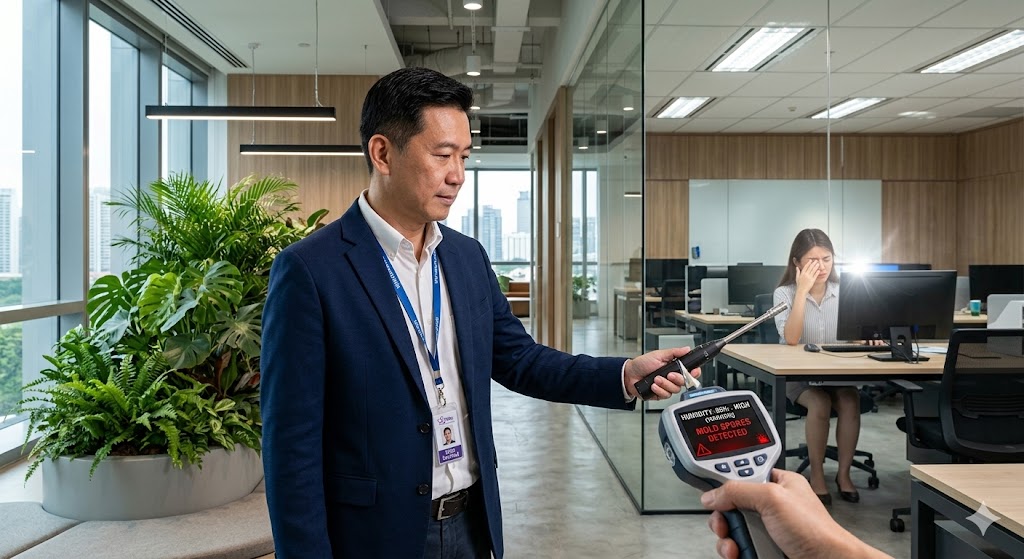
This constant airborne moisture provides an ideal breeding ground for mold. Modern offices rely entirely on air-conditioning and mechanical ventilation (ACMV). Poorly maintained ACMV systems fail to expel moisture effectively outdoors.38
Consequently, fungal spores rapidly colonize hidden structural spaces without detection. Mold grows inside air conditioning blowers, cooling fins, and ceilings.39
Airborne mold spores act as potent biological allergens for workers. They trigger asthma, rhinitis, and severe allergic reactions upon inhalation.40 Routine IAQ testing is strictly necessary to detect spore accumulations.
7.3 Volatile Organic Compounds (VOCs)
Office environments emit a complex mixture of dangerous chemical pollutants. Volatile Organic Compounds (VOCs) evaporate easily at standard room temperature.41
They originate from carpets, adhesives, paints, and new office furniture.42 Formaldehyde is a particularly dangerous VOC found in pressed wood.41
Short-term exposure to VOCs causes sudden dizziness and throat irritation. Long-term chronic exposure is linked to severe internal organ damage.41
Furthermore, certain VOCs possess known and dangerous carcinogenic chemical properties.41 Adequate mechanical ventilation is the primary defense against VOC accumulation.
7.4 Photocopier and Laser Printer Emissions
Office printers are surprising sources of severe localized air pollution. Laser printers emit high concentrations of Ultrafine Particles (UFPs) constantly.43
UFPs have a microscopic diameter of less than 0.1 micrometers.44 These microscopic particles penetrate deep into human lung tissue easily.44 They can easily cross into the bloodstream and reach organs.44
Operating a laser printer is comparable to smoking cigarettes indoors.45 Furthermore, thermal printing processes generate highly toxic ozone gas emissions.43
Ozone severely exacerbates asthma and damages sensitive respiratory tissue linings. A WSH consultant recommends isolating high-volume printers in separate rooms.23 These dedicated print rooms must possess heavily upgraded ventilation systems.23
7.5 Singapore Standard SS 554 Parameters
Singapore Standard SS 554 strictly governs IAQ in air-conditioned buildings.46 A WSH consultant audits office premises against these exact parameters. Exceeding these limits poses severe health risks to building occupants.
| IAQ Parameter | SS 554 Acceptable Limit | Health Impact of Exceedance |
| Formaldehyde | ≤ 0.1 ppm | Asthma, irritation, cancer risk 47 |
| Total VOCs (TVOC) | ≤ 1000 ppb (1 ppm) | Headaches, dizziness, organ damage 48 |
| Carbon Dioxide (CO2) | ≤ 700 ppm above outdoor level | Fatigue, impaired cognitive function 47 |
| Carbon Monoxide (CO) | ≤ 9 ppm | Nausea, fatal at high doses 47 |
| Respirable Particles | ≤ 50 μg/m³ (PM10) | Respiratory distress, cardiovascular strain 49 |
Regular air sampling guarantees compliance with these stringent national standards. A WSH consultant uses specialized photoionization detectors for accurate measurements.49
8. The Duality of Biophilic Office Design
Biophilic design actively integrates natural elements into the office workspace. This modern architectural trend seeks to reconnect humans with nature.
8.1 Benefits of Natural Elements
Biophilic environments utilize indoor plants to reduce employee psychological stress.50 Plants can naturally filter certain airborne toxins like harmful benzene.51 Access to natural daylight lowers energy consumption and improves mood.52 Research shows these spaces can increase overall productivity by 15%.50
8.2 Hidden Biological and Moisture Hazards
However, improper plant maintenance creates highly unexpected and hidden hazards. Overwatering indoor plants causes rapid mold growth on soil surfaces.53 Placing potted plants on porous materials causes severe water damage.54 This moisture accumulation degrades indoor air quality very rapidly indeed.
Furthermore, flowering plants introduce irritating pollen into the HVAC airstream.54 Pollen acts as a potent allergen for susceptible office employees. Excessive plants create conditions where debris and moisture become unmanageable.54
8.3 Safe Implementation Strategies
Therefore, biophilic design requires strict horticultural maintenance protocols to succeed. Plants must not be placed directly on carpets or wood.54 Selecting appropriate low-maintenance plants like Snake plants is highly recommended.55 A WSH consultant audits biophilic installations for potential biological hazards carefully.
9. Sensory Stressors: Illumination and Acoustics
Environmental ergonomics extend far beyond basic chairs and computer desks. Lighting and noise profoundly impact cognitive function and psychological comfort.
9.1 Visual Fatigue and Poor Lighting
Inadequate lighting causes severe eye strain and debilitating tension headaches.56 Conversely, excessive brightness creates harsh glare on glossy computer screens.57 Glare forces workers into awkward physical postures to view monitors.57 Furthermore, flickering fluorescent tubes can trigger severe migraines and discomfort.58
9.2 Singapore Standard SS 531 Lux Levels
Singapore Standard SS 531 dictates specific lux levels for offices.59 A WSH consultant measures these precise levels using calibrated lux meters.60
| Office Area / Task | SS 531 Recommended Lux Level | Uniformity |
| General Workstations | 300 – 500 lux 61 | N/A |
| Writing, Reading, Data Entry | 500 lux 62 | 0.7 62 |
| Technical Drawing | 750 lux 62 | 0.7 62 |
| Conference / Meeting Rooms | 400 – 700 lux 61 | N/A |
| Reception Desks | 150 – 300 lux 61 | N/A |
They ensure uniform light distribution to prevent hazardous shadow formations. Workstations should utilize task lamps to supplement overhead fluorescent lighting.57
9.3 Acoustic Distractions in Open Offices
Noise pollution is a pervasive hazard in modern open-plan offices. Typical open offices regularly reach 60 to 70 decibels daily.63 This volume is well above the optimal range for focused work. Continuous background chatter reduces employee productivity by up to 66%.63
Furthermore, noise acts as a highly significant psychological environmental stressor. It elevates blood pressure and increases general fatigue among workers.64 99% of employees report their concentration is impaired by noise.63 It takes 23 minutes to regain focus after an interruption.63
9.4 Singapore Standard SS 657 Noise Regulations
Singapore Standard SS 657 provides strict guidelines for workplace noise.65 The permissible exposure limit is 85 dB(A) over 8 hours.66
Peak sound pressure levels must never exceed 140 dB(C) anywhere.66 Mitigating noise requires acoustic panels, carpets, and strategic spatial separation.23 WSH consultants utilize sound level meters to map acoustic hazards carefully.
10. Psychosocial Hazards and Mental Well-being
Historically, WSH focused purely on physical injuries and chemical exposures. However, modern frameworks recognize psychosocial hazards as critical workplace risks. Workplace stress, severe burnout, and harassment destroy organizational efficiency completely.
10.1 The Mental Health Epidemic
Mental health is a rapidly growing concern in modern workplaces. The 2022 National Population Health Survey revealed concerning mental statistics.
Prevalence of poor mental health among Singapore residents was 17.0%.67 Employees experiencing depression miss nearly five days of work quarterly.68 62% of missed work days are attributed to severe burnout.68
10.2 The Tripartite Advisory Guidelines
The Singapore Tripartite Advisory on Mental Well-being provides comprehensive guidance.69 It categorizes interventions at the individual, team, and organizational levels.69 Employers should not demand mental health declarations during hiring processes.70 Doing so violates fair employment practices unless strictly job-related.70
Employers must actively foster a psychologically safe and trusting environment. They should train supervisors to spot early signs of distress.70 Furthermore, providing access to Employee Assistance Programmes (EAPs) is recommended.70 EAPs offer confidential professional counseling for emotionally distressed workers.70
10.3 The Total WSH Programme and AIME Framework
The WSH Council strongly champions the innovative Total WSH programme.71 This framework integrates safety, occupational health, and personal health simultaneously.71 It utilizes an Assessment, Intervention, Monitoring, and Evaluation (AIME) framework.72
The programme deploys specific modular activity packages through appointed providers.71
- Assessment: Evaluating current health statuses using the iWorkHealth tool.73
- Intervention: Implementing chronic disease management and stress reduction workshops.74
- Monitoring: Tracking employee participation and physiological health improvements continuously.75
- Evaluation: Reviewing the performance of the implemented intervention programmes.75
SMEs participating in the health screening module receive tangible benefits. They can secure premium discounts on corporate group insurance plans.71
10.4 The Mental Well-being Playbook
The WSH Council issued a specific Playbook on Workplace Mental Well-being.73 It guides employers through a structured six-step implementation methodology.73
- CHECK: Use routine pulse surveys to assess employee needs.73
- AIM: Create a roadmap with specific, measurable success indicators.73
- RALLY: Secure highly visible commitment from top senior management.73
- ACT: Deploy targeted initiatives like trained peer support networks.73
- TELL: Communicate available resources clearly through multiple internal channels.73
- REFINE: Review feedback and continuously improve the wellness offerings.73
Proper management of psychosocial hazards slashes presenteeism and boosts retention.
11. The Comprehensive WSH Audit Process
Identifying and controlling these diverse hazards requires a highly systematic approach. A WSH consultant conducts rigorous, standardized, and fully documented safety audits. In Singapore, audits evaluate compliance against the WSH Act strictly.76
11.1 Preparing for the Safety Audit
Auditors initiate the process by reviewing the foundational safety architecture. They demand immediate access to all core health and safety documentation.77 The corporate safety policy must be current and signed appropriately.77 Risk assessments must cover all activities using recognized analytical methodologies.77
Safe Work Procedures (SWP) must be documented clearly for hazards.77 Training records must prove all personnel received mandated safety inductions.77 Missing or outdated risk assessments constitute the most common failure.76 Fines for this specific failure range from $1,000 to $5,000.8
11.2 ConSASS and BizSAFE Methodologies
Different workplaces require different standardized audit methodologies in Singapore. The Construction Safety Audit Scoring System (ConSASS) applies to construction.78 General offices and SMEs typically pursue bizSAFE Level 3 audits.11 The bizSAFE audit verifies the implementation of robust risk management systems.5 High-risk factories manufacturing semiconductor wafers require audits every 24 months.79
11.3 Physical Site Inspections
The consultant executes a meticulous physical walk-through of the premises. This phase uncovers the dangerous discrepancies between policies and reality. They check housekeeping for clear walkways and properly organized cables.77 Fire safety checks ensure extinguishers are serviced and routes clear.77 Electrical inspections search for illegal daisy-chains and overloaded sockets.77 Ventilation checks look for visible mold and thick dust accumulation.76
11.4 Behavioral Safety Evaluations
A robust corporate safety culture relies on human behavior primarily. The WSH consultant conducts private interviews with various staff members.76 They assess whether employees actually understand the documented safety procedures.76 They observe workers executing tasks to identify dangerous behavioral shortcuts. For instance, do workers use ladders, or stand on chairs? Do they report near-miss incidents, or ignore them completely?
11.5 Corrective Action Planning
Following the audit, the consultant generates a comprehensive findings report. This detailed report highlights non-compliances, weaknesses, and immediate physical hazards. More importantly, it provides a strictly prioritized corrective action plan. Addressing these gaps ensures successful bizSAFE certification and prevents fines.80
12. Technological Advancements in Risk Management
The future of WSH in Singapore relies heavily on advanced technology. The WSH 2028 strategy explicitly promotes technology-enabled safety and health solutions.81 A modern WSH consultant leverages these digital tools to enhance accuracy.
12.1 Smart Sensors and IoT Integration
Continuous digital monitoring rapidly replaces intermittent manual air sampling today. IoT sensors provide real-time data on indoor air quality parameters. They track PM2.5, VOCs, carbon dioxide, and humidity levels instantly.41 Facility managers receive automated digital alerts when thresholds approach limits. This allows immediate HVAC adjustments before Sick Building Syndrome occurs.
12.2 Video Analytics and Predictive Safety
Smart acoustic sensors continuously monitor open-plan office noise levels precisely. They map noise topography to identify optimal acoustic dampening locations.82 Furthermore, video analytics powered by AI automatically detect unsafe behaviors.83
Smart cameras can flag blocked fire exits or tripping hazards.83 These technologies transform WSH from reactive compliance into predictive science. They provide the WSH consultant with unprecedented, granular safety data.
13. Conclusion
The modern office is a complex ecosystem harboring numerous hidden dangers. The perception of the office as a universally safe haven is dangerously inaccurate. Hazards range from ultrafine printer particles to severe ergonomic postural strains.
Ignored psychosocial hazards drive massive economic losses through invisible presenteeism. Singapore’s strict regulatory environment heavily penalizes employers who ignore these risks.
A certified WSH consultant provides indispensable value in this demanding landscape. They possess the clinical expertise to uncover invisible toxins and failures.
By conducting comprehensive safety audits, they align operations with the WSH Act. Implementing holistic frameworks like the Total WSH programme improves well-being drastically. Ultimately, proactive safety investment eradicates hidden costs and protects human capital.
Works cited
- What is the Workplace Safety & Health Act (WSHA) | Workday SG, accessed May 12, 2026, https://www.workday.com/en-sg/topics/hr/wsh-act-singapore.html
- Workplace Safety and Health Act: what it covers – MOM, accessed May 12, 2026, https://www.mom.gov.sg/workplace-safety-and-health/workplace-safety-and-health-act/what-it-covers
- Singapore Workplace Safety Regulations 2026: What Every Business Must Know, accessed May 12, 2026, https://sageshield.com/singapore-workplace-safety-regulations-2026/
- Workplace Safety and Health (Risk Management) Regulations – MOM, accessed May 12, 2026, https://www.mom.gov.sg/-/media/mom/documents/safety-health/guidetoriskmgtregver20.pdf
- About bizSAFE, accessed May 12, 2026, https://www.tal.sg/wshc/programmes/bizsafe/about-bizsafe
- Cleaning and Custodial Services – Workplace Safety and Health Guidelines, accessed May 12, 2026, https://www.tal.sg/wshc/-/media/TAL/Wshc/Resources/Publications/WSH-Guidelines/Files/WSH_Guidelines_Cleaning_and_Custodial_Services.pdf
- Workplace Safety and Health Act – MOM, accessed May 12, 2026, https://www.mom.gov.sg/workplace-safety-and-health/workplace-safety-and-health-act
- Workplace Safety Fines in Singapore: MOM Penalties and How to Avoid Them, accessed May 12, 2026, https://sageshield.com/workplace-safety-fines-mom-singapore/
- Action against errant companies – MOM, accessed May 12, 2026, https://www.mom.gov.sg/workplace-safety-and-health/safe-measures/action-against-errant-companies
- WSH Act: liabilities and penalties – Singapore – MOM, accessed May 12, 2026, https://www.mom.gov.sg/workplace-safety-and-health/workplace-safety-and-health-act/liabilities-and-penalties
- Comprehensive Guide to WSH Consultant Singapore Services – ProSkill Workforce Pte Ltd, accessed May 12, 2026, https://proskillworkforce.com/wsh-consultant/
- Economic Cost of Work-related Injuries and Ill-health in Singapore – ResearchGate, accessed May 12, 2026, https://www.researchgate.net/publication/259220728_Economic_Cost_of_Work-related_Injuries_and_Ill-health_in_Singapore
- Workplace Safety and Health Report 2024 – Singapore – MOM, accessed May 12, 2026, https://www.mom.gov.sg/-/media/mom/documents/safety-health/reports-stats/wsh-national-statistics/wsh-national-stats-2024.pdf
- How Intellect can help your organisation achieve a 14x ROI in just 6 weeks, accessed May 12, 2026, https://intellect.co/read/intellect-dimensions-roi-study/
- What is the cost of presenteeism in the workplace? – Robert Half, accessed May 12, 2026, https://www.roberthalf.com/sg/en/insights/hiring-help/what-risk-presenteeism-singapore
- Financial Stress Is Making Your Employees Sick: What 20 Years of Health Screening Data Actually Reveals – Health Outreach Programme Singapore, accessed May 12, 2026, https://hop.sg/financial-stress-employee-health-screening-singapore/
- Corporate Health Screening ROI: How Singapore Companies Save Money Through Preventive Healthcare – HOP Medical Centre, accessed May 12, 2026, https://hop.sg/corporate-health-screening-roi-singapore-companies/
- Hidden hazards in the workplace – EcoOnline, accessed May 12, 2026, https://www.ecoonline.com/blog/hidden-workplace-hazards/
- Common Workplace Hazards in Singapore: HIRADC & WSH Risk Management Guide, accessed May 12, 2026, https://www.anjouhealth.com/workplace-hazards-singapore/
- Recognizing hidden dangers: 25 steps to a safer office, accessed May 12, 2026, https://countyrisk.org/wp-content/uploads/2022/01/SAFETY-Hidden-Dangers.pdf
- Hidden Office Hazards: Steps to Keep Your Workers Safe – Arbill, accessed May 12, 2026, https://www.arbill.com/safety-topics/hidden-office-hazards-steps-to-keep-your-workers-safe/
- Office Safety and Health, accessed May 12, 2026, https://www.tal.sg/wshc/topics/office-safety-and-health/office-safety-and-health
- Ten Often-ignored Office Hazards | SMG – Safety Management Group, accessed May 12, 2026, https://safetymanagementgroup.com/blog/ten-often-ignored-office-hazards/
- Power Strips and Dangerous Daisy Chains – OCWR, accessed May 12, 2026, https://www.ocwr.gov/publications/fast-facts/power-strips-and-dangerous-daisy-chains/
- Fast Facts – Power Strips and Dangerous Daisy Chains, accessed May 12, 2026, https://uwf.edu/media/university-of-west-florida/finance-and-administration/departments/environmental-health-and-safety/images/fastfacts_daisychains-(2)-(1).pdf
- Preventing Common Kitchen Hazards, accessed May 12, 2026, https://www.tal.sg/wshc/topics/kitchen-safety/preventing-common-kitchen-hazards
- Food Safety Tips – Singapore Food Agency, accessed May 12, 2026, https://www.sfa.gov.sg/food-safety-tips/safe-food-practices/food-safety-tips
- WSH Guidelines on Improving Ergonomics in the Workplace, accessed May 12, 2026, https://www.tal.sg/wshc/-/media/TAL/Wshc/Resources/Publications/WSH-Guidelines/Files/WSH_Guidelines_ImprovingErgonomicsintheWorkplace.pdf
- Risk Assessment for Working from Home, accessed May 12, 2026, https://www.tal.sg/wshc/-/media/TAL/Wshc/Resources/Newsletters/WSH-bulletins/Files/20210416RAhome.pdf
- New Study: Use of Standing Desks in Workplace Linked to Increased Productivity, Improved Health – The Professional Association for Interior Designers, accessed May 12, 2026, https://www.asid.org/news/new-study-use-of-standing-desks-in-workplace-linked-to-increased-productivity-improved-health
- Standing desks for sedentary occupations: Assessing changes in satisfaction and health outcomes after six months of use (Resendiz et al., 2019) | CLEAR, accessed May 12, 2026, https://clear.dol.gov/Study/Standing-desks-sedentary-occupations-Assessing-changes-satisfaction-and-health-outcomes-after
- Hot-desking needs to go, unless it’s designed to work for the worker | Nanyang Business School | NTU Singapore, accessed May 12, 2026, https://www.ntu.edu.sg/business/news-events/news/story-detail/hot-desking-needs-to-go-unless-it’s-designed-to-work-for-the-worker
- Workplace Ergonomics In Singapore: A Practical Guide for Safer, Healthier Offices, accessed May 12, 2026, https://www.anjouhealth.com/workplace-ergonomics-singapore-office-setup-wsh/
- Hot Desking Or Hot Zones The Microbiological Reality Of Modern Workspaces Blog Post, accessed May 12, 2026, https://www.nashfacilitysolutions.com/blog/posts/hot-desking-or-hot-zones-the-microbiological-reality-of-modern-workspaces
- Hygiene In The Office: Is Hot Desking a Good Idea? – Addmaster, accessed May 12, 2026, https://www.addmaster.co.uk/blog/hygiene-in-the-workplace-is-hot-desking-a-good-idea
- Hot desk hygiene | WorkSafe.qld.gov.au, accessed May 12, 2026, https://www.worksafe.qld.gov.au/safety-and-prevention/creating-safe-work/hot-desk-hygiene
- Sick Building Syndrome and Other Building-Related Illnesses – PMC – NIH, accessed May 12, 2026, https://pmc.ncbi.nlm.nih.gov/articles/PMC7153445/
- Understanding the Dangers of Mould in Singapore | The Mouldmen, accessed May 12, 2026, https://www.themouldmen.com/understanding-the-dangers-of-mould-in-singapore-homes-and-how-to-eliminate-it/
- Humidity causing mould – worried about health issues : r/askSingapore – Reddit, accessed May 12, 2026, https://www.reddit.com/r/askSingapore/comments/1olgjew/humidity_causing_mould_worried_about_health_issues/
- Fungal pollution of indoor environments and its management – PMC – NIH, accessed May 12, 2026, https://pmc.ncbi.nlm.nih.gov/articles/PMC3730554/
- VOC Testing & Emissions Analysis Services | Newway, accessed May 12, 2026, https://newway.sg/voc-testing-emissions-analysis/
- Indoor Pollution in Work Office: VOCs, Formaldehyde and Ozone by Printer – ResearchGate, accessed May 12, 2026, https://www.researchgate.net/publication/265160670_Indoor_Pollution_in_Work_Office_VOCs_Formaldehyde_and_Ozone_by_Printer
- The impact of printer emissions on indoor air quality – eCopier Solutions, accessed May 12, 2026, https://www.ecopiersolutions.com/blog/the-impact-of-printer-emissions-on-indoor-air-quality
- Office Printers Emit Pollution – Commercial Air Filtration, accessed May 12, 2026, https://commercialairfiltration.co.uk/blogs/news/office-printers-emit-pollution
- Particle emissions from laser printers might pose health concern – EurekAlert!, accessed May 12, 2026, https://www.eurekalert.org/news-releases/852040
- Workplace Safety and Health Guidelines, accessed May 12, 2026, https://www.tal.sg/wshc/-/media/tal/wshc/resources/publications/wsh-guidelines/files/wsh_guidelines_on_management_of_iaq.ashx
- Towards Personalization of Indoor Air Quality: Review of Sensing Requirements and Field Deployments – PMC, accessed May 12, 2026, https://pmc.ncbi.nlm.nih.gov/articles/PMC9104953/
- SAS REIMAGINED: AIR QUALITY UPDATE | Posts – Singapore American School, accessed May 12, 2026, https://www.sas.edu.sg/enews/posts/~board/posts/post/sas-reimagined-air-quality-update-may-30
- Table 1 – Recommended IAQ parameters – Acceptable limit (8 hours), accessed May 12, 2026, http://aom.sg/wp-content/uploads/2015/01/Recommended-IAQ-Parameters-SS554-2009.pdf
- Biophilic Office Design in Singapore: 7 Tips for a Green Workspace, accessed May 12, 2026, https://www.adevo.sg/biophilic-office-design-in-singapore/
- The Benefits of Having Plants in Your Singapore Office Spaces – The Work Project, accessed May 12, 2026, https://theworkproject.com/blog/the-benefits-of-having-plants-in-your-singapore-office-spaces
- Biophilic Office Design in Singapore | ID Integrated, accessed May 12, 2026, https://idi.sg/blog/biophilic-office-design/
- Actually, Houseplants Don’t Clean the Air | American Lung Association, accessed May 12, 2026, https://www.lung.org/blog/houseplants-dont-clean-air
- Indoor Plants and Indoor Air Quality – Mass.gov, accessed May 12, 2026, https://www.mass.gov/info-details/indoor-plants-and-indoor-air-quality
- Biophilic Office Interior Design Singapore: Bringing Nature Into Your Workspace, accessed May 12, 2026, https://officereno.sg/blog/biophilic-office-interior-design-singapore-bringing-nature-into-your-workspace/
- Lighting Ergonomics – Survey and Solutions – CCOHS, accessed May 12, 2026, https://www.ccohs.ca/oshanswers/ergonomics/lighting/lighting_survey.html
- eTools : Computer Workstations – Workstation Environment | Occupational Safety and Health Administration, accessed May 12, 2026, https://www.osha.gov/etools/computer-workstations/workstation-environment
- GUIDELINES FOR GOOD INDOOR AIR QUALITY IN OFFICE PREMISES, accessed May 12, 2026, https://policy.asiapacificenergy.org/sites/default/files/Guidelines%20for%20good%20indoor%20air%20quality%20in%20office%20premises.pdf
- Code of practice for lighting of work places – Singapore Standards, accessed May 12, 2026, https://www.singaporestandardseshop.sg/Product/GetPdf?fileName=180331110851SS+531-1-2006(2013)_Preview.pdf&pdtid=df67737c-a95c-4a21-acfb-a52b086e37b4
- Lighting – Environmental Health Solutions, accessed May 12, 2026, https://ehsolutions.com.au/what-we-do/occupational-hygiene/lighting/
- Office lighting design in Singapore for productivity & well-being – OSCA Asia, accessed May 12, 2026, https://www.osca.asia/office-lighting-design/
- Working from Home: Are the Lighting Conditions Ideal?, accessed May 12, 2026, https://www.a-star.edu.sg/nmc/news-articles/news-and-articles/research-spotlight/working-from-home-are-the-lighting-conditions-ideal
- Workplace Noise Statistics 2026: Open Office Decibels, Concentration Loss, and Acoustic Distraction – Speakwise, accessed May 12, 2026, https://speakwiseapp.com/blog/workplace-noise-statistics
- Lighting, thermal comfort, working space, noise and vibration – HSE, accessed May 12, 2026, https://www.hse.gov.uk/humanfactors/topics/lighting.htm
- Code of practice for workplace noise control – Singapore Standards, accessed May 12, 2026, https://www.singaporestandardseshop.sg/Product/GetPdf?fileName=200819150602SS%20657-2020.Preview.pdf&pdtid=935b0641-4e7f-4de8-a9b3-c676cff660c9
- Workplace Safety and Health (Noise) Regulations 2011 – Singapore Statutes Online, accessed May 12, 2026, https://sso.agc.gov.sg/SL/WSHA2006-S424-2011
- tripartite advisory on mental health and well- being at workplaces – mom, accessed May 12, 2026, https://www.mom.gov.sg/-/media/mom/documents/covid-19/advisories/tripartite-advisory-on-mental-well-being-at-workplaces.pdf
- Workplace Mental Health Playbook – Webflow, accessed May 12, 2026, https://uploads-ssl.webflow.com/6010e149d9130a63e7b78adb/6273534c5cc5eb8546b058b8_Workplace%20Mental%20Health%20Playbook.pdf
- Tripartite Advisory on Mental Well-being at Workplaces – MOM, accessed May 12, 2026, https://www.mom.gov.sg/-/media/mom/documents/covid-19/posters/infographic-tripartite-advisory-on-mental-well-being-at-workplaces.pdf
- Tripartite advisory on mental health and well-being at workplaces – MOM, accessed May 12, 2026, https://www.mom.gov.sg/employment-practices/tripartism-in-singapore/tripartite-guidelines-and-advisories/tripartite-advisory-on-mental-well-being-at-workplaces
- Total Workplace Safety and Health, accessed May 12, 2026, https://www.tal.sg/wshc/programmes/total-workplace-safety-and-health
- Total WSH, accessed May 12, 2026, https://www.tal.sg/wshc/topics/total-wsh/total-wsh
- A Playbook On Workplace Mental Well-being, accessed May 12, 2026, https://www.tal.sg/wshc/-/media/TAL/Wshc/Resources/Publications/Guides-and-Handbooks/Files/Playbook-On-Workplace-Mental-Well-being.pdf
- Total Workplace Safety and Health (WSH) Implementation Programme – Division of Graduate Medical Studies – NUS Medicine, accessed May 12, 2026, https://medicine.nus.edu.sg/dgms/continuing-ed-training-programmes/total-workplace-safety-and-health-wsh-implementation-programme/
- Guide to Total Workplace Safety and Health, accessed May 12, 2026, https://li.eversafe.com.sg/HTIM/1.%20Guide%20to%20Total%20WSH.pdf
- Workplace Safety Audit Singapore: Complete Guide for Businesse…, accessed May 12, 2026, https://sageshield.com/workplace-safety-audit-singapore/
- Safety Audit Checklist Singapore — MOM Compliant 2026 | Sage S…, accessed May 12, 2026, https://sageshield.com/safety-audit-checklist-singapore/
- A Guide to the CONSTRUCTION SAFETY AUDIT SCORING SYSTEM (ConSASS) (updated Sep 2013) – MOM, accessed May 12, 2026, https://www.mom.gov.sg/~/media/mom/documents/services-forms/safety%20and%20health/a%20guide%20to%20the%20consass.pdf
- Requirements for a safety and health management system – MOM, accessed May 12, 2026, https://www.mom.gov.sg/workplace-safety-and-health/safety-and-health-management-systems/safety-and-health-management-system-requirements
- How Safety Consultancy Companies Facilitate Compliance with WSH Regulations, accessed May 12, 2026, https://qesafety.com/how-safety-consultancy-companies-facilitate-compliance-with-wsh-regulations/
- Workplace Safety and Health (WSH) Technology – Singapore – MOM, accessed May 12, 2026, https://www.mom.gov.sg/workplace-safety-and-health/wsh-technology
- Turning Down the Volume on Workplace Noise – Occupational Health & Safety, accessed May 12, 2026, https://ohsonline.com/articles/2026/04/print/turning-down-the-volume-on-workplace-noise.aspx
Top 5 Workplace Safety AI Trends in Singapore in 2026 – viAct, accessed May 12, 2026, https://www.viact.ai/post/top-5-workplace-safety-ai-trends-in-singapore-in-2026