

Workplace safety management steps are defined as a structured, sequential series of actions that systematically identify hazards, assess and control risks, engage workers, and drive continuous improvement across an organization’s operations. Recognized frameworks such as ISO 45001:2018 and OSHA’s Process Safety Management standard provide the regulatory architecture within which these steps operate, establishing both the minimum compliance threshold and the aspirational performance ceiling for safety officers and managers. A well-executed safety management system (SMS) does not merely satisfy auditors. It materially reduces incident rates, protects organizational liability, and builds the kind of safety culture that sustains itself beyond any single program cycle.
What are the essential workplace safety management steps?
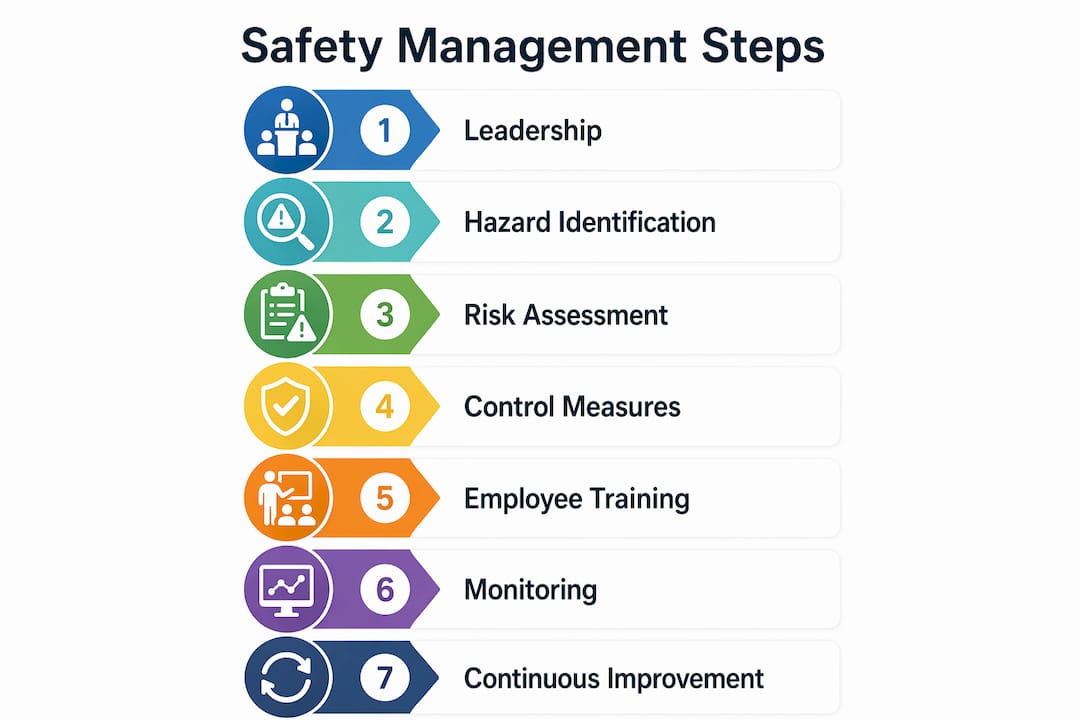
A complete SMS implementation follows a 10-step sequential process that begins with leadership commitment and concludes with ongoing review and improvement. This sequence is not arbitrary. Each step creates the conditions necessary for the next to function, meaning gaps in early stages compound into systemic failures downstream.
-
Establish leadership commitment and define scope. Senior leadership must formally authorize the SMS, allocate resources, and define the operational boundaries of the program. Without documented executive sponsorship, safety initiatives lack the authority to override production pressures.
-
Conduct a baseline assessment. Evaluate the current state of safety policies, procedures, incident records, and compliance status against applicable standards such as ISO 45001 or OSHA PSM. This gap analysis determines where the program must be built from scratch versus where existing controls can be strengthened.
-
Develop safety policies and objectives. Translate leadership commitment into written policy statements with measurable objectives. Policies must align with statutory frameworks applicable to the jurisdiction and industry sector.
-
Identify hazards and assess risks. Apply systematic methods to identify all hazard categories across routine, non-routine, and emergency scenarios. This step is addressed in depth in the section below.
-
Implement risk controls. Apply the hierarchy of controls to eliminate or reduce identified risks to tolerable levels. Control selection must be documented and justified.
-
Define roles, responsibilities, and accountabilities. Every safety function requires a named owner. Ambiguity in accountability is the single most common root cause of SMS failure identified in third-party audits.
-
Develop and deliver employee training. Training must be role-specific, competency-verified, and linked directly to the hazards and controls identified in steps four and five.
-
Establish communication and reporting channels. Workers must have accessible, non-punitive mechanisms to report hazards, near-misses, and incidents. Communication channels should be tested periodically for effectiveness.
-
Monitor performance and investigate incidents. Track both leading and lagging indicators. Investigate every incident to root cause, not just to immediate cause.
-
Review, audit, and improve continuously. Schedule formal management reviews and external audits. Use findings to update policies, controls, and training.
Pro Tip: Treat steps four through six as a closed loop rather than a linear sequence. New hazards identified during monitoring in step nine should feed directly back into the risk assessment and control selection process.
How to identify and assess workplace hazards effectively
Hazard identification is the analytical foundation of any step by step workplace safety plan, and its quality determines the adequacy of every control measure that follows. ISO 45001 Clause 6.1.2 mandates systematic hazard identification covering routine operations, non-routine tasks, emergency scenarios, and hazards originating from external parties such as contractors and visitors. This four-category scope is broader than most organizations initially assume, and gaps in non-routine or emergency coverage are among the most frequent findings in ISO 45001 certification audits.
The following methods constitute a defensible hazard identification program:
- Job Hazard Analysis (JHA): Deconstructs each task into discrete steps and identifies the hazard associated with each step. JHA is most effective when conducted with the workers who perform the task, not by safety personnel alone.
- Risk Matrix: Plots likelihood against consequence severity to produce a risk rating. Ratings drive prioritization of control measures and resource allocation.
- Walk-through inspections: Scheduled and unannounced site inspections capture hazards that desk-based analysis misses, particularly those arising from behavioral or environmental conditions.
- Incident and near-miss data review: Historical data reveals hazard patterns that prospective methods may overlook.
Worker participation in hazard identification is not a procedural courtesy. It is a substantive audit requirement under ISO 45001 and a proven mechanism for capturing operational knowledge that management-level assessments routinely miss.
| Hazard identification tool | Best application | Key output |
|---|---|---|
| Job Hazard Analysis | Task-level, routine operations | Step-by-step hazard and control record |
| Risk Matrix | Program-level prioritization | Risk rating and control urgency ranking |
| Walk-through inspection | Site-wide, routine and non-routine | Inspection report with corrective actions |
| Incident data review | Trend analysis and recurring hazards | Pattern identification and systemic gaps |

A risk register must capture hazard details, assigned controls, and residual risk ratings, and it must be treated as a live document updated whenever operational conditions change. Static risk registers are a compliance liability, not an asset.
Pro Tip: Schedule hazard identification reviews whenever a new process, material, or piece of equipment is introduced. Waiting for the annual review cycle means operating with unassessed risk for months.
Which risk control measures should workplaces implement and how?
The hierarchy of controls is the governing framework for risk mitigation across all industries and is explicitly required by ISO 45001 and OSHA standards. The hierarchy ranks control measures by their effectiveness and reliability, from most to least protective.
| Control level | Definition | Construction example | Manufacturing example |
|---|---|---|---|
| Elimination | Remove the hazard entirely | Prefabricate components off-site to eliminate working at height | Redesign process to remove toxic solvent |
| Substitution | Replace with a less hazardous alternative | Use water-based adhesives instead of solvent-based | Replace manual lifting with automated conveyor |
| Engineering controls | Physical barriers or design changes | Install guardrails and edge protection systems | Machine guarding and local exhaust ventilation |
| Administrative controls | Procedures, permits, and scheduling | Permit-to-work systems, job rotation schedules | Lockout/tagout procedures, shift rotation |
| PPE | Personal protective equipment as last resort | Hard hats, harnesses, safety boots | Respirators, cut-resistant gloves, safety glasses |
Over-reliance on PPE is the most frequently cited audit finding in high-risk operations, and it represents a fundamental misapplication of the hierarchy. PPE fails when it is damaged, improperly fitted, or not worn consistently. Engineering and elimination controls do not depend on human behavior to function. Safety officers must document the rationale for each control level selected, particularly when higher-level controls are deemed technically or economically infeasible, as auditors will scrutinize this justification.
Integrating controls into existing workflows requires coordination with operations management. Controls that disrupt productivity without explanation generate resistance. The most effective approach is to present control measures alongside the incident cost data and regulatory penalty exposure they prevent, framing safety investment as operational risk management rather than compliance overhead.
Pro Tip: When higher-level controls are not immediately feasible, implement interim administrative controls and PPE while engineering solutions are procured. Document the interim status and set a firm implementation deadline.
How to engage and train employees to support workplace safety management
Employee safety training is not a one-time orientation event. It is a continuous program structured across three distinct delivery types, each serving a different function within the broader safety management workflow.
- Orientation training establishes baseline hazard awareness for all new workers and contractors before they access the worksite. It covers site-specific hazards, emergency procedures, reporting channels, and the organization’s safety policy commitments.
- Task-specific training addresses the particular hazards and controls associated with a worker’s assigned role. For high-risk tasks such as confined space entry, working at height, or operation of heavy plant, task-specific training must be competency-verified and documented before the worker is authorized to perform the task unsupervised.
- Refresher training maintains competency over time and incorporates lessons learned from incidents, near-misses, and audit findings. Refresher cycles should be risk-proportionate: higher-hazard roles require more frequent intervals.
Effective consultation mechanisms that actively involve workers in occupational safety and health decisions are a specific requirement of ISO 45001, not an optional engagement practice. Toolbox talks, safety committees, and anonymous hazard reporting systems each serve this function at different organizational levels. The critical distinction is that consultation requires a genuine two-way exchange, not a broadcast of management decisions.
Training outcomes must be linked to measurable safety performance metrics. Tracking near-miss reporting rates, hazard observation submissions, and safety observation scores before and after training cycles provides objective evidence of program effectiveness. Organizations that invest in training-driven compliance consistently demonstrate stronger audit outcomes and lower incident frequency rates than those treating training as a documentation exercise.
How to monitor, investigate, and continuously improve workplace safety programs
Performance monitoring is the mechanism by which a safety management program generates the evidence needed to sustain and improve itself. Safety officers should track both leading indicators, which predict future incidents, and lagging indicators, which record past performance.
-
Define leading indicators. Examples include the number of hazard observations submitted per week, percentage of safety inspections completed on schedule, and near-miss reports per 100 workers per month. Leading indicators provide early warning of deteriorating safety culture before incidents occur.
-
Track lagging indicators. Total Recordable Incident Rate (TRIR), Lost Time Injury Frequency Rate (LTIFR), and severity rates measure the outcomes of the safety program. Lagging indicators alone are insufficient for proactive management but remain essential for benchmarking and regulatory reporting.
-
Investigate every incident to root cause. Immediate cause analysis, which identifies the unsafe act or condition, is only the first layer. Root cause analysis tools such as the 5 Whys, Fault Tree Analysis, and Bow-Tie methodology reveal the systemic failures in management, procedure, or design that permitted the incident to occur. OSHA’s PSM standard incorporates incident investigation as one of its 14 interlocking elements precisely because incident data is the most direct feedback mechanism available to safety managers.
-
Schedule formal audits and management reviews. Quarterly reviews documented in an audit log, as recommended by structured WHS compliance frameworks, track corrective action closure rates and identify recurring gaps. Annual management reviews should assess whether safety objectives have been met and set revised targets for the next cycle.
-
Update policies, controls, and training based on findings. A safety management program that does not change in response to audit and investigation findings is not functioning as a system. It is functioning as a documentation archive.
“No single element suffices alone; integrated continuous improvement of all elements sustains high safety levels.” This principle, drawn from Process Safety Management practice, applies equally to any SMS regardless of industry sector.
A 7-step health and safety program framework reinforces that systematic policies and ongoing review are the structural backbone of incident prevention, not supplementary activities to be scheduled when time permits.
Key takeaways
Effective workplace safety management requires a sequential, standards-aligned process that integrates hazard identification, risk-proportionate controls, worker participation, and evidence-based continuous improvement to achieve durable compliance and incident reduction.
| Point | Details |
|---|---|
| Leadership commitment is foundational | Without documented executive authorization, safety programs lack the authority to override operational pressures. |
| Risk registers must be live documents | Update hazard records whenever processes, materials, or equipment change to maintain audit-ready accuracy. |
| Hierarchy of controls governs mitigation | Prioritize elimination and engineering controls over PPE to meet ISO 45001 audit standards and improve worker protection. |
| Training must be competency-verified | Task-specific training requires documented verification before workers perform high-hazard tasks unsupervised. |
| Monitoring requires both indicator types | Leading indicators predict deterioration; lagging indicators benchmark outcomes. Both are required for a complete picture. |
Safety management as a living system, not a compliance artifact
From my experience working across construction and industrial sectors, the most persistent failure mode in safety management is not ignorance of the steps. It is the organizational tendency to treat the SMS as a document set rather than an operational system. Leadership signs the policy, the risk register gets populated, training records are filed, and the program is declared complete. Then nothing changes until the next audit cycle.
The organizations that genuinely reduce incident rates are those where the safety management workflow generates real decisions. Hazard observations submitted by workers actually change procedures. Incident investigations produce corrective actions that are tracked to closure and verified for effectiveness. Management reviews result in revised objectives, not just ratified reports.
Worker engagement is where this distinction becomes most visible. ISO 45001’s consultation requirements exist because workers possess operational knowledge that no desk-based assessment can replicate. When a scaffolder tells a safety officer that a particular access route creates a specific slip hazard under wet conditions, that information is worth more than a generic fall prevention procedure. The challenge for larger organizations is creating the structural conditions, safety committees, toolbox talk formats, anonymous reporting systems, where that knowledge flows upward consistently rather than being filtered out by supervisory layers.
The warning I would offer to any safety officer implementing a new program is this: treat the first audit not as a pass/fail event but as the most valuable data collection exercise your program will ever conduct. The gaps an external auditor identifies in year one are the gaps your program needs to close to become self-sustaining. Compliance is the floor, not the ceiling.
— Aman
How MOSAIC supports your safety management program

MOSAIC Eco-construction Solutions provides end-to-end safety management consultancy for construction companies, developers, and industrial operators seeking to build or strengthen their safety programs. From safety audit services and BizSAFE certification support to ISO 45001 implementation, Design for Safety consultancy, and ConSASS assessments, MOSAIC’s team of specialist practitioners delivers structured, audit-ready solutions tailored to your operational context. Whether you are building a site safety management system from the ground up or closing gaps identified in a recent audit, MOSAIC provides the technical expertise and regulatory knowledge to move your program from compliance baseline to performance excellence. Contact MOSAIC to discuss a tailored safety management engagement.
FAQ
What are the first steps in a workplace safety management system?
The first steps are establishing leadership commitment, defining the SMS scope, and conducting a baseline assessment against applicable standards such as ISO 45001 or OSHA PSM. These foundational steps determine the resources, authority, and gap analysis that all subsequent actions depend on.
How does ISO 45001 define hazard identification requirements?
ISO 45001 Clause 6.1.2 requires systematic hazard identification covering routine operations, non-routine tasks, emergency scenarios, and hazards from external parties including contractors. Worker participation in this process is a specific audit requirement, not an optional practice.
Why is PPE considered the least preferred control measure?
PPE is ranked lowest in the hierarchy of controls because its effectiveness depends entirely on consistent human behavior, correct fit, and equipment condition. Engineering and elimination controls function independently of individual compliance, making them inherently more reliable for sustained risk reduction.
How often should a safety management program be reviewed?
Quarterly reviews documented in an audit log are recommended by structured WHS compliance frameworks, with annual formal management reviews assessing objective achievement. Reviews should also be triggered by significant incidents, operational changes, or new regulatory requirements.
What is the difference between leading and lagging safety indicators?
Leading indicators measure proactive safety activities such as hazard observations and inspection completion rates, predicting future performance. Lagging indicators such as TRIR and LTIFR record past incident outcomes and are used for benchmarking and regulatory reporting.
Recommended
- Enhancing Workplace Safety Through Effective Audit Checklists And Risk Management Systems – MOSAIC Eco-construction Solutions Pte Ltd
- How to Build Site Safety Management System – MOSAIC Eco-construction Solutions Pte Ltd
- Implementing Effective Workplace Safety And Health Management Systems In Singapore Construction Industry – MOSAIC Eco-construction Solutions Pte Ltd