
Most business leaders encounter OHS compliance as a documentation exercise: forms to file, checklists to sign, posters to hang. That framing is dangerously incomplete. Why OHS compliance genuinely matters extends far beyond satisfying regulatory inspectors. The ILO identifies workplace safety as fundamental to protecting lives and enabling work with dignity, a standard that carries direct legal, financial, and operational weight in every jurisdiction. Organizations that treat compliance as a bureaucratic formality expose themselves to escalating penalties, preventable injuries, and a workforce that quietly disengages. The full picture is far more consequential.
Table of Contents
- Key takeaways
- Why OHS compliance is a legal and financial imperative
- OHS compliance advantages for safety and employee well-being
- Common pitfalls that undermine OHS compliance
- How to ensure OHS compliance through continuous risk management
- My perspective on what OHS compliance actually demands
- How MOSAIC supports your OHS compliance program
- FAQ
Key takeaways
| Point | Details |
|---|---|
| Legal penalties are substantial | 2026 OSHA fines reach $165,514 per willful or repeat violation, making non-compliance a serious financial liability. |
| Safety culture drives performance | Organizations with strong OHS programs report measurable gains in productivity, retention, and workforce morale. |
| Documentation protects you legally | Comprehensive training records and hazard logs directly reduce penalty exposure during regulatory inspections. |
| Minimum compliance is a hidden risk | Settling for the legal floor leaves organizations exposed to normalized hazards that inspectors and attorneys will scrutinize. |
| Leadership enforcement is decisive | Written safety policies only protect organizations when supervisors actively enforce them under real production conditions. |
Why OHS compliance is a legal and financial imperative
Occupational Health and Safety compliance is not a discretionary investment. In the United States, the Occupational Safety and Health Administration sets legally binding obligations on employers to identify hazards, implement controls, maintain records, and provide adequate training. These are not guidelines. Violation carries enforceable financial penalties that have been adjusted annually for inflation under the Federal Civil Penalties Inflation Adjustment Act, and 2026 figures represent the highest thresholds in OSHA’s history.
For serious violations, 2026 OSHA serious fines reach $16,550 per violation. Willful or repeat violations can climb to $165,514 per instance. When regulators identify multiple violations across a worksite, those penalties compound rapidly. A single inspection with ten serious citations produces $165,500 in exposure before any legal defense costs are factored in.
The following table illustrates how violation categories translate into financial exposure:
| Violation type | Maximum penalty per instance | Common triggers |
|---|---|---|
| Other-than-serious | $16,550 | Minor recordkeeping errors, signage deficiencies |
| Serious | $16,550 | Inadequate fall protection, missing machine guards |
| Willful | $165,514 | Documented knowledge of hazard with no corrective action |
| Repeat | $165,514 | Same violation cited within three years of a prior citation |
| Failure to abate | $16,550 per day | Unresolved violations beyond OSHA’s correction deadline |
Penalty reductions are available but not automatic. OSHA penalty reductions of up to 60% apply to small employers, 25% for documented good-faith safety programs, and 10% for a clean inspection history. Securing those reductions requires disciplined documentation of safety measures, training records, and hazard control logs maintained before an inspector arrives.
Pro Tip: Treat your safety documentation as a legal asset. Organized, current records of training sessions, hazard assessments, and corrective actions are the primary mechanism for penalty mitigation when OSHA arrives unannounced.
The importance of OHS compliance in financial terms extends beyond fines. Workers’ compensation premiums, civil litigation exposure, and reputational damage to client relationships in sectors like construction represent multiplier effects that far exceed the initial penalty figure.
OHS compliance advantages for safety and employee well-being
The OHS compliance advantages most frequently quantified are legal, but the operational benefits to workforce performance are equally significant and often more durable. A well-constructed compliance framework systematically eliminates the conditions that produce injuries and occupational illnesses, not merely by ticking regulatory boxes but by embedding hazard recognition into daily operations.
Consider what happens in organizations where hazard reporting is genuinely encouraged versus those where it is nominally permitted but culturally discouraged:
- Workers in psychologically safe environments report early discomfort before it becomes a recordable injury, reducing the incidence of cumulative trauma disorders.
- Supervisors who conduct regular site inspections identify equipment degradation and behavioral drift before incidents occur.
- Documented near-miss reporting creates an organizational memory that informs future hazard controls.
- Retention rates improve measurably when workers trust that their employer takes physical safety seriously. Replacing a skilled tradesperson costs between 50% and 200% of their annual salary when recruitment, onboarding, and productivity loss are combined.
- Safety-aware organizations attract higher-caliber contractors and subcontractors who evaluate client safety culture before committing to long-term partnerships.
One of the most underappreciated risks in the importance of OHS compliance discussion is what OHS Canada describes as ergonomics debt. Workers normalize early symptoms, such as chronic lower back stiffness, wrist aches, or recurring headaches, treating them as ordinary discomfort rather than warning signals. Ergonomics debt hides behind normalized early symptoms, accumulating into cumulative strain and eventual injury. By the time a worker seeks medical attention, the condition is often months or years into development, and the employer’s exposure is severe.
A compliance system that only counts injuries misses the entire early-warning layer of occupational health. Organizations that measure and respond to discomfort reports, near-misses, and early symptom patterns maintain a fundamentally different risk profile than those waiting for recordable events.
Why is OHS important at this level of granularity? Because the difference between a workforce that reports early symptoms and one that does not is a leadership choice, codified through the systems, incentives, and cultural signals that management establishes.
Common pitfalls that undermine OHS compliance

Understanding why OHS compliance fails in practice is as instructive as understanding why it matters in theory. Organizations settling for minimum compliance cite financial pressures, training resource limitations, enforcement bottlenecks, and competing organizational priorities as the primary drivers. Each of these barriers is real, but each is also a choice about resource allocation that reflects organizational values.
The risk of minimum compliance is not simply that inspectors may find gaps. It is that hazards normalized at the floor of legal acceptability tend to expand over time. Supervisors under production pressure take incremental shortcuts. Workers observe that certain unsafe behaviors go unremarked. Gradually, the gap between documented policy and operational practice widens, and organizations become legally and physically exposed in ways their paperwork would not reveal.
Regulators and plaintiff attorneys operate with precise understanding of this dynamic. Enforcement focuses on practice, specifically whether safety expectations were enforced in real operational conditions, not merely documented in a policy binder. An organization with a comprehensive written safety program and supervisors who routinely override it under production pressure carries significantly greater legal exposure than its documentation suggests.
The following practical steps reduce the risk of falling into minimum-compliance patterns:
- Conduct quarterly gap analyses comparing written procedures against observed supervisor behavior on active worksites or production floors.
- Establish anonymous reporting mechanisms that allow workers to flag safety concerns without fear of retaliation or managerial dismissal.
- Incorporate safety metrics into supervisor performance evaluations alongside production and quality KPIs, preventing safety from being treated as a separate and secondary concern.
- Require that corrective actions from incident investigations be formally tracked to closure, with accountability assigned to named individuals rather than departments.
- Audit your training records proactively, not reactively. Comprehensive documentation and training records are the primary determinant of penalty mitigation outcomes during regulatory enforcement.
Pro Tip: The most revealing indicator of your compliance culture is not what your safety program says. It is what your supervisors do when they are behind schedule on a Friday afternoon. That behavioral reality is what regulators and attorneys examine.
How to ensure OHS compliance through continuous risk management
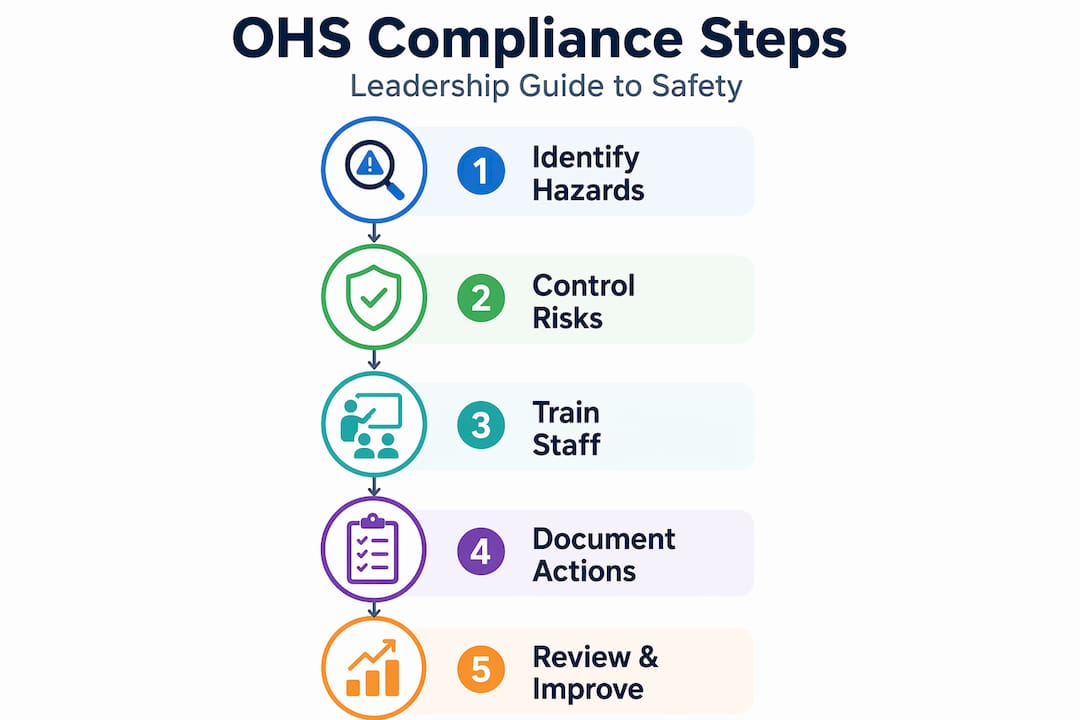
How to ensure OHS compliance at an organizational level requires moving decisively away from the checklist mentality and toward a continuous risk management architecture. Checklists confirm that specific conditions existed at a specific moment. Risk management systems track the trajectory of those conditions over time and intervene before adverse events occur.
Effective OHS compliance operates as a continuous risk management loop that prioritizes early symptom reporting and incremental workplace ergonomic improvements. The practical components of that loop include structured inspection schedules, defined corrective action workflows, leading indicator monitoring, and regular management review of safety performance data. The following framework elements are non-negotiable in high-performing safety management systems:
- Hazard identification and assessment: Formal risk assessments conducted before work begins, updated when work scope or conditions change, and documented with named accountable personnel.
- Training currency: Verification that all personnel hold current, role-specific competency training, with records maintained in accessible, auditable format.
- Inspection cadence: Scheduled and unannounced site inspections that evaluate actual work conditions, not prepared presentations. Frequency should scale with hazard severity.
- Incident and near-miss reporting: Accessible reporting systems with defined investigation timelines and mandatory corrective action workflows. Organizations should also explore construction hazard identification resources for sector-specific guidance.
- Corrective action tracking: A formal mechanism that records identified deficiencies, assigns correction responsibility, sets deadlines, and verifies closure.
- Management review: Regular executive review of leading and lagging indicators, ensuring OHS performance data informs strategic and operational decisions.
A particularly instructive tool for leadership is what practitioners term the leadership litmus test. Written safety programs versus actual supervisor enforcement under production pressure reveals the true state of organizational compliance. Where discrepancies exist between policy and practice, regulatory scrutiny intensifies. Closing that gap requires supervisors to understand that safety enforcement is a non-negotiable component of their role, supported by clear accountability structures and visible leadership commitment.
The construction safety management systems frameworks available for construction sector organizations provide structured methodologies for implementing these components within the specific hazard profile and regulatory environment of that industry.
| OHS system component | Lagging indicator | Leading indicator |
|---|---|---|
| Training | Incidents involving undertrained workers | Training completion rate by role |
| Inspections | Citation rate during regulatory audits | Deficiencies identified per internal inspection |
| Near-miss reporting | Recordable injury rate | Near-miss reports submitted per quarter |
| Corrective actions | Repeat violations | Corrective actions closed within target timeframe |
| Management review | Workers’ compensation cost trend | Safety agenda time in executive meetings |
My perspective on what OHS compliance actually demands
I have spent years working with organizations that possess well-drafted safety programs and genuinely dangerous workplaces simultaneously. The gap is never the documentation. The gap is always the distance between what the program says and what supervisors actually do when a deadline is pressing and a worker raises a concern that slows production.
I have seen safety managers who understood every regulatory requirement in technical detail, yet found themselves unable to move their organizations because leadership treated safety as a compliance function rather than an operational value. The organizations that achieve genuinely safe workplaces are not necessarily the ones with the most sophisticated programs. They are the ones where a frontline supervisor can stop work without fear of reprimand, and where that authority is publicly reinforced by executive leadership.
The contrarian view worth stating plainly: OHS compliance that stops at legal minimums is not compliance in any meaningful sense. It is a calculated bet that nothing will go wrong before the next inspection. That bet carries real human consequences, and the leaders who make it carry real accountability when it fails. Treating safety as genuinely synonymous with how you treat people is the only standard that produces durable results.
— Aman
How MOSAIC supports your OHS compliance program

MOSAIC Ecoconstruction Solutions brings specialized consultancy expertise to construction sector organizations navigating the demanding intersection of regulatory compliance, hazard control, and operational performance. Whether your organization is building foundational OHS systems, preparing for a formal safety audit, or pursuing certification milestones such as BizSAFE Star, MOSAIC provides structured, audit-ready guidance tailored to your specific risk profile and regulatory obligations.
MOSAIC’s safety consultancy services encompass gap analysis, compliance auditing, corrective action program development, and certification preparation, with each engagement designed to close the distance between documented policy and operational practice. For organizations seeking to prepare systematically, MOSAIC’s safety audit preparation resources provide a structured pathway to audit readiness. Contact MOSAIC to assess your current compliance posture and identify the highest-priority actions for your organization.
FAQ
What does OHS compliance require from employers?
OHS compliance requires employers to identify workplace hazards, implement appropriate controls, provide role-specific training, maintain accurate records, and enforce safety procedures in actual operational conditions, not merely in written policy.
Why is OHS important beyond avoiding fines?
Beyond legal penalties, OHS compliance directly reduces injury and illness rates, improves workforce retention and morale, reduces workers’ compensation costs, and strengthens an organization’s reputation with clients and regulatory bodies.
How severe are OSHA penalties for non-compliance in 2026?
Serious violations carry fines up to $16,550 per violation, while willful or repeat violations reach $165,514 per instance. Failure to abate cited violations adds $16,550 per day until the deficiency is corrected.
How can organizations reduce their OSHA penalty exposure?
Employers can reduce penalties by up to 60% for small employer status, 25% for documented good-faith safety programs, and 10% for a clean inspection history, but these reductions require proactive documentation maintained before any enforcement action begins.
What is the most common reason OHS compliance fails in practice?
The most pervasive failure point is the gap between written safety policies and actual supervisor behavior under production pressure. Regulators and plaintiff attorneys specifically examine whether documented safety expectations were enforced in real operational conditions, not just recorded in a safety manual.
Recommended
- Streamlining Safety Protocols And Ensuring Compliance With Regulatory Requirements Through ISO 45001 Audit – MOSAIC Eco-construction Solutions Pte Ltd
- Implement Effective Risk Management Systems And Boost Business Reputation With Successful ISO 45001 Certification – MOSAIC Eco-construction Solutions Pte Ltd
- OHS in Singapore construction: A complete compliance guide