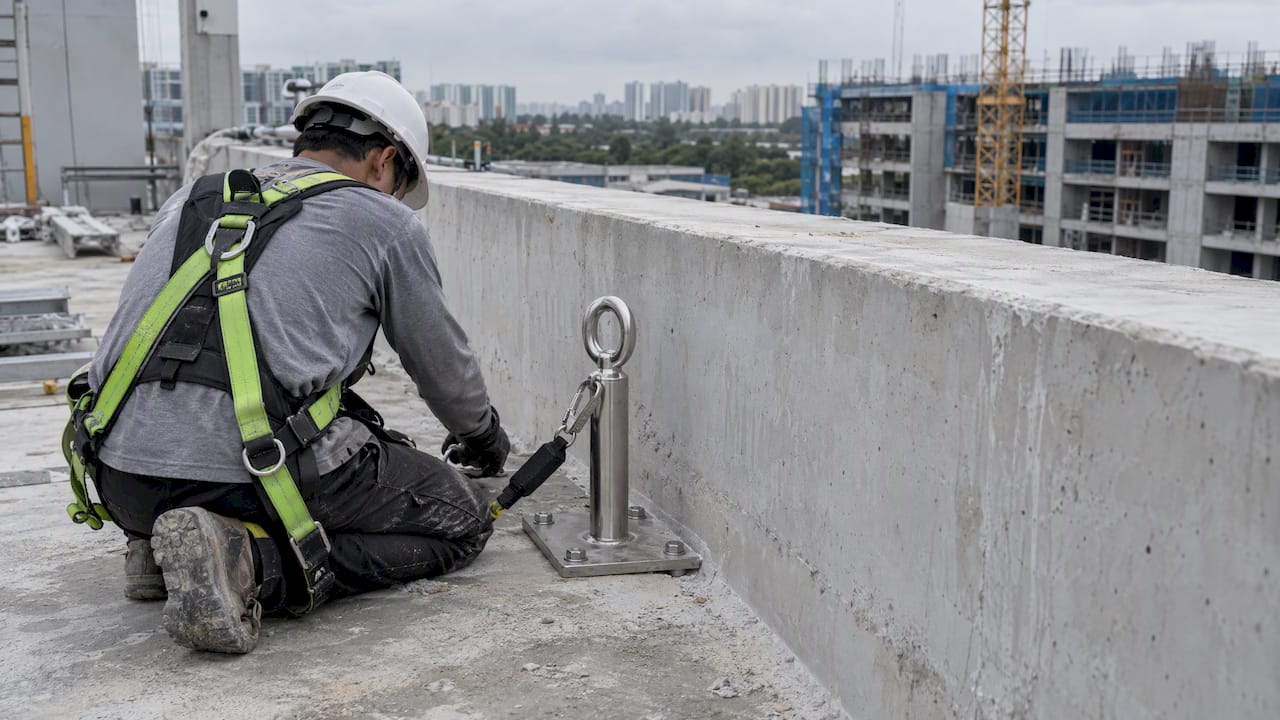
Construction tender safety requirements preparation is the process of compiling and presenting documented, project-relevant safety evidence that satisfies regulatory, client, and contractual expectations to gain bidding eligibility and improve competitive positioning. Regulatory frameworks including OSHA standards and ISO 45001 define the baseline for what evaluators expect to see. Safety criteria now compose a minimum of 5% of overall tender weightage or up to 15% of the quality score on many public contracts. Contractors who treat safety documentation as an afterthought routinely lose bids to competitors who present structured, evidence-based submissions. This guide gives construction managers and contractors a direct path through the documentation, process, and performance evidence that wins tenders.
What mandatory safety documents must be prepared for tenders?
The core of any tender safety submission rests on a defined set of documents that demonstrate both regulatory compliance and site-specific hazard control. Site-specific safety plans and Safe Work Method Statements (SWMS) must be submitted or ready before work starts, particularly for high-risk tasks. These documents prove that your organization has analyzed the actual project conditions, not just copied a generic template.
Evaluators also require quantitative safety performance data. Experience Modification Rate (EMR) and Total Recordable Incident Rate (TRIR) are the two most common metrics. Projects exceeding $1 million typically require an EMR threshold of 1.0 and TRIR limits between 2.5 and 4.0. Exceeding those thresholds can disqualify a bid before evaluators read a single page of your methodology.

Subcontractor prequalification documentation rounds out the mandatory package. Failure to meet subcontractor safety standards may result in removal from site and can void the entire submission. Evaluators want to see that your safety controls extend across the full supply chain, not just your direct workforce.
| Document | Purpose | Key Contents |
|---|---|---|
| Site-specific safety plan | Demonstrates hazard identification for this project | Risk register extracts, hazard controls, emergency procedures |
| SWMS | Confirms high-risk work procedures | Step-by-step controls for each high-risk task |
| EMR letter | Quantifies historical safety performance | Insurer-verified rate, coverage period, scope |
| OSHA 300A summary | Annual injury and illness record | Recordable incidents, lost-time cases, TRIR calculation |
| Training matrix | Proves workforce competency | Certifications, license numbers, renewal dates |
| Subcontractor prequalification | Extends safety controls to supply chain | Performance metrics, documented safety programs |
The construction safety compliance guide published by Com provides a detailed breakdown of how each document maps to specific regulatory requirements in the Singapore context.
How to tailor safety requirements to specific tenders without overcommitting
Generic submissions cost contractors bids. Tender evaluators penalize full WHS manuals and prefer concise, tender-specific plans of 10–15 pages that focus on project-relevant hazards and controls. Submitting your entire company safety manual signals that you did not read the tender documents carefully.
The risk of overcommitting is equally serious. A safety plan that promises specific incident rates or guarantees zero fatalities creates contractual exposure that no project can reliably meet. The balanced tender safety approach means showing evidence of a mature system without binding guarantees that cannot be fulfilled. Use indicative language such as “our target” or “our standard practice” rather than absolute commitments.
Consistency between your safety plan and your project methodology is non-negotiable. If crane usage appears in the methodology, corresponding high-risk plans for crane operations must appear in the safety documents. Evaluators cross-reference these sections deliberately. A mismatch signals either poor preparation or a safety culture that exists only on paper.
Key principles for tailoring without overcommitting:
- Extract only the risk register entries relevant to this project’s scope and site conditions.
- Label SWMS as “sample” or “indicative” documents where final versions depend on confirmed site conditions.
- Reference ISO 45001 alignment without claiming full certification unless it is current and verifiable.
- Avoid copying safety statistics from a different project type or geography.
- Include a disclaimer that final safety plans will be developed in consultation with the client’s HSEQ team after contract award.
Pro Tip: Add a one-paragraph “scope note” at the front of every safety submission explaining that the documents are prepared for tender evaluation purposes and will be finalized to reflect confirmed site conditions. This single addition protects you legally and signals professional maturity to evaluators.
Step-by-step process for compiling and submitting safety requirements
A structured process eliminates last-minute gaps and prevents the document inconsistencies that disqualify otherwise competitive bids. Follow these steps for every tender submission.
-
Review the tender’s safety criteria in full. Identify the EMR and TRIR thresholds, required document list, page limits, and any project-specific hazard categories the client has flagged.
-
Assemble your standardized safety qualification package. A quarterly-updated package should include OSHA 300A summaries, EMR letters, a safety manual table of contents, site-specific plan templates, and training matrices. Quarterly updates prevent the common error of submitting expired certifications.
-
Map the project’s key hazards. Construction fatalities arise primarily from four hazards: falls, struck-by incidents, electrocution, and caught-in/between events. These “Fatal Four” cause nearly 60% of construction deaths annually. Your site-specific safety plan must address each one that applies to this project’s scope.
-
Customize the site-specific safety plan. Pull relevant extracts from your construction risk register and write SWMS for the high-risk tasks confirmed in the project methodology. Do not use a plan written for a different project type.
-
Integrate training records and personnel qualifications. List the competent persons assigned to this project by name and credential. Evaluators want to see that qualified individuals are already identified, not that you will find them after award.
-
Conduct an internal review with legal and HSEQ teams. Internal review processes must verify consistency, currency, and appropriateness of all safety documentation before submission. Legal review catches overcommitments. HSEQ review catches technical gaps.
-
Submit with a cover index. A one-page index mapping each submitted document to the corresponding tender criterion saves evaluators time and signals organizational discipline.
Pro Tip: Maintain a “tender safety annex” folder updated after every project completion. Store your latest EMR letter, OSHA 300A, training matrix, and a library of sample SWMS organized by task type. When a new tender arrives, you pull from this folder rather than building from scratch. This cuts preparation time significantly and keeps documentation current.
Common mistakes in safety requirements preparation
Avoidable errors account for a large share of tender disqualifications. Recognizing these patterns before submission protects your bid score.
- Submitting outdated documentation. An EMR letter from two years ago or an expired certification immediately signals poor document control. Evaluators treat outdated records as evidence of a weak safety culture.
- Overpromising outcomes. Claiming zero incidents or guaranteeing specific TRIR figures creates legal exposure and raises evaluator skepticism. Zero-incident records raise skepticism among experienced evaluators who understand that near-miss reporting is a sign of a healthy safety system, not a failure.
- Inconsistencies between safety plans and project scope. A safety plan that does not mention confined space entry when the methodology describes underground utility work will be flagged immediately.
- Neglecting subcontractor safety controls. Many contractors submit strong primary documentation but leave subcontractor prequalification blank or generic. Evaluators view this as a supply chain risk.
- Ignoring updated regulatory requirements. Safety regulations evolve. Contractors with poor safety metrics or failed audits may be disqualified from public tenders under Safety Disqualification frameworks. Staying current with regulatory updates is not optional.
A tender safety submission is not a compliance exercise. It is a structured argument that your organization has the systems, people, and track record to execute this specific project without harming workers. Every document in the package must support that argument with evidence, not assertions.
How to demonstrate safety performance and continuous improvement
Presenting safety statistics effectively separates credible submissions from those that simply list numbers without context. Safety statistics must include timeframes, incident types, and ongoing review disclaimers to build evaluator trust. A raw TRIR figure without context tells evaluators nothing about trajectory or systemic improvement.
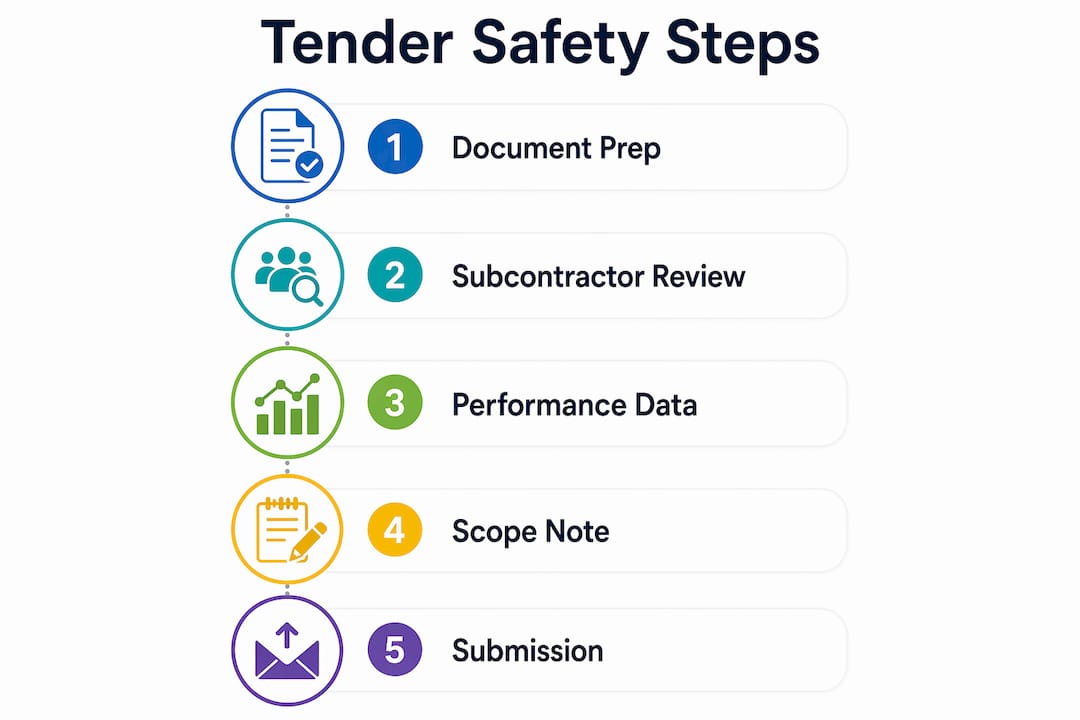
Near-miss reporting data is one of the most underused performance indicators in tender submissions. A high near-miss reporting rate signals a mature safety culture where workers feel safe to report hazards before they escalate. Evaluators familiar with ISO 45001 recognize this immediately. Pair near-miss data with a brief narrative explaining what corrective actions followed each category of near miss.
The following elements strengthen a safety performance section:
- EMR and TRIR data presented with a three-year trend line, not a single-year snapshot.
- A brief explanation of any year with elevated incident rates, including the corrective actions taken.
- Subcontractor oversight records showing audit frequency and performance thresholds applied.
- Training program completion rates by role and certification type.
- Extracts from risk registers and SWMS that show how controls were applied on recent comparable projects.
| Performance Indicator | What It Demonstrates | Presentation Tip |
|---|---|---|
| EMR (3-year trend) | Historical cost of injuries relative to industry | Show trajectory, not just current figure |
| TRIR | Frequency of recordable incidents | Include scope: hours worked, project types |
| Near-miss reporting rate | Safety culture maturity | Compare to industry benchmarks |
| Audit completion rate | System discipline | List frequency and corrective action closure rate |
| Training matrix coverage | Workforce competency | Break down by role and certification type |
Addressing the Fatal Four hazards with clear mitigation strategies ranks highly in tender evaluations. Evaluators look for explicit evidence that your safety system targets the hazards most likely to cause fatalities on a construction site. A general statement about “hazard management” does not satisfy this criterion. Specific controls for falls, struck-by, electrocution, and caught-in/between incidents do. For practical guidance on identifying and controlling these hazards at the site level, the construction hazard examples resource from Com provides a useful reference framework.
Key Takeaways
Effective construction tender safety requirements preparation requires project-specific documentation, verified performance data, and internal review processes that align every safety document with the stated project methodology.
| Point | Details |
|---|---|
| Document specificity wins bids | Tender-specific safety plans of 10–15 pages outperform generic company manuals in evaluator scoring. |
| EMR and TRIR thresholds are gatekeepers | Projects over $1 million typically require EMR at or below 1.0 and TRIR between 2.5 and 4.0. |
| Consistency is non-negotiable | Every hazard or activity in the methodology must have a corresponding control in the safety documents. |
| Avoid overcommitment | Use indicative language and scope notes to protect against contractual exposure from undeliverable safety guarantees. |
| Near-miss data signals maturity | Including near-miss reporting rates and corrective action narratives demonstrates a functioning safety culture to evaluators. |
What I have learned about tender safety preparation after years in the field
The single most common mistake I see from contractors is treating tender safety documentation as a box-checking exercise. They pull the same safety plan from the last bid, update the project name, and submit it. Evaluators notice. They have seen the same boilerplate dozens of times, and they score it accordingly.
What actually works is treating the safety submission as a technical argument. Every document should answer one question: why should the client trust this contractor to manage safety on this specific project? That means referencing the actual site conditions, the actual high-risk tasks, and the actual personnel who will be responsible. Generic language does not answer that question.
The shift I have observed in 2026 tender evaluations is a growing emphasis on safety culture evidence over safety statistics alone. Clients want to see near-miss reporting programs, lessons-learned registers, and evidence that safety findings from past projects influenced current procedures. A contractor with a TRIR of 1.8 and a documented near-miss program will often outscore a contractor with a TRIR of 0.9 and no evidence of proactive reporting.
My practical advice: build your tender safety annex now, before the next bid arrives. Keep it updated quarterly. Engage your HSEQ team in every submission review, not just the project manager. And never submit a safety plan that your site supervisor has not read and confirmed as operationally realistic. The gap between what the tender promises and what the site delivers is where safety failures and contract disputes originate.
— Aman
How Com supports your tender safety compliance
Construction managers preparing for competitive bids need more than templates. They need verified compliance evidence, trained personnel, and audit-ready documentation that holds up under evaluator scrutiny.

Com provides safety audit examples aligned with Singapore’s regulatory framework, giving contractors the documented compliance evidence that tender evaluators require. The safety leadership coaching program builds the on-site leadership capability that supports credible safety submissions. For contractors who need to demonstrate workforce competency through training records, the employee safety training programs provide the certifications and matrices that evaluators verify. Com’s consultancy team works directly with construction managers to prepare, review, and strengthen safety documentation before submission deadlines.
FAQ
What safety documents are required in a construction tender?
Most tenders require a site-specific safety plan, SWMS for high-risk tasks, an EMR letter, OSHA 300A summaries, a training matrix, and subcontractor prequalification records. Projects exceeding $1 million typically apply formal EMR and TRIR thresholds as eligibility criteria.
What EMR and TRIR scores qualify a contractor for tender?
The standard threshold is an EMR at or below 1.0 and a TRIR between 2.5 and 4.0, though specific clients and public sector bodies may set stricter limits. Exceeding these thresholds can result in automatic disqualification before qualitative evaluation begins.
How long should a tender safety plan be?
Tender evaluators prefer concise, project-specific safety plans of 10–15 pages over full company WHS manuals. The plan should focus on hazards and controls relevant to the specific project scope, not the organization’s entire safety system.
How does ISO 45001 certification affect tender scoring?
ISO 45001 certification demonstrates a verified, third-party-audited safety management system, which evaluators treat as evidence of systemic compliance. Contractors without certification can still score well by presenting aligned documentation, but certification removes evaluator doubt about system credibility.
What disqualifies a contractor from a public sector tender on safety grounds?
Poor safety metrics, failed audits, or incomplete documentation can trigger disqualification under Safety Disqualification frameworks applied by public sector clients. Submitting outdated records, inconsistent documentation, or unverifiable subcontractor safety programs are the most common grounds for rejection.