

Near-miss reporting is the formal process of capturing, documenting, and investigating workplace events that carried the potential for injury or damage but produced neither — and it is one of the most reliable early-warning mechanisms available to safety professionals. OSHA defines near misses as incidents that could have caused harm under slightly different circumstances, and provides a template form with the fields required to investigate them properly. When you encounter a near miss, act immediately: preserve the scene with photographs, note the exact location, notify your supervisor, and log the minimum required fields before conditions change.
Immediate next steps after a near miss:
- Photograph the scene and note the exact grid location or address
- Notify your direct supervisor within the same shift
- Log date, time, task, brief description, and potential consequence
- Preserve any physical evidence (spilled material, failed equipment, unsecured load)
- Submit the report through your designated channel before the end of the workday
Key Takeaways
Near-miss reporting is the most cost-effective leading indicator available to construction safety programs — and its value depends entirely on a non-punitive culture, low-friction reporting, and visible corrective action.
| Point | Details |
|---|---|
| Define and report immediately | A near miss is any event with harm potential that produced no injury; report it before the shift ends. |
| Prioritize by potential severity | Investigate high-potential near misses within 48–72 hours; batch low-severity events for trend review. |
| Keep reporting frictionless | Forms under 60 seconds and mobile-first channels produce the highest participation rates in field environments. |
| Close the loop visibly | Post corrective actions within 72 hours; workers who see results keep reporting. |
| MOSAIC accelerates program launch | MOSAIC’s QES consultancy delivers program design, audits, and training tailored to construction site requirements. |
Table of Contents
- Why near miss reporting matters for prevention and compliance
- What counts as a near miss? Recognizable examples
- Who should report, and what every report must capture
- How to set up a near-miss reporting program
- How to investigate near misses and turn findings into action
- How to encourage reporting and build a Just Culture
- Practical tools, sample form fields, and reporting metrics
- Common mistakes that kill near-miss reporting programs
- A consultant’s perspective on near-miss reporting for construction sites
- MOSAIC’s near-miss program services for construction teams
- Sources
Why near miss reporting matters for prevention and compliance
Near misses function as leading indicators: they signal systemic weaknesses before those weaknesses produce a recordable injury. The Texas Department of Insurance recommends a five-step near-miss program — encourage reporting, investigate, analyze trends, correct, and communicate — precisely because each step converts raw event data into preventive action. Without that pipeline, organizations react to injuries rather than preventing them.
The business case is equally direct. Reduced injury frequency lowers workers’ compensation premiums, cuts lost-time costs, and strengthens the compliance data that OSHA inspectors and insurance underwriters examine. ISSA guidance states that every incident without injury or damage is a learning opportunity equal in value to an accident — without the human cost. In mature programs, near-miss frequency serves as a quantitative leading indicator that triggers targeted engineering controls before a recordable event occurs.
Statistic: The National Safety Council notes that near misses occur daily across every industry, yet most go unreported — meaning organizations are operating with a systematically incomplete picture of their actual risk exposure.
Pro Tip: Prioritize near misses by potential severity, not by frequency. A single high-potential event — a suspended load that nearly struck a worker — warrants immediate investigation even if low-severity slips are reported ten times more often. Directing resources toward high-consequence potential events is where near-miss data delivers its greatest return.
What counts as a near miss? Recognizable examples
A near miss is distinguished from a hazard (a static condition) and from an incident (an event that caused harm). The defining criterion is potential consequence: something happened, no one was hurt, but the outcome could have been serious under slightly different circumstances.
- Construction — suspended load swing: A crane load swings unexpectedly and passes within two feet of a worker on a scaffold. No contact, no injury. Near miss.
- Warehousing — forklift pedestrian conflict: A forklift rounds a blind corner at speed; a pedestrian steps back just in time. Near miss.
- Maintenance — dropped tool: A wrench falls from an elevated platform and strikes the deck three feet from a technician. Near miss.
- Office — electrical near miss: An employee notices a frayed power cord arcing against a metal desk leg. No fire ignites. This sits on the borderline: it is primarily a hazard, but if the arc was observed during active use, it qualifies as a near miss.
- Construction — vehicle interaction: A reversing excavator comes within one meter of a site worker who was outside the designated exclusion zone. Near miss.
The borderline case worth clarifying: an unsafe condition discovered during inspection (a missing guardrail, a wet floor with no signage) is a hazard, not a near miss, unless a person was actually exposed to it in a way that could have caused harm. Consistent classification across your team is more important than perfect theoretical precision — define the boundary in your toolbox talks and apply it uniformly.
Who should report, and what every report must capture
Every person on site — employees, supervisors, subcontractors, and visitors — carries the authority and the responsibility to submit a near-miss report. Restricting reporting to supervisors or safety officers suppresses the volume of data and introduces selection bias. UVA EHS guidance specifically recommends short forms and supervisor follow-up as the two structural elements most likely to sustain participation.

Reports should flow to a designated safety owner: a site safety officer, a safety committee, or a supervisor with a defined triage role. That single-point ownership prevents reports from diffusing across inboxes and disappearing.
Anonymous channels are most valuable when a program is new and psychological safety is still developing. As trust builds through visible corrective action, named reporting tends to produce richer, more investigable data.
Pro Tip: Keep the report form to one page or under 60 seconds on mobile. Every additional field reduces submission rates. Capture the six core fields first; supplementary detail can be gathered during the investigation.
How to set up a near-miss reporting program
A structured program requires governance, channels, training, and a feedback loop. The following sequence reflects the implementation logic recommended by both the National Safety Council and state-level guidance from TDI.
- Establish a written non-punitive policy. Define explicitly that near-miss reports will not be used for disciplinary action. Publish it, post it, and have leadership sign it. This is the foundation of a Just Culture.
- Assign a single intake owner. Designate one person or role responsible for receiving, logging, and triaging every report. Shared ownership produces gaps.
- Select low-friction reporting channels. Mobile app, QR-code form, or paper card — whichever your workforce will actually use. Maintain a paper backup for field environments with poor connectivity.
- Define triage criteria and investigation timelines. Acknowledge receipt within 24 hours. Complete initial investigation within 48–72 hours for high-potential events. Assign corrective-action ownership with a due date.
- Train supervisors and workers. Use short toolbox talks with real examples drawn from your own site data. Workers who recognize what a near miss looks like report more consistently.
- Set KPIs and communicate results. Track reports per 100 employees, high-potential near-miss rate, and corrective-action closure time. Share outcomes at team meetings so reporters see their submissions produce change.
Building the safety culture that sustains this program requires leadership to model the behavior — submitting their own reports, attending investigations, and visibly acting on findings.
How to investigate near misses and turn findings into action
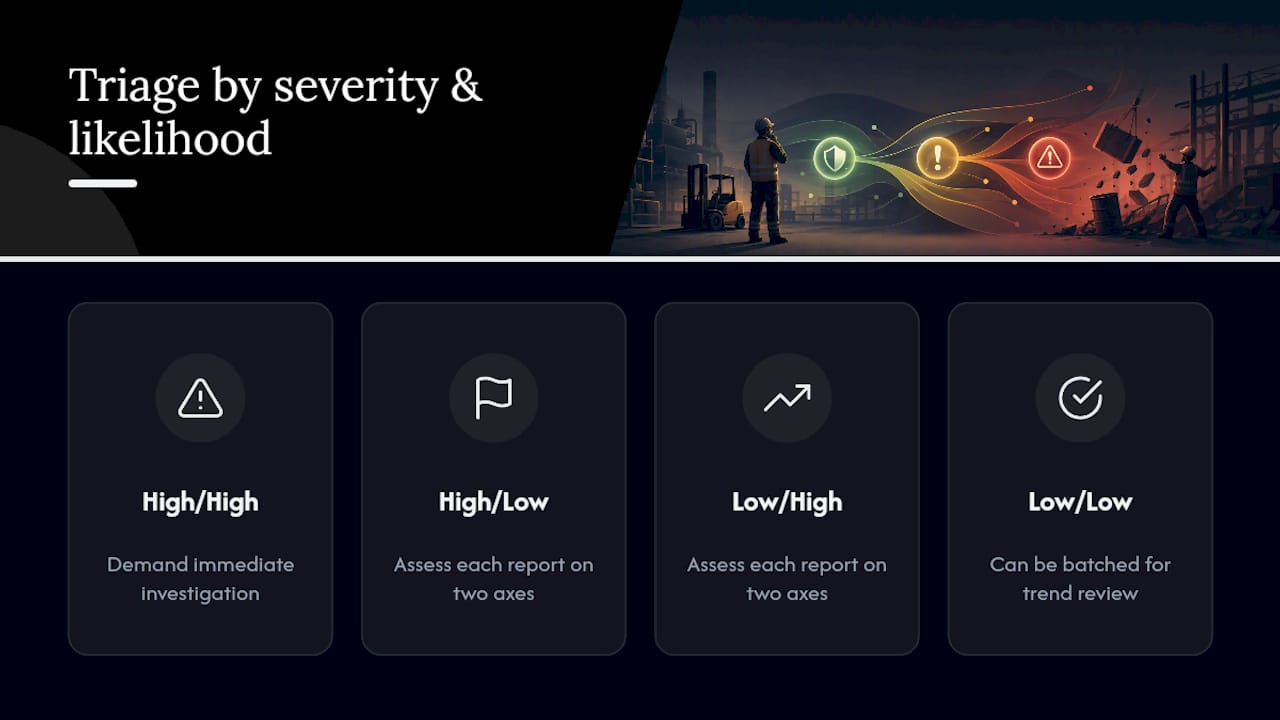
Triage determines the response priority. Assess each report on two axes: potential severity (what was the worst credible outcome?) and likelihood of recurrence (how probable is it that conditions will repeat?). High-potential, high-likelihood events demand immediate investigation; low-potential, low-likelihood events can be batched for trend review.
The investigation focus is systemic, not personal. The operative question is: what conditions allowed this to occur? Root causes typically reside in system design, procedural gaps, training deficits, or equipment condition — not individual error. PMC research on just culture principles confirms that shifting from blame to learning increases both reporting volume and the quality of data organizations receive.
Expected investigation timeline: acknowledge within 24 hours, complete root-cause analysis within 48–72 hours for high-potential events, implement corrective action within a defined deadline, and close the loop with a written communication to the reporting team. Guidance from ISSA recommends clear role assignment and communication of findings as non-negotiable elements of any functional near-miss program.
How to encourage reporting and build a Just Culture
Sustained participation depends less on technology than on trust. PMC research on psychological safety and just culture principles demonstrates that leadership-visible corrective action is the single most powerful driver of long-term reporting engagement. Workers submit reports when they believe those reports produce results.
Practical tactics that increase participation:
- Post corrective actions on site boards within 72 hours of investigation completion
- Allow anonymous submissions with an optional callback field for follow-up
- Recognize meaningful reports in team meetings — focus on the quality of the observation, not the count of submissions
- Keep forms short; a form that takes under 60 seconds to complete removes the most common friction point
- Share lessons learned from near misses at weekly toolbox talks, using your own site data
Pro Tip: Reward problem-solving, not report volume. A worker who submits one high-potential near miss with a suggested corrective action contributes more to safety than one who submits ten low-severity observations with no context. Recognition programs calibrated to volume alone create perverse incentives and degrade data quality.
Practical tools, sample form fields, and reporting metrics
The OSHA near-miss report template provides a practical baseline. A minimal functional form captures: date and time, exact location (building, floor, grid reference), task being performed, description of the event, potential consequence, people involved, contributing factors, corrective action suggested, and reporter contact or anonymous ID. Photo attachment should be a standard field, not an optional one.
For fire-related near misses in industrial facilities, the fire incident reporting process follows the same core logic — capture, investigate, correct — with additional requirements for equipment inspection and regulatory notification.
| Metric | What it measures | Target |
|---|---|---|
| Reports per 100 employees (monthly) | Reporting participation rate | Rising trend over first 6 months |
| High-potential near misses (%) | Share of reports with serious consequence potential | Track; investigate 100% |
| Corrective-action closure time | Speed from report to implemented fix | Within 72 hours for high-potential |
Low-tech programs (paper cards logged to a spreadsheet) work adequately for small sites. Digital mobile apps add photo capture, GPS location tagging, and automatic routing to the intake owner — advantages that compound as site size and report volume increase.
Common mistakes that kill near-miss reporting programs
Most program failures trace to a small set of predictable errors.
- Punitive use of reports: Using near-miss data to discipline the reporter or the involved worker destroys trust within weeks. Reports stop. The hazards remain.
- High-friction reporting: Forms longer than one page, systems requiring login credentials workers don’t have, or channels accessible only during office hours suppress participation.
- No visible follow-up: Reports that disappear without acknowledgment or action — the “black hole” effect — signal to workers that reporting is performative. OHSE guidance identifies single-point ownership and fast feedback as the structural antidotes.
- Collecting noise instead of signal: Accepting every low-severity observation without prioritization floods the intake owner and delays action on genuinely high-potential events.
- Overly competitive reward programs: Leaderboards and prize competitions for report counts incentivize volume over quality and can produce fabricated or trivial submissions.
Red flags to watch: a sudden drop in monthly report volume, reports consistently closed without documented corrective action, or workers expressing uncertainty about whether their submissions were received. Corrective course: simplify the form, accelerate the feedback cycle, and re-communicate the non-punitive policy at the next all-hands or toolbox talk.
A consultant’s perspective on near-miss reporting for construction sites
The most consistent failure pattern on construction projects is not a lack of policy — it is the gap between a written non-punitive commitment and what workers actually observe when a near miss is reported. That gap closes only through leadership behavior, not documentation.
For construction environments specifically, the following field-focused checklist reflects what functional programs share:
- Use mobile reporting with a QR code posted at site entry; maintain laminated paper cards as backup for connectivity dead zones
- Require supervisors to acknowledge every report within 24 hours, even if only to confirm receipt
- Capture exact grid location or structural reference (not just “Level 3”) to enable repeat-location analysis
- Photograph the scene before conditions change — this single step improves root-cause quality more than any form redesign
- Share one near-miss lesson at every weekly toolbox talk, drawn from your own site data
- Post corrective actions on the site safety board within 72 hours
Construction-specific near misses that warrant heightened attention: suspended load swing events, vehicle-pedestrian conflicts in shared access zones, dropped tools from elevation, and scaffold edge exposure. These categories recur across sites and represent the highest-consequence potential in typical construction operations. A construction site inspection program that systematically checks these zones generates the hazard data that near-miss reports then contextualize.
MOSAIC’s near-miss program services for construction teams
Construction organizations that need to build, audit, or retrain on near-miss reporting gain a measurable compliance and prevention advantage when the program is designed by specialists who understand both the regulatory framework and the operational realities of field environments. MOSAIC provides program design, safety audits, toolbox talk development, and digital reporting template configuration — services that translate directly into faster program launch, higher reporting participation, and defensible corrective-action records.

Whether you are launching a program from scratch, auditing an existing one that has stalled, or onboarding a new subcontractor workforce, MOSAIC’s QES consultancy team can conduct a site assessment, identify structural gaps, and deliver a ready-to-implement near-miss reporting framework. Explore MOSAIC’s EHS manpower and consultancy support to schedule a consultation and determine the fastest path to a functional, compliant program on your site.
Sources
- Template for Near Miss Report Form — OSHA
- Near Miss Reporting — National Safety Council
- ISSA — Guidance on How to Manage Near Misses
- PMC article on just culture and leadership impact
- Reporting near misses – Texas Department of Insurance (TDI)
- Importance of Reporting Near Misses — UVA EHS