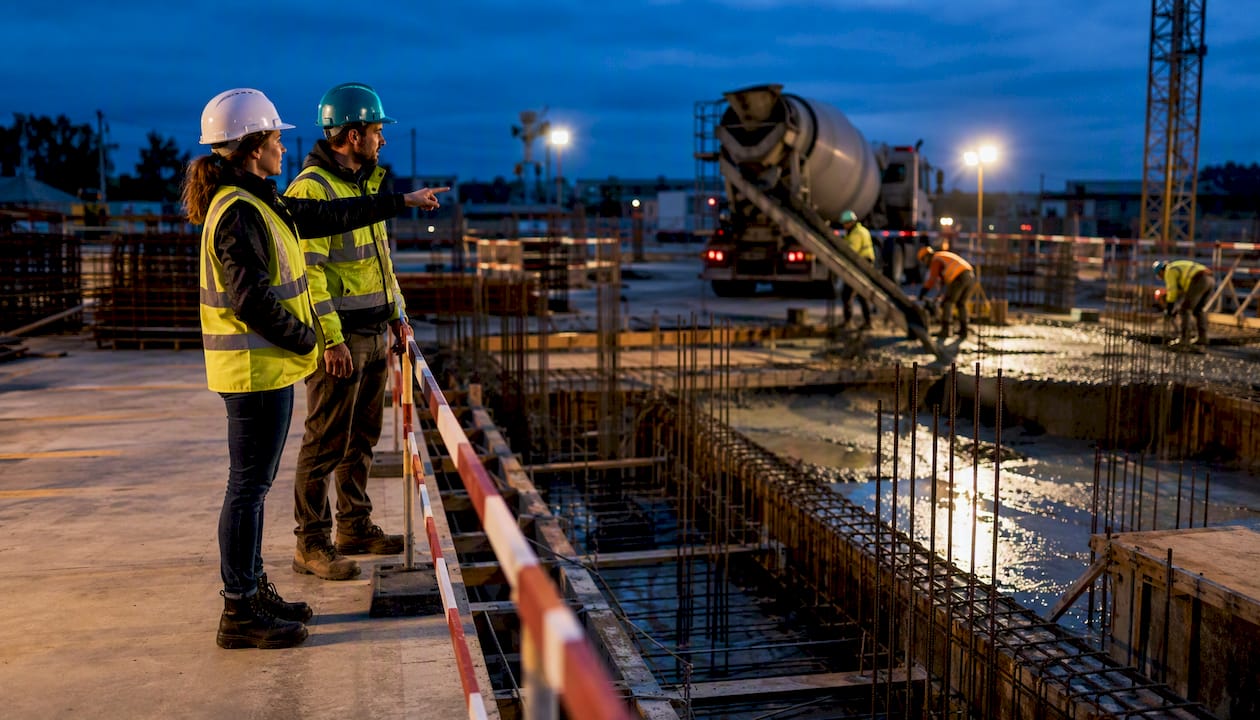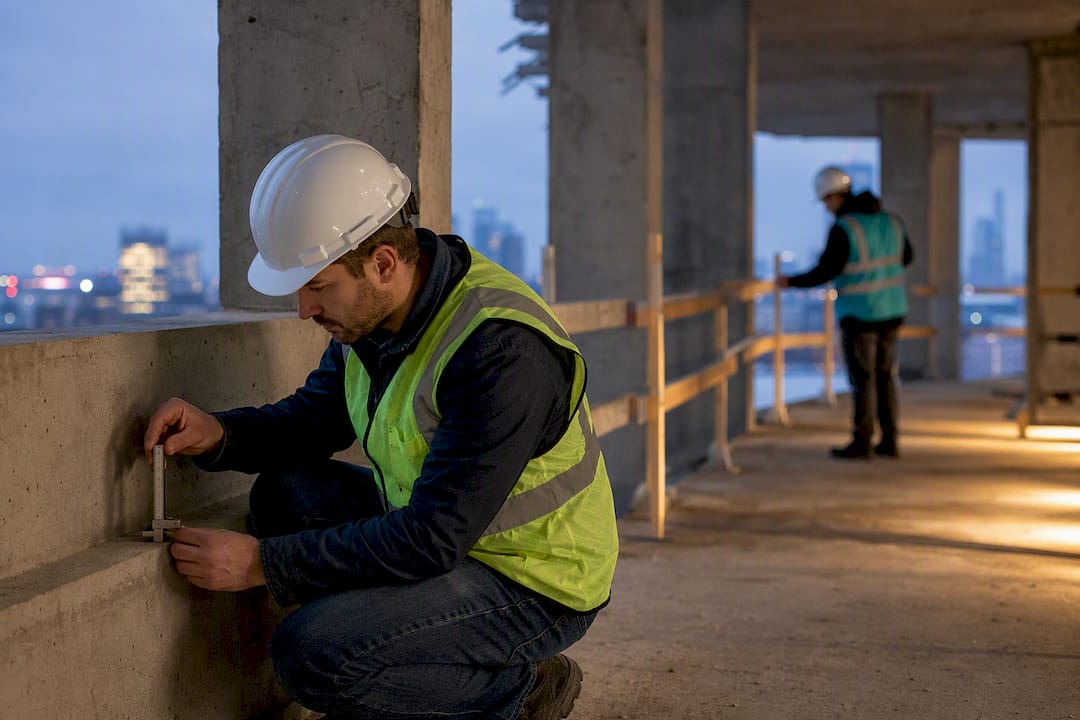
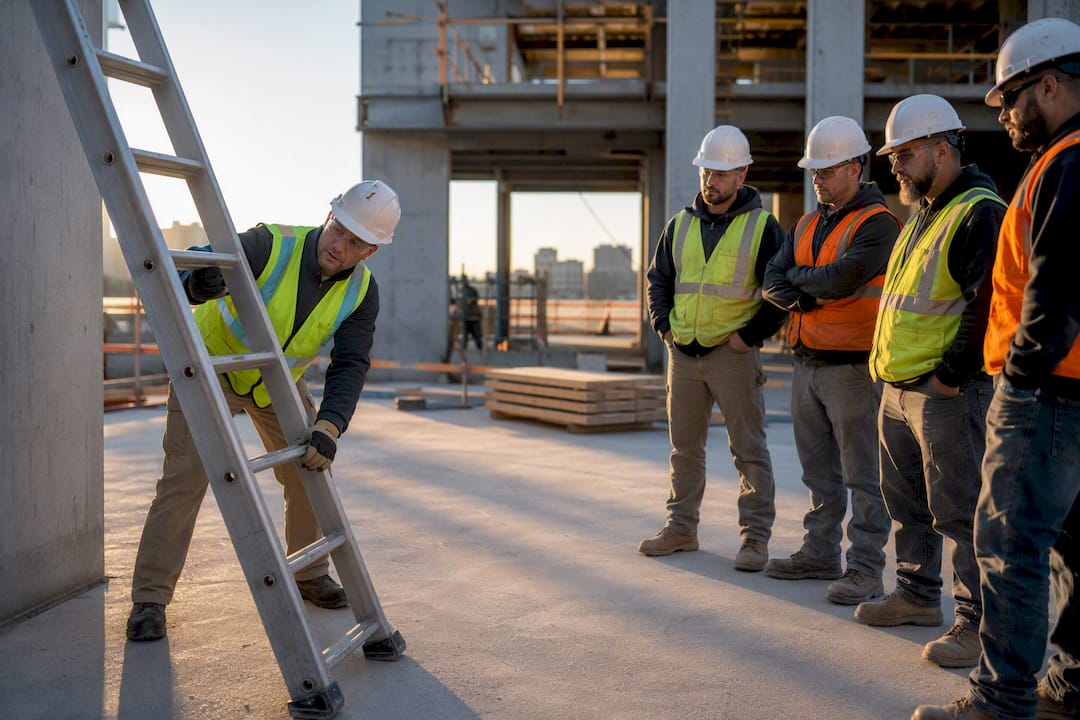
This article gives you a categorized bank of ready-to-use toolbox talk topics construction supervisors can deploy today, along with short delivery scripts and templates. Run these talks in 10 to 15 minutes, weekly, tied to whatever hazard is active on your site that day. Pick a category below, borrow the one-line prompt, and lead the talk before your crew starts work.
TL;DR:
- Most toolbox talks should focus on high-priority hazards like falls, struck-by incidents, and electrical safety, which cause the majority of construction fatalities.
- Reinforcing top hazards weekly helps maintain awareness, especially if targeted with concrete actions such as inspecting fall protection gear or verifying power line clearances.
- Use specific, actionable prompts like checking anchor points or following rigging signals to drive behavior change during short, focused discussions.
- Adjust the rotation frequency based on site risk levels, with high-risk phases prompting daily talks and lower-risk periods favoring weekly sessions.
- Keep records with detailed sign-in sheets and action notes to demonstrate active hazard communication and support safety audits or certification efforts.
Table of Contents
- Toolbox Talk Topics Construction Crews Need Most
- Quick Scripts and Delivery Tips for a 10 to 15 Minute Talk
- How to Build a Toolbox Talk Rotation Schedule
- Templates and Records That Keep Your Talks Compliant
- How MOSAIC Applies Toolbox Talks Across Certification Work
- Why the Smallest Toolbox Talks Change Behavior Fastest
- Get Hands-On Support Building Your Safety Program
- Authoritative Libraries for Printable Toolbox Talks
- Sources
- FAQ
Toolbox Talk Topics Construction Crews Need Most
A toolbox talk earns its place on the schedule only if it maps to a real hazard your crew faces that week. OSHA’s Fatal Four, falls, struck-by incidents, electrocution, and caught-in/between events, account for the majority of construction deaths, which is why they deserve more airtime than any other category on this list. Everything else below rounds out a complete rotation, but the Fatal Four should anchor it.
Falls. This category demands the heaviest repeat rotation of anything on this list, and for good reason: falls remain the leading cause of construction fatalities.
- Ladder setup and the 4:1 angle rule
- Scaffold inspection before first use each shift
- Personal fall arrest system (PFAS) inspection and proper donning
- Leading edge protection on open-sided floors
- Hole cover requirements and labeling
- Dropped object prevention from elevated work
Struck-by and caught-in/between hazards. Equipment movement and unprotected excavations create some of the fastest-moving risks on any site.
- Spotter communication signals and hand signals
- Establishing and respecting exclusion zones around mobile equipment
- Tool tethering at height to prevent falling objects
- Rigging signals for crane and hoist operations
- Trench collapse prevention and sloping/shoring basics
Electrocution and electrical safety. Overhead lines and temporary power setups cause preventable deaths every year, often because a crew assumed a line was de-energized.
- Overhead power line clearance distances
- GFCI use on all temporary power circuits
- Extension cord and cable inspection before use
- Temporary power setup and grounding checks
- Lockout/tagout basics for energized equipment
Equipment and vehicle safety. Heavy machinery injuries often trace back to a skipped pre-start check or a blind spot nobody accounted for.
- Pre-start equipment checks and daily inspection logs
- Blind spot awareness around excavators and loaders
- Crane pick safety and load path clearance
- Forklift spotter rules on congested sites
- Seat belt and ROPS use on all mobile equipment
Hazardous materials and respiratory protection. Chronic exposure risks like silica dust do not announce themselves the way a struck-by injury does, which makes talks in this category easy to skip and dangerous to skip.
- Silica dust controls during cutting and grinding
- Asbestos awareness in renovation and demolition work
- Reading and applying Safety Data Sheets (SDS)
- Solvent handling and ventilation requirements
- Respirator fit basics and seal checks
Personal protective equipment. PPE discussion points work best when tied to the actual task at hand rather than delivered as a generic reminder.
- Hard hat inspection and replacement triggers
- Eye protection selection for grinding and cutting
- Hearing protection thresholds and proper insertion
- Glove selection by task (cut, chemical, impact)
- High-visibility garment requirements in low-light conditions
Manual handling and ergonomics. Musculoskeletal injuries build up slowly, which is exactly why they need scheduled attention instead of being addressed only after someone reports back pain.
- Safe lifting technique and load assessment
- Team lifts for oversized or awkward materials
- Vibration exposure from power tools
- Fatigue prevention during repetitive tasks
Supervisors looking for deeper technique guidance can pair this topic with safe lifting practices or a fuller ergonomics guide for follow-up training.
Environmental and weather hazards. Weather-driven talks should shift with the forecast, not sit static on a printed calendar.
- Heat illness prevention and hydration schedules
- Lightning procedures and shelter protocols
- Air Quality Index (AQI) and wildfire smoke response
Confined spaces and excavation. Permit and atmospheric testing failures are among the most common root causes when these jobs go wrong.
- Confined space entry permit basics
- Atmospheric testing before and during entry
- Daily trench inspection requirements
- Access and egress rules for excavations
Emergency preparedness. A crew that has never practiced a muster drill will hesitate exactly when speed matters most.
- Muster point locations and roll call procedures
- Fire extinguisher PASS technique
- First-aid kit inventory checks
- Incident and near-miss reporting steps
Mental health and fatigue. These talks tend to get skipped on busy sites, yet fatigue contributes to errors across every other category above.
- Spotting fatigue in yourself and coworkers
- Referral pathways for mental health support
- Break scheduling and workload management
Housekeeping and site hygiene. Poor housekeeping is a hazard multiplier, not a cosmetic issue.
- Cord and hose management to prevent trip hazards
- Housekeeping as an active hazard control, not an afterthought
- Waste segregation and disposal procedures
For examples specific to your site conditions, review common construction hazard examples before selecting next week’s topic.
Quick Scripts and Delivery Tips for a 10 to 15 Minute Talk
Weekly 10 to 15 minute toolbox talks are the standard cadence across the construction industry, and that window is tight enough to demand a script rather than improvisation. Open strong, stay on task, and close with something the crew can act on before lunch.
Try one of these openers, matched to the day’s actual work:
- “We’re cutting concrete on slab A today. Today’s talk is silica dust controls.”
- “Three cranes are picking loads this morning. Let’s cover rigging signals before the first lift.”
- “Rain moved through overnight. Today’s talk is trench inspection before anyone enters.”
- “We had a near miss with a forklift yesterday. Today’s talk is spotter rules.”
- “Temperatures hit the 90s this week. Today’s talk is heat illness prevention.”
Structure the talk in three blocks. Spend 1 to 2 minutes opening with the task connection above. Spend 5 to 8 minutes on the actual hazard, the control measure, and what failure looks like on this specific site, not a generic textbook version. Reserve 3 to 4 minutes for questions and assigning action items. Sessions in this 10 to 20 minute range hold attention better than 30 to 45 minute sessions, which are better reserved for formal, required training.
Engagement separates a talk crews remember from one they tune out. Ask for examples from the crew’s own experience rather than lecturing at them. Invite near-miss sharing, even informally. Run a 60 second physical demo, like a proper ladder angle check or a glove selection comparison, instead of only talking through it. Rotate which supervisor or foreman leads the talk each week; a rotating voice keeps the format from going stale.
Close every talk by assigning one visible action, something the crew can point to before the shift ends, and record it on the sign-in sheet. “Check your PFAS anchor point before your first tie-off today” works better than “be careful up there.”
Pro Tip: Keep a laminated card of your top five opening lines in your site trailer. When you’re pressed for time, a 30-second scan beats writing a script from scratch.
Avoid three habits that quietly kill toolbox talks: long lectures that read like a training manual, jargon-heavy language that assumes everyone already knows the acronyms, and delivering a topic disconnected from the day’s actual tasks. A concrete-cutting crew does not need a talk on crane rigging that morning, even if it is next on your rotation list.
How to Build a Toolbox Talk Rotation Schedule
Not every hazard deserves equal airtime. The Fatal Four should repeat more often than everything else, since rotating high-priority topics every 12 weeks while layering in seasonal and task-specific content keeps the schedule both thorough and relevant.
Think in three tiers when building your calendar:
- Tier 1 (weekly or high-frequency): Falls, struck-by, electrocution, caught-in/between, and PPE basics
- Tier 2 (monthly): Manual handling, HazMat, equipment-specific talks, housekeeping
- Tier 3 (seasonal or as-needed): Heat illness, lightning procedures, AQI response, mental health check-ins
A sample 12-week rotation for a general contracting site might look like this:
| Week | Topic | Category |
|---|---|---|
| 1 | Ladder setup and inspection | Falls |
| 2 | PPE: hard hats and eye protection | PPE |
| 3 | Overhead line clearance | Electrical |
| 4 | Spotter communication | Struck-by |
| 5 | Safe lifting technique | Manual handling |
| — | Scaffold inspection | Falls |
| — | Silica dust controls | HazMat |
| 8 | Trench inspection and excavation | Caught-in/between |
| — | Heat illness prevention | Environmental |
| 10 | Fire extinguisher PASS and muster points | Emergency prep |
| — | Fatigue and mental health | Mental health |
| 12 | Housekeeping as hazard control | Housekeeping |
Adjust this rotation whenever your injury log flags a pattern, a near miss occurs, or the forecast changes. A talk on lightning procedures scheduled for a dry week in a seasonal plan should get pulled forward the moment a storm system enters the area. After any incident, insert a checkpoint talk revisiting that exact hazard within the next shift or two, not weeks later when the memory has faded.
Templates and Records That Keep Your Talks Compliant
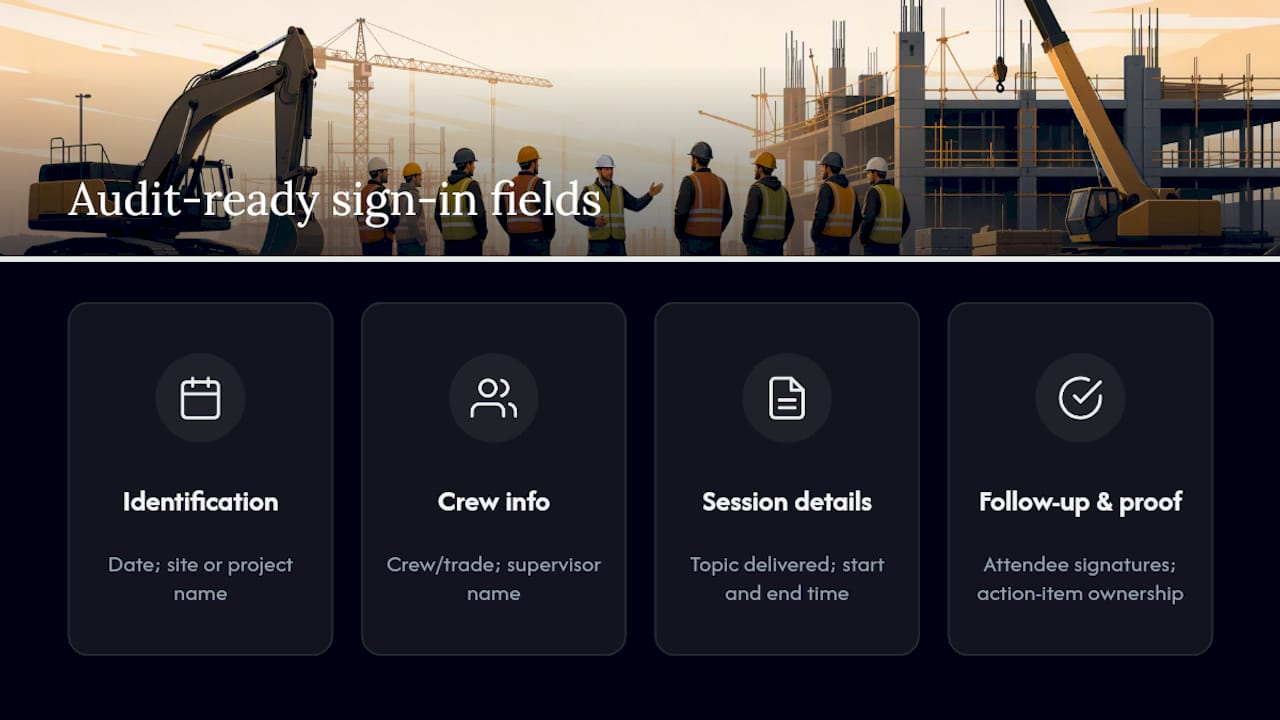
A sign-in sheet is the single document auditors ask for first, and it needs to capture more than just names. Build yours with these fields: date, site or project name, crew or trade, supervisor name, topic delivered, start and end time, attendee signatures, and a column for action items with who owns each one.
Pair that with a one-page talk format so any supervisor can lead a talk with zero prep beyond grabbing the sheet. A solid one-pager includes the objective in a single sentence, the key hazards for that topic, the controls in place, two or three engagement questions to prompt discussion, and space to note actions and references. Free libraries maintain printable one-page formats built exactly this way, which makes them a fast starting point if you are building your own set from scratch.
Before delivering any talk, run a quick mental checklist: Does this topic tie to today’s actual tasks? Do I have the sign-in sheet ready? Is there a follow-up action from last week’s talk that needs checking? A talk that ignores yesterday’s assigned action undermines the credibility of every talk that follows it.
Store completed sheets, whether scanned or physical, in a single dated folder by month or by project phase. This matters for two reasons beyond compliance: it lets you spot which topics keep resurfacing in near-miss reports, and it gives you a clean audit trail when a certification body or client asks for proof of ongoing safety communication on-site.
How MOSAIC Applies Toolbox Talks Across Certification Work
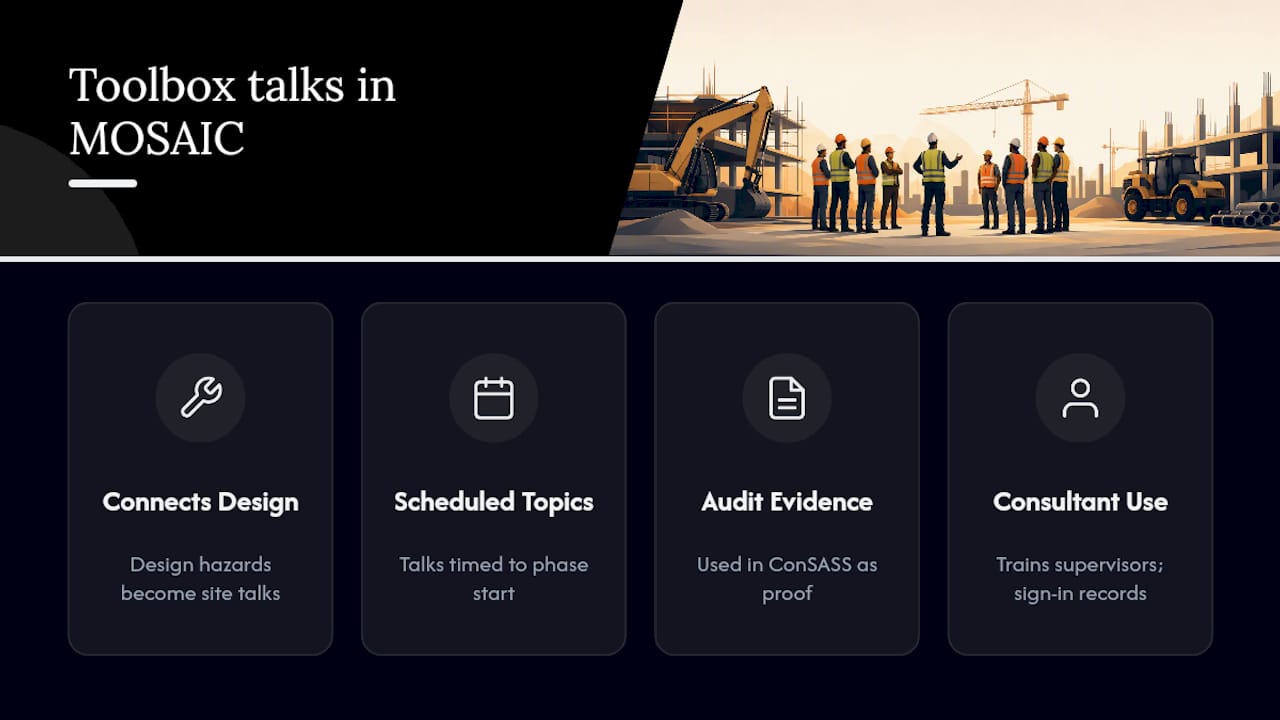
Toolbox talks are not a standalone compliance box to check. On MOSAIC-supported projects, they function as the daily connective layer between a site’s Design for Safety planning and the practical realities crews face once work actually starts. A hazard flagged during design review, an unprotected leading edge in a structural plan, for instance, becomes a scheduled talk topic the week that phase of work begins, closing the loop between paper planning and site behavior.
During ConSASS assessments, documented toolbox talks serve as tangible evidence that a contractor’s safety management system is functioning day to day, not just on paper.
Consistent, well-documented toolbox talks give auditors exactly what they need: proof that hazard awareness is active on-site, not filed away in a binder nobody opens.
Consultants may train site supervisors to lead these talks as part of broader consultancy engagements supporting BizSAFE and ISO certification goals, treating the sign-in sheet and one-page talk record as evidence supporting a client’s overall compliance file.
Why the Smallest Toolbox Talks Change Behavior Fastest
Supervisors often assume a daily talk beats a weekly one, but that is not always true. Daily talks make sense during high-risk phases, active excavation, crane operations, confined space entry, when hazards shift by the hour. Outside those windows, weekly 10 to 15 minute talks tend to hold attention better than a rushed daily habit that starts to feel like background noise.
What actually shifts behavior is not the frequency alone but the specificity of the ask. A talk that ends with “be safe out there” changes nothing. A talk that ends with “check your anchor point before your first tie-off” gives a crew member something concrete to do in the next five minutes.
Start small. Pick one measurable action per talk, track whether it happened, and follow up the next week. That feedback loop, more than any topic list, is what turns a toolbox talk from a formality into a habit that sticks.
— Aman
Get Hands-On Support Building Your Safety Program
A topic bank and a sign-in sheet get you running talks this week, but building a full safety management system around them, one that holds up under audit and supports certification, takes more than a template. Consultants may work directly with construction companies on QES consultancy: safety audits, BizSAFE and ISO certification support, Design for Safety advisory, and ConSASS assessments that turn daily toolbox talks into documented proof of an active safety culture.

If your team needs structured training on delivering talks, standardized documentation across multiple sites, or help tying your rotation schedule to a broader compliance framework, consultants can build that with you rather than handing you a generic template and walking away. Start by downloading the environmental compliance guide for construction projects, which covers how environmental and safety compliance intersect on active sites, or reach out directly to scope a training or audit engagement for your crew.
Authoritative Libraries for Printable Toolbox Talks
Three resources cover most of what a supervisor needs beyond this bank. CPWR maintains a free, regularly updated library of printable talks and is a strong pick when you want regulatory-aligned content backed by a research organization. Safety Talk Ideas offers over 150 free construction-specific talks and works well for building out a full rotation. SafetyFolio focuses on practical delivery guidance, timing, and format, useful if you are refining how you run talks rather than what topics you cover.
Sources
- Workplace safety topics for meetings: a practical guide | SafetyFolio
- 150+ Free Construction Industry Safety Talks – Safety Talk Ideas
- CPWR Toolbox Talks
FAQ
What are some good topics for a toolbox talk?
Falls, struck-by hazards, electrocution, and caught-in/between incidents make the strongest recurring topics since they account for most construction fatalities. Round those out with PPE, manual handling, hazardous materials, and seasonal weather topics based on your current site conditions.
What are 100 safety topics I can discuss in a daily toolbox talk in construction?
The categorized bank above covers falls, struck-by hazards, electrical safety, equipment, hazardous materials, PPE, manual handling, weather, confined spaces, emergency preparedness, mental health, and housekeeping, each with multiple specific topics you can rotate through daily or weekly.
What are 250 safety topics?
Large topic counts like this typically come from combining multiple categories (falls, electrical, PPE, ergonomics, and more) with task-specific variations within each one; the core categories in this article, expanded with site-specific variations, can realistically generate that volume over a full year’s rotation.
What are some good free toolbox talks for construction workers?
CPWR and Safety Talk Ideas both offer free, printable one-page talks covering Fatal Four hazards and general construction safety topics.
How long should a toolbox talk last?
Toolbox talks typically run 10 to 15 minutes, delivered weekly, though high-risk phases of work may call for brief daily talks focused on that day’s specific tasks.