Safety communication is defined as the deliberate, structured exchange of safety-critical information between workers, supervisors, and managers to prevent accidents and promote safe behavior at every stage of work. In construction and industrial settings, this process is not a background administrative function. Over 80% of construction incidents are linked to unsafe behaviors that effective communication can correct. That single figure reframes the entire discipline: most injuries are not caused by equipment failure or unforeseeable events. They are caused by information that was missing, misunderstood, or never confirmed.
What is safety communication and why does it matter on site?
Safety communication is the formal industry term for the continuous, bidirectional flow of hazard information, procedural guidance, and behavioral feedback across a worksite. It operates at every level, from pre-shift briefings to written method statements to real-time verbal warnings between workers. The goal is not simply to transmit information. The goal is to change behavior and build a culture where workers act on what they know.
The importance of safety communication becomes measurable when you examine its effect on safety culture. Safety communication predicts safety culture with a beta coefficient of 0.724 in high-risk manufacturing environments. That is a strong statistical relationship. It means that organizations with disciplined communication practices consistently produce stronger safety cultures, not by accident, but by design.
Construction sites present unique communication demands. Workforces are multilingual, transient, and exposed to rapidly changing hazard conditions. A new subcontractor crew arriving on a Monday morning carries no institutional knowledge of that site’s specific risks. Without structured safety communication, those workers operate on assumptions. Assumptions, as any experienced safety manager knows, are where incidents begin.
Safety communication also functions as the foundation of safety documentation practices, ensuring that verbal instructions are reinforced through written records that workers can reference independently.
How does safety communication influence worker behavior and safety culture?
Clear safety communication changes what workers do, not just what they know. The behavioral mechanism is direct: when workers receive consistent, credible safety messages from supervisors they trust, they are more likely to follow procedures, report near-misses, and intervene when they see unsafe acts.
Supervisors carry disproportionate influence in this process. Research confirms that direct supervisor communication predicts operational safety performance with a beta coefficient of 0.368. Supervisors who communicate safety expectations clearly and consistently produce measurably safer teams. Those who rely on assumption or informal culture produce the opposite.
The social dynamics of safety communication matter as much as the content. Workers observe how management responds to safety concerns. Punitive responses to reported hazards shut down the feedback loop immediately. Solution-focused communication sustains the continuous improvement cycle by keeping workers willing to raise concerns before those concerns become incidents.
Key behavioral outcomes of effective safety communication include:
- Increased near-miss reporting, which surfaces hazards before they cause injury
- Higher compliance with personal protective equipment requirements and safe work procedures
- Greater willingness to stop work when conditions become unsafe
- Faster adoption of new procedures following method statement updates
“Small missed or misunderstood messages, not big mistakes, cause most workplace injuries. Managers must foster safe spaces for questions.” — OHS Expert Commentary, 2026
Building this environment requires management commitment that goes beyond posting notices. It requires supervisors to model the behavior they expect, respond constructively to every safety concern raised, and treat communication as a core operational discipline rather than a compliance checkbox.
What are the best methods for safety communication in high-risk workplaces?
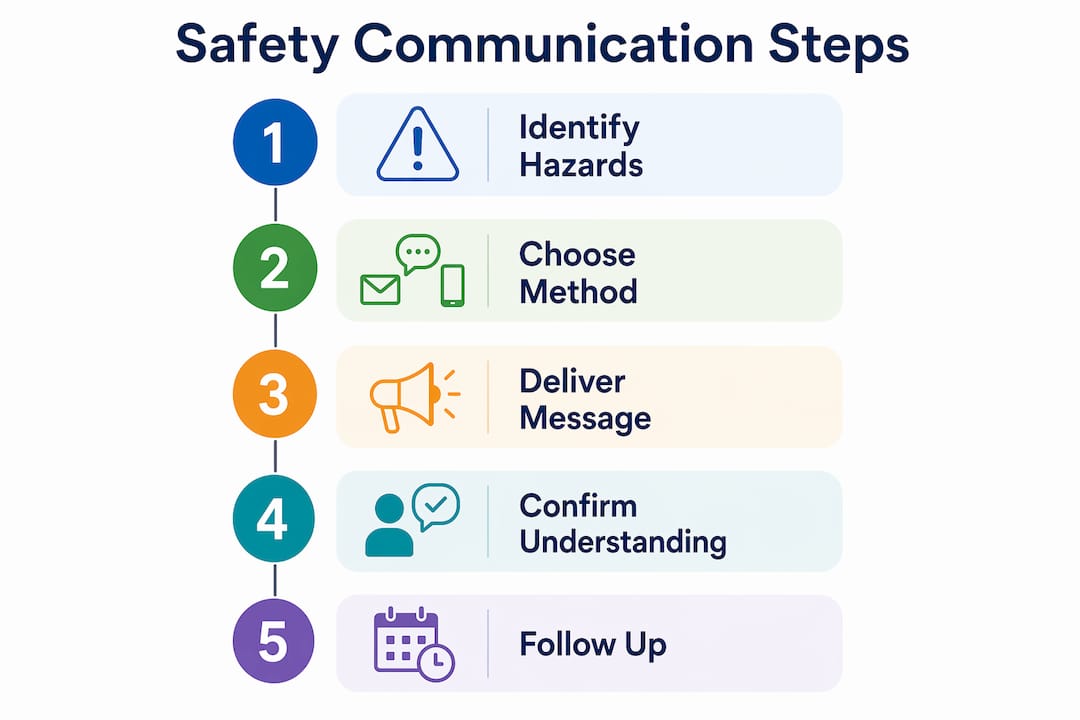
Effective safety communication in workplaces relies on method selection, timing, and confirmation. No single channel reaches every worker with equal clarity. The best safety communication strategies layer multiple methods to reinforce the same message across different formats and moments.
The most commonly used methods in construction and industrial settings are:
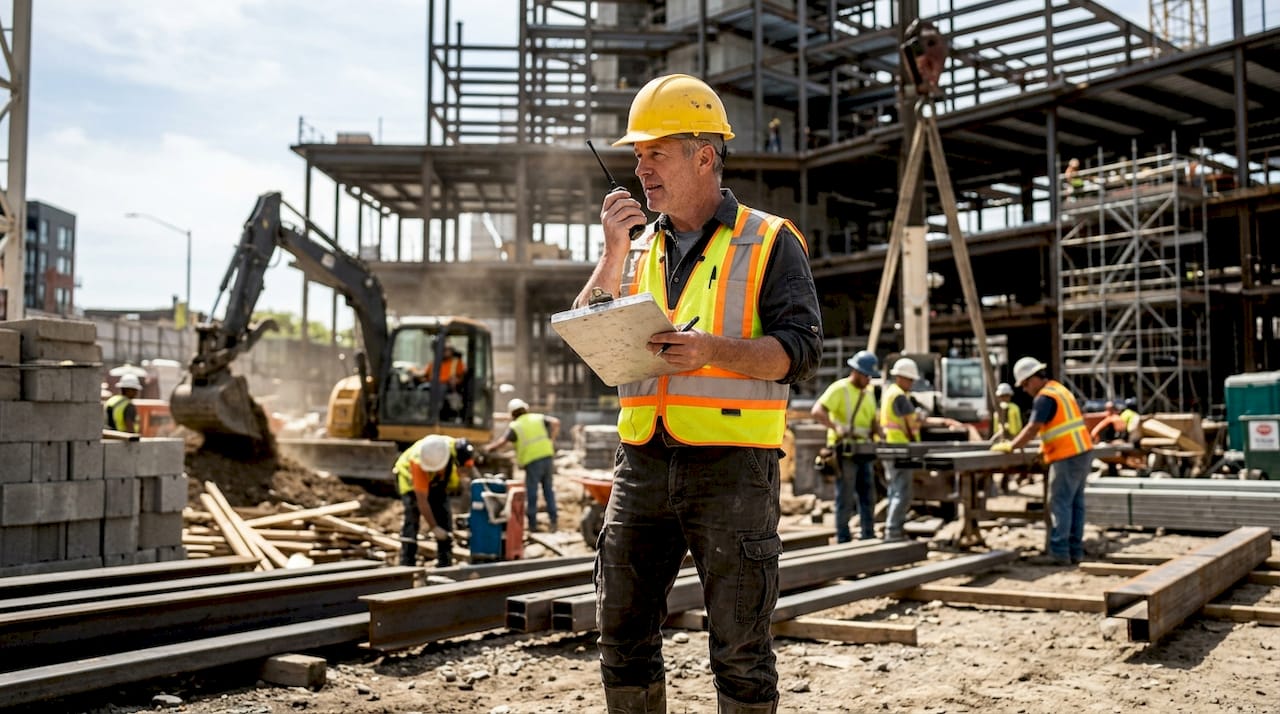
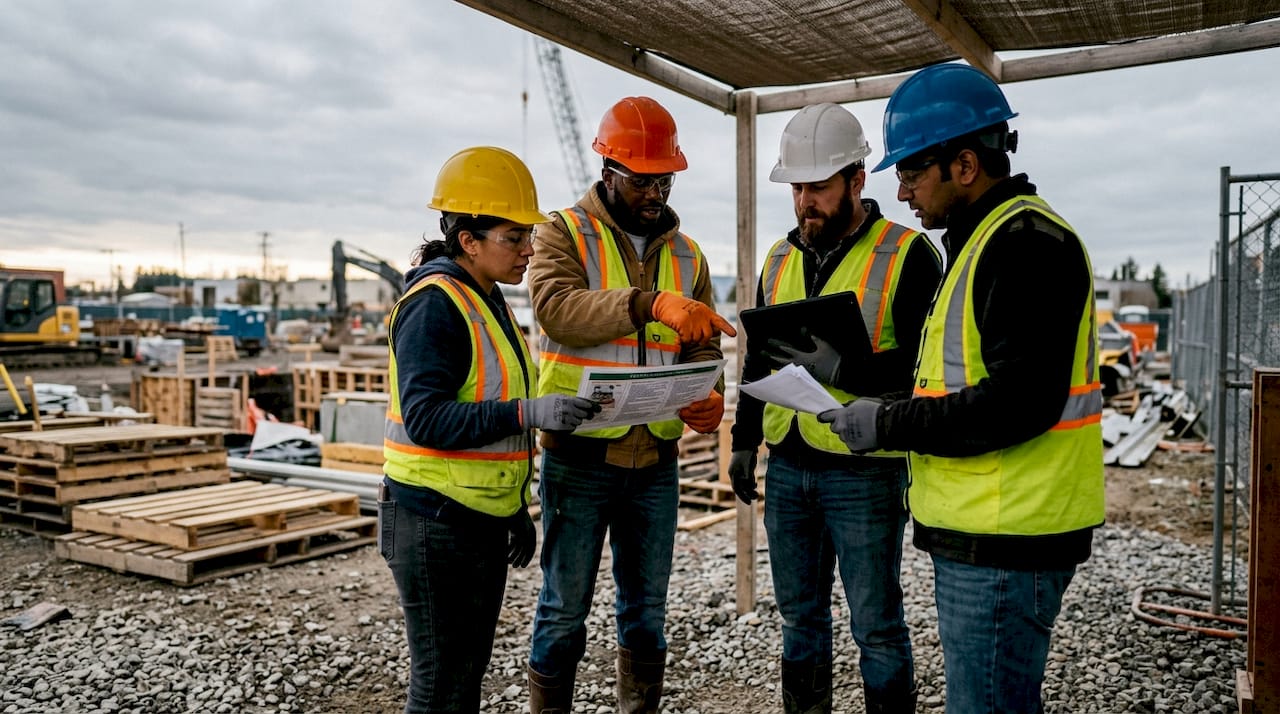
- Pre-task briefings and toolbox talks. Delivered before work begins, these sessions align the team on the day’s hazards, controls, and emergency procedures. They work best when kept to 10 minutes or less, focused on the specific task at hand, and conducted at the workface rather than in a site office.
- Written method statements and safe work procedures. These documents formalize the verbal briefing and give workers a reference point during the task. Plain language and visual diagrams increase comprehension across multilingual teams.
- Digital alerts and signage. Real-time digital notifications and physical site signage reinforce critical hazard information at the point of risk. Signage must use plain language and internationally recognized symbols to serve diverse workforces.
- Two-way feedback sessions. Structured opportunities for workers to raise concerns, ask questions, and report near-misses. These sessions close the communication loop and generate the hazard intelligence that managers need to improve site conditions.
Timing is as critical as method. Safety communication should be timely, consistent, and use multiple methods including verbal delivery backed by written records, according to UK Health and Safety Executive guidance. A safety message delivered after a task begins is already late.
The teach-back technique is the most reliable confirmation method available. Rather than asking “Do you understand?”, supervisors ask workers to explain the procedure back in their own words. Teach-back confirms understanding far more reliably than yes-or-no responses, which workers often give to avoid appearing incompetent.
Pro Tip: Run toolbox talks at the workface, not the site office. Workers retain safety information better when they can see the actual hazards being discussed while the briefing is happening.
Effective safety communication also demands plain language. Technical jargon that experienced workers use fluently can be completely opaque to new starters or workers from different trade backgrounds. Plain language is not a concession to low literacy. It is a precision tool that eliminates ambiguity for every worker, regardless of experience level.
What common challenges impair safety communication and how can they be overcome?
Communication breakdowns on construction sites follow predictable patterns. Recognizing them is the first step toward eliminating them.
The most damaging barrier is the assumption of understanding. Supervisors with years of site experience often suffer from what communication researchers call the “curse of knowledge.” They assume that what is obvious to them is equally obvious to the workers they are briefing. Communication gaps form where assumptions replace confirmation, and those gaps are where incidents occur.
Common barriers that impair effective safety communication practices include:
- Jargon and insider language. Trade-specific terminology creates hidden comprehension barriers for new workers, subcontractors, and multilingual teams. Jargon audits standardize terminology across a site, eliminating the risk that the same term means different things to different crews.
- Workplace stress and cognitive overload. High-pressure environments degrade a worker’s ability to process and retain information. Stress limits cognitive capacity; micro-communications that deliver one essential safety point at a time reduce overload and improve retention during peak-demand periods.
- Rushed or one-directional instructions. Time pressure pushes supervisors to deliver instructions quickly without confirming receipt. Workers who do not understand but feel unable to ask questions will proceed on incomplete information.
- Punitive communication culture. When workers fear negative consequences for raising concerns or admitting confusion, they stay silent. That silence accumulates risk invisibly until an incident makes it visible.
Pro Tip: Conduct a jargon audit on your site at least once per year. Ask new starters to flag every term they did not understand in their first week. The results will surprise experienced managers.
Overcoming these barriers requires deliberate structural changes, not motivational messaging. Confirmation protocols, plain language standards, and psychologically safe reporting channels must be built into the site’s daily operating rhythm. For a practical framework on how these structures integrate into broader safety systems, the safety management system guide from Com provides a detailed operational model.
How can safety managers improve safety communication continuously on site?
Safety managers who treat communication as a continuous improvement discipline, rather than a one-time training event, produce the most durable results. The mechanisms for improvement are well established. The challenge is sustaining them under operational pressure.
The table below outlines the core improvement levers available to safety managers, with the specific actions and expected outcomes for each.
| Improvement lever | Specific action | Expected outcome |
|---|---|---|
| Regular communication audits | Review briefing records, near-miss reports, and worker feedback quarterly | Identifies gaps before they produce incidents |
| Safety committee engagement | Involve worker representatives in reviewing communication methods | Increases worker trust and message credibility |
| Supervisor communication training | Train supervisors in teach-back, plain language, and active listening | Reduces assumption-based gaps at the task level |
| Feedback channel formalization | Establish anonymous reporting systems and open-door briefing reviews | Surfaces hazards workers would not otherwise report |
| Integration with safety management systems | Embed communication standards into method statements and risk assessments | Ensures consistency across all crews and subcontractors |
Site safety committees are particularly effective because they give workers a formal voice in how safety information is developed and delivered. Workers who help shape safety messages are more likely to act on them. This is not a soft cultural benefit. It is a measurable driver of compliance and hazard reporting rates.
Safety managers should also conduct periodic communication audits that assess not just whether briefings are happening, but whether workers can accurately recall and apply the information delivered. Audit findings should feed directly into the site’s safety management system, creating a documented improvement cycle that satisfies both internal governance and regulatory scrutiny from bodies such as the Ministry of Manpower in Singapore.
Improving contractor safety culture through structured communication programs is one of the highest-return investments a site manager can make, because it addresses the behavioral root cause of the majority of construction incidents.
Key Takeaways
Effective safety communication is the single most controllable factor in reducing construction site injuries, because it directly addresses the unsafe behaviors that cause over 80% of incidents.
| Point | Details |
|---|---|
| Definition matters | Safety communication is a structured, bidirectional process, not a one-way instruction channel. |
| Behavior drives outcomes | Supervisor communication directly predicts safety performance; consistent messaging changes what workers do. |
| Method and timing are critical | Layer verbal briefings, written procedures, and digital alerts; deliver messages before tasks begin, not during. |
| Confirmation beats assumption | Teach-back techniques confirm true understanding; yes-or-no responses do not. |
| Continuous improvement is required | Communication audits, safety committees, and supervisor training sustain gains over time. |
Why communication gaps are the real safety crisis on construction sites
After years of working across construction safety programs, the pattern I keep seeing is this: the incidents that were preventable were almost never caused by a missing guardrail or a faulty piece of equipment. They were caused by a message that was sent but not received, or received but not understood.
The uncomfortable truth is that most safety managers know their communication is imperfect. They know the toolbox talk was rushed. They know the new subcontractor crew did not fully follow the briefing. They know the near-miss reporting system is underused. But operational pressure creates a constant temptation to treat communication as a background function rather than a primary safety control.
What I have observed in the highest-performing sites is a deliberate inversion of that priority. Communication is treated as the first line of defense, not the last. Supervisors are trained and held accountable for confirmation, not just delivery. Workers are actively rewarded for raising concerns, not quietly discouraged. The result is a site where hazard information flows upward as freely as it flows downward, and where the feedback loop actually functions.
The sites that struggle are the ones where management assumes that posting a notice or running a monthly safety meeting constitutes a communication program. It does not. A real program is daily, specific, two-directional, and audited. If yours is not, the gap between what you think workers know and what they actually know is wider than you realize.
— Aman
How Com supports safety communication on construction sites
Construction safety communication requires more than good intentions. It requires structured programs, trained personnel, and systems that hold up under regulatory scrutiny.

Com, operating as MOSAIC Ecoconstruction Solutions, provides safety consultancy services specifically designed for Singapore’s construction sector. Com’s consultants work directly with site managers to assess communication gaps, design briefing protocols, and integrate communication standards into BizSAFE and ISO-compliant safety management systems. The approach is practical and site-specific, not generic. If your site’s communication program needs a structured review or a full rebuild, Com’s team brings the regulatory knowledge and operational experience to make that happen.
FAQ
What is safety communication in the workplace?
Safety communication is the structured exchange of hazard information, procedures, and feedback between workers and management to prevent incidents. It operates through verbal briefings, written documents, and digital alerts, and requires two-way confirmation to be effective.
Why does safety communication matter in construction?
Over 80% of construction incidents are linked to unsafe behaviors that clear communication can correct. Sites with strong communication practices produce measurably safer outcomes because workers act on accurate, confirmed information rather than assumptions.
What is the teach-back method in safety communication?
Teach-back is a confirmation technique where supervisors ask workers to explain a procedure back in their own words, rather than simply asking if they understood. It reliably identifies comprehension gaps before they produce errors on site.
How can safety managers improve communication on site?
Safety managers improve communication by conducting regular audits, training supervisors in plain language and confirmation techniques, formalizing near-miss reporting channels, and integrating communication standards into the site’s safety management system.
What are the biggest barriers to effective safety communication?
The three most common barriers are jargon that confuses workers from different backgrounds, workplace stress that limits cognitive capacity, and punitive communication cultures that discourage workers from raising concerns or admitting confusion.