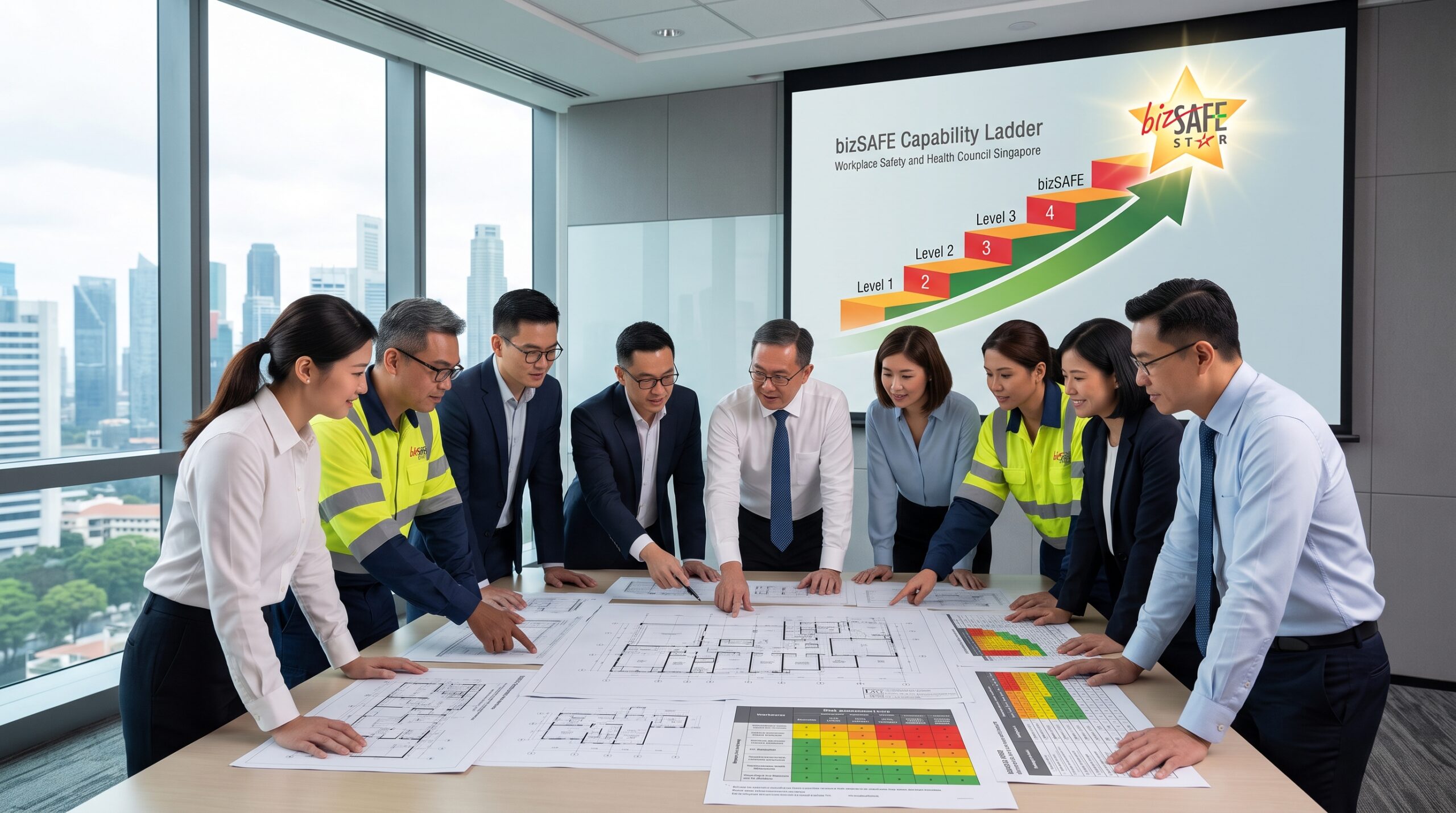
From Level 1 to Star: A Step-by-Step Roadmap to bizSAFE Certification
Navigating the increasingly complex and heavily regulated contemporary commercial landscape within the Republic of Singapore demands far more from enterprise leadership than merely possessing a highly competitive product or an innovative service offering, primarily because stringent regulatory frameworks and highly sophisticated public procurement methodologies now definitively position robust workplace safety as an absolutely non-negotiable strategic differentiator1.
The legislative integration of the stringent Workplace Safety and Health (WSH) Act with modern paradigms of corporate governance dictates unequivocally that executive leadership must actively and visibly champion comprehensive risk management, transforming occupational safety from a peripheral administrative burden into a central, foundational pillar of operational resilience and long-term commercial viability1.
This exhaustively detailed analysis comprehensively demystifies the progressive, five-level bizSAFE certification programme meticulously administered by the Workplace Safety and Health Council (WSHC), offering ambitious business owners, human resource leaders, and operations managers operating within small and medium-sized enterprises (SMEs) a meticulously detailed, step-by-step roadmap designed to achieve sustainable WSH excellence5.
By advancing methodically and deliberately from the foundational executive leadership commitments firmly established during Level 1, progressing through rigorous tactical implementations, and ultimately culminating in the globally recognised management systems required for the prestigious bizSAFE Star designation, progressive SMEs can systematically mitigate debilitating operational risks, drastically reduce statutory insurance premiums, and successfully unlock highly lucrative government and private-sector contracts3.
The Macro-Strategic Environment of Workplace Safety in Singapore
Before delving deeply into the granular operational mechanics and specific auditing criteria associated with the individual bizSAFE capability levels, it remains absolutely critical for corporate leaders to understand the profound macro-economic and legislative forces that are currently driving the ubiquitous adoption of this framework across the entire Singaporean commercial ecosystem1.
The overarching paradigm of occupational safety has irrevocably and deliberately shifted away from a reactive, compliance-driven checklist mentality based on the antiquated Factories Act, transitioning decisively toward a proactive, performance-based culture of total risk ownership, where the catastrophic consequences of operational failure extend far beyond mere regulatory reprimands to encompass severe commercial disenfranchisement and devastating personal legal liabilities for corporate directors1.
The Ministry of Manpower (MOM) has aggressively pursued a national “Vision Zero” strategy, operating under the philosophical commitment that all workplace injuries and occupational diseases are fundamentally preventable through rigorous systemic interventions and unwavering leadership commitment8.
National statistics released for the 2025 calendar year indicate that this comprehensive, data-driven approach is yielding substantial dividends, with the workplace fatal injury rate falling to a historic record low of 0.96 per 100,000 workers, representing exactly 36 workplace fatalities and placing Singapore firmly among the safest industrialised jurisdictions globally alongside nations like the Netherlands and Sweden12. Furthermore, the major injury rate simultaneously declined to an impressive 14.6 per 100,000 workers during the first half of 2026, demonstrating that continuous vigilance, stronger enforcement mechanisms involving thousands of targeted inspections, and a pervasive commitment from all industry stakeholders are critically essential for sustaining these hard-won improvements10.
| Key Workplace Safety Metric | 2024 Performance Data | 2025 Performance Data | H1 2026 Performance Data |
| National Fatal Injury Rate | 1.2 per 100,000 workers | 0.96 per 100,000 workers | 1.1 per 100,000 workers (Annualised) |
| Total Workplace Fatalities | 43 recorded fatalities | 36 recorded fatalities | 21 recorded fatalities |
| National Major Injury Rate | 15.9 per 100,000 workers | 15.7 per 100,000 workers | 14.6 per 100,000 workers (Annualised) |
| Total Major Injuries | 587 recorded injuries | 586 recorded injuries | Data ongoing for full year |
Despite these commendable overarching national improvements, high-risk sectors including Construction, Manufacturing, and Transportation & Storage persistently remain the primary contributors to both fatal and major injuries, thereby necessitating the continued, rigorous enforcement of the bizSAFE capability-building framework12. Additionally, the legislative landscape experienced a monumental expansion with the enactment of the Platform Workers Act on 1 January 2025, which formally required platform operators to rigorously report work-related injuries and subsequently revealed that delivery workers suffer major injuries at an alarming rate of 84.6 per 100,000 workers, a figure approximately 4.5 times higher than the general national average, further underscoring the absolute necessity for universally applied, systemic risk management frameworks across all evolving employment models12.
Mitigating Executive Liability Through the Approved Code of Practice
The enactment of the Workplace Safety and Health Act in 2006 fundamentally dismantled the previously prescriptive regulatory regime, replacing it with a robust, performance-oriented framework that places the uncompromising onus of hazard identification and continuous risk mitigation squarely upon the specific stakeholders who create, manage, and oversee those operational risks1.
Under the stringent provisions delineated within Section 48(1) of the WSH Act, corporate officers, encompassing chief executives, managing directors, and formally appointed board directors, face severe personal criminal liabilities and potentially devastating financial penalties if their organisation commits a safety offence, unless those executives can conclusively and extensively demonstrate that they exercised all possible due diligence to prevent the specific infraction from occurring1.
To effectively operationalise and explicitly clarify this demanding standard of executive due diligence, the Ministry of Manpower officially introduced the Approved Code of Practice (ACOP) on Chief Executives’ and Board of Directors’ WSH Duties, a profoundly important document that currently serves as a definitive legal yardstick during judicial proceedings to comprehensively evaluate whether corporate leaders have adequately integrated WSH considerations into their overarching business strategies, resource allocations, and corporate governance structures1.
The ACOP demands that company directors deliberately set workplace safety as a recurring, mandatory agenda item during all formal board meetings, explicitly demand highly effective WSH standards from their entire supply chain, and proactively establish secure, non-punitive internal reporting systems that assure workers they can report near-misses without fear of retaliatory action4. Achieving the foundational levels of bizSAFE certification Singapore provides meticulously documented, irrefutable evidence that top management has proactively engaged with these critical statutory obligations, thereby constructing a vital, indispensable legal shield against potential allegations of systemic negligence following an unforeseen, catastrophic industrial incident8.
The Commercial Imperatives: Government Procurement and WICA 2025 Revisions
For ambitious enterprises actively seeking to secure highly lucrative public sector contracts, particularly within the heavily regulated construction, facilities management, and landscape sectors, possessing a mature, externally audited bizSAFE certification is unequivocally no longer merely advantageous, but rather an absolute, non-negotiable prerequisite for successfully passing initial pre-qualification thresholds3.
The Singaporean government, functioning as the nation’s single largest procurer of goods and services, strategically employs the sophisticated Price-Quality Method (PQM) through its comprehensive GeBIZ platform to rigorously evaluate competitive tenders, explicitly and categorically rejecting the fundamentally flawed “lowest quote wins” philosophy in favour of a holistic, multi-dimensional assessment that heavily weights qualitative safety performance7.
Within this highly rigorous PQM framework, measurable safety attributes frequently account for 5% to 15% of the total evaluation score, and for major infrastructure projects exceeding S$3 million in value, this specific safety weighting can occasionally dominate the entire qualitative assessment criteria20.
Consequently, an enterprise proudly holding a verified bizSAFE Level 3 or bizSAFE Star certification commands a profound, quantifiable mathematical advantage during the exhaustive tender evaluation process, often allowing them to successfully outbid rival contractors who submitted significantly lower financial quotes but ultimately lacked the requisite audited safety credentials necessary to secure the decisive quality premium20.
Furthermore, the strategic integration of the bizSAFE framework with the Building and Construction Authority’s (BCA) Contractors Registration System (CRS) permanently cements the certification’s status as a critical commercial passport, where achieving highly sought-after C1 and C2 financial grades within the Construction Workhead (CW) strictly requires bizSAFE Level 3, while ascending to the elite A1, B1, or B2 grades absolutely necessitates the comprehensive implementation of an ISO 45001 system validated through the bizSAFE Star designation19.
[Image Prompt: An extraordinarily detailed infographic meticulously illustrating the complex financial benefits of bizSAFE certification, prominently featuring a classic balance scale carefully weighing the initial, short-term costs of safety training and external audits against the massive, long-term financial savings derived from drastically reduced Work Injury Compensation Act (WICA) insurance premiums, the total avoidance of ruinous Stop Work Order (SWO) penalties, and guaranteed access to high-value GeBIZ government tenders.]
Maintaining a robust, continuously verified WSH management system directly impacts corporate liquidity and recurring operational expenditures, most notably through substantial, highly measurable reductions in mandatory statutory insurance premiums2. The Work Injury Compensation Act (WICA), which stringently governs statutory financial payouts for workplace accidents, underwent a series of highly significant revisions that officially took effect on 1 November 2025, substantially raising the maximum compensation limits to ensure they accurately keep pace with broader wage growth and rapidly escalating national healthcare costs23. These critical legislative amendments dramatically increased the maximum compensation for workplace death to S346,000, and significantly raised the absolute cap on claimable medical expenses to S$53,00023.
| WICA Compensation Category | Previous Maximum Limit (Pre-Nov 2025) | New Maximum Limit (Effective 1 Nov 2025) | Percentage Increase |
| Death Benefits | S$225,000 | S$269,000 | 19.5% |
| Total Permanent Incapacity (PI) | S$289,000 | S$346,000 | 19.8% |
| Medical Expenses | S$45,000 | S$53,000 | 17.8% |
As these newly elevated statutory compensation limits invariably and inevitably exert intense upward pressure on baseline insurance premiums across the entire market, major commercial underwriters actively and meticulously scrutinise an applicant’s official bizSAFE status as an extraordinarily reliable proxy for determining overall risk quality7.
Consequently, insurers frequently and enthusiastically reward bizSAFE Level 3 and bizSAFE Star certified organisations with substantial, highly attractive premium discounts and vastly superior coverage terms, explicitly recognising that their externally audited hazard control systems fundamentally and statistically reduce the probability of catastrophic, high-value financial claims7.
bizSAFE Level 1: Institutionalizing Top Executive Commitment
The foundational architecture of the comprehensive bizSAFE capability-building programme is deliberately and meticulously structured to forcefully prevent the highly dangerous organisational phenomenon commonly known as “checkbox compliance,” a toxic situation where critical safety responsibilities are inappropriately and systematically delegated to junior officers who lack the corresponding budgetary authority or executive oversight necessary to effect genuine change2.
Therefore, achieving bizSAFE Level 1 serves as the absolutely mandatory entry point for any organisation, demanding explicit, verifiable, and highly visible commitment from the absolute apex of the corporate hierarchy2.
Historically characterised by a somewhat generic half-day workshop, the specific entry requirements for acquiring bizSAFE Level 1 recently underwent a highly significant and targeted transformation, culminating in the widespread deployment of the specialised Top Executive WSH Programme (TEWP)18.
As of 1 March 2024, it became a strict, non-negotiable legal requirement for chief executives, managing directors, or specifically designated board directors of companies operating within designated high-risk sectors—specifically Construction, Manufacturing, Marine, and Transport & Storage—to successfully and personally complete the intensive TEWP curriculum18.
Administered as a highly focused three-hour curriculum seamlessly accessible via synchronous in-person sessions or flexible asynchronous e-learning platforms, the TEWP explicitly and comprehensively addresses the unique leadership imperatives rigorously outlined within the Approved Code of Practice on Chief Executives’ and Board of Directors’ WSH Duties18.
During this intensive, executive-level programme, corporate leaders are thoroughly and meticulously educated on their deeply personal legal liabilities under the provisions of the WSH Act, highly trained in sophisticated root-cause analysis methodologies designed for dissecting complex workplace accidents, and explicitly instructed on the strategic formulation of a comprehensive corporate WSH policy that aligns inextricably and perfectly with their overarching business objectives8. Upon the successful completion of this rigorous curriculum, participating executives are formally awarded a Certificate of Completion (COC), which subsequently and exclusively enables the organisation to officially apply for bizSAFE Level 1 recognition through the WSH Council’s integrated digital portal28.
It remains crucially important for all business owners to comprehensively note that a bizSAFE Level 1 certificate possesses a strictly limited validity period of exactly six months from the precise date of approval, and this preliminary status is entirely non-renewable, a policy deliberately designed to force progressive momentum and compel organisations to immediately commence their necessary preparations for achieving subsequent, higher capability levels32.
bizSAFE Level 2: Cultivating Internal Risk Management Capabilities
While the introductory bizSAFE Level 1 successfully establishes the requisite executive mandate and high-level corporate commitment, bizSAFE Level 2 focuses entirely and unapologetically on actively building the specific technical competence required to translate theoretical safety commitments into highly actionable, site-specific risk mitigation strategies2.
This highly operational stage necessitates the formal, documented appointment of a dedicated Risk Management (RM) Champion, an individual who must be explicitly empowered by senior management to orchestrate the comprehensive identification, rigorous evaluation, and effective control of all potential hazards present within the organisation’s entire operational footprint2.
To definitively satisfy the stringent, non-negotiable requirements associated with bizSAFE Level 2, the appointed RM Champion must personally attend and successfully complete a rigorous, two-day Workforce Skills Qualifications (WSQ) certifiable course officially titled “Develop a Risk Management Implementation Plan”32.
Representing a highly structured investment of approximately 15 hours of intensive classroom instruction perfectly complemented by a rigorous one-hour formal assessment, this highly technical and demanding programme systematically equips participants with the complex analytical frameworks necessary to construct a legally compliant risk management architecture36.
The extensive curriculum delves deeply and systematically into the complex regulatory stipulations of the WSH (Risk Management) Regulations, meticulously teaching delegates exactly how to effectively establish a multidisciplinary risk assessment team, deploy internationally recognised hazard identification methodologies, and navigate the intricate complexities of the universally accepted 3×3 or 5×5 risk evaluation matrices to accurately and consistently quantify both the likelihood and severity of potential workplace incidents37.
Furthermore, the designated RM Champion is extensively and rigorously trained in the practical application of the Hierarchy of Control methodology, a foundational cornerstone concept that strictly mandates organisations to prioritise proactive upstream interventions—such as eliminating the specific hazard entirely or substituting highly dangerous chemicals with benign alternatives—long before they ever attempt to rely on fundamentally weaker downstream measures like administrative procedures or the mere provision of personal protective equipment (PPE)2.
The financial investment required to access this crucial, mandatory training typically ranges from S600 before factoring in any applicable government subsidies, though eligible Singapore Citizens, Permanent Residents, and SME-sponsored employees can seamlessly and easily access SkillsFuture Singapore (SSG) funding, a robust mechanism which routinely offsets up to 70% of the baseline course fees, significantly reducing the out-of-pocket financial burden placed on rapidly developing enterprises37.
Exactly mirroring its direct predecessor, the bizSAFE Level 2 certificate fiercely maintains a strictly enforced six-month, entirely non-renewable validity period, functioning exclusively as an introductory, educational stepping stone specifically designed to propel the organisation purposefully towards the pivotal, highly demanding external audit phase32.
[Image Prompt: A dynamic, wide-angle, highly vibrant photograph showcasing a diverse, multidisciplinary Risk Management team clad in high-visibility safety vests meticulously conducting a rigorous site inspection within a bustling Singaporean manufacturing facility, dynamically pointing at complex heavy machinery while simultaneously consulting industrial tablets that prominently display a brightly colour-coded 5×5 risk assessment matrix.]
bizSAFE Level 3: The Critical Threshold of External Audit Validation
Achieving the coveted bizSAFE Level 3 designation represents the absolute most critical transitional milestone within the entire five-step capability-building framework, clearly marking the exact, definitive juncture where internally developed safety intentions must successfully survive the rigorous, unyielding independent scrutiny of a third-party auditor officially registered with the Ministry of Manpower20.
Comprehensively understanding exactly how to get bizSAFE Level 3 is fundamentally paramount for all ambitious SMEs, as this specific, externally validated certification tier functions as the undisputed baseline standard for establishing commercial trust, unlocking vital access to GeBIZ government tenders, satisfying primary contractor supply chain mandates, and legally demonstrating absolute, irrefutable compliance with the pervasive WSH (Risk Management) Regulations2.
The absolute essence of successfully navigating bizSAFE Level 3 lies in the flawless, highly documented execution of the comprehensive Risk Management Implementation Plan previously developed during the Level 2 phase2. Organisations absolutely cannot merely possess a theoretical, beautifully bound safety manual sitting idly on a supervisor’s desk; they must actively and comprehensively demonstrate that rigorous risk assessments (RAs) have been meticulously conducted for every single routine and non-routine work activity occurring within their expansive operational scope, encompassing everything from complex commissioning protocols to basic daily maintenance tasks2.
To officially validate this widespread implementation, the enterprise must formally engage an independent, MOM-approved Auditing Organisation (AO) to conduct a rigorous, uncompromising site inspection and comprehensive documentation review, meticulously evaluated against the exceedingly strict requirements of the latest iteration of the bizSAFE Level 3 Risk Management Audit Checklist31.
The demanding external audit process is exhaustively thorough, typically unfolding over one to three highly intensive working days depending entirely upon the specific size, geographical spread, and operational complexity of the enterprise being evaluated6.
The assigned auditor will systematically and deeply scrutinise the overarching corporate WSH Policy to verify the current Chief Executive Officer’s official signature, painstakingly examine the comprehensive Risk Register to ensure that absolutely all operational hazards have been accurately captured and categorised, and meticulously evaluate the corresponding Safe Work Procedures (SWPs) that are specifically designed to govern high-risk, potentially fatal activities such as scaffolding erection, confined space entry, or complex heavy lifting operations2.
Crucially, the auditor will definitively not restrict their investigative efforts to the comfort of the boardroom; they will actively traverse the physical workspace to physically verify that documented engineering controls—such as physical machine guards or advanced local exhaust ventilation systems—are properly installed and functioning correctly, whilst simultaneously conducting spontaneous, unscripted interviews with various frontline workers to definitively assess whether critical safety protocols have been effectively communicated and deeply understood at the grassroots level2.
Expanding the Audit Scope: SGSecure and Total WSH Integration
A highly frequent and commonly devastating point of failure for numerous organisations attempting to successfully secure their bizSAFE Level 3 status stems from a fundamental, deeply rooted misunderstanding regarding the massively expanded scope of modern risk assessments, which now extend significantly beyond traditionally recognised physical hazards like falling objects, moving machinery, or exposed electrical wiring2. The highly modernised bizSAFE Level 3 Risk Management Audit Checklist unequivocally demands the seamless integration of national security protocols and holistic employee wellness parameters directly into the core framework of the corporate risk management architecture20.
Specifically, the rigorous external audit mandates strict, uncompromising compliance with the national SGSecure framework, legally requiring organisations to explicitly and prominently list “terror threats” as a documented, actionable hazard within their formal risk registers, designate an official, highly trained SGSecure Representative, and provide incontrovertible, documented evidence that the entire workforce has been comprehensively trained in both the “Run, Hide, Tell” protocol for active shooter situations and the “Press, Tie, Tell” protocol for immediate trauma response43.
A generic, outdated occupational safety policy that carelessly fails to explicitly reference active terror threat management will immediately and automatically trigger a critical non-conformance during the auditing process, effectively halting the certification journey43.
Furthermore, the WSH Council has aggressively and successfully championed the “Total WSH” philosophy across the Singaporean business landscape, effectively and legally compelling employers to formally recognise psychological stress, mental fatigue, and pervasive workplace harassment as highly legitimate, comprehensively assessable occupational hazards that demand immediate mitigation strategies20.
Diligent auditors will meticulously review submitted documentation to confirm that highly prevalent psychosocial risks—such as excessive, unmanageable workloads, a profound lack of role clarity, or potential verbal abuse stemming from hostile clients—have been thoroughly evaluated and appropriately mitigated through targeted, systemic administrative controls49.
To effectively facilitate this highly complex, emotionally nuanced assessment, the Ministry of Manpower highly recommends the widespread deployment of the innovative iWorkHealth tool, a completely free, self-administered online psychosocial health assessment platform meticulously designed in collaborative partnership with the Institute of Mental Health and Changi General Hospital, which provides organisations with highly valuable anonymised, aggregated data detailing the specific, hidden workplace stressors currently impacting their workforce’s mental well-being51.
Recent data extracted from the iWorkHealth tool alarmingly revealed that approximately one-third of all participating workers within Singapore explicitly reported experiencing significant work-related stress or severe occupational burnout, thereby highlighting the absolute, undeniable necessity of aggressively integrating psychosocial evaluations directly into the mandatory bizSAFE Level 3 risk management paradigm50.
| Modern Audit Requirement | Specific bizSAFE Level 3 Verification Criteria | Necessary Documentation & Evidence |
| Comprehensive Hazard Identification | Complete coverage of all physical, chemical, biological, and ergonomic risks across all routine/non-routine tasks. | Exhaustive Risk Register; Satisfactory responses during spontaneous employee interviews. |
| Hierarchy of Controls Application | Absolute prioritisation of upstream engineering and elimination controls over the mere provision of PPE. | Documented Risk Assessments highlighting engineering controls; On-site physical verification by auditor. |
| SGSecure Threat Integration | Formalised, documented response strategies to potential terror threats and suspicious activities within the workplace. | Updated WSH Policy referencing SGSecure; Attendance records for “Run, Hide, Tell” training. |
| Total WSH Psychosocial Risks | Thorough assessment of mental well-being, severe occupational burnout, and potential workplace harassment scenarios. | Risk Assessment documents explicitly addressing stress; Demonstrable utilisation of the iWorkHealth tool. |
| Verified Safe Work Procedures | Step-by-step, highly detailed safety instructions permanently established for all inherently high-risk tasks. | Approved, signed SWPs; Worker ability to flawlessly demonstrate protocols during on-site interviews. |
bizSAFE Level 4: Architecting a Comprehensive WSH Management System
While bizSAFE Level 3 successfully validates the tactical, immediate implementation of specific risk controls across the operational floor, bizSAFE Level 4 purposefully demands the highly strategic construction of a comprehensive Workplace Safety and Health Management System (WSHMS), effectively transitioning the ambitious organisation from merely managing individual, isolated hazards to governing an integrated, continuous-improvement lifecycle2. This highly advanced stage is specifically tailored for organisations that are rapidly scaling their operations, expanding their workforce, or meticulously preparing for the ultimate, highly demanding transition towards securing international ISO standards9.
To successfully achieve this prestigious recognition, the enterprise must formally nominate a highly capable, dedicated WSHMS Programme Leader to aggressively tackle and complete the intensive, four-day WSQ course officially titled “Develop a Workplace Safety and Health Management System (WSHMS) Implementation Plan”27.
Requiring an exhausting 28 hours of rigorous classroom instruction seamlessly paired with a highly scrutinised two-hour formal assessment, this advanced curriculum deeply explores the complex systemic frameworks necessary for establishing highly robust emergency preparedness and response plans, conducting sophisticated, data-driven internal management reviews, and architecting comprehensive WSH training matrices that guarantee enduring, verifiable competency across the entire organisational hierarchy56.
Course fees for this advanced, highly specialised training generally range from S1,000, though substantial SkillsFuture subsidies and highly accessible Absentee Payroll funding drastically reduce the net financial impact for eligible, forward-thinking Singaporean enterprises42. Exactly mimicking the structure established in Level 3, the bizSAFE Level 4 certificate boasts a highly valuable three-year validity period, firmly cementing the organisation’s elevated status as a highly sophisticated practitioner of advanced WSH governance33.
bizSAFE Star: Achieving Global Excellence and Local Compliance
Ascending to the highly coveted bizSAFE Star tier represents a monumental quantum leap in operational maturity, definitively signifying that an enterprise has successfully and harmoniously blended its strict local regulatory obligations with the absolute most stringent internationally recognised benchmarks for occupational health and safety3.
Accurately unlocking and calculating the true bizSAFE Star cost involves deeply understanding that this ultimate designation is unequivocally not merely a superficial training exercise, but rather a monumental organisational transformation demanding profound executive commitment, substantial financial investment, and relentless, uncompromising operational discipline3.
The Dual Requirement: Integrating ISO 45001 / SS 651 with the RM Audit
A highly pervasive and incredibly dangerous misconception constantly circulating within the construction and manufacturing industries incorrectly suggests that acquiring a generic ISO 45001 certification automatically and instantly confers bizSAFE Star status upon an organisation; this assumption is unequivocally false20.
The WSH Council fiercely enforces a remarkably strict, uncompromising dual-requirement framework for attaining the Star tier, ensuring that global standards do not inadvertently override critical local nuances32. First, the organisation must painstakingly achieve full certification to either ISO 45001:2018 (representing the premier global standard for occupational health and safety management systems) or SS 651:2019 (the highly specialised Singapore Standard for Safety and Health Management Systems tailored explicitly and exclusively for the complex risk profiles of the chemical industry)6.
Crucially, this overarching management system certificate must be officially awarded by a prestigious certification body that is formally and rigorously accredited by the Singapore Accreditation Council (SAC), such as TÜV SÜD PSB, QCert Singapore, or AIM Certification, thereby ensuring the absolute utmost integrity, impartiality, and rigour of the external audit process32.
Secondly, and arguably equally importantly, the ambitious organisation must concurrently submit a highly valid, currently active Risk Management Implementation Audit Report officially issued by a MOM-approved Auditing Organisation, precisely mirroring the incredibly stringent requirements initially established during the Level 3 phase32. This complex dual approach is highly deliberate; while the internationally acclaimed ISO 45001 framework excellently dictates overarching systemic management structures and continuous improvement cycles, it absolutely does not inherently mandate the specific assessment of hyper-localised Singaporean requirements, such as the vital SGSecure anti-terrorism protocols or the highly specific psychosocial metrics systematically evaluated by the iWorkHealth tool20.
The mandatory RM Audit effectively and seamlessly bridges this massive gap, ensuring that the globally recognised management system remains perfectly calibrated and highly responsive to the unique legislative and complex societal realities defining the Singaporean operating environment20.
Demystifying the True bizSAFE Star Cost
Evaluating the comprehensive bizSAFE Star cost requires a highly holistic, transparent assessment of both direct financial expenditures and the substantial internal human resources necessary to architect, deploy, and maintain a fully compliant, internationally recognised management system7. Progressive SMEs embarking on this highly demanding journey generally face a complex, multifaceted investment profile that they must carefully budget for:
- Consultancy and System Architecture: Designing a highly bespoke ISO 45001 or SS 651 management system entirely from scratch almost always necessitates the formal engagement of highly specialised, deeply experienced EHS consultants. These comprehensive consultancy engagements, which typically include exhaustive gap analyses, extensive manual drafting, and rigorous internal auditor training, generally range anywhere from S25,000, depending exponentially upon the sheer scale, geographical distribution, and inherent hazard profile of the organisation’s specific operations7.
- Certification Body (CB) Audits: The selected SAC-accredited certification body will mandatorily conduct a grueling two-stage audit process, comprising a Stage 1 intensive document review followed by a Stage 2 comprehensive site implementation verification, which generally incurs substantial fees ranging from S8,000 for a standard SME, followed closely by recurring annual surveillance audit fees that are absolutely necessary to maintain the certificate’s ongoing validity49.
- The Supplementary RM Audit: The concurrent, mandatory MOM-approved Risk Management audit, which must be submitted alongside the ISO certification, predictably adds an additional S1,800 to the baseline certification expenditure6.
While the substantial upfront bizSAFE Star cost may initially appear highly daunting, astute business leaders invariably and correctly recognise this expenditure as an extraordinarily high-yield strategic investment rather than a sunk cost7. The prestigious certification essentially functions as a highly exclusive golden ticket, providing unfettered, highly privileged access to elite Tier-1 main contractor supply chains and rapidly unlocking the absolute highest echelons of public sector procurement, where massive, multimillion-dollar infrastructure contracts strictly and unequivocally stipulate bizSAFE Star as an absolutely non-negotiable prerequisite for tendering participation3.
Furthermore, it is critical to note that the official validity of the bizSAFE Star status is inextricably and permanently linked directly to the specific expiry date of the underlying ISO 45001 or SS 651 certificate, meaning the highly strategic alignment of the disparate renewal audits is absolutely essential for maximising long-term operational efficiency and avoiding unnecessary administrative redundancies59.
Navigating Regulatory Enforcement: The Business Under Surveillance (BUS) Programme
Securing any level of bizSAFE certification is unequivocally not a static, one-time achievement; rather, it constantly demands relentless vigilance, continuous operational refinement, and unwavering leadership attention9.
Certificates for Level 3, Level 4, and Star possess a strict, non-negotiable three-year validity, absolutely necessitating the highly proactive submission of renewal applications—strictly accompanied by fresh, highly comprehensive audit reports—at least two months prior to official expiration to prevent any catastrophic, business-halting lapse in commercial tendering eligibility6.
Organisations that foolishly succumb to operational complacency and allow their hard-won safety standards to aggressively deteriorate face truly devastating, highly punitive regulatory consequences65. The Ministry of Manpower fiercely maintains an aggressively punitive Demerit Points System (DPS) specifically designed for the construction and manufacturing sectors, where the rapid accumulation of just 25 demerit points within a rolling 18-month window immediately triggers multi-month disqualifications from all public sector tenders and imposes severe, highly restrictive limits on the hiring of new foreign migrant workers65.
Furthermore, companies exhibiting exceptionally poor WSH performance—typically characterised by tragic fatal accidents, frequent dangerous occurrences, or the devastating issuance of full Stop Work Orders (SWOs) that instantly paralyse operations for an average duration of four weeks while haemorrhaging capital—will be forcefully and publicly entered into the highly dreaded Business Under Surveillance (BUS) programme68.
Mandatory placement within the extremely restrictive BUS programme immediately and unequivocally suspends a company’s previously earned bizSAFE status, forcefully removes their corporate profile from the highly visible bizSAFE Marketplace, and legally prohibits the display of any bizSAFE logos on corporate marketing collateral, effectively signaling to the entire market that the company is currently unsafe to partner with6.
Successfully extricating an enterprise from the punitive BUS regime requires the incredibly arduous development and rigorous, repeated auditing of a comprehensively overhauled safety and health management system, underscoring the undeniable, highly expensive reality that proactive risk management is infinitely more cost-effective than engaging in reactive crisis mitigation3.
Leveraging Government Grants: StartSAFE and the SkillsFuture Enterprise Credit
Proactively recognising the profound national economic importance of aggressively cultivating a highly resilient and uncompromising safety culture, the Singaporean government, acting synergistically through various statutory boards, has brilliantly deployed a comprehensive, highly accessible ecosystem of financial subsidies and support programmes specifically designed to radically offset the daunting compliance costs for smaller SMEs34.
For smaller enterprises that feel entirely overwhelmed by the vast complexities of the WSH Act and hopelessly lack dedicated in-house safety professionals, the WSH Council generously offers the highly impactful, easily accessible StartSAFE programme34. Under this fully subsidised, absolutely free national initiative, the Ministry of Manpower entirely bears the heavy cost of deploying a certified, highly experienced WSH professional directly to the SME’s physical premises to systematically conduct a preliminary hazard identification walkthrough and subsequently provide highly bespoke, hands-on guidance for successfully navigating the foundational requirements of bizSAFE Levels 1 and 2, thereby dramatically lowering the intimidating barrier to entry for resource-constrained organisations4.
To further alleviate the substantial financial burden heavily associated with the mandatory WSQ training courses required for achieving Levels 2 and 4, eligible SMEs can aggressively and strategically leverage the Enhanced Training Support for SMEs (ETSS) scheme, which routinely and generously subsidises up to 70% of the baseline educational course fees9. Additionally, forward-thinking companies can seamlessly utilise the SkillsFuture Enterprise Credit (SFEC), a highly robust S$10,000 financial credit specifically designed to aggressively encourage employers to invest deeply in critical enterprise transformation and sustainable workforce development72.
Through the user-friendly GoBusiness portal, authorised employers can seamlessly submit SFEC claims to rapidly offset up to 90% of their remaining out-of-pocket expenses for eligible WSH training programmes, ultimately rendering the vital acquisition of critical safety competencies extraordinarily cost-effective and highly accessible for all businesses operating in Singapore75.
Works cited
- The Ultimate Guide to EHS Compliance in Singapore, https://mosaicsafety.com.sg/ehs-compliance-in-singapore-navigating-key-nea-mom-regulations-for-your-business/
- bizSAFE Level 3: From Mandatory Compliance to Your Greatest, https://mosaicsafety.com.sg/bizsafe-level-3-from-mandatory-compliance-to-your-greatest-competitive-advantage/
- BizSafe Star Singapore (2025): The Ultimate Guide to Certification, https://mosaicsafety.com.sg/bizsafe-star-singapore-guide-2025/
- Singapore’s MOM launches workplace safety and health Code of, https://www.humanresourcesonline.net/singapore-s-mom-launches-workplace-safety-and-health-code-of-practice
- bizSAFE Singapore: Complete Guide to Levels 1-4 & STAR, https://sageshield.com/bizsafe-guide/
- bizSAFE Singapore: All 5 Levels, Costs & Requirements (2026), https://www.anjouhealth.com/blog/bizsafe-singapore-complete-guide/
- bizSAFE Certification ROI: How to Unlock Tenders & Lower, https://mosaicsafety.com.sg/bizsafe-certification-roi-how-to-unlock-tenders-lower-insurance-costs-in-2025/
- BizSafe 2025: The Ultimate Guide to Certification & ROI, https://mosaicsafety.com.sg/bizsafe-2025-the-ultimate-guide-to-certification-roi/
- Beyond Compliance: Building a Proactive WSH Culture in, https://mosaicsafety.com.sg/beyond-compliance-building-proactive-wsh-culture-singapore-smes/
- WSH National Statistics Report, http://wshsingapore.blogspot.com/search/label/%E2%80%8BWSH%20National%20Statistics%20Report
- 0421 Speech by SMS Zaqy at SCIC Annual Dinner 2023 – MOM, https://www.mom.gov.sg/newsroom/speeches/2023/0421-speech-by-sms-zaqy-at-scic-annual-dinner-2023
- Case Studies in Safety: Deep Insights from MOM WSH Alerts, https://mosaicsafety.com.sg/case-studies-in-safety-essential-lessons-from-recent-mom-wsh-alerts/
- MOM WSH Alerts: Workplace Safety Case Studies & Prevention, https://mosaicsafety.com.sg/mom-wsh-alerts-workplace-safety-case-studies-prevention/
- Workplace Safety and Health Report January – June 2026 – MOM, https://www.mom.gov.sg/-/media/mom/documents/safety-health/reports-stats/wsh-national-statistics/wsh-national-stats-2026.pdf
- Workplace Safety and Health Report 2024 – Singapore – MOM, https://www.mom.gov.sg/-/media/mom/documents/safety-health/reports-stats/wsh-national-statistics/wsh-national-stats-2024.pdf
- JUDGMENT – :: eLitigation ::, https://www.elitigation.sg/gd/gd/2025_SGHC_179/pdf
- Workplace Safety and Health Act 2006 – Singapore Statutes Online, https://sso.agc.gov.sg/Act/WSHA2006?ProvIds=P17-
- TEWP – Workplace Safety And Health ,WSH Safety Resources Blog, https://wshsingapore.blogspot.com/search/label/TEWP?m=0
- BCA CRS bizSAFE Level 3: Insurance Proof for Specific Registration, https://covarage.com/guides/licensing/bca-crs-bizsafe-level-3-insurance-proof
- BizSafe Level 3 requirements Building Strategies, https://mosaicsafety.com.sg/bizsafe-level-3-requirements-building-strategies/
- Unlocking Government Tenders: How BizSAFE Level 3 Star Affects, https://mosaicsafety.com.sg/unlocking-government-tenders-how-bizsafe-level-3-star-impact-public-sector-bidding/
- BCA Contractors Registration System Evolution 2024-2026, https://covarage.com/guides/regulatory-change/bca-crs-workhead-evolution-construction-insurance
- Changes to Work Injury Compensation Act | Howden SG, https://www.howdengroup.com/sg-en/insight/changes-work-injury-compensation-act
- Higher Compensation Limits Under the Work Injury Compensation Act, https://www.mom.gov.sg/newsroom/press-releases/2024/0802-higher-compensation-limits-under-the-work-injury-compensation-act
- Higher Compensation Limits Under Work Injury … – Rajah & Tann Asia, https://www.rajahtannasia.com/viewpoints/higher-compensation-limits-under-work-injury-compensation-act-effective-from-1-november-2025/
- Understanding The WICA Changes Effective on 1 Nov 2025, https://allegiance.com.sg/understanding-the-changes-to-the-work-injury-compensation-act-from-1-nov-2025/
- About bizSAFE | 5 Levels Explained – Bond International Consultants, https://bond-intl.com/about-bizsafe/
- TEWP Course | Top Executive WSH Programme | In-Person – AKC, https://www.sg-akc.com/tewp-course-top-executive-wsh-programe/
- TEWP vs. bizSAFE Level 1 – Singapore – SCAL Academy, https://scal-academy.com.sg/courses/course_detail/TEWP-vs-bizSAFE-Level-1
- TEWP Course | Top Executive WSH Programme | Asynchronous – AKC, https://www.sg-akc.com/tewp-course-top-executive-wsh-programme-online/
- About bizSAFE, https://www.tal.sg/wshc/programmes/bizsafe/about-bizsafe
- What is bizSAFE: Certifications, Processes, Benefits and, https://scal-academy.com.sg/courses/course_detail/What-is-bizSAFE-Certifications-Processes-Benefits-and-Requirements
- bizSAFE Frequently Asked Questions, https://www.tal.sg/wshc/programmes/bizsafe/frequently-asked-questions
- bizSAFE Certification Singapore 2025 Guide for SMEs, https://mosaicsafety.com.sg/bizsafe-certification-singapore-2025-guide-for-smes/
- BizSAFE Level 2 Risk Management Plan: A Practical Guide, https://www.advancesafe.com.sg/2025/11/29/bizsafe-level-2-risk-management-plan-a-practical-guide/
- 2026 Complete bizSAFE Level 2 Course Singapore – Assure Academy, https://assureacademy.com.sg/course/course-bizsafe-level-2-course-sg/
- bizSAFE Level 2 – Develop a Risk Management Implementation Plan, https://scal-academy.com.sg/courses/course_detail/bizSAFE-Level-2-Course/17819
- WSH Risk Management Code of Practice | PDF – Scribd, https://www.scribd.com/document/264571221/CP-on-Risk-Management
- Code of Practice on – Tripartite Alliance Limited, https://www.tal.sg/wshc/-/media/tal/wshc/resources/publications/codes-of-practice/files/code-of-practice-risk-management-third-revision-2021.ashx
- WSH Risk Management Regulations 2026: Are Your Safety, https://mosaicsafety.com.sg/wsh-risk-management-regulations-2026-are-your-safety-assessments-updated/
- Develop a Risk Management Implementation Plan (bizSAFE Level 2), https://kbatraining.org/develop-a-risk-management-implementation-plan-bizsafe-level-2/
- bizSAFE Level 4 Course | WSHMS ISO 45001 | SSG Funding, https://bond-intl.com/course/bizsafe-courses/bizsafe-level-4-course/
- We Failed Our bizSAFE Level 3 Audit.” Here’s What Went Wrong, https://www.ensuresafe.sg/bizsafe-level-3-audit/
- bizSAFE Level 3 Audit Checklist | PDF | Auditor’s Report – Scribd, https://www.scribd.com/document/931168958/BizSafe-Audit-Criteria-1-Mar-2022
- BizSAFE Level 3 Renewal Fee Singapore | EHS Universal, https://www.ehscertification.sg/bizsafe-level-3-renewal-fee-in-singapore-what-to-expect/
- BizSAFE Level 3 Singapore: Requirements & Process – AnjouHealth, https://www.anjouhealth.com/blog/bizsafe-level-3-singapore-guide/
- SGSecure: Enhancing Workplace Safety | PDF | Risk – Scribd, https://www.scribd.com/document/943310737/SGSecure-Reference-Notes
- Is Your Business BizSafe? Guide to WSH Compliance & Survival, https://mosaicsafety.com.sg/is-your-business-bizsafe-guide-to-wsh-compliance-survival/
- BizSafe Star Certification Singapore Guide Outline, https://mosaicsafety.com.sg/bizsafe-star-certification-singapore-guide-outline/
- Mental Wellbeing: Singapore’s New Workplace Safety Focus, https://mosaicsafety.com.sg/mental-wellbeing-singapores-new-workplace-safety-focus/
- iWorkHealth, https://www.iworkhealth.gov.sg/
- Overview, https://www.tal.sg/wshc/programmes/iworkhealth/overview
- 0703 Oral Answer to PQ on TMW Workplace Mental Wellness – MOM, https://www.mom.gov.sg/newsroom/parliament-questions-and-replies/2023/0703-oral-answer-to-pq-on-tmw-workplace-mental-wellness
- Singapore’s workforce battles burnout, highlighting need for stronger, https://hrmasia.com/singapores-workforce-battles-burnout-highlighting-need-for-stronger-mental-health-support/
- bizSAFE Level 4 | DWSHMSIP Course – AKC, https://www.sg-akc.com/bizsafe-level-4-dwshmsip/
- 2026 Complete bizSAFE Level 4 Course Singapore – Assure Academy, https://assureacademy.com.sg/course/course-bizsafe-level-4-course-sg/
- WSQ bizSAFE Level 4 course in singapore – Greensafe International, https://www.greensafe.com.sg/courses/wsq-develop-a-workplace-safety-and-health-management-system-implementation-plan-bizsafe-level-4/
- Search For Bizsafe Level 4 Courses – MySkillsFuture, https://courses.myskillsfuture.gov.sg/search?hasUpcomingCourseRun=false&q=Bizsafe+Level+4
- bizSAFE Star Requirements: The ISO 45001 Condition, https://www.advancesafe.com.sg/2026/09/08/bizsafe-star-requirements-the-iso-45001-condition/
- SS 651 Singapore | Chemical Industry SHMS Consultancy | Sage S, https://sageshield.com/ss-651-singapore/
- ISO Accreditation by SAC – QCert Singapore, https://www.qcert.sg/accreditation/
- Our Accreditations and Approvals in Singapore – TÜV SÜD, https://www.tuvsud.com/en-sg/about-us/singapore/our-accreditations-and-approvals-in-singapore
- BizSAFE Level 3 Certification Singapore | ExpertRA Consultancy, https://expertra.com.sg/bizsafe-level-3/
- How to Renew Your bizSAFE Status: The 60-Day Window Checklist, https://mosaicsafety.com.sg/how-to-renew-your-bizsafe-status-the-60-day-window-checklist/
- Demerit Point System (DPS) | Meaning & Definition | viAct AI, https://www.viact.ai/glossary/demerit-point-system-%28dps%29
- MOM Safety Compliance: Navigating Singapore’s WSH Act with an, https://mosaicsafety.com.sg/mom-safety-compliance-navigating-singapores-wsh-act-with-an-expert/
- Safety disqualification criteria for public sector construction … – MOM, https://www.mom.gov.sg/workplace-safety-and-health/monitoring-and-surveillance/safety-disqualification-criteria-for-public-sector-construction-and-construction-related-projects
- Business Under Surveillance (BUS) Program – Dynamic Safety, https://www.dynamicsafety.com.sg/index.php/consulting/index/business-under-surveillance-bus-program
- Business Under Surveillance (BUS) Programme Audit, https://aimcertification.com.sg/business-under-surveillance-bus-program-audit/
- Workplace Safety – Migrant Workers Singapore, https://migrantworkerssingapore.wordpress.com/category/workplace-safety/
- Develop a Risk Management Implementation Plan. (Synchronous e, https://skillsfuture.gobusiness.gov.sg/course-directory/courses/TGS-2012501054
- SkillsFuture Enterprise Credit (SFEC), https://skillsfuture.gobusiness.gov.sg/support-and-programmes/funding/skillsfuture-enterprise-credit-sfec
- How to Use SkillsFuture Enterprise Credit (SFEC) for Smarter, https://heicodersacademy.com/blog/how-to-use-skillsfuture-enterprise-credit-sfec-for-smarter-employee-training
- SFEC Guide – SkillsFuture Enterprise Credit Explained – ASK Training, https://asktraining.com.sg/blog/use-your-10000-sfec-before-the-revamp/
- SkillsFuture Enterprise Credit (SFEC) Singapore 2026: How to Use, https://rafflescorporateservices.com/skillsfuture-enterprise-credit-sfec-singapore-2026-using-credit/
- How to Use SKILLSFUTURE ENTERPRISE CREDIT for Team, https://www.clickacademyasia.com/post/how-to-use-skillsfuture-enterprise-credit-for-team-courses-in-singapore-a-2026-guide
- About iWorkHealth and Workplace Stress, https://www.tal.sg/wshc/programmes/iworkhealth/about-iworkhealth-and-workplace-stress