Introduction
A safety officers course in Singapore is a professionally structured training program that equips individuals with the knowledge, skills, and legal certification required to manage workplace safety across high-risk industries. Whether you are entering the field for the first time or advancing toward senior WSH officer registration, understanding the available course pathways is essential to making informed career decisions.
This guide covers the full spectrum of safety officers courses available in Singapore – from basic safety certification to the Specialist Diploma in WSH and beyond. It is written for aspiring safety professionals, current workers seeking career advancement, supervisors looking to formalize their safety management credentials, and employers evaluating training options for their employees. The Safety Officers Course trains professionals to identify and manage workplace hazards, protecting workers, operations, and assets while helping prevent work-related injuries and illnesses – making this a topic with direct impact on lives and livelihoods.
Direct answer: Safety officers courses are structured training programs regulated by the Ministry of Manpower (MOM) that provide essential knowledge and certification for workplace safety management, typically ranging from 1–2 days for orientation-level courses up to 10 months for a Specialist Diploma, depending on specialization level and career goals.
After reading this guide, you will understand:
-
The different types of safety officers courses and how they fit within Singapore’s WSH qualification framework
-
Certification requirements, prerequisites, and registration processes for becoming a registered safety officer
-
Core curriculum areas including risk assessment, hazard identification, and incident investigation
-
Cost considerations, funding options through SkillsFuture Singapore, and practical enrollment steps
-
Career pathways, salary benchmarks, and continuing professional development obligations

Understanding Safety Officers Courses
Safety officers courses are structured educational programs covering workplace safety, health regulations, risk management principles, and compliance frameworks mandated under Singapore’s Workplace Safety and Health (WSH) Act. These courses are designed to comply with legal and regulatory safety standards set by MOM, and they lead to formally recognized WSH qualifications under the Singapore Workforce Skills Qualifications (WSQ) framework – specifically the Workplace Safety & Health Professionals WSQ (WSHP WSQ) Framework.
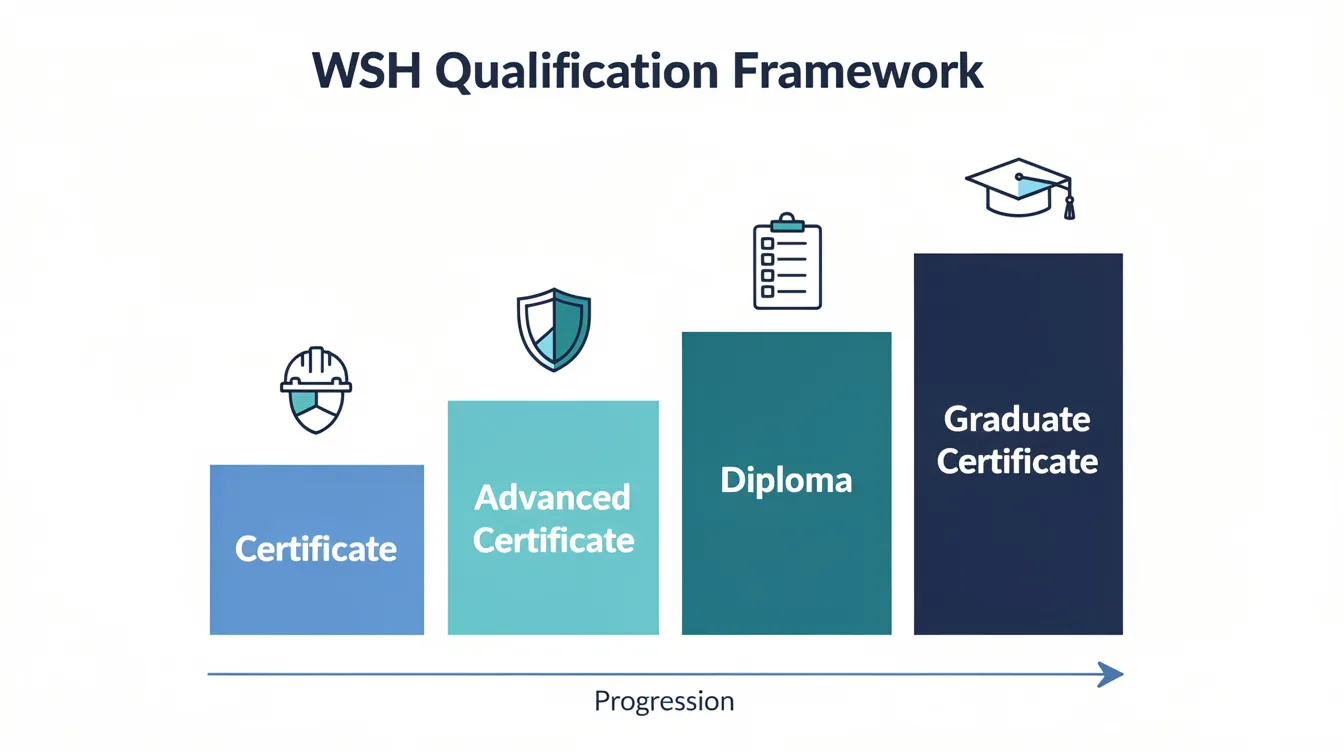
The courses are designed not just for compliance but to build genuine competency. Occupational safety acts govern the duties of safety officers, and the WSHP WSQ Framework classifies qualifications into four ascending levels, each corresponding to progressively more complex safety roles. The framework ensures that WSH professionals possess acceptable WSH-related qualifications before they can be legally appointed to protect workers and manage risks on-site.
Qualified safety officers are in high demand across various industries, particularly in construction, manufacturing, transportation, and healthcare – sectors where occupational health and environmental management concerns are most acute.
Basic Safety Certification Courses
Entry-level safety officers courses form the foundation of the WSHP WSQ Framework and serve as the gateway for workers and supervisors entering safety-focused roles.
Level A – Certificate in WSH (CWSH): This is the entry point for individuals with minimal WSH experience or knowledge. It covers foundational workplace safety standards, basic hazard awareness, and an introduction to safety regulations. No advanced basic academic qualification is required beyond minimum literacy.
Safety Orientation Courses (SOC): These are short, industry-specific programs – such as the Construction Safety Orientation Course (CSOC) and Metalworking Safety Orientation Course (MSOC) – designed for workers entering high-risk sectors. Duration is typically 1–2 days (8–16 hours), and these are often mandatory for foreign work pass holder employees seeking permits in specific industries.
Level B – Advanced Certificate in WSH (ACWSH): Functioning as a bridging qualification, the ACWSH prepares individuals for WSH Coordinator roles. Core topics include risk management fundamentals, safety legislation, and incident investigation basics. Entry typically requires some prior safety course units or relevant experience. Duration ranges from several days to multiple weeks depending on the provider’s delivery mode.
Safety officer course prerequisites vary by provider but often include age and educational requirements at these levels.
Advanced Safety Officer Programs
For professionals aiming to become a registered safety officer or pursue senior leadership in occupational safety, advanced programs provide the necessary depth and legal standing.
Level C – Specialist Diploma in WSH (SDWSH): This is the minimum qualification for WSH officer registration under the WSH Act. The SDWSH includes 13 compulsory core competency units covering behavioral safety management, emergency response, hazard identification, risk management, technical writing, and safety culture development. BCA Academy offers the construction-industry SDWSH over approximately 10 months of evening sessions, with full tuition fees around S$7,770 before government funding. Participants in safety officer courses often learn about legal compliance and safety management systems at this level. The curriculum typically includes hazard identification and conducting risk assessments as core assessed competencies.
Level D – Graduate Certificate in WSH (GCWSH): This highest-tier qualification targets WSH Auditors and senior advisory professionals. It includes advanced units in risk quantification, auditing frameworks, and specialized technical domains. Entry requirements include a recognized WSH degree qualification, completion of prerequisite units, and typically at least two years of post-qualification work experience.
Recognized safety officer courses enhance employability and career advancement opportunities – Safety Officer certification can lead to roles such as Health and Safety Manager, WSH Auditor, or senior compliance advisor. The pathway from basic certification to advanced programs creates a clear career progression that rewards continued professional development.
Course Curriculum and Content Areas
Building on the qualification framework, each safety officers course delivers specific curricular content designed to develop both theoretical knowledge and practical competency. Key topics include legal frameworks, risk management, and incident investigation across all levels.

Core Safety Management Topics
Every accredited safety officers course covers foundational safety management disciplines. Hazard identification trains participants to recognize sources of harm across physical, chemical, biological, ergonomic, and psychosocial categories. Risk assessment – estimating likelihood multiplied by severity – enables safety officers to prioritize control efforts systematically. Participants learn to proactively spot workplace hazards and maintain risk control measures through structured methodologies.
Incident investigation equips officers with root cause analysis tools including Ishikawa (fishbone) diagrams, the 5 Whys method, and failure mode effects analysis. Emergency response management covers planning for fires, chemical spills, structural collapse, first aid protocols, and rescue coordination. Safety officer courses provide essential skills for emergency preparedness and incident management. Safety legislation modules ensure understanding of the WSH Act, relevant Codes of Practice, and SS 506 (Singapore Standard for WSH Management Systems). Safety officer courses cover risk assessment and safety management as integrated competencies assessed through both written examinations and practical case studies.
Industry-Specific Workplace Safety and Health Training Modules
Different sectors present different risk profiles, and safety officers courses reflect this through specialized elective modules. Construction-focused programs – such as BCA Academy’s SDWSH – include modules on managing site safety systems, scaffolding operations, work-at-height procedures, and heavy machinery use. The construction sector’s fatal and major injury rate was approximately 26.3 per 100,000 workers in 2025, down from approximately 31 the previous year, illustrating both progress and ongoing risk.
Manufacturing modules address machine guarding, process safety, and chemical handling. Marine safety covers shipyard practices, welding operations, and marine works protocols. Safety officer courses cover workplace health topics including ergonomics and hazardous materials management. Emerging specializations include occupational hygiene – addressing noise-induced hearing loss, chemical exposures, and human factors – which has its own WSQ Specialist Diploma pathway for professionals seeking expertise in environmental and occupational health.
Practical Skills Development
Hands-on learning is non-negotiable in safety officers training. Many safety officer courses include practical exercises and case studies to reinforce learning, ensuring that theoretical knowledge translates into real-world competency.
Core practical components include field visits to active worksites for hazard identification practice and safety inspection simulations. Emergency response drill workshops develop coordination and decision-making under pressure. Safety auditing techniques are practiced through internal audit exercises against SS 506 and relevant Codes of Practice, including gap analysis and corrective action planning.
Technical writing – a dedicated competency unit – trains officers to produce investigation reports, safety audit findings, and regulatory submissions. These practical skills directly support the documentation requirements that WSH professionals face daily, including preparing supporting documents for MOM submissions.
Essential practical competencies: real-world hazard recognition, emergency drill coordination, safety audit execution, incident investigation reporting, and regulatory compliance documentation.
Course Selection and Enrollment Process
With a clear understanding of curriculum content, the next step is selecting the right course and how to enroll. Singapore offers multiple accredited providers – including Ngee Ann Polytechnic, Singapore Polytechnic, NTUC LearningHub, BCA Academy, and the Singapore Institution of Safety Officers (SISO) – each with different delivery modes, costs, and industry focus areas.

Step-by-Step Enrollment Process
Before beginning enrollment, assess your current educational qualifications and career timeline. Completing a MOM-approved course is mandatory for safety officer registration, so ensuring your chosen program meets MOM accreditation is critical.
-
Assess current qualifications and career goals – Determine your starting point within the WSHP WSQ Framework. Those with a technical diploma or engineering degree may enter the SDWSH directly (Track 1). Those without may need to complete bridging courses including applied basic mathematics and science topic units (Track 2), plus hold GCE “O”-Level passes in English, Maths, and Science.
-
Research accredited training providers and course options – Compare providers on delivery mode (evening, weekend, full-time, blended), industry specialization, and total cost. Verify that the provider offers WSQ-certified courses recognized by MOM and the WSH Council. Safety officer courses are accredited by IOSH in Singapore, adding an international dimension to some programs.
-
Submit application with required documents and fees – Candidates must submit educational certificates and work experience proof. You need to submit documents in PDF format for your application. Required materials typically include a full result transcript, diploma certificate copies, employer testimonials confirming relevant WSH experience, and a passport-sized photograph in JPEG format with a white background.
-
Complete course attendance and assessment requirements – Each competency unit requires assessment, with learners graded as “COMPETENT” upon passing. Programs like the SDWSH may require additional time for candidates who need to complete elective units or retake assessments.
-
Obtain certification and register with MOM if applicable – Graduates can apply for WSH Officer registration after completing the course, provided they meet all eligibility criteria including age and experience requirements. Registration applications may take up to eight weeks to process, and the application fee is S$110 (non refundable). Successful applicants receive a registration card by mail as proof of approval.
Course Comparison Factors for WSH Officer Registration
|
Criterion |
Basic WSH Course |
Specialist Diploma (SDWSH) |
Degree Program |
|---|---|---|---|
|
Duration |
1–2 days (8–16 hours) |
~10 months part-time |
2–3 years part-time |
|
Cost |
S$300–500 |
S$3,000–7,770 (before funding) |
S$15,000–25,000+ |
|
Accreditation |
MOM approved |
WSQ certified, MOM recognized |
University accredited (e.g., National University, Leeds Beckett University Singapore campus) |
|
Career Level |
Entry-level / orientation |
WSH Officer registration eligible |
Senior professional / specialist |
|
Prerequisites |
Basic literacy |
Technical diploma or bridging pathway |
Varies by institution; often degree-level entry |
How to choose: If you are new to workplace safety, start with orientation-level courses to build foundational knowledge. If you hold a relevant technical diploma or non engineering degree in social sciences or applied sciences, the SDWSH provides the most direct route to WSH officer registration. For those seeking international recognition or planning to move into senior advisory, auditing, or academic roles, degree programs offered through partnerships with institutions like Singapore University of Social Sciences or Leeds Beckett University provide broader credentials.
Completing safety training can increase salary potential for safety officers – historical data shows senior WSH Officers in leadership roles commanding salaries around S$9,000 per month, approximately double Singapore’s national median wage.
Common Challenges and Solutions
Even with a clear pathway, candidates frequently encounter obstacles during course selection and completion. Understanding these challenges in advance allows for proactive planning.

Balancing Work and Study Commitments
The SDWSH typically spans approximately 10 months with three weekday evening sessions per week – a significant commitment for working professionals who may require additional time to manage both responsibilities. Solution: Choose providers offering flexible part-time, evening, or weekend delivery modes. Many theoretical modules are increasingly available through online or hybrid instruction. Coordinate with your employer early – some organizations provide study leave or flexible scheduling for employees pursuing WSH qualifications. Employer support is particularly common in construction and manufacturing firms that benefit directly from having registered WSH professionals on staff.
Meeting Financial Requirements
Full fees for the Specialist Diploma can reach approximately S$7,770 before subsidies, with degree programs costing significantly more. Additional costs include materials, examination fees, and potentially safety gear for practical sessions. Solution: Leverage SkillsFuture Singapore credits, Skills Development Fund subsidies, and Workforce Singapore grants to reduce net costs substantially. Many employers offer sponsorship programs, particularly for roles where having a registered safety officer is a legal requirement. Payment plans are available through most accredited providers. Explore all funding options before enrollment to minimize out-of-pocket expenses.
Understanding Course Prerequisites
Candidates without engineering or science diplomas may face prerequisite gaps that block direct entry into the SDWSH. Track 2 entry requires GCE “O”-Level passes in English, Mathematics, and Science – plus completion of bridging courses – which can extend the overall timeline. Those with non engineering backgrounds or degrees in unrelated fields may need to complete the Advanced Certificate in WSH first. Solution: Contact training providers directly for a prerequisite assessment before applying. Many institutions – including Ngee Ann Polytechnic and Singapore Polytechnic – offer advisory services to map your existing educational qualifications against entry requirements and recommend the most efficient bridging pathway. A recognized diploma or degree in safety is required for registration, so understanding this requirement early prevents wasted time and resources.
Conclusion and Next Steps
Choosing the right safety officers course is a decision that shapes both your professional trajectory and your capacity to protect workers across Singapore’s industries. The WSHP WSQ Framework provides a structured, competency-based pathway from entry-level orientation through to specialist and auditor-level credentials, with each level building meaningfully on the last. Safety Officers must be at least 21 years old to register, applicants must have at least two years of relevant work experience, and you must hold a recognized diploma or degree in safety – requirements that ensure registered WSH professionals bring both knowledge and practical judgment to their vital role.
Singapore’s workplace safety outcomes reflect the impact of this system: the fatal injury rate dropped to 0.96 per 100,000 workers in 2025 – a record low – while the major injury rate fell to 15.7 per 100,000 (excluding platform workers). High-risk sectors including construction, manufacturing, and transportation continue to drive demand for qualified WSH professionals who can sustain and accelerate this progress.
Your immediate next steps:
-
Assess your current qualifications against the WSHP WSQ Framework levels and identify your target certification
-
Research accredited providers – compare BCA Academy, Ngee Ann Polytechnic, Singapore Polytechnic, SISO, and NTUC LearningHub on mode, cost, and specialization
-
Apply for the course that matches your career stage, ensuring all supporting documents are prepared in the required formats
-
Plan your career progression pathway – from course completion through MOM registration to continuing professional development and specialization
Related topics worth exploring: the MOM WSH Officer registration process, continuing professional development requirements (including Safety Development Units for registration renewal), the Platform Work Safety Act implications for expanding safety officer responsibilities, and emerging specializations in occupational hygiene, process safety, and technology-driven hazard detection.

Additional Resources
-
MOM Workplace Safety and Health Training Portal – Official directory of accredited courses, training record verification, and eServices for registration
-
Singapore Institution of Safety Officers (SISO) – Detailed information on WSQ qualification levels, CPD requirements, and professional membership
-
MOM National WSH Statistics Report 2025 – Latest fatality and major injury rates by sector, trend analysis, and enforcement priorities
-
SkillsFuture Singapore Course Finder – Search for subsidized WSH courses and check SkillsFuture credit eligibility
-
Professional associations: SISO membership provides networking, CPD events, and career support for WSH professionals at all levels